Greek History Midterm
 Call Kai
 Learn
Learn Practice Test
 Spaced Repetition
 Match
Match Flashcards
 Knowt Play
1/62

There's no tags or description
Looks like no tags are added yet.
Name | Mastery | Learn | Test | Matching | Spaced | Call with Kai | Chat |
|---|
No analytics yet
Send a link to your students to track their progress
63 Terms
Bronze Age
c. 2800-1100
Iron Age
c. 1100-700
Archaic
c. 700-479
Greek cultures in the Bronze Age
Mycenaean Helladic: Mainland & Peloponnese, Mycenae
Cycladic: Cyclades, Thera
Minoan: Crete, Knossos


CYCLADIC FIGURES
Date: EC II, 2800-2300 BCE
About:

Knossos: Palace located on Crete (rugged landscape)
First palace period: (c. 1900-1750 BCE)
Second palace period: (c. 1750-1490 BCE)
Writing: Linear A

Kamares Ware: Phaistos MM II (ca. 1900-1800)
-Minoan pottery produced on the island of Crete for the elite
-Featured light-on-dark abstract, floral, and geometric motifs: spirals, rosettes, and curved lines

GOLD PENDANT
From: CHRYSOLAKKOS CEMETERY, MALIA (MM III)
-Minoan gold artifact from the Chrysolakkos royal cemetery near the ancient Minoan palace of Malia in Crete, Greece.
- Crafted with advanced Bronze Age goldsmithing methods including filigree (delicate wirework), granulation (tiny gold balls soldered onto the surface), repoussé (hammered relief), and incised decoration.
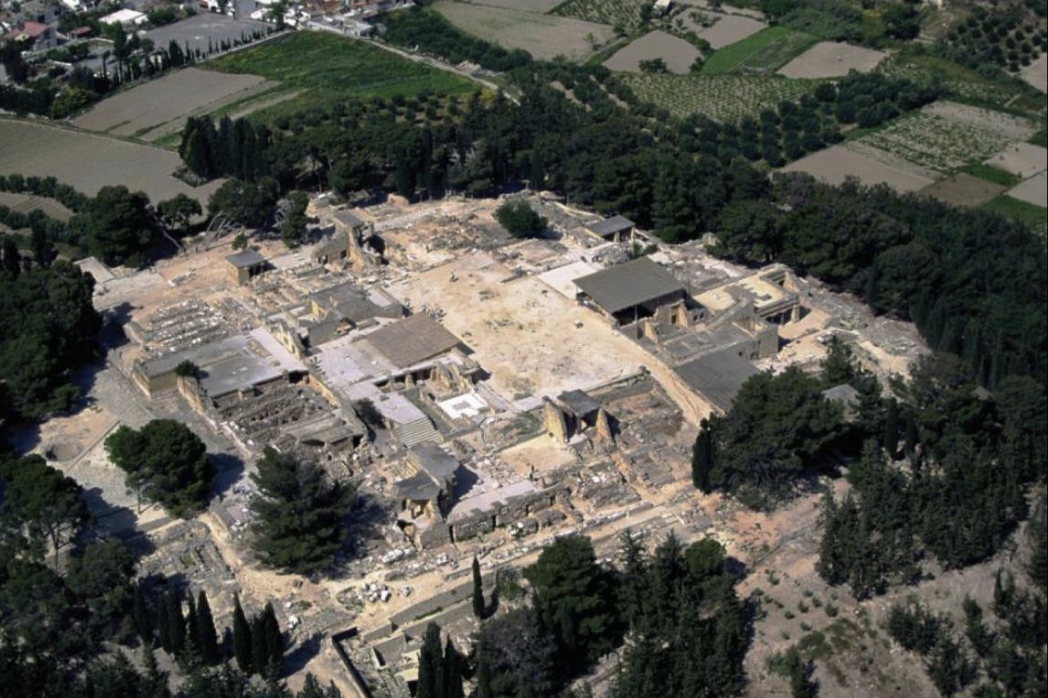
Knossos palace located in Crete, Greece
-The complex was built around an open central courtyard featured a labyrinth-like, organic arrangement rather than a rigid geometric grid.
-Distinctive Minoan wooden columns were wider at the top and tapered toward the bottom, typically painted red or black and capped with a round capital.
-Light wells were built deep into the multi-story structure to channel natural sunlight and fresh air through the interior rooms.


Pithoi
-Found in the Palace of Knossos, they are massive, human-sized ceramic storage jars used by the Minoans during the Bronze Age
-They stored the palace's bulk agricultural surplus, including olive oil, wine, grain, barley, and figs.
-Housed in long, narrow basement corridors known as magazines, primarily located in the West Wing of the palace.
-Provides insight into the lives of the working class/ evidence of trade?
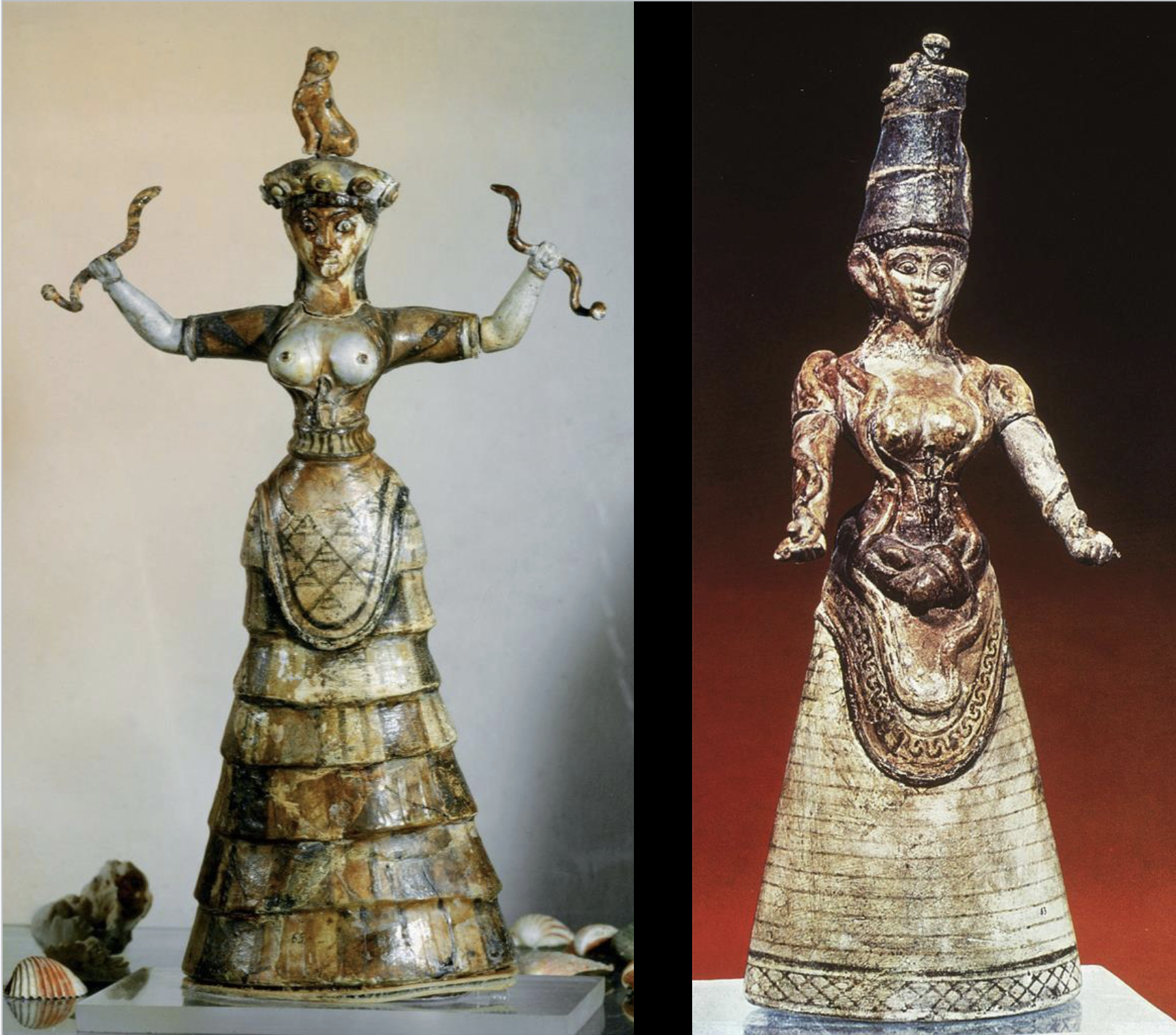
Minoan “Snake Goddess” figurines from Knossos
(Middle Minoan III to Late Minoan IA period)
-Both surviving figures are made of faience, a glazed silicate ceramic technique adopted from ancient Egypt.
- The figures wear formal Neopalatial court attire. This features a tight, short-sleeved bodice that exposes the breasts (commonly associated with fertility or divine power), a tiered, flounced skirt, and a patterned, heavy apron.
-Scholars interpret the snakes as chthonic symbols representing the underworld, renewal, and domestic protection. The open-bodice costume highlights feminine divinity and maternity, while the animal motifs indicate dominion over nature.

The Grandstand Fresco from the Palace of Knossos in Crete, dated to the Second Palace Period (1600–1450 BCE)
-Potentially depicts a large public ceremony or festival happening in the Central Court of the palace.
-The center of the composition features a three-part sacred shrine crowned with horns of consecration
Color conventions: men are painted with reddish-brown skin and woman are painted to have white skin
Costume/Dress: elite women are dressed in highly detailed, lavish Minoan garments including tiered, multi-colored flounced skirts, open-breasted bodices, and elaborate updos adorned with headbands and jewelry.
Rendering: All figures are drawn in strict profile view, though their bodies often twist slightly toward the front.

Artistic Conventions (Knossos Frescos)
Gender-Coded Skin Tones: Women are depicted with pale white/creamy skin, while men are depicted with reddish-brown skin.
Cinched Waistlines: Both male and female figures are portrayed with narrow waists.

TOMB OF REKHMIRE, THEBES, EGYPT (ca. 1479–1425 BCE)
-Visual evidence of Late Bronze Age international trade and material culture
The Keftiu (Aegean/Minoan Cretans): Depicted with distinct kilted attire, long braided hair, carrying Aegean-style rhyta (drinking vessels) and copper ingots.

BULL-LEAPER FRESCO, KNOSSOS (LM II-IIIA)
-depicts bull-leaping, likely a sacred ritual or athletic performance.
-Bulls were likely symbols of power, virility, and divine force in Minoan Crete.
Cross-Cultural Exchange: Similar depictions of bull-leaping frescoes have been discovered in Egypt, demonstrating a shared iconography or mythology across the Mediterranean.

BULL’S-HEAD RHYTON (KNOSSOS LM I)
-Ceremonies: As a rhyton (a ceremonial vessel used for pouring liquids), liquid (possibly wine) was poured through a hole in the top of the bull’s neck and flowed out through the mouth/snout. This created a dramatic ritual spectacle where the wine ran out of a hole in the bull’s mouth.
The bull is an emblematic religious symbol of the Minoan world.

AKROTIRI
-Akrotiri was a Bronze Age port city destroyed and sealed beneath layers of volcanic ash following the Theran eruption around 1600 BCE.
Domestic Architecture & Social Hierarchy: Rather than focusing solely on elite palaces or tombs, Akrotiri offers rare insight into private homes and merchant quarters.
Negative Space Conservation: archaeologists poured plaster into hollow voids created by organic materials to recreate exact replicas of Bronze Age furniture.
-Entire wall frescos were preserved in their original architectural context providing insight into communal spaces and the lives of the working class.

XESTE 3, ROOM 3, LUSTRAL BASIN Frescos

Xeste 3, Akrotiri, Fresco of Wounded Woman
-The woman kneeling on the ground rests her hand on her forehead or hair. Her foot is visibly bleeding. The other older woman seems to offer a necklace to the wounded figure. The third woman looks younger and wears a veil.
-Some scholars interpret Xeste 3 as a ceremonial building dedicated to female rites of passage (puberty, maidenhood to womanhood, and marriage preparation).
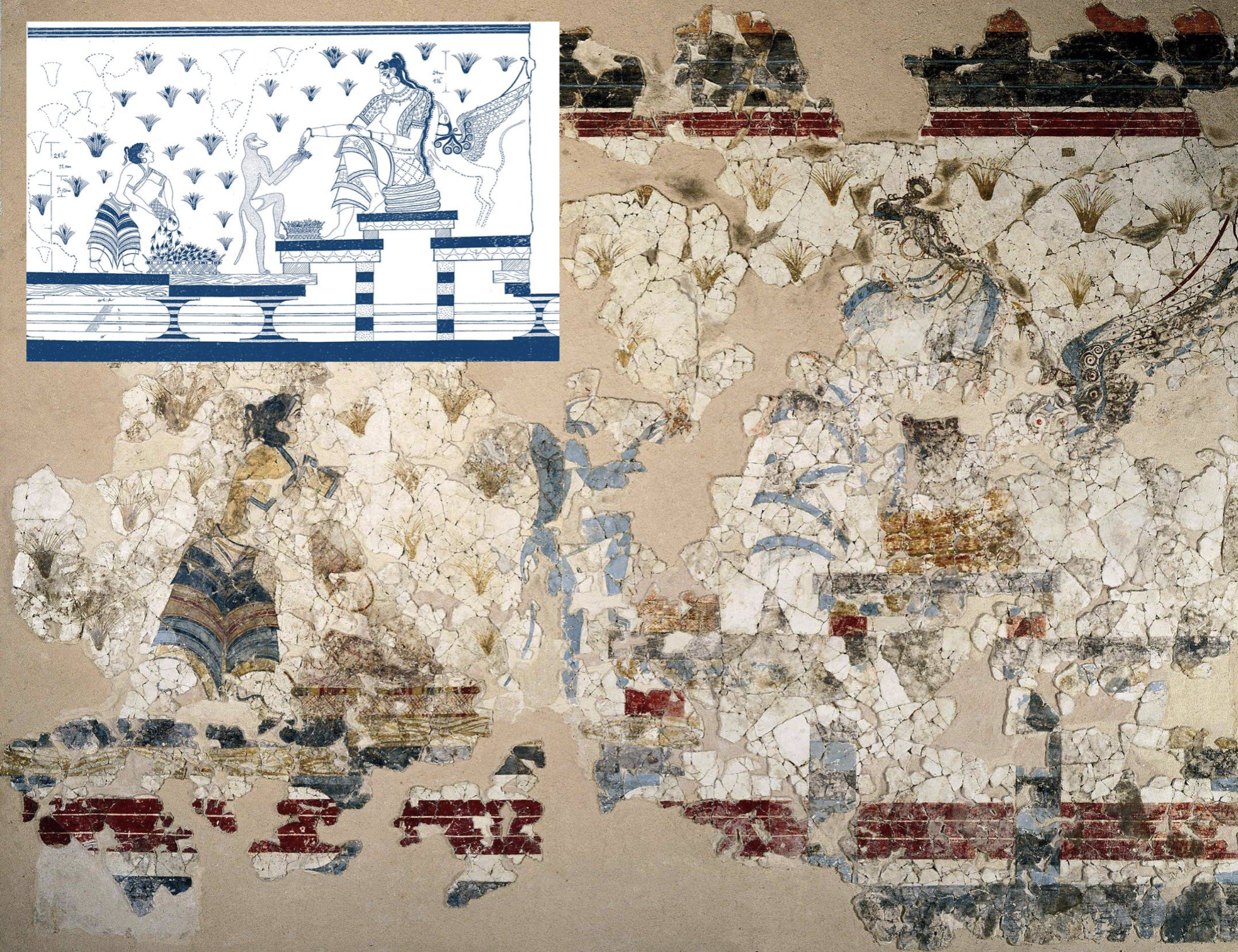
Xeste 3, Akrotiri, Fresco of Saffron Goddess
-The composition centers around a female figure seated high on a tiered, wooden platform or throne. Her posture and elevated position may indicate a divine status.
-Behind the goddess is a mythical winged griffin possibly showing her power over both the natural and supernatural realms.
-A blue monkey hands the figure a bowl filled with red saffron. The monkey may serve as a intermediary between the divine and human realm.

Xeste 3, Akrotiri, Fresco of Saffron Gatherers
-This fresco shows a scene of young women harvesting flowers on a rocky hillside
Hairstyles & Age Identification: In Theran art, age is explicitly signaled through hair. Shaved heads with blue scalps and small tufts or pigtails denote childhood/early youth. As girls mature, their hair grows longer into curly black locks. The Saffron Gatherers showcase different stages of adolescence.

Flotilla Fresco, Room 5 in the West House at Akrotiri (c. 1600 BCE)
-The frieze presents a continuous panoramic narrative set against a coastal landscape
-One theory is that this fresco depicts an annual festival marking the opening of the navigation season in spring. The ships are elaborately decorated rather than outfitted for war.
Spatial Organization: Depth is suggested through tiered vertical stacking. Buildings and figures placed higher on the wall are meant to be seen as further back in the landscape.

ASSEMBLY & SHIPWRECK Frieze, Room 5 in the West House at Akrotiri (c. 1600 BCE)
-Unlike peaceful Minoan nature frescoes, this is one of the rare depictions of conflict, coastal defense, and naval warfare in Aegean Bronze Age art.
-Provides primary visual proof of Aegean armor later described in Homeric epic tradition and found in Mycenaean shaft graves.

MYCENAE
Setting: Strategic hilltop location in Peloponnese, Greece.
Key Features: Cyclopean masonry, Lion Gate, relief triangle, fortified citadel.
Burial Types: Shaft Graves (Grave Circles A & B), Tumulus (man-made mound over body), and Tholos Tombs ("Beehive" Tombs: interest in visiting the dead).
The Megaron: The central reception hall and throne room complex of a Mycenaean palace

“TREASURY OF ATREUS” THOLOS TOMB MYCENAE (LH I-II)
Architectural Design & Layout:
Dromos: A long, unroofed, sloping stone-lined walkway leading up to the monumental entrance.
Stomion: The heavy stone doorway, featuring a massive lintel stone topped with a triangular relief window/relieving triangle to redistribute the weight of the earth above it.
Entrance: Decorative reliefs made of green limestone, carved with intricate zigzag + spiral patterns
The Dome: A circular beehive chamber constructed using corbel vaulting
-Demonstrates Mycenaean structural engineering, masonry, centralized labor, wealth, and power.


The Megaron at Mycenae
Location: Atop the citadel of Mycenae, Greece (c. 13th century BCE)
Architectural Layout: porch (open-air entrance with two wooden columns), the main hall or throne room (a large rectangular room featuring a circular central hearth (maybe used for warmth and ritual) surrounded by four wooden columns that supported the ceiling).

MYCENAE, LION GATE, LH IIIB (ca. 1300-1200)
Monumental citadel gateway featuring two lions flanking a central Minoan-style column topped by a cushion-like capital.
Corbeled Arch, Relief Triangle & Ashlar Masonry
The lions may symbolize authority and divine power
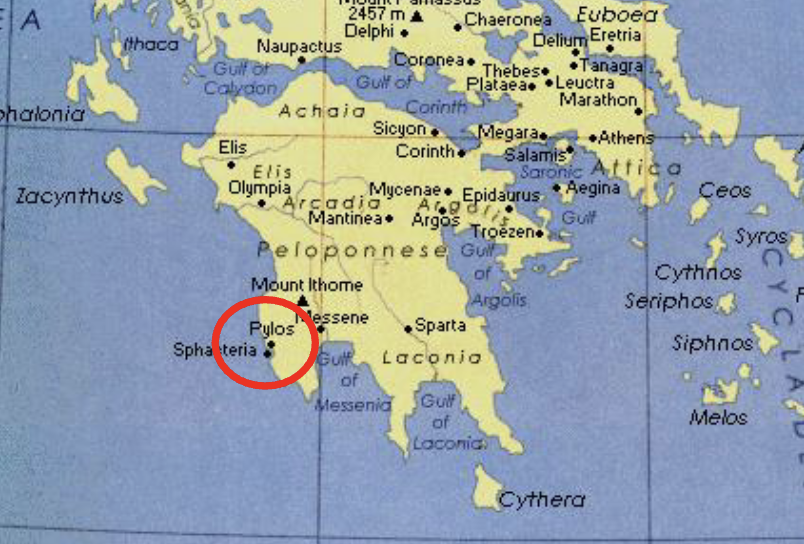
PYLOS (ca. 1300-1200)

Grave of the Griffin Warrior
-200 yards from Palace of Nestor, Pylos

The “Combat Agate” from Griffin Warrior Tomb
Bronze sword with a gold-embroidered pommel from the grave = detail of “combat agate” holding
the same kind of sword?

Bronze Age Collapse (c. 1200–1150 BCE)
The ability to adapt and recover defines a continuing society
Sudden & Widespread Disruption: Over a few decades, major Mediterranean and Near Eastern civilizations experienced catastrophic decline or complete collapse.
The Bronze Age Collapse destroyed the rigid, fragile structures of palace empires, but it did not erase the people or their cultural memory. Their capacity to adapt allowed Greek culture to emerge transformed, setting the foundation for Archaic Antiquity.
DARK AGE / IRON AGE ca. 1075-700 BCE
BRONZE AGE COLLAPSE c. 1200-1150
SUBMYCENAEAN ca. 1125-1050
PROTOGEOMETRIC ca.1050-900
EARLY GEOMETRIC ca. 900-850
MIDDLE GEOMETRIC ca. 850-760
LATE GEOMETRIC ca. 760-700

TOUMBA BUILDING, LEFKANDI (island of Euboea, Greece)
PROTOGEOMETRIC (c. 1000-950 BC)
Type: Elite burial structure: rectangle ending in a curved, rounded end (apse), establishing a precursor to early Greek temple architecture.
Shaft grave: cremated warrior wrapped in a decorated bronze amphora, an elite woman adorned with gold jewelry, and four sacrificed horses.

CREMATION URN (MALE)
Made in Cyprus c. 1100 BCE
Deposited ca.1000-950 BCE

INHUMATION (woman’s burial)
FAIENCE NECKLACE, buried with female at Lefkandi
51 lion-headed male figures, Isis, Horus


LEFKANDI CENTAUR (ca. 900)
-divided and buried in the Lefkandi graves

The Proto/Middle Geometric Period (Art, Pottery & Burial Practices)
Wheel-thrown ceramic vessels & monumental grave markers.
Core Innovations: Strict geometric surface decoration and the universal adoption of ceramic cremation urns reflecting social/gender identities.
Strictly Abstract Decor: Vessels (such as amphorae and kraters) were completely covered in orderly, rhythmic geometric motifs.
Universal Shift to Cremation & Urns: Burial customs shifted toward cremation, making ceramic urns universally central to funerary rites across Greece.
-Marked the artistic awakening of Greece out of the "Dark Ages," establishing a distinct visual language based on order, symmetry, and geometric abstraction.

DIPYLON VASE, ATHENS, Late Geometric period (c. 750 BCE)
Medium: Wheel-thrown terracotta ceramic vessel
Type: Monumental grave marker and funerary urn
Funerary Scene: Located in the main frieze between the handles is a funeral depiction. The deceased lies on a bier (bed for the deceased) surrounded by stylized figures of mourners tearing their hair in grief.
Re-emergence of Narrative Art: Represents a monumental turning point in Greek art: the return to storytelling narratives after centuries of abstract Post-Collapse/Dark Age decoration.


ATTIC KRATER, ATHENS, Late Geometric period (c. 750 BCE)
Medium: Wheel-thrown terracotta ceramic vessel
Type: Monumental grave marker and funerary urn
Geometric framing and may depict aristocratic burial rituals/public mourning

Mt. Lykaion & Early Greek Sanctuaries
Site: Mt. Lykaion, Arcadia, Greece
Context: The evolution of early Greek sanctuaries, altars, and temples in relation to the emerging polis (city-state).
Mt. Lykaion The Ash Altar: Composed entirely of the accumulated ash of centuries of animal sacrifices, serving as the primary focus for direct communication with the divine
Practice-Oriented & Collective: Rituals here were communal, focused on active participation, shared civic identity, and personal benefit/blessings from the gods.
The Sacrifice: Ritual slaughter of animals (such as an ox) offered directly to Zeus on the open-air ash altar.
Sanctuaries as Treasuries: Sanctuaries functioned as secure storehouses for votive objects
Role of the Temple: The ancient Greek temple was primarily designed as a monumental house for the cult statue of the god, rather than a gathering space for congregants. Rituals and sacrifices always took place OUTSIDE at the altar.


CORINTH (Greece)
-port city home to the SANCTUARY OF HERA PERAKHORA
-gods or embedded in the city-state
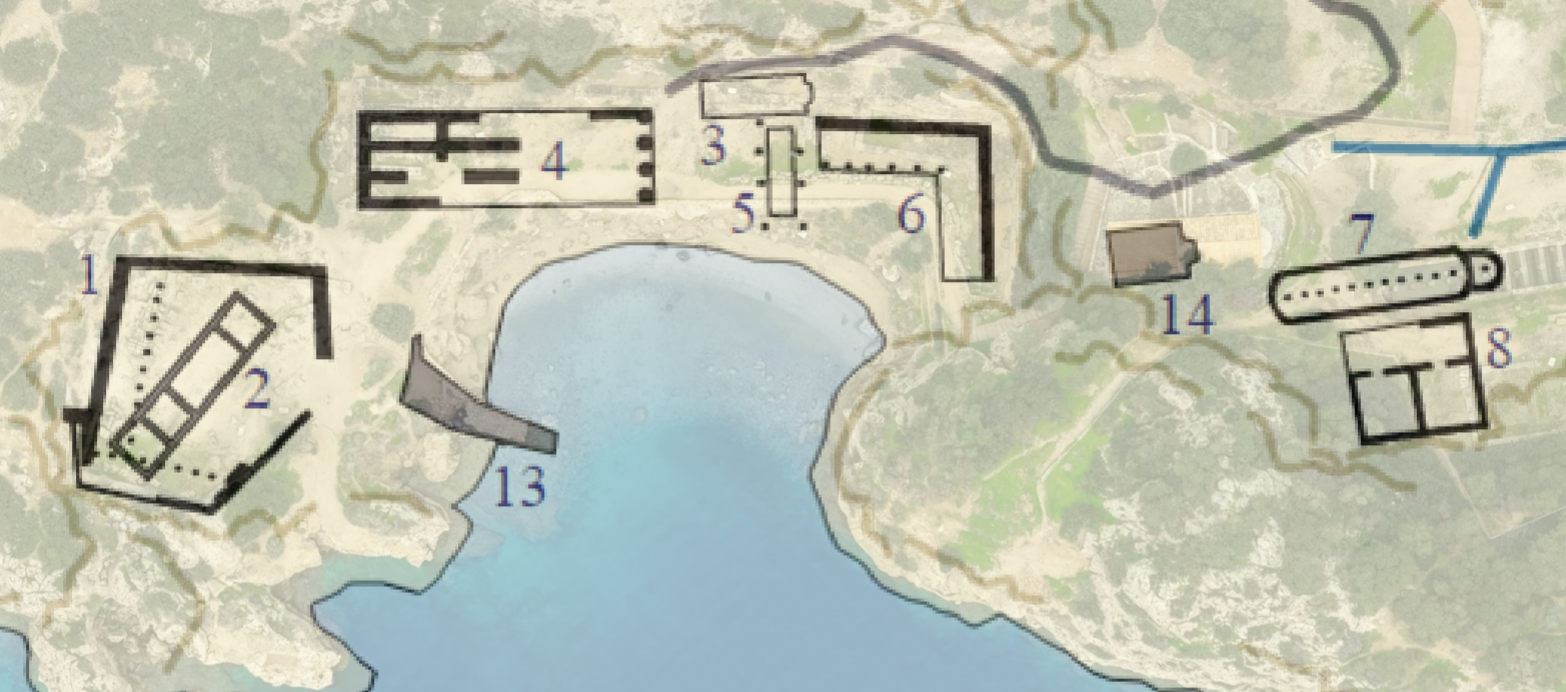
SANCTUARY OF HERA PERAKHORA
Site: Sanctuary of Hera, Perachora (Corinthia, Greece)
Excavation: Discovered/excavated between 1930–1939 (British School at Athens).
Key Structures:
Temple of Hera Akraia
Open-Air Altar
L-shaped Stoa
Key Artifacts: Terracotta temple models, bronze pins, terracotta heads of Hera, bronze horses.
Temple of Hera Akraia: An early Geometric/Archaic shrine situated in a protected harbor cov
L-Shaped Stoa & Altar: Famed the outdoor altar where communal sacrifices took place.
Terracotta Temple Models: Small-scale ceramic architectural models discovered at the site provide crucial early evidence for how geometric and early archaic temples were roofed and constructed
Religious Significance: Worshippers gave prized, tangible gifts to win divine favor, protection, and answered prayers. Suggests the ancient Greeks believed the gods valued the same material items, status symbols, and beautiful objects that held value in human society.


The Hekatombedon (Heraion / Temple of Hera)
Date: c. 800–750 BCE (Geometric to Archaic period)
Key Features: 100-foot-long temple structure, connected to the sea, associated with Hera's mythological birthplace, two structural phases.
Name Meaning: "Hekatombedon" literally translates to "100-foot-long building", highlighting its monumental scale for the early Geometric period.
Mythological Association: Believed in local tradition to be the birthplace of Hera, making it a primary cult center. Positioned near or directly connected to the sea linking the structure to maritime protection and worship.

SANCTUARY OF ARTEMIS EPHESOS (Türkiye)
Deity: Artemis (Mistress of Animals, Master of Nature, Virgin Goddess of Motherhood)
Key Early Votive Offerings: Amber beads, pendants, early cult statue/iconography.
Worshipped both as the virgin huntress and as the protectress of childbirth, motherhood, and fertility.

Olympia (Peloponnese, Greece)
Pan-Hellenic Sanctuary: Dedicated to Zeus; birthplace/site of the ancient Olympic Games (founded traditionally in 776 BCE). Unlike local city-state (polis) sanctuaries, Olympia brought together Greeks from all over the Mediterranean to compete, unite, and worship.
Key Concept: Temenos (sacred boundary around the sanctuary)
Key Votives (Geometric Period):
Animal figurines (8th c. BCE): Small bronze or terracotta figures of bulls, horses, and deer left by worshippers as stand-ins for live animal sacrifices or prayers for agricultural/livestock fertility.
Bronze Tripod (c. 900 BCE): Massive, three-legged bronze vessels dedicated by elite aristocrats. They symbolized wealth, status, and victory (often serving as prizes in athletic/poetic competitions).
Protomes (first appearing in the late 8th c. BCE): Decorative attachment busts/projections (often griffin or siren heads) added to the rims of cauldrons.

“NESTOR” CUP
Location: Pithekoussai (early Euboean Greek colony)
Date: c. 720 BCE (Late Geometric)
The Text: Features a three-line inscription scratched into the clay after firing, written in the Euboean Greek alphabet.
Homeric Allusion: The text claims: "I am Nestor’s cup, good for drinking. Whoever drinks from this cup straightway the desire of fair-crowned Aphrodite will seize him."
Nestor: Refers to the wise King of Pylos from Homer's Iliad and Odyssey, who famously possessed a massive golden drinking goblet.
Early Literacy: One of the oldest surviving examples of Greek alphabetic writing in the Mediterranean, demonstrating that early colonists were literate and actively engaging with epic poetry.
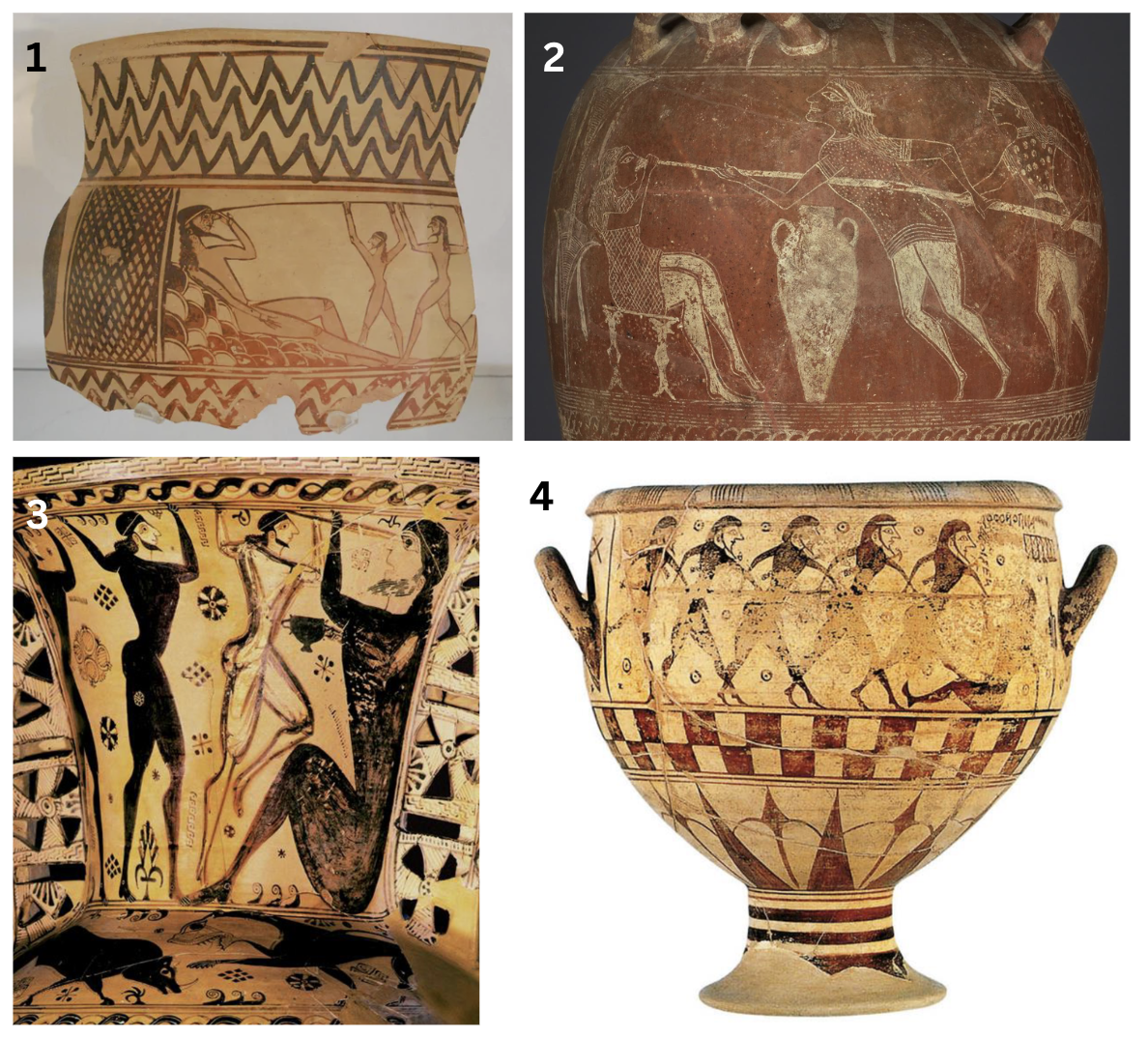
7th-century BCE depictions of the Blinding of Polyphemus
1) Polychrome krater fragment (mid-7th century BCE)
Key Feature: Highly geometric, fine-line technique. Odysseus leads two companions holding a long wooden stake above the seated Cyclops.
2) Pithos with the Blinding of Polyphemos (Calabresi Workshop) 650–625 BCE
3) Proto-Attic Amphora (ca. 650-625)
Key Feature: Odysseus is rendered in white slip to visually separate him as the heroic leader. Polyphemus holds a wine vessel as the stake is driven directly into his eye.
4) Aristonothos Krater (c. 680–650 BCE)
Demonstrates how different regions (Attica, Etruria, and Greek island/mainland workshops) experimented with new artistic techniques during the transition out of the Geometric period.

MYKONOS VASE (ca. 675-650)
Key Feature: Earliest known artistic representation of the Trojan Horse with windows showing the Greek warriors inside. Demonstrates a sophisticated early narrative technique of showing interior space and simultaneous action.

The Doric Temple (Development of Greek Sacred Architecture)
Period: Archaic Period (emerging from 7th to 6th century BCE)
Key Concept: Developing a sacred visual language, architectural elements as indicators of divine space
Layout:
Cella: The main interior chamber designed to house the cult statue of the deity.
Pronaos: The porch area leading into the cella.
Peripteros (Peristyle): A single row of columns surrounding the exterior of the entire building.
Despite the grand scale of the temple, most ritual activity, communal gatherings, and animal sacrifices took place outside at the open-air altar. The temple building itself functioned primarily as a “house” for the god's cult image, rather than a space for worshippers.
Doric Fluting: Characterized by vertical grooves carved into the columns that meet at sharp, pointy edges
The Doric temples of the Archaic period may have evolved from earlier 8th/7th-century BCE wooden structures
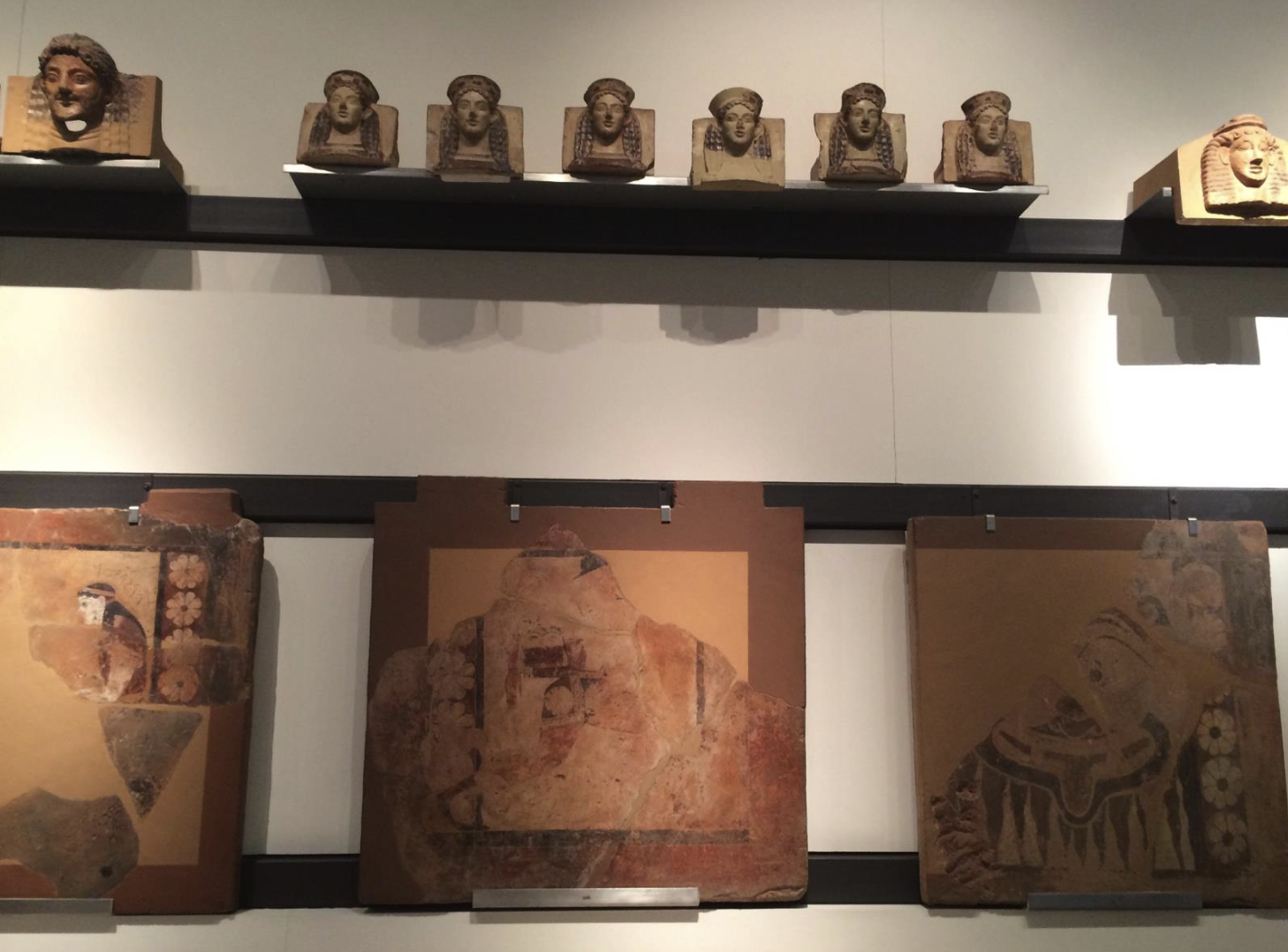
Terracotta antefixes and metopes from TEMPLE OF APOLLO, THERMON (630-20 BCE)
Represents some of the earliest surviving monumental painted panel works from early Greece.
Key Idea: Architectural polychromy (vibrant color), early Doric order development, and narrative mythological displays.
Metopes: Rectangular painted terracotta plaques inserted into the frieze between wooden triglyphs
Antefixes: Decorative roof tiles placed along the eaves

Temple of Artemis at Corcyra (Corfu) ca. 580 BCE
The first all-stone monumental Greek temple (Doric order).
Pedimental Triangle: Sculptors grappled with how to fit narrative figures into the awkward, sloped shape of the triangular pediment.
Imagery: Medusa depicted in a dynamic, kneeling-running pose with snakes in her hair and belted around her waist. Medusa and her divine children stare directly out at the viewer, creating a direct contact point with the divine. Flanked by her divine offspring born from her severed neck: Pegasus (a political symbol of Corinth) and Chrysaor (son of Medusa).
Left Corner: Depicts King Priam who was slain by Neoptolemus during the fall of Troy?
Right Corner: Features Zeus wielding his lightning bolt against the Titans.

Magna Graecia (ancient Greek colonial settlement of Poseidonia, modern Paestum, Italy)
Temple of Hera (ca. 550-520 BCE)
Temple of Zeus or Poseidon (450s BCE)
Demonstrates how Greek colonists exported and evolved religious architecture abroad, projecting Hellenic identity, civic wealth, and religious devotion far beyond the Greek mainland.
