Formative Evaluation 4
 Call Kai
 Learn
 Practice Test
 Spaced Repetition
 Match
 Flashcards
 Knowt Play
1/66

There's no tags or description
Looks like no tags are added yet.
67 Terms
TRUE or FALSE: According to problem-solving theory, an essential element of problem-solving is checking your answer.
TRUE
True or FALSE: According to problem-solving theory, nearly all of cognition is about problem solving.
TRUE
TRUE or FALSE: The goal of task analysis is to find simple solutions
FALSE
TRUE or FALSE: An assumption in task analysis is that problems are complex.
TRUE
Describe a cognitive step required to mentally solve 29 + 82.
breaking the problem down into smaller components by setting subgoals
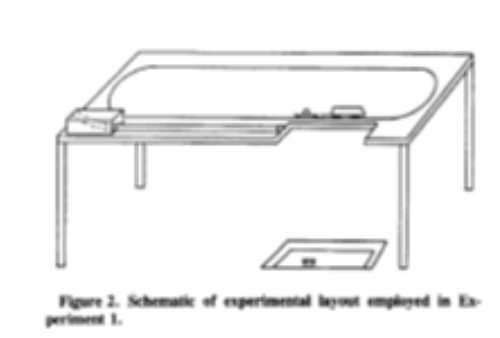
What was the participant’s task in the experiment depicted on the left?
predict the trajectory of a ball released from the bottom of a moving train car
In which experimental condition would you have probably performed more accurately?
rolled condition
Name an object for which you have a mental model.
mobile phone
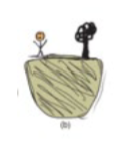
What question did experimenters pose to children in the experiment on the left?
if you planted a 3rd tree on this island, where would you put it?
State an original domain-general fact.
breaking a hard problem into smaller steps makes it easier to understand and solve
State an original domain-specific fact.
in math, multiplication is commutative: changing the order doesn’t change the answer
What are the general ages for using these rules on the balance beam:
Rule 1:
Rule 2:
Rule 3:
Rule I: 5 years old
Rule II: 9 years old
Rule IV: 13 and 17 years old

For the following configurations on the balance beam, indicate (Left, Right, Balance) how a Rule I child would respond, how a Rule II child would respond, and how a Rule IV child would respond
Rule I: balance
Rule II: left
Rule IV: left
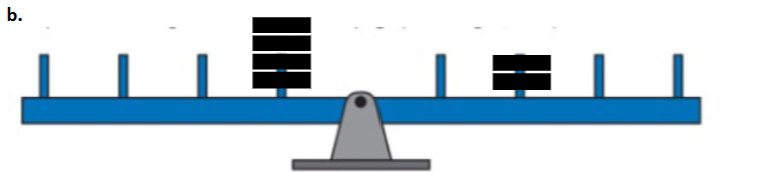
For the following configurations on the balance beam, indicate (Left, Right, Balance) how a Rule I child would respond, how a Rule II child would respond, and how a Rule IV child would respond
Rule I: left
Rule II: left
Rule IV: balance

For the following configurations on the balance beam, indicate (Left, Right, Balance) how a Rule I child would respond, how a Rule II child would respond, and how a Rule IV child would respond
Rule I: left
Rule II: left
Rule IV: balance
What are the general ages for solving these Tower of Hanoi problems:
2-Move:
4-Move:
6-Move:
2-Move: 3 years old
4-Move: 4 year olds
6-Move: 6 year olds
What is the minimum number of moves to solve a 4-disk problem?
15 moves

What is the best first move in the Tower of Hanoi problem shown below?
move smallest can from child’s side to goal side

If there were 4 cans stacked on the child’s side, what would be the best first move?
smallest can from child’s side to the goal side

TRUE or FALSE: Siegler designed the problem on the left to be similar to the Tower of Hanoi problem
TRUE
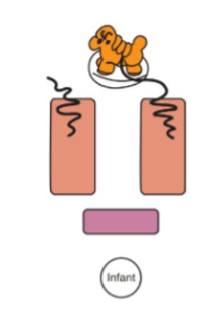
State the steps that an infant needs to follow in order to solve a problem like the one shown on the left.
moved the barrier
pulled the cloth
reeled in the string
What did Bauer et al. (1999) find when they asked children to assemble toys like the Gong (base with two posts, bar hinged to one of the posts, metal plate with a lip to fit over the bar, small plastic mallet)
about 40% of problems were solved
in 90% of solutions, steps were correctly executed the first time
TRUE or FALSE: When 4-7 and 7-10 year-olds were given the task of getting from point A to point B in a maze, both groups tried to plan the entire route in advance
FALSE
David Hume, a Scottish philosopher, attributed causal inference to three factors. State the three factors.
contiguity
precedence
covariation
What is the earliest age at which infants demonstrate causal understanding?
5 months old+
TRUE or FALSE: 6-month olds understand spatial continuity, but have difficulty understanding temporal continuity.
FALSE
TRUE or FALSE: After 11-month-olds are habituated to a medium sized object colliding with another object, they are surprised when a larger object has a larger causal force
FALSE
TRUE or FALSE: 8-year-olds understand covariation
TRUE
To test for an understanding of causality (i.e., What caused an event), 3- and 5-year-olds were shown pictures of three events, for example, A. a boy pitching and a boy batting a ball, B. a picture of a broken window, C. a picture of boys gathered around with a bat. When asked what made B happen, which picture did 5-year-olds choose (A, B, or C)?
A
5-year-olds heard a story about a genie transporting jewels across a wall and into a bottle. She used a posterboard to make a tube. The children were then given a problem of an Easter bunny who had to get eggs across a river and into a basket . (Brown, Kane, & Echols, 1986).
TRUE or FALSE: 5-year-olds could solve the problem, but only if asked guiding questions
FALSE
Briefly describe one of the several experiments by DeLoache (1995) (Symbolic Tools in Powerpoint slides) and colleagues that used representations of things to help children find objects. Be sure to very briefly describe the participants, methods, and findings, in your response.
participants: 2.5-3 years old
methods: watched an experimenter hide a toy in a miniature-size room. told by experimenter that he’d hide the toy in the same place in the actual-size room next door. then they were asked to find the toy in the next room
findings: 3 year olds found it without error 70% of the time. 2.5 year olds only 20% of the time
List three ways in which problem-solving ability grows in young children
learning how to plan
a deepening understanding of casualty
a growing understanding of different kinds of causes
What are the three types of knowledge that are necessary for the development of skill in any domain?
declarative knowledge
procedural knowledge
strategies
What are three strategies that young children use to solve simple addition problems?
retrieve answers
count on your fingers from one
count from larger digit
Decompose this problem: 1001 x 53
1001 x (50 + 3)
Simply, when are problem-solvers likely to use a backup strategy?
a preferred strategy fails/ person is uncertain

What does Associative Strength refer to in Siegler’s (1986) model?
distribution of associations between problems and possible solutions

What is the most likely answer in the figure on the left?
3

What is the most likely answer in the figure on the right?
7
Describe not-so-good, good, and perfectionist students using Siegler’s (1986) distribution-of-associations model
not-so-good: flat distributions and low criteria
good: peaked distributions, moderately stringent criteria
perfectionists: peaked distributions and very high criteria
TRUE or FALSE: The Distribution of Association model applies to addition and subtraction, but not to multiplication
FALSE
TRUE or FALSE: College students use backup strategies for single-digit addition
TRUE
Provide an original example of a problem involving the inversion principle.
24+9-9= 24

Describe this student’s subtraction bug.
they subtract the smaller digit form the larger digit in each column without borrowing

How were you able to tell that this was the student’s bug?
the pattern of responses on diagnostic problems indicated which specific steps students were struggling with
Estimate 310/320 + 8/90 with a whole number.
1
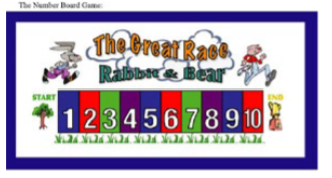
List three number skills that 4-to-5-year-olds learned by playing this board game
number rank
numerical identification
number magnitude

State the two critical elements in reading skill:
fluent identification of words
skilled comprehension
Describe one example of a test of phonemic awareness.
tap once for each sound you hear in ‘hat’
According to Chall (1979), at what grade levels do students begin reading for information?
4th-8th grade
There are two methods that are used to teach children how to read words. What are they?
phonological recoding
whole-word identification

What skill is being modeled in the figure on the left.
visual, phonological, and semantic pathways
TRUE or FALSE: Dyslexia involves oral and written language
TRUE
TRUE or FALSE: Surface dyslexia is associated with words like zim and piv
FALSE
TRUE or FALSE: Phonological dyslexia is associated with words like muggle and instriton
TRUE
List two metacognitive reading strategies:
monitoring comprehension
visualizing information
Reciprocal teaching is a method for _______
teaching comprehension
List the eight emotions that can be observed in 2- 9-month-olds’ facial expressions
interest
surprise
enjoyment
pain
disgust
anger
sadness
fear
Which theory of emotion is closest to Vygotsky’s socio-cultural theory of development?
social-constructivist theory
Which theory of emotion downplays the role of thought and learning?
charles darwin- evolutionary theory
Describe one example that shows that young children experience emotional empathy
very young infants will spontaneously cry when they hear other infants cry
Describe one example that shows that young children experience cognitive empathy
pretend play allows young children to think from other perspectives
Describe a situation in which cognitive and emotional empathy are part of a child’s experience.
child sees friend crying. they use cognitive empathy by understanding that their friend is upset. the child experiences emotional empathy by feeling sad for their friend as well. because of these 2 things, the child begins to comfort their friend
List three factors that play a key role in emotional development.
biological and physical characteristics
individual differences in temperament
skills and limitations in cognitive, language, and social domains
List two abilities of high emotional intelligence.
ability to monitor one’s own and other’s emotions
being able to discriminate between emotional states
What is EQ?
emotional intelligence
Which is personally more important for you, EQ or IQ?
EQ