Learn: Organic Reactions [CHEM 232 UIUC]
 Call Kai
 Learn
 Practice Test
 Spaced Repetition
 Match
 Flashcards
 Knowt Play
1/58

There's no tags or description
Looks like no tags are added yet.
59 Terms
Radical Bromination
Br2, hv or heat.
OR
NBS, H202, hv or heat.
Formation of the radical intermediate is endothermic (slower), so the transition state is similar to the intermediate and the reaction is selective for more substituted positions.

Radical Chlorination
Cl2, hv or heat.
Formation of the radical intermediate is exothermic (faster), so the transition state is similar to the reactants and the reaction is less selective.

SN1
Rate = k[E-LG]
Step 1 : RDS. Leaving group leaves. Favors more substituted alkyl halides, more stable carbocations (look out for rearrangements).
Step 2 : Nucleophile attacks carbocation. Can attack sp2 hybridized carbocation from either side, results in a racemic mixture.
Polar protic solvents favored, stabilize the carbocation intermediate. Occurs with more substituted electrophiles and weak nucleophiles (like H20 or HOR).
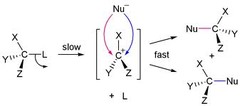
SN2
Rate = k[E-LG][Nu]
Nucleophile attacks electrophilic carbon through a backside attack (attacks sigma antibonding orbital, must attack from back), kicking off the leaving group in a concerted mechanism. Forces an inversion of stereochemistry.
Polar aprotic solvents favor stronger, smaller nucleophiles. Polar protic solvents favor weaker, larger nucleophiles (less caging of solvent around nucleophile). Occurs with less substituted electrophiles and strong nucleophiles (like OH-, OR-, NH2-).

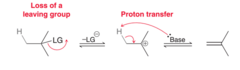
E1
Rate = k[E-LG]
Step 1 : RDS. Leaving group leaves. Favors more substituted alkyl halides, more stable carbocations (look out for rearrangements).
Step 2 : Base pulls off hydrogen from beta carbon, forming a double bond between the alpha and beta carbons.
Occurs with more substituted electrophiles and weak nucleophiles (like H20 or HOR). Often occurs at the same time as SN1; percentage of E1 products can be increased by using non-nucleophilic bases, increasing temperature, or creating more substituted alkenes.
E2
Rate = k[E-LG][Base]
Occurs via a concerted mechanism in which the base removes a proton from the beta carbon, forming a double bond between the alpha and beta carbons. The hydrogen and leaving group need to be antiperiplanar so that the electrons from the C-H sigma orbital can be donated to the C-LG sigma antibonding orbital.
Occurs with strong bases that can remove protons. If the base is small, more substituted alkenes will form (Zaitzev, OH-, NH2-). If the base is large, less substituted alkenes will form (Hoffman, tert-butoxide or LDA).

Deprotonating Alcohols
NaNH2 OR NaH OR t-butoxide OR LDA
Generates an alkoxide.

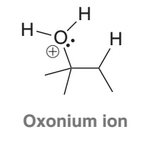
Protonating Alcohols
Any strong acid (e.g. H2SO4)
Generates an oxonium.
Alcohol Synthesis from Alkyl Halides
NaOH if alkyl halide is a methyl or primary unbranched. SN2 mechanism.
H2O if alkyl halide is tertiary. SN1 mechanism.
1) CH3COONa
2) NaOH, H2O if alkyl halide is primary branched or secondary. However, works for anything less than tertiary. SNAc mechanism.

Dehydration of Alcohols
H2SO4, heat.
OR
POCl3, pyridine. (avoids carbocations).
- Occurs via E2 for primary alcohols.
- Occurs via E1 for secondary or tertiary alcohols. Protonation of the OH gives OH2+, which is a very good leaving group and can leave to give a carbocation.
HSO4- acts as the base to remove a proton. Forms more substituted alkenes (Zaitzev).

Alcohol Activation with HX
HX
The nucleophilic acid protonates the OH group, giving a good leaving group which can be replaced with X.
If alcohol is primary, goes through SN2.
If alcohol is secondary or tertiary, goes through SN1 (rearrangements).

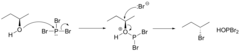
Alcohol Activation with PBr3 or PCl3
PBr3
OR
PCl3
Replaces OH group with a Br or Cl, respectively. P is the electrophilic atom, while O on the alcohol is the nucleophile. Results in inversion of stereochemistry (involves SN2 step).
Alcohol Activation with Thionyl Chloride
SOCl2, pyridine.
Replaces OH group with a Cl. Results in inversion of stereochemistry (involves SN2 step).

Alcohol Activation with Sulfonyl Chlorides
MsCl OR TsCl OR TfOTf, pyridine.
Replaces OH group with a sulfonate ester (OMs, OTs, Otf), which function as good leaving groups. Involves a retention of stereochemistry (no SN2 step).

Base (Williamson) Ether Synthesis
Alkoxide, Alkyl Halide.
O- on alkoxide acts as the nucleophile and attacks the alkyl halide via SN2; halogen leaves. The alkoxide is a strong nucleophile and strong base, so alkyl halide must be methyl or primary unhindered to ensure SN2, not E2.
Can be performed intramolecularly with halohydrins. When the halohydrin contains only 2 carbons, this forms an epoxide.

Acid Ether Synthesis
Oxonium, Alcohol.
The O on the alcohol acts as a nucleophile and attacks the carbon bonded to the oxonium, kicking off the oxonium as a good leaving group. The extra proton is then removed by a base.

Ether Cleavage
HX
OR
H2SO4, H2O
Treating an ether with HX will result in two products; one alcohol and one alkyl halide.
Treating an ether with H2SO4 and H2O will result in two products; both alcohols.

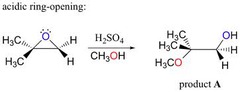
Epoxide Opening
Good nucleophiles under basic conditions.
OR
Good nucleophiles under acidic conditions.
Under basic conditions, the nucleophile will attack the less substituted carbon.
Under acidic conditions, the nucleophile will attack the more substituted carbon.
If the nucleophile being used is an especially strong base (LiAlH4, Grignard or organolithiums, terminal alkynes), then use an ether solvent to avoid deprotonation of protic solvents (like H2O).
Synthesizing Grignard Reagents
Mg, R-X
Use ether solvents (very strong base). Grignard reagents only react with epoxides and carbonyls.

Synthesizing Organolithium Reagents
2 eq. Li, R-X
Use ether solvents (very strong base). Organolithium reagents only react with epoxides and carbonyls.

Reduction of Carbonyls
LiAlH4 or NaBH4
OR
MgBr-R or Li-R or Na-C ≡C-R
Carbonyls can be reduced into alcohols by using hydride reducing agents (LiAlH4 or NaBH4) or with organometallics (Grignard, organolithiums, terminal alkynes).

Oxidation of Alcohols with PCC
CrO3, HCl, pyridine.
Converts primary alcohols into aldehydes.
Converts secondary alcohols into ketones.

Oxidation of Alcohols with Jones Reagents
CrO3, H2SO4, H2O
Converts primary alcohols into carboxylic acids.
Converts secondary alcohols into ketones.

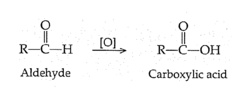
Oxidation of Aldehydes with Tollens Reagents
Ag2O, NH4OH
Converts aldehydes into carboxylic acids.
Synthesizing Enols
Carbonyl compound under acidic conditions.
Under acidic conditions, the carbonyl oxygen becomes protonated, which makes the hydrogens on the alpha carbon more acidic. Once the alpha carbon is deprotonated, it is called an enol.
en = alkene, ol = alcohol

Synthesizing Enolates
Carbonyl compound under basic conditions.
Under basic conditions, the alpha carbon becomes deprotonated, giving an enolate.
en = alkene, ol = alcohol, ate = deprotonated

Aldol Addition
Two carbonyl compounds, NaOH, H2O
One carbonyl compound is converted to a nucleophilic enolate and attacks the other (electrophilic) carbonyl compound. Yields a beta-hydroxy carbonyl.

Aldol Condensation
Basic : Two carbonyl compounds, NaOH, H2O, heat.
OR
Acidic : Two carbonyl compounds, H3O+, H2O.
Starts with an aldol addition, generating a beta-hydroxy carbonyl. The alpha carbon of the beta-hydroxy carbonyl is deprotonated again (with OH- or H2O), and the beta-hydroxy group is removed through the addition of heat or by protonation to an OH2+ group. Yields an alpha-beta unsaturated carbonyl, or enone.

Addition to Enones
Enone/alpha-beta unsaturated carbonyl, nucleophile.
Strong nucleophiles will favor 1,2-Addition because they are attracted to the more positive carbon bonded to the oxygen, and is too reactive to be kicked back off.
e.g. LiAlH4, LiR, MgBrR
Weak nucleophiles will favor 1,4-Addition because they are stable enough to be kicked back off when they do 1,2-Additions. They eventually break the C=C bond instead because C=O bonds are much more stable.
e.g. RS-, CN-, R2NH, LiCuR2

Synthesizing Gilman Reagents
2 eq. LiR, CuCl
Function to perform 1,4-Additions on enones.

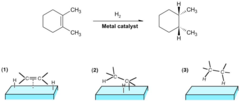
Hydrogenation of Alkenes
H2, Pd/C or Pt
Syn-Addition mechanism. Alkene is converted into an alkane.
Hydrohalogenation of Alkenes
HX
Hydrogen gets added to the less substituted carbon (Markovnikov) on the alkene, so that the carbocation goes to the more substituted position. X- can then attack the carbocation.

Hydration of Alkenes
H2SO4, H2O
Hydrogen gets added to the less substituted carbon (Markovnikov) on the alkene, so that the carbocation goes to the more substituted position. OH2 can then attack the carbocation and become deprotonated, leaving an alcohol.

Alkene Isomerization
H2SO4
Hydrogen gets added to the less substituted carbon (Markovnikov) on the alkene, so that the carbocation goes to the more substituted position. HSO4- can then deprotonate one of the beta carbons for E1 and tends to generate the most stable alkene.

Halogenation of Alkenes
X2
Anti-Addition mechanism. A three membered ring forms containing the two carbons of the alkene and one X atom. The other X atom from X2 can then attack, resulting in one X atom being bonded to each carbon of the starting alkene.

Halohydrin or Haloether Synthesis
X2, H2O or HOR solvent
Anti-Addition mechanism. A three membered ring forms containing the two carbons of the alkene and one X atom. An oxygen from either H2O or HOR can attack the more substituted carbon, resulting in an X bonded to one carbon of the initial alkene, and an OH or OR group bonded to the other. Similar to epoxide opening under acidic conditions.

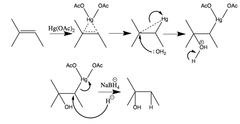
Oxymercuration-Reduction
1) Hg(OAc)2, H2O or HOR
2) NaBH4, NaOH
Anti-Addition mechanism. A three membered ring forms containing the two carbons of the alkene and one Hg atom. An oxygen from either H2O or HOR can attack the more substituted carbon, resulting in an HgOAc bonded to one carbon of the initial alkene, and an OH or OR group bonded to the other. NaBH4 replaces HgOAc with a hydrogen, and NaOH deprotonates the H2O or HOR group.
Hydroboration-Oxidation of Alkenes
1) BH3 or B2H6
2) H2O2, NaOH
Syn-Addition mechanism. In one concerted step, BH3 adds a hydrogen to the more substituted carbon (Anti-Markovnikov) and BH2 gets added to the less substituted carbon. H2O2 and NaOH then replace the BH2 group with a hydroxyl.

Epoxidation
mCPBA, Peracetic Acid, or Trifluoroperacetic Acid
Treating an alkene with one of the above peroxycarboxylic acids will create an epoxide through a concerted, syn-addition mechanism.

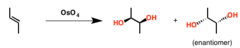
Syn-Dihydroxylation
1) OsO4
2) H2S or Zn
OR
OsO4, NMO or TMAO, H2O and acetone solvent
Syn-Addition mechanism. Adds two vicinal hydroxy groups (dihydroxylation) across the alkene.
Ozonolysis
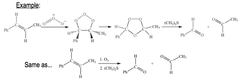
1) O3
2) S(CH3)2 or H2O2, H2O
Ozonolysis breaks an alkene into two molecules across the double bond. If you use S(CH3)2 in the second step, this is called a reductive workup, and it will yield ketones and aldehydes. If you use H2O2 and H2O in the second step, this is called an oxidative workup, and it will yield ketones and carboxylic acids.
Alkyne Synthesis
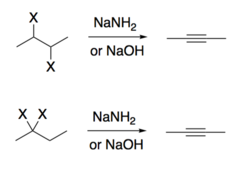
Vicinal or Geminal alkyl halide, NaNH2
If making internal alkynes, use 2 eq. of NaNH2.
If making terminal alkynes, use excess NaNH2 because some of the NH2- will end up deprotonated the alkyne.
Just how alkenes are synthesized through an elimination reaction, alkynes are synthesized by going through two elimination reactions. Geminal alkyl halides give mixtures of products, so are usually not used.
Synthesizing Acetylide
Terminal alkyne, strong base (NaNH2, NaOH, LiR, MgBrR)
Treating a terminal alkyne with a strong base will deprotonate the alkyne, yielding an acetylide ion. Just like Grignard and organolithium reagents, acetylide can react with epoxides and carbonyls. However, acetylide can also act as the nucleophile in SN2 reactions.

Hydrogenation of Alkynes
2 eq. H2, Pd/C or Pt
Reduces the alkyne completely to an alkane.

Partial hydrogenation of Alkynes
H2, Pd/CaCO3, Pb(OAc)2, Quinoline (Lindlar's Catalyst)
OR
Na, NH3
Reduction of the alkyne with Lindlar's poisoned catalyst gives a cis-alkene because hydrogens are added through a syn-addition mechanism.
Reduction of the alkyne with Na and NH3 gives a trans-alkene because it minimizes steric hindrance.

Hydrohalogenation of Alkynes
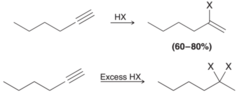
HX
1 eq.
Hydrogen gets added to the less substituted carbon (Markovnikov) on the alkene, so that the carbocation goes to the more substituted position. X- can then attack the carbocation.
Excess
The process repeats again, giving an alkyl halide with geminal halogens. The halogens always add to the same carbon because in that case, the carbocation intermediate is resonance stabilized.
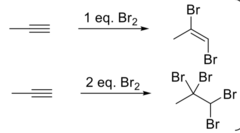
Halogenation of Alkynes
X2
1 eq.
A three membered ring forms containing an alkene joined with an X atom. The other X atom attacks the more substituted carbon, breaking the ring. Results in the anti-addition of halogens.
Excess
The process repeats again, giving an alkyl halide with geminal halogens on each carbon of the initial alkyne.
Hydration of Alkynes
H2SO4, H2O
OR
H2SO4, H2O, HgSO4 catalyst
The hydrogen is added to the less substituted carbon (Markovnikov) so that the carbocation appears at the more substituted carbon. The carbocation can then be attacked by OH2. This is then followed by tautomerization to generate a carbonyl.

Hydroboration-Oxidation of Alkynes
1) R2BH R : Cyclohexane, 1,2 - dimethylpropyl, bulky.
2) H2O2, NaOH
Hydrogen gets added to the more substituted carbon (Anti-Markovnikov) and the BR2 gets added to the less substituted. Treating with H2O2 and NaOH replaces the BR2 with OH, which can then tautomerize to give a carbonyl. R2BH is used instead of BH3 so that it can react with only 1 equivalent of alkyne, and the R groups used are bulky so that the alkene cannot react again.

Halogenation of Benzene
X2, FeX3
Adds X onto the benzene ring.
Halogens are electron withdrawing groups, and are therefore deactivating. However, halogens direct groups to the para/ortho positions.

Nitration of Benzene
HNO3, H2SO4
Adds NO2 onto the benzene ring.
NO2 is an electron withdrawing group, and is therefore deactivating. Like other deactivating groups, NO2 directs groups to the meta positions.

Sulfonation of Benzene
SO3, H2SO4
Adds SO3H onto the benzene ring.
SO3H is an electron withdrawing group, and is therefore deactivating. Like other deactivating groups, SO3H directs groups to the meta positions.

Desulfonation of Benzene
H2SO4, H2O, heat (100 C, steam)
Removes SO3H from the benzene ring.
Sulfonation followed by desulfonation is useful for blocking off the para position on the benzene ring when you want to specifically add an ortho group.

Friedel-Crafts Alkylation of Benzene
Alkyl halide, AlCl3
Treating an alkyl halide with AlCl3 generates a carbocation (rearrangements). Benzene will attack the carbocation, and AlCl4- can regenerate the double bond. Can not be used to add primary carbocations, will always rearrange; instead use hydrogenation of benzylic position or Clemmensen reduction.

Synthesizing Acyl Chlorides
RCOOH, SOCl2, pyridine
Converts carboxylic acids into acyl chlorides.

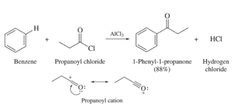
Friedel-Crafts Acylation of Benzene
Acyl Chloride, AlCl3
Treating acyl chloride with AlCl3 generates an acylium ion. Benzene will attack the carbon in the acylium ion, and AlCl4- can regenerate the double bond. The result is the addition of a carbonyl at the benzylic position of the benzene. The benzene is added to the acyl chloride at the position of the chlorine atom.
Hydrogenation of Benzene
High pressure H2, heat, Ni catalyst
Generates a cyclohexane from benzene. Other hydrogenation mechanisms do not affect the benzene ring since it is so unreactive.

Hydrogenation of Benzylic Carbonyls
H2, Pd/C or Pt
Carbonyls located at the benzylic position relative to a benzene ring are reactive enough to be completely replaced with hydrogens. The benzene ring and any non-benzylic carbonyls are unaffected.

Clemmensen Reduction
Zn/Hg alloy, HCl, heat
This reaction with hydrogenate all carbonyls, regardless of whether or not they are at the benzylic position. Aldehydes and ketones are replaced by hydrogens. Can be used to add primary alkyl groups to benzene by first adding a ketone via Friedel-Crafts acylation, then performing a Clemmensen reduction.
