ARTH2800 Exam 3 Mothership
 Call Kai
 Learn
 Practice Test
 Spaced Repetition
 Match
 Flashcards
 Knowt Play
1/245

There's no tags or description
Looks like no tags are added yet.
246 Terms

Worcester Chronicle
Romanesque
c. 1000-1140 AD

Bayeux Tapestry- details
Romanesque
c. 1000-1140 AD

Cathedral of St. James
Romanesque
c. 1000-1140 AD, Spain

Abbey Church of Sainte Foy
Romanesque
c. 1000-1140 AD, France

Reliquary Statue of Sainte Foy
Romanesque
c. 1000-1140 AD

Tympanum reliefs from the Abbey Church of Sainte Foy
Romanesque
c. 1000-1140 AD

Virgin and Child
Romanesque
c. 1000-1140 AD

Abbey Church of Saint-Denis
Early Gothic
c. 1140-1250 AD, France

Cathedral of Notre-Dame
Transitional Gothic
c. 1140-1250 AD, Paris, France

Chartres Cathedral
Transitional Gothic
c. 1140-1250 AD, France

Chartres Cathedral- details of the Westwork & Nave
Transitional Gothic
c. 1140-1250 AD, France

Chartres Cathedral- detail of the Royal Portal
Transitional Gothic
c. 1140-1250 AD, France

Chartres Cathedral- detail of the Rose Window
Transitional Gothic
c. 1140-1250 AD, France

Cathedral of Notre-Dame
High Gothic
c. 1140-1250 AD, Reims, France

Amiens Cathedral
High Gothic
c. 1140-1250 AD, France

Belleville Breviary
High Gothic
c. 1140-1250 AD

Barrel Vault
An elongated or continuous semicircular vault, shaped like a half cylinder.

Transverse Arch
An arch that crosses from one side of the nave to the other side.

Groin Vault
Formed at the point at which 2 barrel vaults intersect at right angles.

Pier
A vertical support that holds up an arch or a vault.
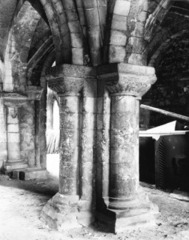
Compound Pier
A pier with a group or cluster of attached respondents

Bay
A repeating unit of space defined by vertical supports (piers) or by regularly spaced openings like windows.

Arcade
A collection of arches.

Rib Vault
A vault in which the diagonal and transverse ribs compose a structural skeleton that partially supports the masonry web between them.
Choir
This makes the layout of a church into a cross shape. It is a place for the choir to set up their instruments.

Reliquary
A relic statue is considered valuable and holy at times. Usually, to represent a holy being such as a saint or Jesus. It contains remnants of a holy person.
Crossing
The space in the middle of the transept and nave.

Ambulatory
A place for walking around inside a building. Almost a hallway.
Chapels
This is a room that is used for personal prayer.

Westwork
Two Peaks at the entrance and one in the back.

Portal
A door into the church.

Tympanum
Half-round panel that fills the space between the lintel and the arch over the doorway of the church.

Trumeau
In church architecture, the pillar or center post supports the lintel in the middle of the doorway.

Jambs
The side posts of a doorway.

Historiated Capital
A capital having carvings that depict an event or story.
Feudalism
A political system in which nobles are granted the use of lands that legally belong to their king, in exchange for their loyalty, military service, and protection of the people who live on the land
The Crusades
A series of holy wars from 1096 to 1270 AD undertaken by European Christians to free the Holy Land from Muslim rule.
Pilgrimage
A journey to a place considered sacred for religious purposes.
William the Conqueror
Duke of Normandy, who invaded England and claimed the English crown.
The Battle of Hastings
A military engagement between William the Conqueror and the English Anglo-Saxon army of King Harold II Godwinson in 1066 AD. Following the death of the previous king (King Edward the Confessor) without a clear heir, King Harold II Godwinson took the throne. Duke William claimed that Edward had previously promised him the throne and that Harold had sworn an oath to support William's claim.
1066 AD
Battle of Hastings
1140 AD
Gothic Architecture begins in France.
Abbot Suger
A pivotal figure who is credited with pioneering the Gothic architectural style through his rebuilding of the Abbey Church of Saint-Denis near Paris.
Age of Cathedrals
During the Gothic Period, many cathedrals were built to replace earlier churches destroyed in fires.
Guilds
They controlled artists' training, production, quality standards, and economic survival from the medieval period through the early modern era.

Rose Window
A circular window with stained glass and stone tracery used on the facades and the ends of the transepts in Gothic cathedrals.

Lancets
Long, pointed arch stained-glass windows (look like a lancet).
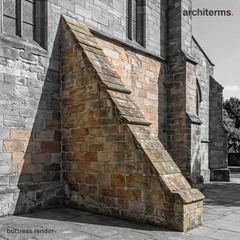
Buttress
A support or prop from an exterior wall to reinforce it and resist outward (lateral) pushing forces.

Flying Buttress
A support or prop from an exterior wall that stands apart from the main structure and is connected to it by an arch to reinforce it and resist outward (lateral) pushing forces.

Pinnacles
Tall, pointed formations.

Trefoil
A three-lobed decorative motif resembling a clover leaf or three interlocking circles.

Quatrefoil
A four-lobed decorative motif resembling a four-leaf clover or four interlocking circles.

Gargoyle
A grotesque carved human or animal figure, especially one used as a rainspout carrying water clear of a wall. They were believed to scare away evil spirits, demons, and negative forces from the sacred space of the church.
Grotesque
Something that is strangely, unnaturally, or comically ugly, distorted, or bizarre.

Royal Portal
An entrance facing west, decorated with holy images.

Triforium
A gallery or arcade above the arches of the nave, choir, and transepts of a church.

Bar Tracery
It replaced heavy, solid stone walls with delicate, skeletal stone ribs, allowing windows to expand dramatically in size and flood sacred interiors with stained glass.
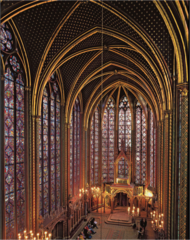
Rayonnant Style/ Court Style
Having extremely elongated and elaborate lines, thin columns, often refers to rose windows with thin lines and spidery patterns. It shifted the primary center of artistic patronage, scale, and aesthetic from local monastic or purely ecclesiastical control to royal courts.
Master Mason
The central creative, engineering, and supervisory force behind the construction of massive cathedrals. Unlike modern building projects, where roles are divided, the master mason uniquely combined the jobs of architect, structural engineer, designer, and master craftsman.

Koran- or Qur'an
Islamic
undated

The Kaaba
Islamic
undated; Mecca, Saudi Arabia

The Dome of the Rock
Islamic
c. 691 AD, Jerusalem

The Great Mosque
Islamic
c. 850 AD; Tunisia, North Africa
Muhammad
"Messenger of God", was the founder of Islam.
The Night of Destiny
This was the night when Amin was transformed into Muhammad by an angel who visited him in a cave.

Mecca
The night of destiny took place in a cave in Mecca, (Kaaba is located here).
622 AD
This was when Muhammad and his people fled to Medina. This is the date Muslims began their history.
Muslim
Meaning "submission to God".
Qur'an (also spelled Koran)
The foundational text that drove the development of Islamic visual arts. Because the divine revelations were conveyed in Arabic, copying and decorating the Qur'an became a supreme act of religious devotion.
Caliph
The writers of the Koran. They went to school for it and are highly educated.
Aniconism
The absence of figural images of gods. (Avoiding images in the Koran).

Arabesque
A form of decorative ornamentation based on rhythmic, interlocking lines. It features stylized leaves, vines, flowers, and stems that repeat in a seamless, continuous flow.

Qibla wall
The wall of a mosque that faces Mecca; the wall Muslims face when praying.

Mihrab
A niche, ornamental recess with a pointed arch. It contains verses from the Koran. The Imam (prayer leader) typically stands inside or just in front of the mihrab to lead the congregation in prayer. The concave shape also helped project and echo the imam's voice.

Minbar
An elevated pulpit or stepped platform in a mosque from which the imam (prayer leader) or khatib (preacher) delivers the khutbah (sermon).
Five Pillars of Islam
Core religious practices and duties that guide a Muslim's faith, daily life, and relationship with God.
1. Shahada (Profession of Faith)
2. Salat (Prayer)
3. Zakat (Almsgiving) (Act of giving wealth to those in need)
4. Sawm (Fasting) (Abstaining from food, drink, and physical desires during Ramadan)
5. Hajj (Pilgrimage) (to the Kaaba in Mecca)

Minaret
A tall, slender tower attached to or built near a mosque. Serves as a call to prayer and a visual landmark.

Horseshoe Arch
An arch of more than a half-circle.
Catacomb
Underground cemeteries / burial spaces. Often took the form of tunnels and niches and were built beneath the earth.
Syncretism
The merging of images or ideas from different sources, such as religion and culture and adapting them to other needs.
Basilica
A meeting house in Roman times, for Christians it was a place to hold mass.
Cross Plan
A church plan that was in the shape of a cross.

Nave
The walkway in the middle of the basilica.

Transept
The part of a church with an axis that crosses the nave at a right angle.

Crossing
The space in the middle of the transept and nave.
Apse
A semi-circular space at the far end of the church. It is where the altar is located.

Clerestory
A row of windows in the upper part of a wall that rises above an adjoining roof. Its purpose is to provide direct lighting, as in a basilica or church.

Constantinople
Capital of the eastern half of the Roman Empire.
Ravenna, Italy
Where San Vitale is. The administrative capital of the west.
Central Plan
A church having a circular plan with the altar in the middle

Ambulatory
A place for walking around the inside of a building. Almost a hallway.

Icon
Meaning image. It is an image of Christ or another holy figure located in a Byzantine or other Christian church.
Iconoclasm
A belief that the practice of worshiping and honoring objects such as icons was sinful.
The Iconoclast Controversy
End of the early Byzantine period. Christians felt that images were bring worshipped rather than representing the real story and destroyed the images.
Byzantium
The eastern portion of the Roman empire; lasted 1000 years after the fall of Western Rome

Illuminated Manuscripts
Illustrated manuscripts of the New Testament. They are over 300 words long and handwritten.
Codex
Another word for book after the use of scrolls.
Parchment / Vellum
Vellum is lambskin and these were both used as paper in the books.
Carpet Page
This is a page in a manuscript that is fully decorated ( looks like a carpet on a page)

Cloisonne
Enamel decoration between raised cells. They look like stained glass windows.
