Vocabulary Unit VII: Industrial Development
0.0(0)
Studied by 2 people Call Kai
 Learn
Learn Practice Test
 Spaced Repetition
 Match
Match Flashcards
 Knowt Play
Card Sorting
1/63

Last updated 8:53 PM on 4/10/23
Name | Mastery | Learn | Test | Matching | Spaced | Call with Kai | Chat |
|---|
No analytics yet
Send a link to your students to track their progress
64 Terms
1
New cards
Industrial Revolution
The rapid transformation of the economy through
the introduction of machines, new power sources, and new chemical processes in Europe and the United States between 1760 and 1830.
the introduction of machines, new power sources, and new chemical processes in Europe and the United States between 1760 and 1830.
2
New cards
Industrialization
The development of industries in a country or region on a wide scale.
3
New cards
core
A small territorial nucleus from which a country grows in area and over time.
4
New cards
semi-periphery
Countries or regions whose economies have elements of both the core and the periphery.
5
New cards
periphery
States that have relatively little industrial development, simple production systems focused mostly on agriculture and raw materials, and low levels of consumption of manufactured goods.
6
New cards
labor
Expenditure of physical or mental effort especially when difficult or compulsory.
7
New cards
land costs
The sum of all wages paid to employees.
8
New cards
resources
Materials available in our environment which are technologically accessible, economically feasible and culturally sustainable and help us to satisfy our needs and wants.
9
New cards
markets
The exchange of goods and services that takes place as a result of buyers and sellers being in contact with one another.
10
New cards
transportation
The movement of goods and persons from place to place and the various means by which such movement is accomplished.
11
New cards
shipping container
Standardized. stackable, intermodal metal boxes used to transport goods by ship, railroad, or truck.
12
New cards
intermodal container
A large metal box used to transport goods from one port to another by road, rail, sea, or air.
13
New cards
intermodal connections
A transfer of a shipment from one transportation mode to another as the shipment moves from origin to destination.
14
New cards
break of bulk point
A location where cargo is transferred from one mode of transportation to another.
15
New cards
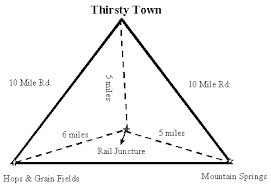
Least Cost Theory
Alfred Weber's theory that transportation costs and labor costs play a strong role in determining the location of manufacturing facilities.
16
New cards
agglomeration
Occur where firms cluster spatially in order to take advantage of geographic concentrations of skilled labor and industry suppliers, specialized infrastructure, and ease of face-to-face contact with industry participants.
17
New cards
footloose industries
A general term for an industry that can be placed and located at any location without effect from factors of production such as resources, land, labor, and capital.
18
New cards
post-industrial society
Society marked by a transition from a manufacturing-based economy to a service-based economy.
19
New cards
GDP (gross domestic product)
The total value of all goods and services produced within a country over a specific period, regardless of the producer's national origin.
20
New cards
GNP (gross national product)
The total value of all the goods and services made by a country's residents and businesses in a specific time period regardless of the country or location in which they were made.
21
New cards
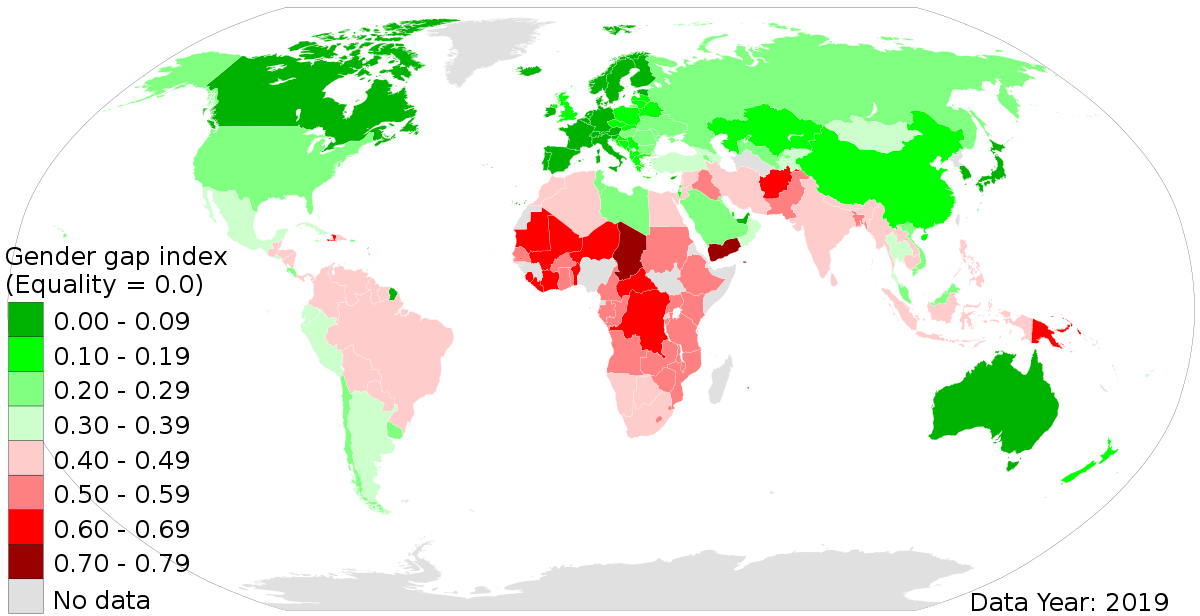
GII (gender inequality index)
A statistical measure of gender inequality that combines data on reproductive health, empowerment, and labor market participation.
22
New cards
HDI (human development index)
A statistical measure of human achievement that combines data on life expectancy at birth, education levels, and gross national income (GNI) per capita purchasing power parity [PPP]) population.
![A statistical measure of human achievement that combines data on life expectancy at birth, education levels, and gross national income (GNI) per capita purchasing power parity [PPP]) population.](https://knowt-user-attachments.s3.amazonaws.com/af7d3c48ece14a099a90c66dce54a460.jpeg)
23
New cards
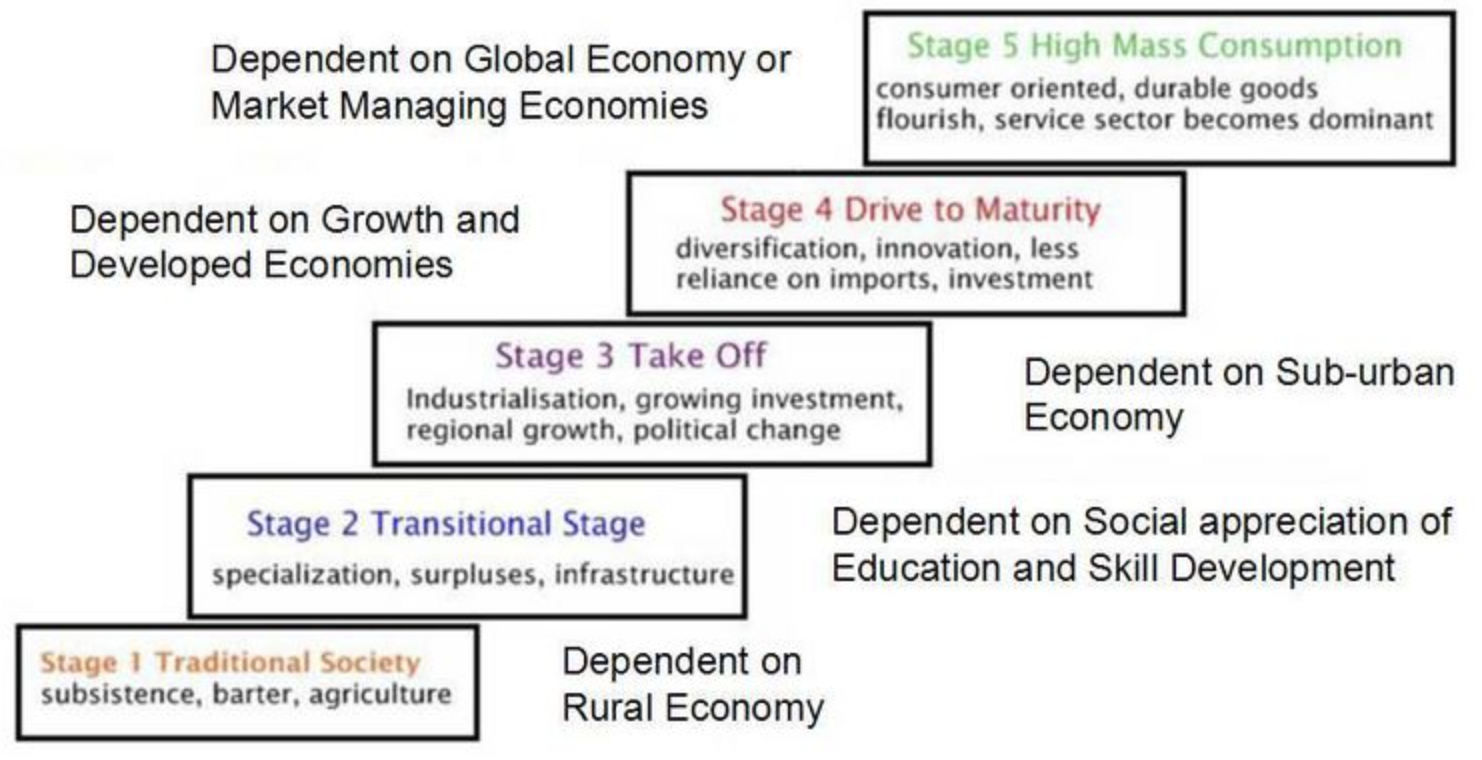
Rostow's Stages of Economic Growth
The process of economic development in all societies divided into five stages: the traditional society, the preconditions for takeoff, the takeoff, the drive to maturity, and the age of high mass consumption.
24
New cards
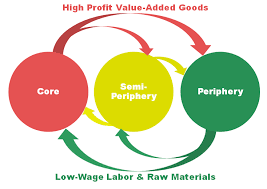
Wallerstein's World Systems Theory (Core-Periphery Model)
The world economic system is divided into a hierarchy of three types of countries: core, semi-peripheral, and peripheral.
25
New cards
comparative advantage
A country's ability to produce one product much more efficiently than it can produce other products within its economy.
26
New cards
complementary advantage
A measure of how well one country's export profile matches another country's import profile.
27
New cards
neoliberal policies
A range of pro-market and anti-government positions on the economy, such as reducing government ownership and regulation and promoting privatization and market-based solutions.
28
New cards
free trade agreements
A treaty between two or more countries that reduces tariffs and promotes foreign investment.
29
New cards
WTO (World Trade Organization)
An international organization that regulates trade among 184 member states, providing a framework for negotiating trade agreements and resolving trade disputes.
30
New cards
Mercosur
Spanish acronym for the Southern Common Market, a South American customs union that includes Argentina, Brazil, Paraguay, and Uruguay as its full members.
31
New cards
OPEC
An intergovernmental organization created to coordinate and unite petroleum policies among member countries.
32
New cards
tariffs
Tax on imported goods and services.
33
New cards
global financial crisis
a situation where the value of global assets drops rapidly and is often triggered by a panic or a run on banks.
34
New cards
debt crises
Occurs when government's debts exceed its tax revenues to the point that it cannot meet its loan payments.
35
New cards
international lending agencies
An International Financial Organization or any bank, insurance company or other source of financing and sources of suppliers credit.
36
New cards
International Monetary Fund
International organization that seeks to foster global monetary cooperation, achieve financial stability, facilitate international trade, and promote sustainable economic growth.
37
New cards
NGOs (nongovernmental organizations)
A group that functions independently of any government.
38
New cards
outsourcing:
The transfer of part of a firm's internal operations.
39
New cards
Special Economic Zones
Specific area within a country's borders where business and trade laws are different from those in the rest of the country.
40
New cards
Free trade zone
Specially designated duty-free area that provides warehousing, storage, and distribution facilities for goods intended for trade or reexport.
41
New cards
export processing zone
Industrial zone with special incentives to foreign investment to places where imported materials undergo processing or assembly before being re-exported.
42
New cards
international division of labor
The situation in which the labor forces of different countries and world regions play complementary roles in an interdependent global economy.
43
New cards
Fordist
The economic and social arrangement based on the mass production of standardized goods, high labor union membership rates, stable and full-time manufacturing employment, and high factory wages that enable mass consumption.
44
New cards
Post-Fordist methods of production
The saturation of key markets brought on a turn against mass consumption and a pursuit of higher living standards.
45
New cards
multiplier effect
The creation of new business and jobs in other industries as the result of investment in a different industry.
46
New cards
economies of scale
Cost advantages that can come with a larger scale of operations.
47
New cards
just-in-time delivery
A strategy in supply-chain management intended to sync orders to suppliers with production or delivery schedules.
48
New cards
growth poles
Geographically pinpointed center of economic activity organized around a designated industry, commonly in the high-tech sector.
49
New cards
sustainable development
Development that meets present consumption needs without compromising the ability of future generations to meet their consumption needs.
50
New cards
ecotourism
Travel to natural areas of ecological value in support of conservation efforts and socially just economic development.
51
New cards
Sustainable Development Goals (Global Goals)
A universal call to action to end poverty, protect the planet, and ensure that by 2030 all people enjoy peace and prosperity.
52
New cards
primary sector
Industries that extract natural resources from the environment.
53
New cards
secondary sector:
Industries that process the raw materials extracted by primary industries, transforming them into finished, usable forms.
54
New cards
tertiary sector
Industries that provide services to businesses and consumers, including all the different types of work necessary to transport and deliver goods and resources.
55
New cards
Quaternary Sector
The portion of the economy dedicated to intellectual and informational services, such as scientific research and development.
56
New cards
Quinary Sector
The portion of the economy where the highest-level management decisions are made in the areas of business, government, education and science.
57
New cards
Gini Coefficient
The measure of the extent to which the distribution of income or consumption among individuals or households within an economy deviates from a perfectly equal distribution.
58
New cards
gender parity
A way of documenting progress toward gender equality using measures such as relative access to education, average incomes for women versus men, and workforce participation.
59
New cards
microloan
A very small loan to poor people with little income or collateral intended to help them establish or expand a small business.
60
New cards
Dependency Theory
The theory that the periphery is poor because it was economically dependent on the core in a disadvantageous relationship originally established under colonialism and imperialism.
61
New cards
commodity dependence
Occurs when commodities account for more than 60 percent of the value of a country's total exports.
62
New cards
Neo-colonialism
The set of economic and political strategies by which wealth and powerful countries indirectly maintain or extend their influence over less wealthy areas.
63
New cards
Microlending
A very small loan to poor people with little income or collateral intended to help them establish or expand a small business.
64
New cards
Fair trade
A certification program that supports good crop prices for farmers and environmentally sound farming practices.