Early US History: Washington to Mexican-American War
 Call Kai
 Learn
Learn Practice Test
 Spaced Repetition
 Match
Match Flashcards
 Knowt Play
1/39

There's no tags or description
Looks like no tags are added yet.
Name | Mastery | Learn | Test | Matching | Spaced | Call with Kai | Chat |
|---|
No analytics yet
Send a link to your students to track their progress
40 Terms
George Washington
1st U.S. President who established precedents for executive leadership and formed the first cabinet.
Washington's Cabinet
Executive department heads: Jefferson (State), Knox (War), Hamilton (Treasury), and Randolph (Attorney General).
Alexander Hamilton's Financial Plan
Proposed chartering a national bank, assuming state debts, and promoting commerce and manufacturing.
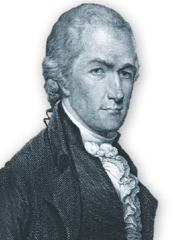
Strict vs. Loose Construction
Jefferson favored strict constitutional powers; Hamilton advocated loose interpretation and implied powers.
Compromise of 1791
Congress passed Hamilton's financial plan in exchange for placing the national capital in Washington D.C.

Whiskey Rebellion
1794 tax protest suppressed by 12,000 militiamen under Washington, demonstrating federal power.

First Political Parties
Democratic-Republicans led by Jefferson and Madison; Federalists led by Hamilton.
Washington's Farewell Address
1796 statement warning against political partisanship and permanent foreign alliances.
John Adams
2nd U.S. President who narrowly defeated Thomas Jefferson in the 1796 election.
Election of 1796 Result
Federalist John Adams became President, while rival Democratic-Republican Thomas Jefferson became Vice President.
Revolution of 1800
Jefferson's presidential victory, marking the first peaceful transition of power between political parties.
Thomas Jefferson
3rd U.S. President who reduced national debt, shrunk the military, and expanded U.S. territory.
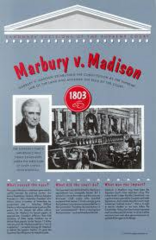
Marbury v. Madison (1803)
Supreme Court case under Chief Justice John Marshall that established judicial review.
Louisiana Purchase (1803)
Jefferson bought 828,000 square miles from France for $15 million, doubling the nation's size.
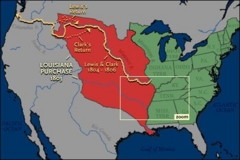
Lewis and Clark Expedition
Exploration of the Louisiana Territory aided by Sacajawea to reach the Pacific Ocean.

James Madison
4th U.S. President known as the 'Father of the Constitution' who led the nation during the War of 1812.
War Hawks
Young congressmen led by Clay and Calhoun who pushed for war against Britain in 1812.
Hartford Convention (1814)
Meeting of Federalists discussing secession, which ultimately destroyed the Federalist Party.
Results of the War of 1812
Spurred American manufacturing self-sufficiency, created war heroes, and fostered a surge of nationalism.
Steamboat
Invention by Robert Fulton (the Clermont) that revolutionized upstream water travel.
Erie Canal (1825)
363-mile canal connecting Lake Erie to the Hudson River, establishing New York City as a commercial hub.

Industrial Revolution
Transition to powered machinery in manufacturing, introduced to U.S. textiles by Samuel Slater and Francis Cabot Lowell.
Interchangeable Parts
Eli Whitney's manufacturing innovation using standardized components for musket production.

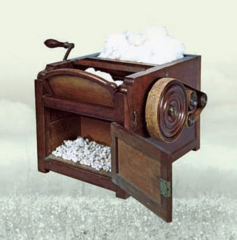
Cotton Gin
1793 invention by Eli Whitney that vastly increased Southern cotton production and expanded slavery.
James Monroe
5th U.S. President whose term was characterized by national unity during the 'Era of Good Feelings'.
Missouri Compromise (1820)
Agreement engineered by Henry Clay admitting Missouri as a slave state and Maine as a free state.

Florida Invasion (1818)
General Andrew Jackson invaded Spanish Florida without orders to attack Seminole Indians.
Election of 1824
Contested election decided by the House of Representatives in favor of John Quincy Adams.

The 'Corrupt Bargain'
Andrew Jackson's claim that Henry Clay traded electoral votes to secure John Quincy Adams's presidency.
John Quincy Adams
6th U.S. President who won the presidency through the 1824 House of Representatives vote.
Andrew Jackson
7th U.S. President elected in 1828 who expanded voter participation through Jacksonian Democracy.
Spoils System
Jackson's practice of rewarding party loyalists with government jobs.
Indian Removal Act of 1830
Law authorizing the forced relocation of Southeastern Native American tribes to lands west of the Mississippi.
Trail of Tears (1838)
Forced march of 16,000 Cherokee to Oklahoma, resulting in over 4,000 deaths.
Manifest Destiny
Belief that God ordained U.S. territorial expansion across the continent to the Pacific Ocean.
Lone Star Republic
Independent republic declared by Texas settlers in 1835 after breaking away from Mexico.
The Alamo
1836 siege in San Antonio where Mexican forces under Santa Anna killed all Texan defenders.
James K. Polk
11th U.S. President who achieved major westward expansion by annexing Texas and acquiring Oregon.
Mexican-American War (1846-1848)
Conflict ending with the Treaty of Guadalupe Hidalgo, in which Mexico ceded California and New Mexico to the U.S.
California Gold Rush (1849)
Mass migration of 80,000 'forty-niners' to California following the discovery of gold at Sutter's Mill.