ASCI 200 Test 3
 Call Kai
 Learn
 Practice Test
 Spaced Repetition
 Match
 Flashcards
 Knowt Play
1/179

There's no tags or description
Looks like no tags are added yet.
180 Terms
58%
Which of the following % muscle values would be expected for a heavy-muscled, lean market hog?
3
What muscle score is associated with a THICK, heavily muscled market hog?
The hog is LEAN
What would the presence of a "groove" down the back and "dimple" above the tail head most likely indicate?
213
Given an average live weight and dressing percentage for market hogs in the industry today, what is a typical carcass weight? Type your answer in to the nearest whole lb.
45%
What would be a reasonable expectation for % muscle of a fat, light-muscled, heavy-weight market hog?
0.80 inch fat cover, 7.5 square inch loineye, and 54% muscle.
Which of the following is most representative of the carcass merit of a typical hog in the swine industry today?
2.4
Calculate the USDA grade for a market hog estimated to have 1.1 inches of last rib fat cover and a 2 muscle score.
78%
Which of the following would be a reasonable dressing percentage estimate for a 290-lb, heavy muscled market hog with 0.80 in fat cover?
true
As live weight of the market hog increases, the percentage of muscle in the carcass decreases.
.8
For a market hog estimated to have 0.80 in 10th rib fat cover, 0.70 in last rib backfat, a 6.7 square inch loineye, and an "average" muscle score; what would be the calculated USDA grade?
280 lbs
Today, what is the average weight of a market hog in the industry?
58
For this question, you will need to calculate percent muscle from the data provided. Then, you will need to type in your answer to the nearest tenth (i.e., 50.0, 49.6, 52.3).
250 lbs
Using the shortcut method for evaluation of % muscle, what is the base live weight?
belly
Which of the following wholesale cuts of pork is NOT considered one of the 4 "lean" cuts of pork?
10th rib fat
Which fat measurement tends to be the most variable? In other words, tends to have the greatest range in fat depth measurements between carcasses?
2.0
What is most desirable USDA grade that can be assigned to a pork carcass that has a THIN muscle score?
ham collar

clear plate

false
Pork carcasses are commonly ribbed in the pork industry to expose the longissimus dorsi (loineye muscle) for evaluation of quantity and quality factors.
52.36
Let's assume a group of pigs are expected to dress 77%, and you were offered a carcass bid of $68.00/cwt. What would be the equivalent live price for this group of pigs? Record your answer as $/cwt to the nearest penny; do not include the dollar sign.
false
All individual pork carcass data used in pork grid pricing programs is collected by an official, 3rd party, independent USDA grader.
45
Assuming a base dressing percentage of 75%, what would be the equivalent live price for a carcass quote of $60.00/cwt? Record your answer as $/cwt to the nearest penny; do not include the dollar sign.
false
Although pork processing plants may develop their own merit-based grids, they must be approved by USDA personnel to assure fairness and accuracy of price determinations.
carcass weight
What pricing factor is associated with nearly ALL merit-based pork pricing systems?
false
Any pork processing facility that purchases hogs on a value-based program that utilizes percent lean must use the standardized equation so values are comparable between plants.
.75 in
Today, what is the average 10th-rib fat thickness of a market hog?
Light weight, narrow light-muscled hog.
Which of the following market hog descriptors is most likely associated with a pig that would be estimted to only dress 73-74%?
42-62
What is the typical range for % muscle in market swine?
60.6
Using the shortcut method provided during class, calculate the percent muscle for a market hog, given the following information.
Live Weight = 240 lbs, 10th rib fat = 0.50 in, Last rib fat = 0.60 in, LEA = 8.7 square inches.
Top of the shoulder; over the blades.
On the live animal, where approximately is the Boston Butt located?
0.8 inch, measured at the 10th rib
In the calculation of percent muscle, using the short-cut method, what is the base fat cover?
7.50 square inches
What is the average loineye area of today's typical market hog?
The pig is lean.
What does a groove down the back of a pig that terminates in a dimple above the tailhead indicate?
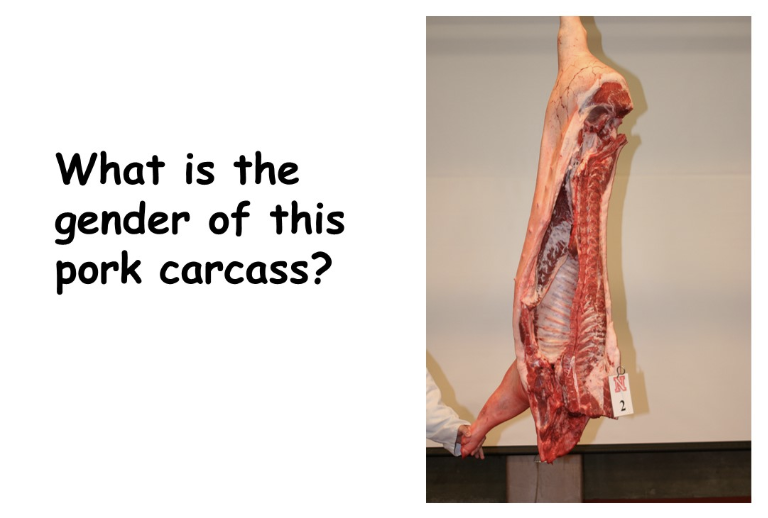
gilt
???
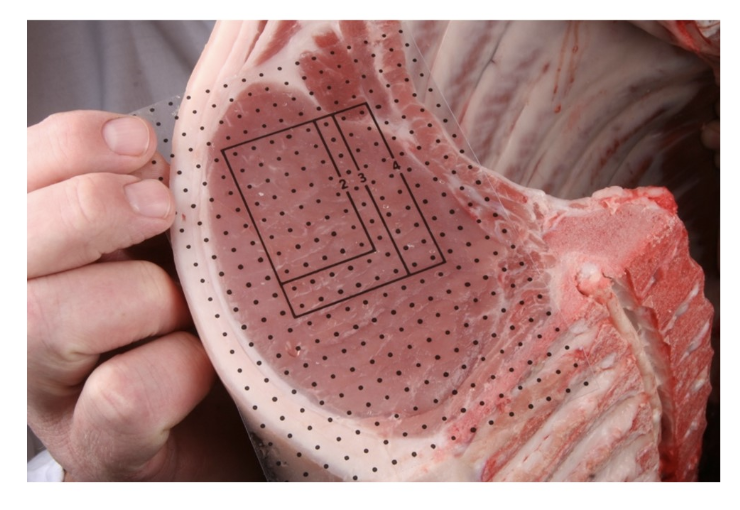
How large is this loineye?
last rib fat
In the industry, which fat measurement is most commonly used as an indicator of carcass composition? This measurement is used because it is exposed and easily measured in a plant setting.
46.2
Using the actual formula for calculation of % muscle, calculate the % muscle for the following carcass:
230 lbs HCW
1.3 in 10th Rib Fat
1.2 in Last Rib Fat
6.4 in2 LEA
The formula is [8.588 + (0.465 HCW) + (3.005 LEA) - (21.896 Fat)] / HCW 100
Input your answer as a percentage, to the nearest tenth such as ... 52.3, 45.6, 58.7
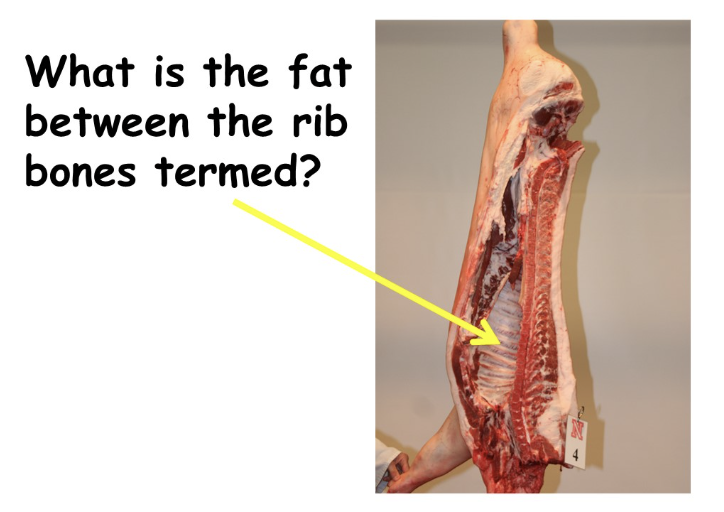
feathering
35.52
Let's assume a group of pigs are expected to dress only 74%, and you were offered a carcass bid of $48.00/cwt. What would be the equivalent live price for this group of pigs? Record your answer as $/cwt to the nearest penny; do not include the dollar sign.
49.8
The Base Price is $60.00/cwt. What is the adjusted grid price for a pork carcass that weighs 186 lbs with 1.40 inches of fat at the last rib? Report your price as $/cwt, to the nearest penny. Do not include the dollar sign.

60
Assuming a base dressing percentage of 75%, what would be the equivalent live price for a carcass quote of $80.00/cwt?
56
Let's assume you received a live weight bid of $42.00/cwt; assuming a standard dressing percent of 75%, what would be the equivalent carcass bid? Record your answer as $/cwt to the nearest penny; do not include the dollar sign.
86.4
The Base Price is $80.00/cwt. What is the adjusted grid price for a pork carcass that weighs 204 lbs and has 0.85 inches of fat at the last rib? Report your price as $/cwt, to the nearest penny. Do not include the dollar sign.
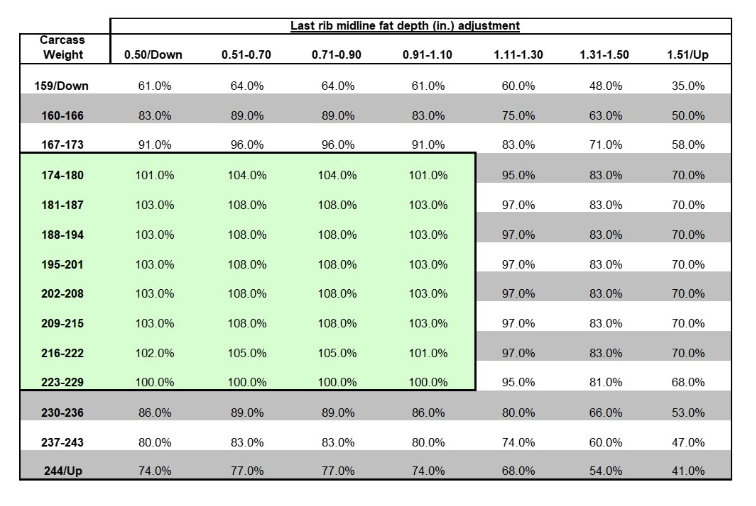
A "boat" shaped top.
Which of the following is indicative of a FAT market hog?
hourglass shape
What is the basic top shape of a heavy-muscled market hog?
The LRBF will likely be greater than 0.45 in
If a market hog was estimated to have 0.45 in 10th rib fat cover, how would you expect the last rib backfat (LRBF) to compare?
Gilts should have a greater percent muscle than the barrows.
Compositionally, how would you expect gilts to differ from genetically similar (littermates) barrows that have been fed and managed the same?
242
Calculate the estimated carcass weight of a market hog that weighs 310 lbs and is expected to dress 78%. Input your answer to the nearest pound (i.e., 186, 213, 227, etc.)
1
What muscle score would typically be assigned to a THIN, light muscled market hog?
The last rib fat measurement is LESS variable than the 10th rib fat measurement.
How does the last rib fat measurement typically compare to the 10th rib fat measurement in swine?
76%
Today, what is the average dressing percentage of a typical market hog?
2.0
A pig was estimated to have 0.50 in 10th rib fat, 0.60 in last rib fat, a thin muscle score, and a 5.2 square inch loineye. What would be the official USDA grade?
belly pocket

chine
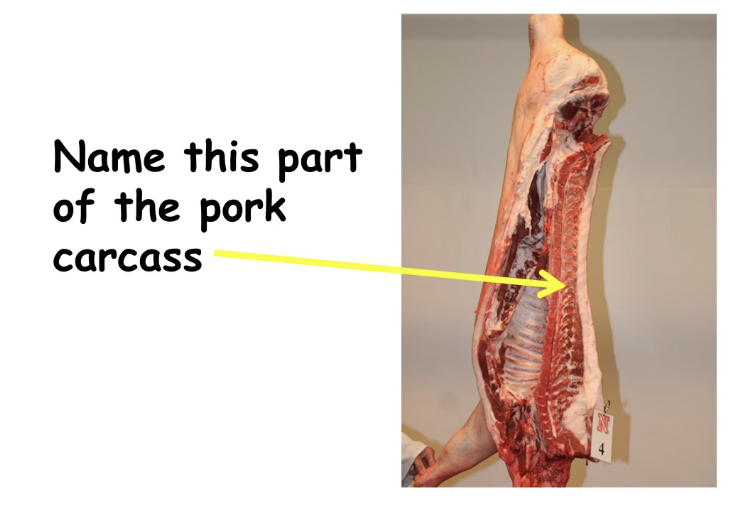
PSE
If/when USDA grades are assigned to pork carcasses, what grade is assigned to a pork carcass that is pale, soft, and exudative (PSE)?
jowl
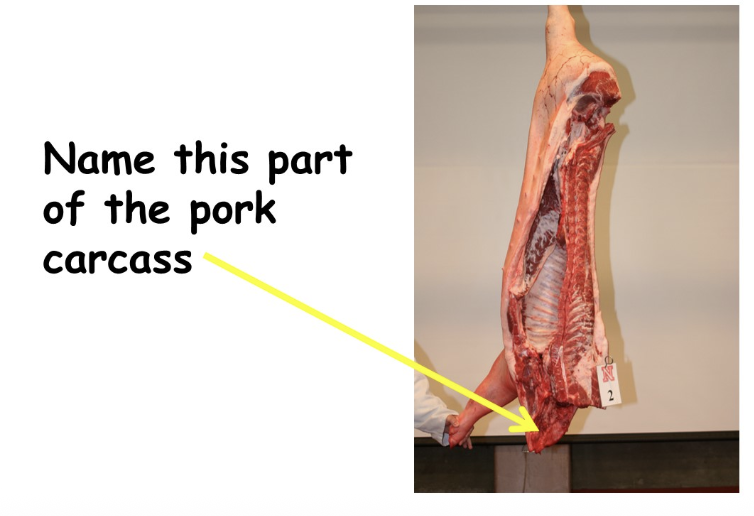
true
Each pork processor develops their own buying program or grid to meet their product needs.
46.15
Let's assume you received a live weight bid of $36.00/cwt; but you know that your pigs normally dress 78%, what would be the equivalent carcass bid? Record your answer as $/cwt to the nearest penny; do not include the dollar sign.
76
The base carcass price is $72.00/cwt. For a pork carcass that weighs 200 lbs with 55.5% lean, what is the adjusted grid price? Report your price as $/cwt to the nearest penny; do not include the dollar sign.

20
Which of the following L* values would be associated with the DARKEST colored pork?
2
Pork marbling standards range from 1.0 to 10.0, and these values represent the percentage of intramuscular fat that is present in the loineye. Today, what marbling score is associated with the typical or average market hog in the industry?
Moisture loss associated with the raw product.
What is purge?
70
What is the Iodine Value associated with most breeds or genetic lines of pork?
The cooked pork will be drier.
How does excessive purge impact eating quality of cooked pork?
false
True / False -- Because stress carrier animals tend to be heavier muscled and do not typically show the behavioral issues like those that are stress positive, stress carriers are beneficial for the pork industry.
The "lightness" of the product.
Differences in color can be determined objectively using a colorimeter. The colorimeter provides L*, a*, and b* evaluations. What does the L* value quantify?
PSE
Which of the following would be associated with excessive shrinkage?
false
True / False -- In the U.S., pork is quality graded (similar to beef) with associated premiums and discounts applied when hogs are sold on a grid basis.
PSE
Let's assume the starting pH of fresh pork at harvest is 7.2. After one hour, the pH is 5.7. After 24 hours, the pH is 5.6. What is the projected pork quality, based on pH?
true
True / False -- Pork quality is critically important for pork exports.
normal
Let's assume the starting pH of fresh pork at harvest is 7.2. After one hour, the pH is 6.5. After 24 hours, the pH is 5.8. What is the projected pork quality, based on pH?
Dark, Firm, and Dry Pork
If animals are stressed and running, associated with improper handling, glycogen (the metabolic fuel for muscles) will be reduced. From a pork quality standpoint, what likely is the result?
napole gene
In the conversion of muscle to meat, glycogen generates lactic acid causing a reduction in pH. Pigs who store an excess of glycogen in their muscles will generate more lactic acid resulting in a low final pH (~ 5.0-5.3) and pork that appears normal but shows excessive moisture loss.
Normal color, but excessive purge
Let's assume the starting pH of fresh pork at harvest is 7.2. After one hour, the pH is 6.5. After 24 hours, the pH is 5.1. What is the projected pork quality, based on pH?
landrace
On average, what breed of swine is known to typically have the "lightest" colored pork?
reddish pink
What is considered "ideal pork color"?
hampshire
In what breed was the Napole gene most prevalent?
stress gene
PSE is caused by what gene?
65
Which of the following L* values would likely be associated with extremely pale, almost white colored pork?
DFD
Let's assume the starting pH of fresh pork at harvest is 7.2. After one hour, the pH is 6.9. After 24 hours, the pH is 6.6. What is the projected pork quality, based on pH?
5.7
What is the pH of normal, fresh pork?
Berkshire & Duroc
What breeds of swine are known to typically have higher levels of marbling?
Greater unsaturation of the fat, which is softer.
higher quality, firmer pork
Higher iodine values are indicative of what?
false
True / False -- The majority of market hogs today have an adequate amount of marbling present in the loineye, from a quality standpoint.
The stress gene causes pork to be "darker" in color.
Which of the following statements is NOT true regarding impact of the stress gene on pork carcass composition and quality?
78
Which of the following Iodine values would likely result in a pork quality discount as the fat would be too soft?
true
As pork producers selected for greater muscle mass and less backfat in the 1980s and 90s, they unknowingly and indirectly selected for greater prevalence of the stress gene within the pork industry.
PSE
What pork quality defect can be identified by a rapid (within the 1st hour), significant post-mortem drop in pH of the muscle?
excessive purge
What is the primary quality effect of the Napole (RN) gene?
pH
In the industry today, what factor is most commonly used to provide an indication of pork quality for pricing purposes?
false
True / False -- In the U.S. pork industry, the pork carcass is ribbed (similar to beef cattle) to expose the longissimus dorsi muscle for evaluation of pork quality factors including marbling.
~40%
In the early 2000's, what percentage of show pigs were estimated to be stress carriers?
Ham & Loin
Despite not usually being the highest priced per lb, but rather because of weight, what two wholesale cuts combined represent approximately 50% of the pork carcass value?
boston butt
From what wholesale cut of Pork would Pork (Blade) steaks be fabricated? Clue: Pork blade steaks will include a portion of the scapula bone.
false
The highest valued wholesale and retail cuts of pork are also the leanest cuts of pork.
65%
What is the expected yield of edible meat from the pork carcass, according to the "Beef & Pork Whole Animal Buying Guide"?
Belly & Rib, combined
In today's market, what wholesale cuts make up a much higher percentage of total value of the pork carcass (~28%) compared to their carcass weight (~21%)?
true
The drop value provides an estimation of the byproduct value to be generated from each market hog?
Pork Blade Steaks
Which of the following retail cuts of pork do NOT originate from the Loin?
A