LESSON 4 - CELL MEMBRANES & SIGNALLING (PART 2)
 Call Kai
 Learn
 Practice Test
 Spaced Repetition
 Match
 Flashcards
 Knowt Play
1/19

There's no tags or description
Looks like no tags are added yet.
20 Terms
WHAT ARE THE 5 ESSENTIAL ELEMENTS FOR CELL SIGNALLING OR COMMUNICATION?
Signal
Receptor
Signal Transduction
Response
Termination
SIGNAL
Usually, an extracellular signalling molecule (ligand) or environmental signal (temperature, light)
RECEPTOR
A specific protein that recognizes the signal; only cells with the correct receptor can respond to it
SIGNAL TRANSDUCTION
Transfers and amplifies the signal through the cell
RESPONSE
The transduced signal causes a cellular response
TERMINATION
The cell “turns off” the response once the signal is gone
WHAT ARE THE 3 COMPONENTS THAT CELL COMMUNICATION SYSTEMS HAVE BASED ON SURFACE RECEPTORS?
Extracellular signal molecules
Surface receptors that receive the signals
Internal response pathways triggered when receptors bind a signal
WHAT ARE THE 3 STAGES OF SIGNAL TRANSDUCTION?
Reception
Transduction
Response
RECEPTION
Binding of a signalling molecule with a specific receptor of target cells
TRANSDUCTION
Signal is charged into form for eliciting the cellular response, which involves a signalling cascade, a sequence of reactions that includes several different molecules
RESPONSE
Transduced signal causes a specific cellular response that depends on the signalling molecule and the receptors of the target cell
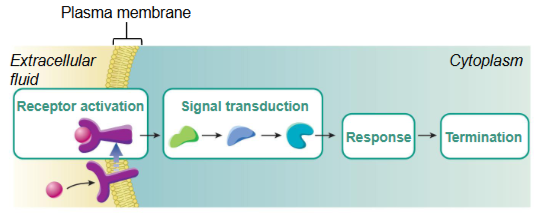
WHAT ARE THE STEPS IN CELL SIGNALLING?
Receptor Activation: The signal binds to a receptor, which is then activated
Signal Transduction: The signal is transmitted to the interior of the cell by a signal transduction pathway
Response: The cell responds, for example, by activating an enzyme or turning on transcription of a gene
Termination: The response is terminated so that new signals can be received
WHAT HAPPENS WHEN A SIGNAL MOLECULE BINDS TO A PLASMA MEMBRANE RECEPTOR?
Activates a signalling cascade
The signal molecule does not enter the cell
HOW CAN SIMILAR MOLECULES AFFECT A CELLULAR RESPONSE?
Can trigger or block a response if they bind to the recognition site of the receptor
Some drug treatments target signal transduction pathways and work at the level of the receptor
WHAT ARE PROTEIN KINASES?
Enzymes that transfer phosphate groups from ATP to specific target protein sites, stimulating or inhibiting their activity
WHAT ARE PROTEIN PHOSPHATASES?
A reverse response by removing phosphate groups from target proteins
WHAT ARE SECOND MESSENGERS?
Involves some signalling cascades; cAMP
WHAT IS A PHOSPHORYLATION CASCADE?
Where kinases often act in a chain and catalyze a series of phosphorylation reactions
Each kinase catalyzes the phosphorylation of another in the cascade
The last protein in the cascade is the target protein, which brings about the cellular response
WHAT IS AMPLIFICATION?
Increases the magnitude of each step as a signal transduction pathway proceeds
Each activated enzyme can activate hundreds of proteins in the next step
More enzyme-catalyzed = Greater amplification
A few extracellular signal molecules can produce a full cellular response
WHAT ARE THE SEVERAL DIFFERENT CELLULAR RESPONSES FOR THE “FIGHT OR FLIGHT” RESPONSE?
Burst of energy from the release of glucose into the bloodstream, released from glycogen stored in the liver
Increased heart rate
Dilated pupils
Longer-lived responses include changes in the expression of some genes in some cell types