02Goals, Motivation, History
 Call Kai
 Learn
 Practice Test
 Spaced Repetition
 Match
 Flashcards
 Knowt Play
1/24

There's no tags or description
Looks like no tags are added yet.
25 Terms
How Hacker is define goals?
According to Hacker, goals are more or less conscious intentions of a person that refer to future, desired results of their actions. At the same time, goals contain cognitive representations of the desired results.
Definition outcome goals
Outcome goals in the sport setting involve striving for results in a competition
Example outcome goal
a certain placement in a race or a specific rank in a league table
Definition Performance goals
Performance goals refer to striving for a performance in relation to a standard or reference level set by the athlete. Individual performance parameters refer to self-referenced standards of performance. They refer only to the athlete herself/himself.
Example performance goals
Examples include a 10-min improvement in a marathon run or an increase in the number of repetitions on the leg press to 35
Definition Process goals
Process goals allude to how certain skills or strategies are implemented and deal with the qualitative execution of an action.
Examples process goals
Examples of process goals include a good feeling in the foot during a jump or a calm or regular steady breathing while jogging
What is the most effective goal-setting programm?
Usually combine all three goal types - outcome + performance + process
What are the two types of goal orientation?
Task orientation and ego orientation
What is task orientation?
success= personal improvement
• learning
• mastering
• effort
What is ego orientation?
success = outperforming others
• rankings
• comparison
• winning
Which climate is more adaptive? (Task or ego)
task-oriented climates are generally associated with more adaptive motivation and persistence (Ausdauer)
What is self-concordance after Sheldon&Elliot (1999)?
goals aligned with personal interests and values lead to:
• greater persistence, effort and well-being
• higher enjoyment

In which types selfconcordance goals can differ in their source?
Some goals are: self-chosen; personally meaningful
Others are: externally imposed; socially driven
Which smart criteria apply to the goal setting?
goals should be specific, measurable, attainable, relevant and timely
What are the common pitfalls in the goal realization?
unrealistic goals, excessive pressure, tunnel vision, increased risk taking, frustration after setbacks
What distinguishes activity- related from outcome- related incentives?
activity- related incentives: arise from performing the activity itself
outcome-related incentives: arise from the anticipated result
both types can influence sport participation
Name an example for activity-related incentives
enjoying movement or experiencing flow
Name an example for outcome- related incentives
improving health, winning, or changing one’s appearance
What four target categories arise in the 2×2 model of goal orientation?
mastery-approach: focus on learning new skills and understanding tasks
mastery-avoidance: focus on avoiding mistakes, often leads to perfectionism and performance anxiety
performance-approach: focus on surpassing others and competition
performance-avoidance: focus on avoiding worse performance than others; leads to procrastination and defensive pessimism
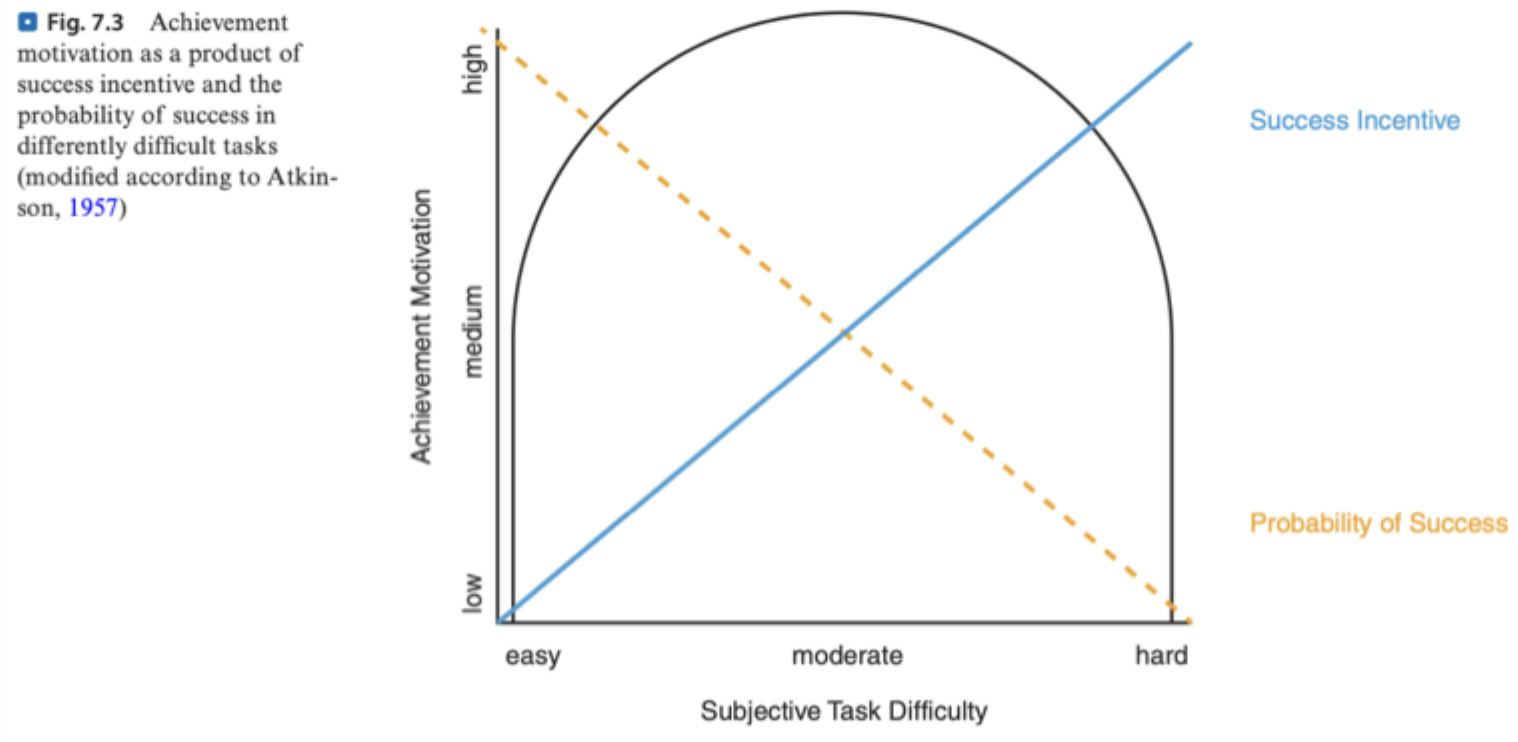
What does performance motivation depend on according to Atkinsons (1957) model and at what task difficulty is it highest?
product from: success incentive (Anreiz) x probability of success
maximum: motivation is highest at medium/moderate task difficulty (inverted U curve)
Easy tasks: high probability of success, low success incentive (low pride/fun) → low overall motivation
Hard tasks: low probability of success, high success incentive (high pride if achieved) → low overall motivation (due to near-zero success probability, )
What are differences in task choice according to Atkinson‘s risk choice model?
Success-Motivated (Hope for Success): Prefer moderate difficulty tasks to realistically test their skills and experience genuine pride
Failure-Avoiders (Fear of Failure / Anxiety Avoidance): Avoid moderate tasks to protect themselves from shame and fear of failure
They choose:
Extremely easy tasks: Success is practically guaranteed → No fear of failure
Extremely hard tasks: Failure is expected by everyone → Easy excuse protects self-esteem
Which three pioneerfigures shaped the early history of sports Psychologie?
Norman Triplett (1898): first sport psychology experiment („Competition Machine“/Social Facilitation/performance increase in the presence of others)
Coleman R. Griffith (1920er): „Father of American Sport Psychology“; founder of the first lab at the University of of Illinois (1923); wrote Psychology of Coaching (1926) and Psychology of athletes (1928)
Charles Féré (1887): published Sensation et mouvement
What is the asp and which maintasks sportpsychology practitioners have?
ASP: German association of sports psychology
Key tasks: Mental competition preparation, pressure/stress management, attention and self-regulation training, injury & career transition support as well as evidence-based intervention development
What is the achievement goal theory according to Nicholls (1984) and how do you read the model?
The achievement goal theory explains how achievement motivation, fear of failure, and perceived competence relate to achievement goals. Read the model from left to right: antecedents → achievement goals → achievement relevant behaviors
The three goals are mastery (improving skills), performance approach (doing better than others), and performance avoidance (avoiding doing worse than others)
The relevant behaviors are intrinsic motivation and performance
