Lifesci 7a - Week 2 Membrane Transport and Energy/Enzymes
 Call Kai
 Learn
 Practice Test
 Spaced Repetition
 Match
 Flashcards
 Knowt Play
1/36

There's no tags or description
Looks like no tags are added yet.
37 Terms
What are the roles of lipids and proteins in maintaining the selective permeability of membranes?
Lipids help maintain the selective permeability of the membrane by preventing charged molecules and ions from diffusing freely into the cell.
They also allow molecules such as gases and small polar molecules to diffuse freely through the membrane. Molecules such as proteins and polysaccharides are too large to cross the cell membrane without help.
Proteins in the membrane help transport these larger molecules by acting as channels and carriers that transport molecules into and out of the cell.
Each kind of channel or carrier is specific for one or a few molecules.
A container is divided into two compartments by a membrane that is fully permeable to water and small ions. Water is added to one side of the membrane (side A), and a 5% solution of sodium chloride (NaCI) is added to the other (side B). In which direction will water molecules move? In which direction will sodium and chloride ions move? When the concentration is equal on both sides, will movement stop?
Water molecules move in both directions, but the net movement of water molecules is from side A to side B. Water moves from regions of higher water concentration to regions of lower water concentration. Likewise, sodium and chloride ions move in both directions, but the net movement of sodium and chloride ions is from side B to side A. Movement of water and ions results from diffusion. Even when the concentrations of all molecules are the same on the two sides, movement in both directions still occurs, but there is no net movement of water molecules or ions.
What is the difference between passive and active transport?
Passive transport into and out of cells works through diffusion. When there is a concentration difference (concentration gradient) of a particular molecule across the cell membrane, the molecule moves from the area of higher concentration to the area of lower concentration. When a molecule cannot move across the cell membrane on its own, it is sometimes able to passively diffuse through channels or carriers in the lipid bilayer in a process called facilitated diffusion.
In contrast, active transport is used to move a molecule into or out of the cell against its concentration gradient.
Molecules move through transport proteins embedded in the cell membrane. This type of transport requires an input of energy, either directly (primary active transport) or indirectly (secondary active transport).
In the absence of the sodium-potassium pump, the extracellular solution becomes hypotonic relative to the inside of the cell. Poisons such as ouabain can interfere with the action of the sodium-potassium pump. What are the consequences for the cell?
If the sodium-potassium pump is made inactive, the cell will swell and burst, as the intracellular fluid becomes hypertonic relative to the outside of the cell and water moves into the cell by osmosis.
What are three different ways in which cells maintain size and shape?
Cells maintain size and shape in the following ways…
(1) Cells can use active transport to maintain the intracellular solute concentration so that it equals the extracellular solute concentration (for example, red blood cell).
(2) The cell walls of plants, fungi, and bacteria help maintain the cell's size and shape by providing a rigid structure surrounding the cell membrane.
(3)Some single-celled eukaryotes contain a contractile vacuole that takes up excess water inside the cell and expels it through contracting.
(4) The cytoskeleton is a network of proteins inside of cells that also helps to maintain the shape of many cells.
Some plant cells create a high concentration of protons outside the cell to move solutes, such as sucrose, across the plasma membrane into the cell where the sucrose concentration is already relatively high. This type of transport is an example of…
secondary active transport
Which molecules can easily diffuse across a plasma membrane?
non-polar gases like O2 and CO2
The random movement of solute molecules within a solution is referred to as…
diffusion
Why does primary active transport of molecules across a membrane require ATP?
An input of energy is needed to allow the movement of molecules from an area of low concentration to one of higher concentration.
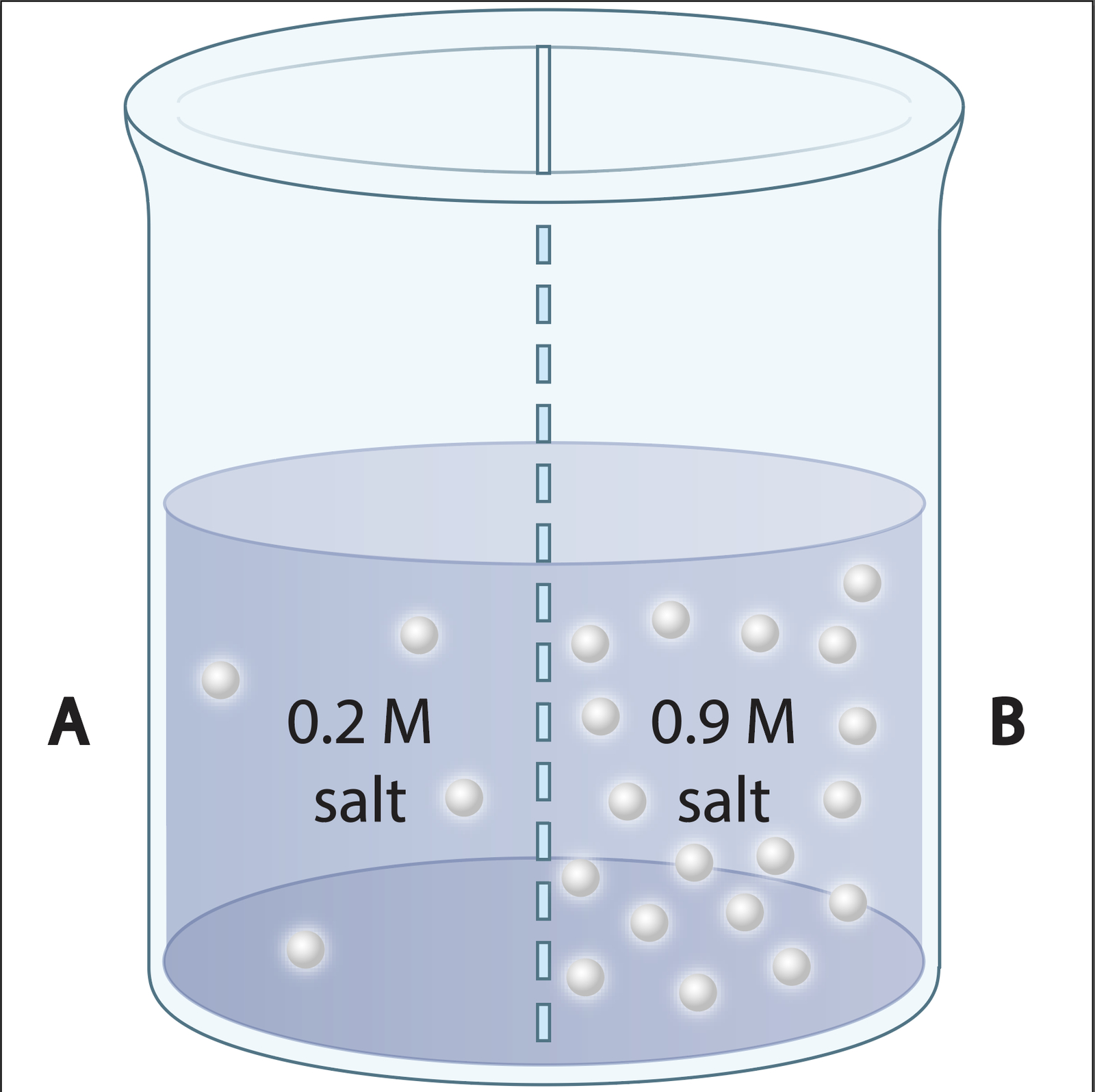
A beaker contains two solutions of salt dissolved in water. The two solutions have different concentrations of salt (measured by molarity, M) and are separated by a membrane that is permeable to water but not salt. Which statement is true about the diffusion of these solutions?
There will be a net movement of water from side A to side B and no movement of salt.
The plasma membranes of some plant cells use transport proteins to move protons out of the cell against their concentration gradient. This is an example of…
active transport
What are the ways that organisms obtain energy and carbon from the environment? What are the names used to describe these organisms?
Organisms obtain energy from the environment in two ways: (1) by harvesting energy from sunlight (phototrophs), and (2) by harvesting energy from chemical compounds (chemotrophs). These groups are further distinguished by how they obtain carbon. Autotrophs obtain carbon directly from inorganic sources, such as carbon dioxide, and convert it into an organic source of carbon, such as glucose. Heterotrophs obtain carbon from organic compounds made by other organisms. (See Fig. 6.1 for examples.)
What is the difference between catabolism and anabolism?
Catabolism is the set of chemical reactions that break down macromolecules into smaller units, releasing energy (ATP). Anabolism is the set of chemical reactions that build macromolecules from smaller units and require an input of energy (usually in the form of ATP).
What are two basic forms of energy? Provide an example of each.
One basic form of energy is kinetic energy (the energy of motion).
Examples of kinetic energy are flexing a muscle and throwing a ball. The other basic form of energy is potential energy (stored energy). Potential energy depends on the structure of the object or its position relative to its surroundings, and it is released by a change in the object's structure or position. A ball sitting on the top of the stairs has a great deal of potential energy, which is released when the ball starts to roll down the stairs (at which point the energy is converted into kinetic energy).
What is the relationship between strength of a covalent bond and the amount of chemical energy it contains?
Chemical energy is a form of potential energy held in chemical bonds (such as covalent bonds) between atoms in a molecule. The stronger the covalent bond, the less chemical energy it contains. The weaker the covalent bond, the more chemical energy it contains. Carbohydrates, lipids, and proteins have many carbon-carbon and carbon-hydrogen bonds. These bonds are relatively weak and are therefore rich sources of chemical energy.
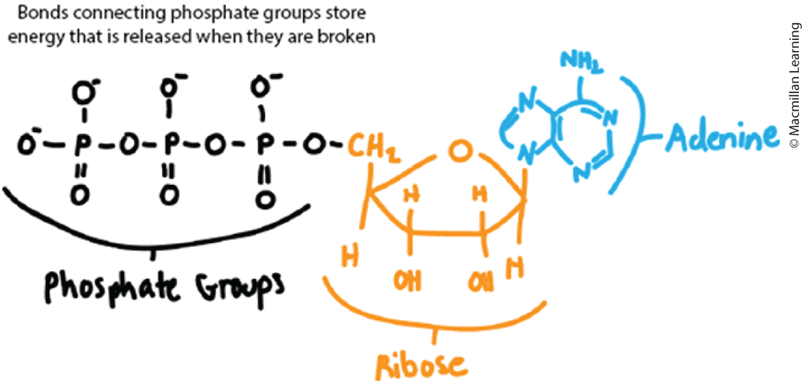
Draw the structure of ATP, indicating the bonds that are broken to power the cell.
What are the first and second laws of thermodynamics and how do they relate to chemical reactions?
The first law of thermodynamics is the law of conservation of energy. It states that energy can be neither created nor destroyed; it can only be transformed from one form into another.
The second law of thermodynamics states that the transformation of energy is associated with an increase in the disorder of the universe. The degree of disorder is called entropy. Chemical reactions are subject to the laws of thermodynamics (like everything else). As a result, the total amount of energy remains the same before and after a chemical reaction, but some of the energy is used to increase the entropy of the system, and only some of the energy is available to do the work of the cell.
Cold air has less entropy than hot air. The second law of thermodynamics states that entropy always increases. Do air conditioners violate this law?
No, because the second law of thermodynamics applies to the universe as a whole. This means that we have to consider not just the air in the room but the heat released to the outdoors as well. An air conditioner produces more hot air than cold air, and therefore total entropy increases, as described by the second law of thermodynamics.

The amount of energy available to do work is called Gibbs free energy (G). In a chemical reaction, you compare the free energy of the reactants and products to determine whether there is energy available to do work. This difference is called AG. AG = AH - TAS. If the enthalpy difference (AH) is positive and the entropy difference (AS) is negative, then AG is positive. This kind of reaction is endergonic and nonspontaneous. By contrast, if the enthalpy difference (AH) is negative and the entropy difference (AS) is positive, then AG is negative. This kind of reaction is exergonic and occurs spontaneously.
How does increasing the temperature affect the change in free energy (AG) of a chemical reaction?
Increasing the temperature increases the value of TAS, which decreases AG, since AG = AH - TAS. As a result, an increase in temperature makes it more likely that a reaction will proceed without a net input of energy.
How can the hydrolysis of ATP drive nonspontaneous reactions in a cell?
The hydrolysis of ATP releases energy. This energy can be used to drive nonspontaneous reactions in a cell if the total AG for the entire pathway is negative.
What are three characteristics of enzymes, and how does each permit chemical reactions to occur in cells?
Enzymes reduce the activation energy of a chemical reaction (or the energy input necessary to reach the transition state) by stabilizing the transition state and decreasing its free energy. See Fig. 6.12. Enzymes are catalysts that participate in a chemical reaction, forming complexes with products and reactants, but are not themselves consumed in the process. Enzymes are also highly specific. They typically catalyze only one reaction, recognizing a specific substrate. Finally, inhibitors and activators can influence enzyme activity. Inhibitors decrease the activity of enzymes, whereas activators increase this activity. See Fig. 6.19 for an example of two different types of inhibitors.
Which of the following do enzymes change: AG, reaction rate, types of product, activation energy, and/or the laws of thermodynamics?
Enzymes increase the reaction rate and decrease the activation energy.
Enzymes do not change the other parameters.
How does protein folding allow for enzyme specificity?
An enzyme only acts on those substrates that bind to its active site, which is the portion of the enzyme that binds substrate and converts it to product. An enzyme folds in such a way that the shape of the active site matches the shape of the substrate.
Anabolic pathways of metabolism are pathways that…
build complex molecules from simple ones
Which of the processes requires net energy input in the form of ATP?
anabolism
A ball has potential energy when it is sitting still ______ of the stairs
in the top, middle, and bottom
Which of the choices is considered a form of kinetic energy?
heat, wind, rolling ball, light
The blood cells quickly moving through your blood stream have a great deal of ______ energy.
kinetic
Nonspontaneous reactions have a _____ ΔG.
positive
Reactions in which there is a negative change in free energy (-ΔG) are…
spontaneous and exergonic.
Which statement is true about exergonic reactions?
There is a net of energy released over the course of the reaction.
Gibbs free energy is defined as…
the amount of energy available to do work.
What are the functions of an enzyme?
to lower the activation energy for the reaction
to increase the rate of a specific reaction
You notice that a the rate of chemical reaction catalyzed by an enzyme in your system is too high.
You want to slow down the reaction. What do you do?
add an inhibitor for the enzyme that catalyzes the reaction
Which of the statements is true of competitive inhibitors of an enzyme?
Competitive inhibitors bind to the active site of the enzyme.
In a reaction, enzymes change the…
activation energy.