Week 7 — Neural Correlates & Memory (1/2)
 Call Kai
 Learn
 Practice Test
 Spaced Repetition
 Match
 Flashcards
 Knowt Play
1/27

There's no tags or description
Looks like no tags are added yet.
28 Terms
What is the difference between a conscious state and conscious contents?
Conscious state = whether a person is capable of conscious experience at all. Conscious contents = what they're experiencing at a particular moment (a voice, a face, pain, an internal thought).
What is a neural correlate of consciousness, and what two kinds of comparison do researchers use to find one?
A nervous-system event co-occurring with — possibly the biological basis of — a mental event, found by comparing states (wakefulness vs. deep sleep) and experiences (aware vs. unaware of a stimulus).
A researcher wants millisecond-by-millisecond timing of processing, and another wants to localise where activity differs. Which methods fit each goal, and why is brain stimulation different?
EEG/MEG suit timing (sequence of processing steps; MEG also gives better spatial resolution). fMRI suits localisation (where activity differs). Brain stimulation (e.g., TMS) tests causality by perturbing the system; fMRI alone is correlational.
Which brain systems support arousal, and which support awareness?
Arousal: brainstem and hypothalamic systems regulating wakefulness, interacting with thalamus and basal forebrain to support cortical activation. Awareness: distributed cortical and thalamocortical activity, including a frontal–parietal network.
What role does the locus coeruleus play in arousal and perception, according to lecture?
A brainstem nucleus releasing norepinephrine widely, enhancing perceptual processing wherever attention is directed — a 'hot spot' for attended processing.
Why is there no single 'consciousness centre' in the brain?
Consciousness depends on interacting systems — damage to one critical structure, or to the connections between areas, can each disrupt it.
A patient shows neither wakefulness nor any behavioural evidence of awareness, and EEG shows no sleep–wake cycle. Which disorder of consciousness is this?
Coma — the most severe condition: wakefulness absent, behavioural evidence of awareness absent.
A patient shows a sleep–wake cycle on EEG but no behavioural evidence of awareness on examination. Which condition is this, and what was it formerly called?
Unresponsive wakefulness syndrome, formerly called vegetative state: wakefulness present, behavioural evidence of awareness absent on examination.
A patient is awake and shows definite but limited and often inconsistent signs of awareness. Which condition is this, and how does it differ from unresponsive wakefulness syndrome?
Minimally conscious state — unlike unresponsive wakefulness, it shows definite (though limited and inconsistent) awareness, not merely wakefulness.
A patient is awake and aware but almost completely unable to move or communicate. Which condition is this, and why can it be mistaken for unconsciousness?
Locked-in syndrome — awareness preserved, but severe movement restriction makes it difficult to detect behaviourally.
What does the Terri Schiavo case illustrate about assessing consciousness?
Her husband wanted life support stopped while her parents believed she reacted to them, but tests showed most of her brain was destroyed and doctors agreed she could not be conscious — feeding tube removed in 2005.
What does the Glasgow Coma Scale (GCS) assess, and what did the GCS-P add in 2018?
Three categories of observable responses: eye-opening, verbal, and motor. GCS-P (2018) adds pupil reactivity.
Why is a failure to respond on a behavioural scale NOT proof that a patient lacks consciousness?
Failure to respond can reflect impaired movement, comprehension, or sensation instead of impaired awareness — so a behavioural scale is an imperfect measure.
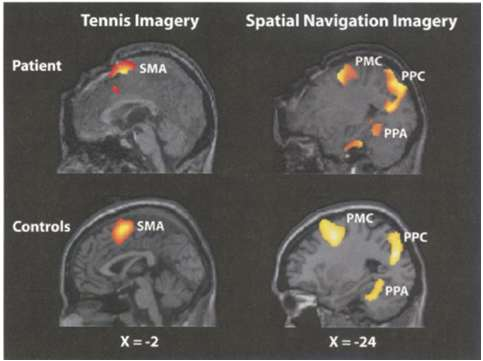
In Owen et al. (2006), an unresponsive patient was asked to imagine playing tennis and to imagine moving through their home. What brain activity was found, and what did it show?
Tennis imagery activated the supplementary motor area (SMA); spatial-navigation imagery activated the parahippocampal place area (PPA) plus PMC/PPC — matching healthy controls. Despite unresponsive wakefulness, the patient understood commands and responded through brain activity: covert command-following.
What is the default mode network (DMN), and what four kinds of internally directed cognition is it commonly involved in?
A large-scale network active when attention turns inward: self-referential thinking, autobiographical memory, imagining future events, and social cognition (thinking about oneself and others).

Name the DMN regions labelled in the lecture brain diagram.
Posterior inferior parietal region, precuneus, posterior cingulate cortex, medial prefrontal cortex, and lateral temporal cortex.

What does 'functional connectivity' mean, and what did Giacino et al. (2014) find for DMN connectivity across levels of consciousness?
Functional connectivity = how strongly activity in different regions varies together (statistical, not proof of a direct connection); Giacino et al. (2014) found DMN connectivity highest in healthy controls, declining with consciousness level: minimally conscious > unresponsive wakefulness > coma.
In the Giacino et al. (2014) DMN graph, one blue dot sits at control-level connectivity. Whose data is it, and why does it matter?
A locked-in syndrome patient — unable to express awareness behaviourally, yet their DMN connectivity matched healthy controls: evidence of preserved consciousness despite paralysis.
During deep non-REM sleep, coma, unresponsive wakefulness, and general anaesthesia, what happens to communication among cortical regions?
Some cortical communication is reduced and frontal–parietal communication is disrupted — the brain isn't simply inactive; the organisation of its activity is disrupted.
What is the central proposal of Global Neuronal Workspace Theory?
Specialised systems process information locally, but some is amplified and shared widely (broadcast/'ignition': a rapid, non-linear change in distributed activity) — this global availability supports conscious access via long-range frontal–parietal interactions.
Global availability in the workspace supports three flexible uses. Name them, with the lecture's person-round-the-corner example.
Working memory: holding an idea in mind after the stimulus is gone (the person round the corner); generativity: combining inputs in new ways (seeing them + remembering to tell them something); flexibility: adjusting one system using others (changing plans to follow them).
What is the central proposal of higher-order theories of consciousness?
A sensory representation becomes conscious when the system also represents itself as being in that state. First-order representation: 'A red object is present.' Higher-order representation: 'I am seeing a red object.' The higher-order representation need not be deliberate or verbal.
How does higher-order theory explain blindsight, and what question does it raise?
A blindsight patient retains a first-order representation sufficient to guide visual judgments but lacks the higher-order representation for awareness — raising: can sensory information guide behaviour without the representation needed for conscious experience?
What is the central proposal of Recurrent Processing Theory, and how does it differ from the workspace account on timing?
Feedforward processing (a first pass through sensory pathways) works without awareness, but recurrent processing (feedback within/between sensory areas) supports conscious perception — so unlike the workspace account, conscious experience may come BEFORE global availability for report.
What is the central proposal of predictive processing approaches, and what does it leave unexplained?
The brain predicts sensory input from prior knowledge and updates from prediction errors (prediction vs. incoming signal) — e.g., context deciding whether an ambiguous character is a letter or number — but leaves unexplained what makes an inferred percept conscious.
What is the central proposal of Integrated Information Theory (IIT)?
Experience corresponds to a system's irreducible causal structure — the whole is more than its parts — and is specific (differs from many alternatives) and unified (parts belong to one experience).
For each theory, how would it explain what makes seeing a red apple conscious?
Workspace: apple information becomes globally available. Higher-order: the system represents itself as seeing the apple. Recurrent processing: sensory feedback supports the percept. IIT: the experience corresponds to an irreducible causal structure. Predictive processing: inference combines sensory signals with predictions.
Do these five theories of consciousness compete or overlap, and what distinguishes them?
They overlap in some mechanisms but differ in what's essential for consciousness — the lecturer's view: not strictly competing, different emphases on related processes, with the most work behind the global workspace accou