ART 201A: Ancient Greek, Roman, and Byzantine Art
 Call Kai
 Learn
 Practice Test
 Spaced Repetition
 Match
 Flashcards
 Knowt Play
1/31

Earn XP
Description and Tags
Vocabulary practice flashcards covering Greek, Roman, Early Christian, and Byzantine art history, key artworks, conventions, and terminology.
32 Terms

Funerary Vase (Krater), Greek Geometric
A Greek Geometric vessel characterized by geometric patterns and triangular torsos, designed possibly as a funerary item specifically for a soldier.

Exekias, Ajax and Achilles Playing a Game (Amphora; Black Figure Painting)
An Archaic black-figure amphora with a minimalist composition depicting an event from the Trojan War where Ajax and Achilles play a game.

Euphronios, Death of Sarpedon (Krater; Red Figure Painting)
A red-figure krater featuring a maximalist composition that depicts a scene from the Trojan Wars involving Sarpedon, one of the leaders.

Dying Warriors from the Temple of Aphaia
Sculptures marking the transition between Archaic and Classical Greek art, seen through an Archaic smile contrasted with Classical tension in the body.

Standing Female Youth (Berlin Kore), Greek Archaic
An Archaic sculpture of a female youth holding a pomegranate, associated with Persephone, featuring bulging eyes and a smile resembling the Archaic rather than Classical style.
Kore
The Greek term for a standing female youth.
Kouros
The Greek term for a standing male youth.

Standing Male Youth (Anavysos Kouros), Greek Archaic
An Archaic statue made for a male soldier considered a hero who died in battle or won an Olympic game, featuring proportions closer to Classical than Archaic.

Parthenon, Greek Classical
The primary Classical temple located in Athens named after Parthenos (virgin Athena), commemorating victory over the Persians with a Doric exterior of simple, round capitals and triglyphs.

Lapith and Centaur from the Parthenon, Greek Classical
Parthenon sculptures acquired by lord elgan that display victory against the Persians, currently in the British Museum amid controversy over whether they belong in London or Athens.

Polykleitos, Spear Bearer (Roman copy), Greek Classical
A Classical statue distinguished as a Roman copy by braces throughout the sculpture, exhibiting naturalistic proportions, a sense of motion, and a weight shift.

Praxiteles, Aphrodite of Knidos (Roman copy), Greek Classical
A Classical sculpture by Praxiteles that served as the first acceptable image of a nude woman, depicting the goddess Aphrodite.

Artemis Slaying Actaeon, Pan Painter, Greek Classical
A Classical krater that illustrates the traditional theme that Greek goddesses' bodies should not be seen by mortal men.

Laocoon, Greek Hellenistic
A Hellenistic sculpture depicting Laocoon and his sons being punished by Greek gods for trying to warn fellow Trojans not to accept the Greek wooden horse, illustrating how petty the Greek gods are.

Augustus of Primaporta, Roman Empire
A portrait of Rome's first emperor with his hand raised to address a crowd, indicating rule by law as a diplomat; conquest of egypt earned him title of augustus; features baby Cupid to emphasize alleged descent from Venus and destiny to rule.

Gemma Augustea, Roman Empire
A Roman cameo depicting Augustus being crowned a god after death alongside a personification of Rome, Jupiter represented by an eagle, and tyberius, centering on the theme of Augustus's succession.

Initiation Rites of the Cult of Bacchus from the Villa of the Mysteries, Pompeii, Roman Empire
A Roman wall painting that probably depicts an initiation scene into the cult of Bacchus, the god of fertility.

Flavian Amphitheatre (Colosseum), Roman Empire
The main Roman arena where gladiators fought, which now functions as a church honoring early Christians believed by modern Christians to have been martyred by gladiators.

Column of Trajan, Roman Empire
A funerary monument holding Trajan's ashes at the base, commemorating the conquest of datia primarily by portraying Roman preparation efforts and road fortification before battle.
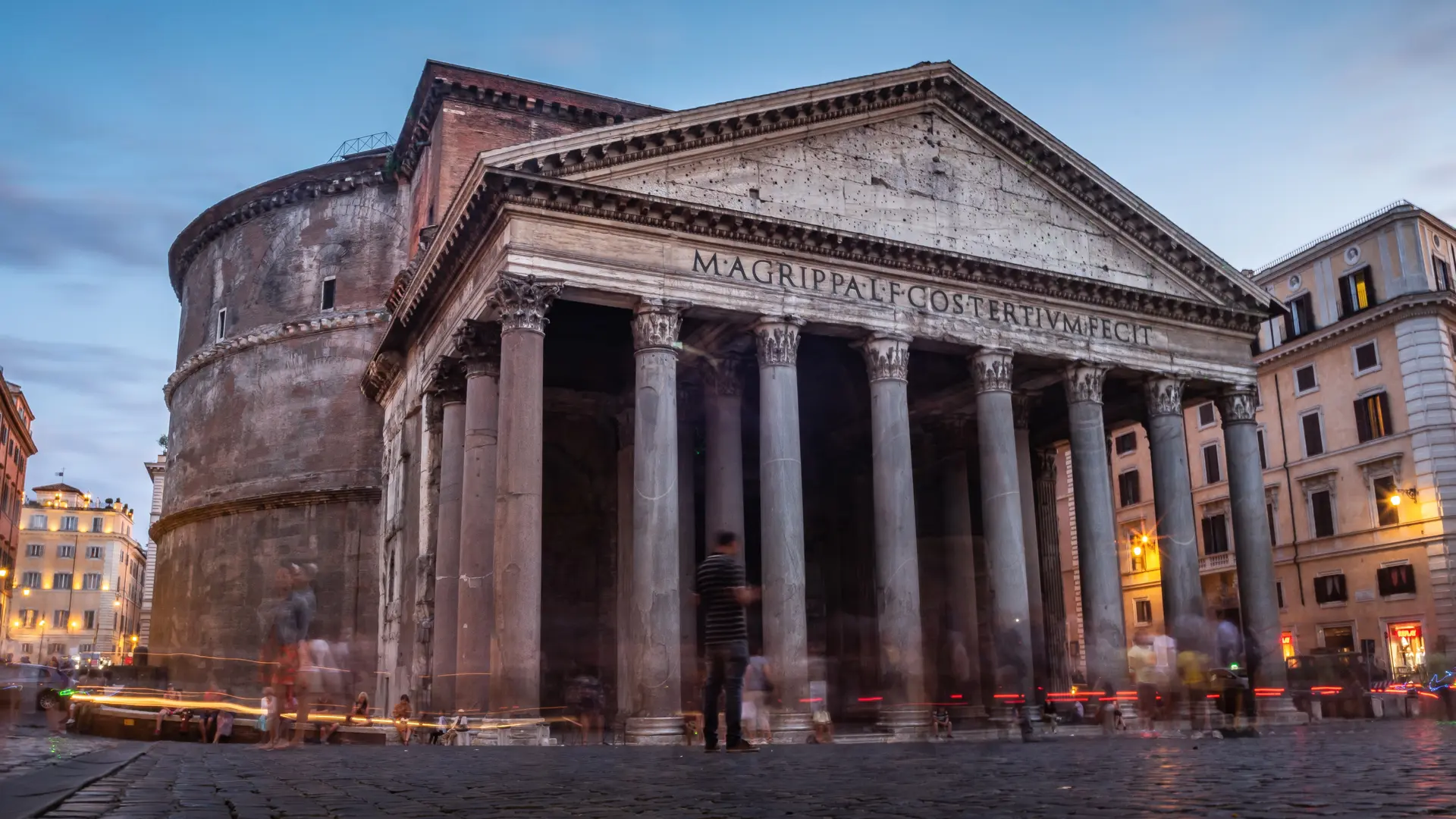
Pantheon, Roman Empire
Roman temple commemorating the collective gods and goddesses that Romans worshipped

Equestrian Statue of Marcus Aurelius, Roman Empire
A bronze equestrian statue showing the emperor in civilian clothes, preserved by mistake because he was misidentified as Constantine, who legalized Christianity but was usually clean shaven.
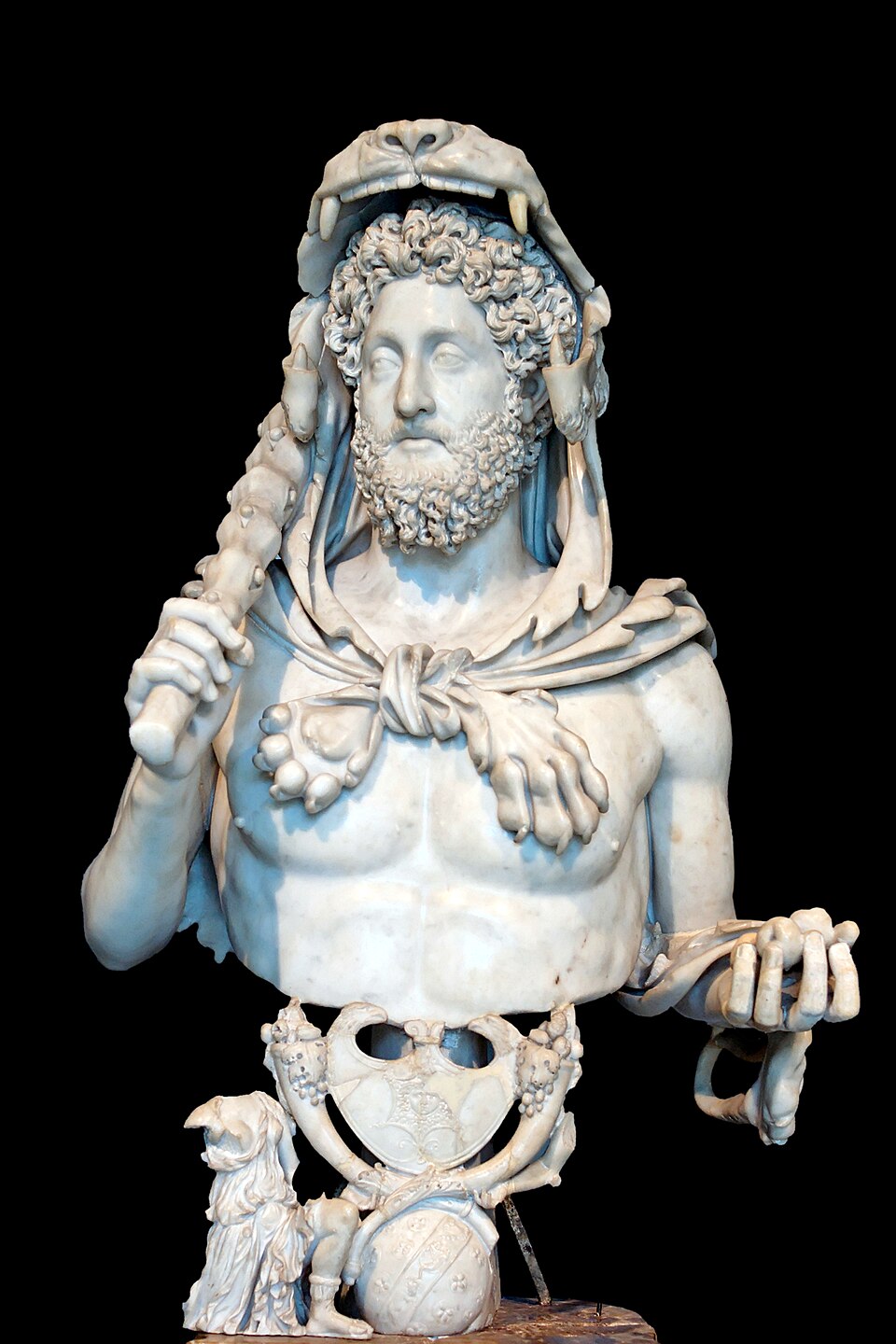
Bust of Commodus, Roman Empire
A portrait bust of Marcus Aurelius's son who murdered his father; infatuated with Hercules, he portrayed himself as a lovable, heroic figure holding the apples of the Hesperides and a studded club before being assassinated by Narcissus.

Bust of Caracalla, Roman Empire
A portrait of a tyrannical Roman emperor who murdered his brother, ordered his brother's image and name destroyed everywhere, banned actors from colosseums, and brought soldiers to Alexandria over a critical play.
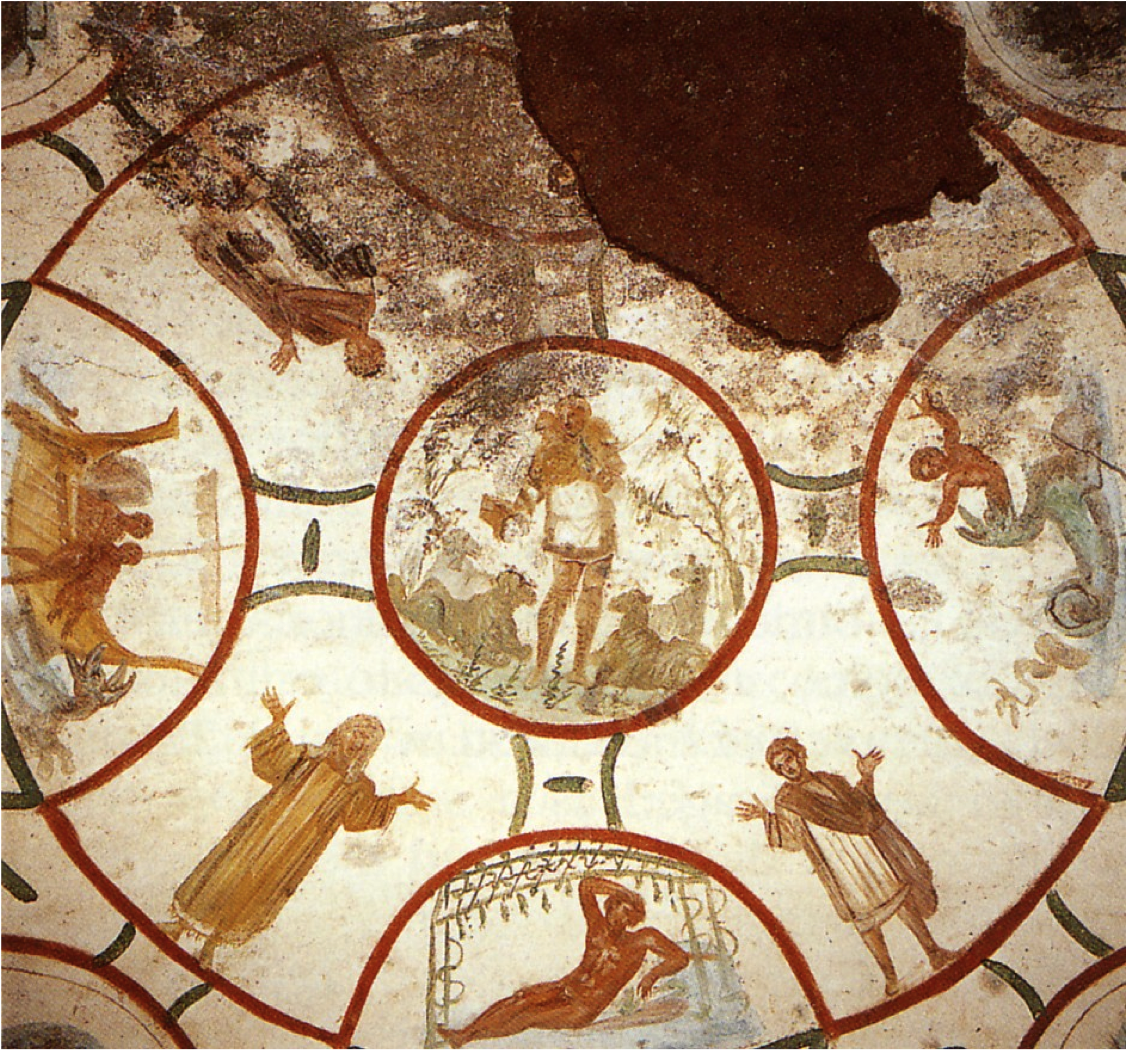
Good Shepard, Orants, and Jonah, Early Christian catacomb, Rome
A cross-shaped fresco created while Christianity was illegal, using Roman-style figures to stay under the radar and interpreting Jonah as a prefiguration of the death and resurrection of Jesus.

Oratory of Galla Placidia, Byzantine, Ravenna
A Byzantine site in Ravenna established after Christianity became the legal, official religion of the empire and the capital moved to Constantinople after Rome was abandoned.

Martyrdom of St. Lawrence, mosaic, Mausoleum of Galla Placidia, Byzantine, Ravenna
A Byzantine mosaic depicting St. Lawrence being martyred on a grill for refusing to surrender gospel texts, later considered the patron saint of bakers.

Good Shepherd, mosaic, Mausoleum of Galla Placidia, Byzantine, Ravenna
A Byzantine mosaic depicting Jesus as a young boy wearing a shepherd's outfit, an expensive gold robe, and purple to signify divine approval of the imperial family.

Church of Hagia Sophia, Constantinople (Istanbul), Byzantine
Meaning holy wisdom, the largest imperial church in Constantinople built by Justinian as a statement of power and piety on the site of a church destroyed during a rebellion.

Emperor Justinian and His Attendants & Empress Theodora and Her Attendants, mosaic, Church of San Vitale, Ravenna, Byzantine
Mosaics depicting the emperor and empress as Christ's emissaries on earth and links between heaven and earth, flanked by clergy and soldiers whose shield shows the Greek letters chi and rho.

Icon of the Virgin and Child with Saints Theodore & George and Angels, Byzantine, Monastery of St. Catherine, Mt. Sinai, Egypt
mosiac showing the Virgin Mary holding the Christ Child, surrounded by Saints Theodore and George, and flanked by angelic figures, reflecting the theological and artistic conventions of the Byzantine era.

Virgin of Vladimir, icon, Russia, Byzantine
A miraculous Byzantine icon thought to be a copy of an original by Saint Luke, transferred from Constantinople to Vladimir and then Moscow, and carried into battle to protect Russia from invasion.

Anastasis (Resurrection), Constantinople, Byzantine
A Byzantine work depicting Jesus as a superheroic, divine figure beginning resurrection and pulling Adam and Eve from their crypts, featuring a star-covered white nimbus behind Him.