Hematology I Automation
 Call Kai
 Learn
 Practice Test
 Spaced Repetition
 Match
 Flashcards
 Knowt Play
1/98

Earn XP
Description and Tags
CLS 536 Unit 3 - 10/15/2026
99 Terms
What are the four major brands for the CBC/auto diff?
Coulter, Sysmex, Abbott Cell-Dyn, and Siemens ADVIA?
What machine is used for an automated manual diff?
Cellavision
How do we measure Hgb?
Spectrophotometrically
What is the Hgb measurement for Coulter and what is the wavelength?
Modified cyanmethemoglobin at 525 nm
What is the Hgb measurement for Sysmex and what is the wavelength?
SLS-Hgb at 555 nm
What is the Hgb measurement for Abbott Cell-Dyn and what is the wavelength?
Modified cyanmethemoglobin at 540 nm
What is the Hgb measurement for Siesman AVIDA and what is the wavelength?
Modified cyanmethemoglobin at 546 nm
Why do we blank a spec?
Ensures we are measuring the inside of the tube and removes the absorbance of any reagents
What is Beer’s law?
Quantitative relationship between absorbance and concentration of analyte
What is the name of the reagent used for Hgb tests?
Drabkin’s
What is in Drabkin’s?
Potassium ferricyanide and potassium cyanide
What is the reaction product with Drabkin’s?
Cyanmethemoglobin
What wavelength do we typically measure Hgb?
540nm
What is the relationship of beers law?
Amount of cyanmethemoglobin is directly proportional to amount of Hgb at 540 nm
What are the two general principles of hematology instrumentation?
Electronic impedance and optical scatter
What type of resistance is electrical impedance?
Low-voltage direct current resistance
What type of resistance is radiofrequency?
Alternating current resistance
What is another name for electronic impedence?
The Coulter principle
What does the Coulter principle measure?
Displacement/volume = size
What is coincidence error?
When two cells pass through the aperture at the same time
What is the Coulter principle?
Changes in impedance are measured as cells pass through an apurature
What is the pulse height relationship to the cell in the Coulter principle?
Pulse height is proportional to the volume of the cell
What information can each pulse in a Coulter provide?
Each pulse can count number and size of each cell

What are the results of this oscilloscope (aperture) pattern from the Coulter?
Many particles of similar size

What are the results of this oscilloscope (aperture) pattern from the Coulter?
Few particles of varied sizes

What are the results of this oscilloscope (aperture) pattern from the Coulter?
Aperture blockage and a few different particles of varying sizes
What does radiofrequency (RF) measure, and what is its relationship to pulse?
Cell interior density which is proportional to the change in RF pulse
What is another name for radiofrequency?
Conductivity
What is seen when RF VS. impedance is graphed?
AC Vs. DC
What is basic optical scatter?
Hydrodynamically focused sample stream
What is basic optical scatter used to evaluate?
RBCs, WBCs, and PLTs
What information does forward scatter provide?
Size
What information does side scatter provide?
Complexity
What mechanism of cell counting does Coulter utilize?
Impedence
What mechanism of cell counting does Sysmex utilize?
Impednece
What mechanism of cell counting does Abbott Cell-Dyn utilize?
Optical scatter and impedance
What mechanism of cell counting does Siesmans ADIVA utilize?
Optical scatter
What types of testing provide a 3-part diff?
Flow cytometry and electrical impedance
What types of testing provide a 5-part diff?
Coulter VCS technology and Abbott Cell-Dyn MAPSS
What types of testing provide a 6-part diff?
Seismens AVIDA and Sysmex
What types of testing provide a complete differential?
Pattern recognition and CellaVision
What is evaluated in a 3-part diff by flow cytometry?
Forward scatter and side scatter
What cell populations appear in a 3-part diff by flow cytometry?
Lymphocytes, monocytes, and granulocytes
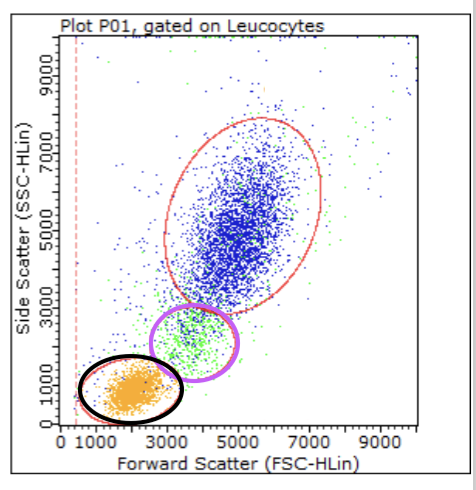
What are the three populations circled in the 3-part diff by flow cytometry?
Black is lymphocytes, purple is monocytes, and red is granulocytes
What is evaluated in a 3-part diff by electrical impedance?
Size and shape of the nucleus and internal structure of cytoplasm
What instrument is typically produces 3-part diff by electrical impedance?
Coulter intruments (LH series)
What is the 3-part diff produced by electrical impedance?
Lysing agent in WBC dilution lyses RBCs and collapses cytoplasmic membrane around the nucleus

What are the cell populations in the 3-part diff by electrical impedance?
Black is PLTs and RBCs, purple is lymphocytes, green is monocytes, and red is granulocytes

With the following CBC results, what is the most likely diagnosis?
WBC = 23.8×10³/uL, lymph % = 8.1%, mixed % = 7.9%, neut % = 84%
Neutrophila

With the following CBC results, what is the most likely diagnosis?
WBC = 7.9×10³/uL, lymph % = 64.7%, mixed % = 15.8%, neut % = 19.5%
Lymphocytosis
What is the MAPSS principle?
Multi-angle polarized scatter seperation
What is the MAPSS plot for nRBCs?
0º (size) by FL3 (DNA)

What is the MAPSS plot for mononuclear and PMNs?
7º or 10º (complexity) by 90º (lobularity)

What is the MAPSS plot for neutrophils and eosinophils?
90º (lobularity) by 90Dº (granularity)

What is the MAPSS plot for lymphocytes and monocytes?
0º (size) by 7º or 10º (complexity)

What are the cell populations present in the 5-part diff by Abbott Cell-Dyn?
Red is nRBCs, blue is lymphocytes, purple is monocytes, green is eosinophils, black is basophils, and orange is neutrophils
What technology does Coulter LH 5-part diff utilize?
VCS technology
What is VCS technology?
Volume, conductivity, and scatter technology
What does DC or electronic impedance detect?
Volume/size
What does radiofrequency detect?
Internal complexity
What are the 3 principles of a Sysmex 6-part diff instrumentation?
DC/RF detection method via the IMI channel, hydrodynamic focusing for RBC/PLT channel, and flow cytometry with semiconductor laser for diff channels
What drives hydrodynamic focusing
Sheath flow and direct current
What is an IMI channel?
Destroys RBC membranes and mature WBCs but not immature WBCs
What makes a Sysmex 6-part diff VS. a 5-part diff?
IMI channel and detection of immature cells
What channels are included in a Sysmex?
Diff channel, WBC/baso channel, nRBC channel and PLT/retic channel
What is the diff channel stromatolyser and what does it do?
4DL and 4DS and it lyses RBCs/PLTs and penetrates WBCs to stain nucleic acid

What are the populations in the diff channel scattergram?
Purple is ghost cells, pink is lymphocytes, green is monocytes, white is blast cells, dark blue is immature granulocytes, light blue is neutrophils and basophils, red is eosinophils, and orange is basophils
What is the WBC/baso channel stromatolyser and what does it do?
FB and it exposes nuclei of all cells but basophils
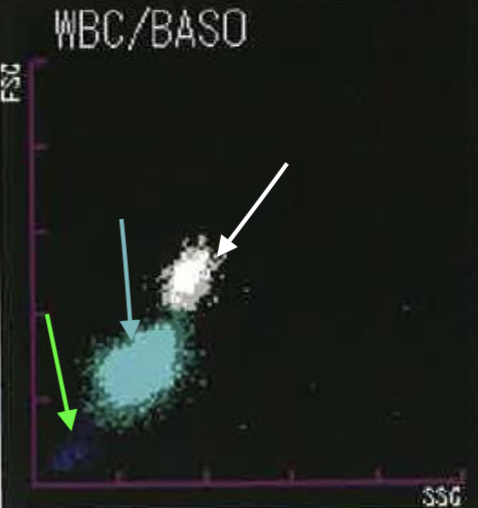
What are the populations in the WBC/baso channel scattergram?
Green is ghost, blue is WBCs and white is basophils
What is the nRBC channel stromatolyser and what does it do?
NR and it destroys the RBC membrane and exposes the nuclei and stains EBC nucleic acid

What are the populations in the nRBC channel scattergram?
Green is ghost cells, purple is nRBCs and blue is WBCs
What is the PLT/retic channel stromatolyser and what does it do?
RET/Search II, which mildly damages membranes and stains RBCs and WBC nucleic acids
What is involved in the optical-only 6-part diff for Seismens AVIDA?
Utilizes light scatter and cytochemistry markers
What is involved in the cytochmistry only 6-part diff for Seismens AVIDA?
Peroxidase staining

What are the populations in the peroxidase scattergram?
1 is noise, 2 is nRBCs, 3 is PLT clumps, 4 is lymphocytes/basophils, 5 is large unstained cells (LUCs), 6 is monocytes, 7 is neutrophils, and 8 is eosinophils

What are the populations in the baso scattergram?
1 is noise, 2 is blast cell nuclei, 3 is mononuclear WBCs (monocyte/lymphocyte nuclei), 4 is basophils, 5 is baso suspect, 6 is saturation, and 7 is PMN WBCs (neutrophil/eosinophil nuclei)
What makes a Siemens ADVIA 6-part diff VS. a 5-part diff?
Large unstained cells (LUC)
Which instrument would have the most difficulty with myeloperoxidase deficiency disorder and why?
Siesmens AVIDA because it utilizes MPO staining
For myeloperoxidase deficiency, which cell population would be elevated on Siesman AVIDA?
LUCs
What are some limitations of automation?
Cold agglutinins, lipemia, hemolysis, abnormal Hgbs, microcytosis, nRBCs, and PLT clumps
What technology does Coulter LH 750 utilize?
VSC
What technology does Sysmex XE-2100 utilize?
Optical scatter and fluorescent staining
What technology does Abbott Cell-Dyn 400 utilize?
MAPSS
What technology does Siemens ADVIA 2120 utilize?
Peroxidase staining and optical scatter and absorption
How is CellaVision PLT estimate counted?
A slide area equivalent to 9 high power fields is divided into grid squares and all are counted for PLTs
When are reticulocyte counts ordered?
When patient has anemia
What do reticulocyte counts correlate to?
Polychromasia
What is a reticulocyte?
Immature RBC that just lost its nucleus
What does an instrument measure reticulocytes?
Supravital staining by new methylene blue (NMB)
What does NMB stain?
Reticulum and precipitated rRNA

What cells are these?
Reticulocytes
How are reticulocyte counts measured in Coulter LH?
Supravital staining (NMB) and VCS technology
How are reticulocyte counts measured in Sysmex XE?
Supravital staining in fluorescence detection
How are reticulocyte counts measured in Abbott Cell-Dyn?
Proprietary stain and florescence detection
How are reticulocyte counts measured in Siemens AVIDA?
Supravital staining with low angle and high angle optical scatter and absorbance
What are the directly measured results of a QBC Star sample?
HCT, WBC, granulocytes, lymhocytes/monocytes, and PLTs
What are the derived results of a QBC Star sample?
Hgb
What are the calculated results of a QBC Star sample?
MCHC
A patient film demonstrates agglutinated RBCs, and the CBC
shows an elevated MCHC. What other parameters will be
affected by the agglutination of the RBCs?
MCV will be increased and RBC will be decreased