Week 4: Inhibitory and Excitatory Conditioning
 Call Kai
 Learn
Learn Practice Test
 Spaced Repetition
 Match
Match Flashcards
 Knowt Play
1/37

Earn XP
Description and Tags
Inhibitory and Excitatory Conditioning
Name | Mastery | Learn | Test | Matching | Spaced | Call with Kai | Chat |
|---|
No analytics yet
Send a link to your students to track their progress
38 Terms
Definition of Excitatory Conditioning
A CS that predicts the occurrence of a US
think of this as an open sign that will predict food
Definition of Inhibitory Conditioning
A CS that predict when a US will not occur
think of this as a closed sign
What is a CS-?
Not a reliable predictor of anything, will not predict anything
ex. Light paired with nothing
What is a CS+?
A reliable Pavlovian predictor that will allow for associative relationships to form
What happens when an excitatory CS is presented during conditioning?
An excitatory CS will create a conditioned response, the amount of conditioned responding increase will more exposure to the excitatory CS
an overall increase in response
What happens when an inhibitory CS is presented during conditioning?
Expect to see a decrease in the levels of conditioned responding when exposed to this type of CS
Seeing an overall decrease in responding is hard to detect without conducting the proper tests
What are the two types of tests used to verify conditioned inhibition?
Summation Test
Impaired Acquisition Test
If a CS passes only one of the test to verify conditioned inhibition, would it be considered a true inhibitor CS?
NO a CS needs to pass BOTH of the tests of verification since there might be other instances that will allow a CS to pass a certain test despite it not being an inhibitory CS
What is a compound CS?
The presentation of multiple CSs together to create a COMPOUND and more powerful CS that will create a single conditioned response
Must be presented together
What are the individual components of a compound CS referred to?
The individual CSs are referred to as elements!
We expect to see growth (increase or decrease) of responding when multiple CSs are presented as a compound
Why would an inhibitory CS pass the summation test?
The test considers that if we present an inhibitory and excitatory CS together then we would expect their conditioned responses to cancel each other out
In order for a inhibitor CS to pass the Summation test, what are the results we expect to see?
We would expect to see that the excitatory CS control would have its own level of response when tested on its own
When an excitatory CS is in compound with the inhibitory CS then we would expect to see a decrease level of responding relative to the excitatory CS alone

If we see an increased level of responding when we pair an excitatory CS with the “inhibitor CS” we are testing, can we say that the CS passes the test?
We would say that the CS we are testing fails the summation test, in order to pass we need to see a decrease in the level of conditioned responding when the CS is paired with an excitatory CS
What is the logic behind the Impaired Acquisition Test for testing for conditioned inhibition?
If a CS predicts that a US will NOT OCCUR, it should take longer to establish the inhibitory CS as a predictor of a US compared to a neutral CS

What is the experimental set up required to conduct the Impaired Acquisition Test?
During Phase 1: We would have a neutral CS which will receive no learning, while the inhibitory CS will be taught to become a conditioned inhibitor
During Phase 2: We would conduct the test where we would have each CS be followed by a US and track the learning for each
What results would we expect to see if a CS passes the Impaired Acquisition Test?
We would expect to see a lower learning curve compared to a neutral CS that was not trained to become an inhibitory CS
Based on the results of the Impaired Acquisition Test, is it possible for an association to be learned with an inhibitory CS?
Yes, an association can still be learned!
A subject would require more experience in order to overcome the previous inhibitory associations (which is why we see a lower learning curve)
What are the three training methods we can use to create an inhibitory CS?
Compound Training
Negative Correlation Training
Differential Conditioning
What is the strongest and most reliable way to create an inhibitory CS?
Conducting Compound Training!
What is the setup we would expect to see when conducting compound training?
We have three CSs for the experiment
CS1 (a sacrificial CS) → excitatory response
CS1 + CS3 → generates inhibitory learning since we will have no US
CS2 (our control group) → we will have an excitatory response
How does the setup of Compound Training contribute to the creation of an inhibitory CS?
The compound training of an excitatory CS with a CS where no US is presented will allow the novel CS to become the inhibitor CS
Subject is being presented with evidence that when paired with that CS it will not receive the US (inhibition)
How would we be able to know if Compound Training was a success?
We could perform a summation test to see if the training was successful where the results are able to be generalized to a pairing that was never conducted before

What is the generic format of a Negative Correlation test?
We are using an Unconditioned Stimulus but not an excitatory CS
Everytime a US is presented is during a time when the CS is absent and everytime the CS is occurring the subject understands that there is no chance that the US will happen
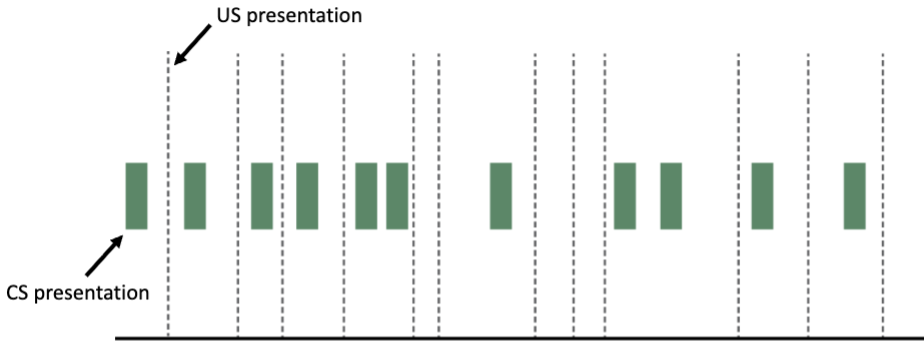
How can we increase the strength of inhibitory learning in a Negative Correlation Test?
We can change the frequency of the occurrence of the US in the absence of the CS
To strengthen learning: We can increase the amount of time the US is presented in the absence of the CS
Subject has more evidence of the inhibitory Cs
To decrease learning: We can decrease the amount of times the US is presented in the absence of the CS
Subject has less evidence of the inhibitory CS
How can we fulfill the Differential Correlation training to form an inhibitory CS?
We will have a CS+ and the CS- in a experimental set up
Only the excitatory CS will be paired with the US an the CS- will never be paired with the US
Only a response is generated from the CS+

What is the weakest form of inhibitory conditioning training?
Differential Correlation Training → since the training is similar to the process we do to test Pavlovian learning
Are we able to create an inhibitory CS if the US is never presented to the subject?
NO!
The subject should have an understanding that the US exists and should have some expectation of the US
Since Compound training is the most powerful training for Conditioned Inhibition, how might we improve the strength for Negative Correlation and Differential Correlation tests?
We can change the frequency of the presentation of the US in the absence of the conditioned inhibitor to provide the subject with more evidence of when the US will NOT occur
Can we pair an inhibitory CS with an excitatory CS its never been paired with an expect to see the same inhibitory response?
Yes! Conditioned Inhibitors are able to generalize beyond being paired with the excitatory CS that was used to create them during their training
What must be true of an inhibitory CS’s conditional probability?
The probability that a US will not occur in the presence of the CS must be the highest!
The CS must not generate an unconditional response
What type of inhibition occurs when there is no US involved when establishing an inhibitory CS?
We will have latent inhibition/Pre-exposure Effect (a type of Pavlovian Learning)
What occurs during the Latent Inhibition/ Pre-Exposure Procedure?
We will have a CS (ex.Light) be shown in trials without the unconditioned stimulus → known as the pre-exposure phase
We will then have the CS and another conditioned stimuli be paired with the US
What will the results of a Latent Inhibition / Pre -Exposure Procedure show us?
The learning rate of a CS that undergoes the pre-exposure phase will have slower learning than the novel CS
Learning is harder since it would be hard for the CS to become a reliable predictor when it was previously not paired with anything
Why is it important for an inhibitory CS to pass both Inhibitory Tests based on the evidence shown with Latent Inhibition?
We would see that Latent Inhibition would pass the Impaired Acquisition Test since the learning rate will be lower than the novel CS
However Latent Inhibition will not pass the Summation Test!
What are the similarities between latent inhibition and conditioned inhibition?
Both will cause a decrease in the learning rate which will passes the impaired acquisition test
What are the differences between latent inhibition and conditioned inhibition?
The information that is presented during latent inhibition is different
Different processes are operations between both forms of inhibition
What type of learning curve would we see if a true inhibitor CS is paired with an excitatory CS ?
We would see a decrease in the learning rate when compared to the learning of a excitatory CS alone since there is no inhibitory relationship that would need to be overcame here
Would we expect the learning curve of the inhibitor CS paired with the excitatory CS to reach the same assymptote as the excitatory CS alone?
Yes we would! They would reach the same level of conditioned response but will take different amounts of time to reach the assymptote