ELECTROCHEMISTRY ❤️🔥🧿🧑⚕️
 Call Kai
 Learn
 Practice Test
 Spaced Repetition
 Match
 Flashcards
 Knowt Play
1/21

There's no tags or description
Looks like no tags are added yet.
22 Terms
Electrochemistry
It is the detailed study of relation between current electricity and chemical equation
The 2 parts
1 electrochemical cell : current is passed through a solution which leads to occurence of chemical reaction
That device which converts electrical energy into chemical reaction
2 Galvanic cell : certain chemical rxn occur which leads to generation of current electricity
That device which converts chemical energy to electrical energy
Electrochemical cell
Electrolysis
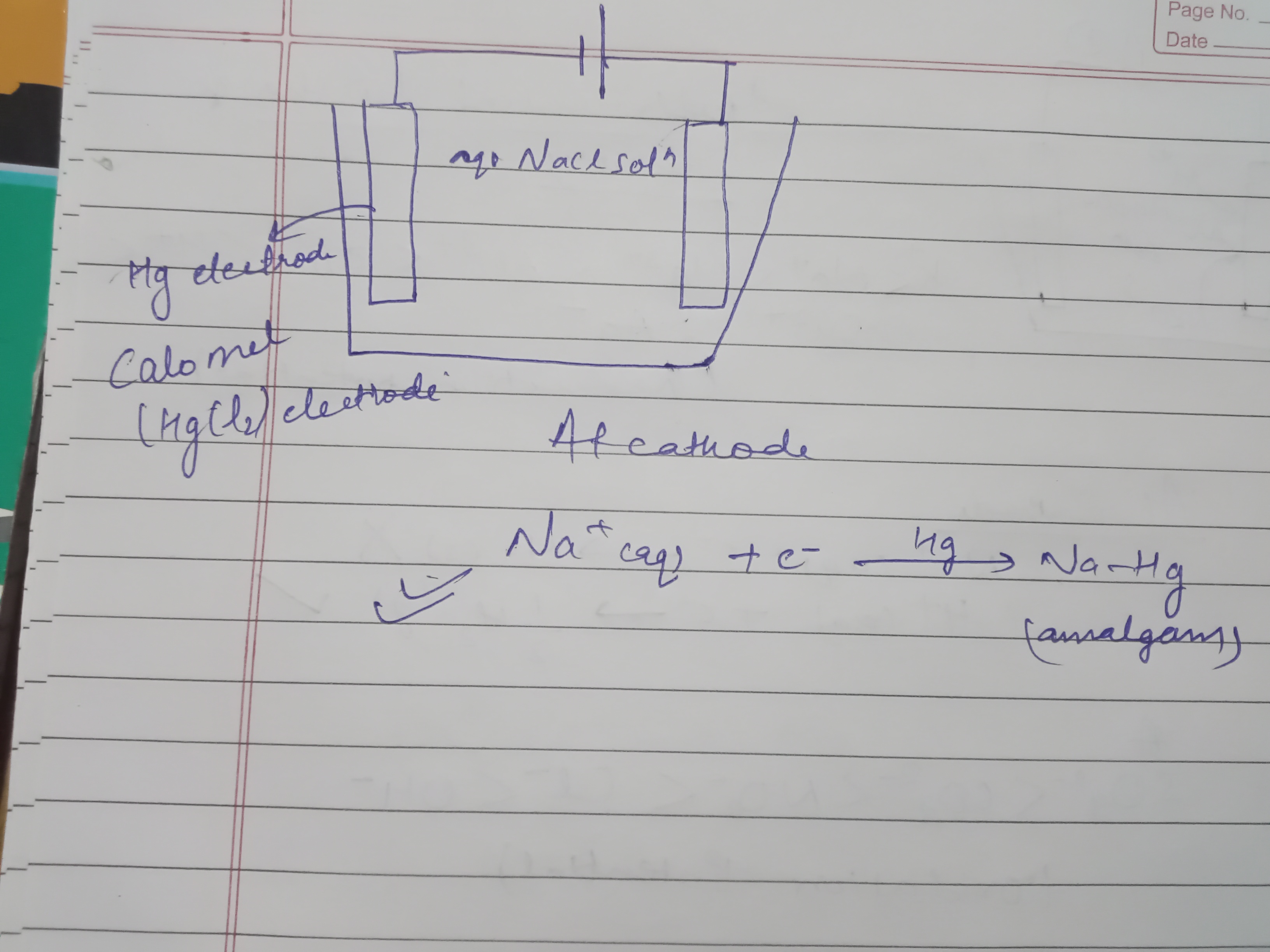
It is the movement of cations and anions of electrolyte towards respective electrodes under the influence of external electric field and their subsequent reduction and oxidation


Answer is H2


To understand the prferrential discharge
But in case of aqueous nacl cl is the product at anode



### Question 1
Calculate the mass of Al³⁺ deposited by 1 Faraday of charge.
A. 27 g
B. 18 g
C. 9 g
D. 1000 g
### Question 2
What is the amount of charge required to obtain 1 mole of Al from Al³⁺?
A. 3 × 96500 C
B. 96500 C
C. 96500/3 C
D. 96500/2 C
### Question 3
When electricity is passed through a solution of AlCl₃, 13.5 g of Al is deposited. The number of Faradays of electricity passed must be:
A. 0.50
B. 1
C. 1.50
D. 2
Question 10
Calculate the thickness of Ag deposited on a plate of area 10 cm² by a current of 10 A for 965 seconds. The density of Ag is 10.8 g cm⁻³.
A. 0.1 cm
B. 1 cm
C. 2 cm
D. None of these
Question 11
One gram of a metal M²⁺ is discharged by the passage of 1.81 × 10²² electrons. What is the atomic weight of the metal?
A. 33.35
B. 33.4
C. 66.7
D. 55.6
Question 12
A current of 9.65 A is passed through an aqueous solution of NaCl using suitable electrodes for 1000 seconds. The amount of NaOH formed during electrolysis is:
A. 2 g
B. 4 g
C. 6 g
D. 8 g
Question 13
A current of 2.6 A is passed through a CuSO₄ solution for 6 minutes 20 seconds. The amount of Cu deposited is (atomic weight of Cu = 63.5, Faraday constant = 96,500 C):
A. 6.35 g
B. 0.635 g
C. 0.325 g
D. 3.175 g
### Question 4
One Faraday of electricity, when passed through a solution of copper sulfate, deposits:
A. One mole of copper
B. One gram-atom of copper
C. One molecule of copper
D. One gram-equivalent of copper
### Question 5
One Faraday of electricity will liberate one mole of metal from the solution of:
A. AuCl₃
B. CuSO₄
C. BaCl₂
D. KCl
### Question 6
Three Faradays of electricity are passed through an aqueous solution of iron(II) bromide (FeBr₂). The mass of iron metal (atomic mass = 56) deposited at the cathode is:
A. 56 g
B. 84 g
C. 112 g
D. 64 g
Question 7
What current strength (in amperes) is required to liberate 10 g of chlorine from a sodium chloride solution in one hour?
A. 7.55 A
B. 7.15 A
C. 7.50 A
D. 7.45 A
Question 8
The density of Cu is 8.94 g cm⁻³. The quantity of electricity needed to plate an area of 10 cm × 10 cm to a thickness of 10⁻² cm using a CuSO₄ solution would be:
A. 3856 C
B. 27172 C
C. 40758 C
D. 20348 C
Question 9
Calculate the current required to deposit 10.8 g of Ag from an AgNO₃ solution if the current is passed for 965 seconds.
A. 1 A
B. 10 A
C. 0.1 A
D. None of these

Question 14
A certain current liberated 0.50 g of hydrogen in two hours. How many grams of copper can be liberated by the same current flowing for the same time through a copper sulfate solution?
A. 12.7 g
B. 15.9 g
C. 31.8 g
D. 63.5 g


Question 1
The unit of cell constant is:
1. cm
2. cm⁻¹
3. cm²
4. cm/s
Question 2
The correct expression for the conductivity of an electrolyte, where the cell constant is A and the resistivity is X, is:
1. 2/XA
2. 1/X
3. A/X
4. 1/XA
Question 3
The resistance of a 0.05 N solution of an electrolyte was found to be 420 Ω at 298 K. Its conductance is:
1. 4.4 × 10⁻³ Ω⁻¹
2. 8.4 × 10⁻³ Ω⁻¹
3. 5.6 × 10⁻⁴ Ω⁻¹
4. 0.2 × 10⁻³ Ω⁻¹
Question 4
The cell constant of an electrolytic solution is 0.5 cm⁻¹ and its resistivity is 24 Ω cm. Find the conductivity of the electrolytic solution.
1. 126
2. 126
3. 1/97
4. 1/27
Question 5
The specific conductance of a solution is 0.3568 Ω⁻¹ cm⁻¹, and when placed in a cell, its conductance is 0.0268 Ω⁻¹. The cell constant is:
1. 1.3568 cm⁻¹
2. 131 cm⁻¹
3. 0.665 cm⁻¹
4. 6.65 cm⁻¹
Question 6
The resistance of a 4 decimolar solution between two electrodes 0.102 m apart and having an area of 0.004 m² was found to be 50 Ω. The specific conductance is:
1. 0.1 S/m
2. 1 S/m
3. 10 S/m
4. 10⁻⁴ S/m


Q1. A 0.01 M KCl solution has a resistance of 100 Ω in a cell having a length of 100 cm and an area of plates of 10 cm². Calculate its molar conductivity.
Options:
(1) 0.0001 S cm² mol⁻¹
(2) 1 S cm² mol⁻¹
(3) 10,000 S cm² mol⁻¹
(4) None of these
Q2. Assertion–Reason Question
Assertion (A): Conductivity of an electrolyte increases with a decrease in concentration.
Reason (R): The number of ions per unit volume decreases on dilution.
Options:
(1) Both Assertion and Reason are correct statements, and Reason (R) is the correct explanation of Assertion (A).
(2) Both Assertion and Reason are correct statements, but Reason (R) is not the correct explanation of Assertion (A).
(3) Assertion (A) is correct, but Reason (R) is an incorrect statement.
(4) Assertion (A) is incorrect, but Reason (R) is a correct statement.
Q3. A 0.1 N NaCl solution has a specific conductivity of 0.01 S cm⁻¹ and a resistance of 100 Ω in an electrolytic cell. A 0.01 M KCl solution is then taken in the same electrolytic cell and shows a resistance of 50 Ω. Calculate its molar conductivity.
Options:
(1) 10 S cm² mol⁻¹
(2) 20 S cm² mol⁻¹
(3) 2 × 10⁻² S cm² mol⁻¹
(4) None of these


Q1. NaCl, MgCl₂ and CaSO₄ are known as ______ types of electrolytes, respectively.
(1) 1:1, 1:2, 1:2
(2) Strong, weak and strong electrolytes, respectively
(3) Electrolytes with different values of Λ°
(4) Electrolytes with the same molar conductivity
Q2. Identify the incorrect statement(s).
(1) Molar conductivity increases with an increase in temperature.
(2) Molar conductivity decreases with an increase in concentration.
(3) Specific conductance increases with an increase in concentration.
(4) Specific conductance decreases with an increase in temperature.
Q3. The increase in the molar conductivity of HCl with dilution is due to:
(1) Increase in the self-ionization of water
(2) Hydrolysis of HCl
(3) Decrease in the self-ionization of water
(4) Decrease in the interionic forces
Q4. When a concentrated solution of an electrolyte is diluted:
(1) Its specific conductance increases.
(2) Its equivalent conductance decreases.
(3) Its specific conductance decreases and equivalent conductance increases.
(4) Both specific and equivalent conductance increase.
Q1. The reason for the increase in electrical conduction of a weak electrolyte with an increase in temperature is:
(A) Increase in the number of ions
(B) Increase in the speed of ions
(C) Increase in the degree of dissociation of the electrolyte
(D) All of the above
Q2. The extent of ionization of a weak electrolyte increases:
(A) With an increase in the concentration of the solute
(B) On addition of excess water
(C) On decreasing the temperature
(D) On stirring the solution vigorously
Q3. The molar conductivity of which of the following increases drastically on dilution?
(A) NH₄Cl
(B) NaCl
(C) CH₃COOH
(D) CH₃COONa
Q1. Which of the following statements is/are false?
Statement 1: The conductivity of a strong electrolyte does not change with temperature at all.
Statement 2: At high concentrations of an electrolyte, the ions of opposite charges influence the speed of each other, besides the viscosity of the medium.
Options:
(A) Statement 1 is correct and Statement 2 is incorrect.
(B) Both Statement 1 and Statement 2 are incorrect.
(C) Statement 1 is correct and Statement 2 is incorrect.
(D) Statement 1 is incorrect and Statement 2 is correct.
Q2. The plot of molar conductance versus for strong electrolytes is:
(A) Parabolic
(B) Linear
(C) Sinusoidal
(D) None
of the above


Question: According to Kohlrausch's law, the limiting value of molar conductivity of an electrolyte AB is:
Option 1: λ°(A⁺) + λ°(B⁻)
Option 2: λ°(A⁺) − λ°(B⁻)
Option 3: 2λ°(A⁺) + (1/2)λ°(B⁻)
Option 4: 2λ°(A⁺) + λ°(B²⁻)
Question: For an HCl solution at 25°C, the molar conductance at infinite dilution is 425 Ω⁻¹ cm² equiv⁻¹. The specific conductance of the HCl solution is 3.825 Ω⁻¹ cm⁻¹. If the apparent degree of dissociation is 90%, the molarity of the solution is:
Options:
(1) 0.90 N
(2) 1 N
(3) 10 N
(4) 1.2 N
Question 1. The dissociation constant and molar conductance of an acetic acid solution are 1.78 × 10⁻⁵ mol L⁻¹ and 48.15 S cm² mol⁻¹, respectively. Calculate the conductivity of the solution, considering the molar conductance at infinite dilution to be 390.5 S cm² mol⁻¹.
(A) 4.9 × 10⁻² S cm⁻¹
(B) 4.9 × 10²
(C) 4.9 × 10⁻⁵
(D) 4.9 × 10⁵


Question 5. Calculate the molarity of H₂SO₄ if the molar ionic conductances of H⁺ and SO₄²⁻ are 210 and 140 S cm² mol⁻¹, respectively.
Options:
(A) 540
(B) 270
(C) 1080
(D) None of the above
GALVINIC CELL
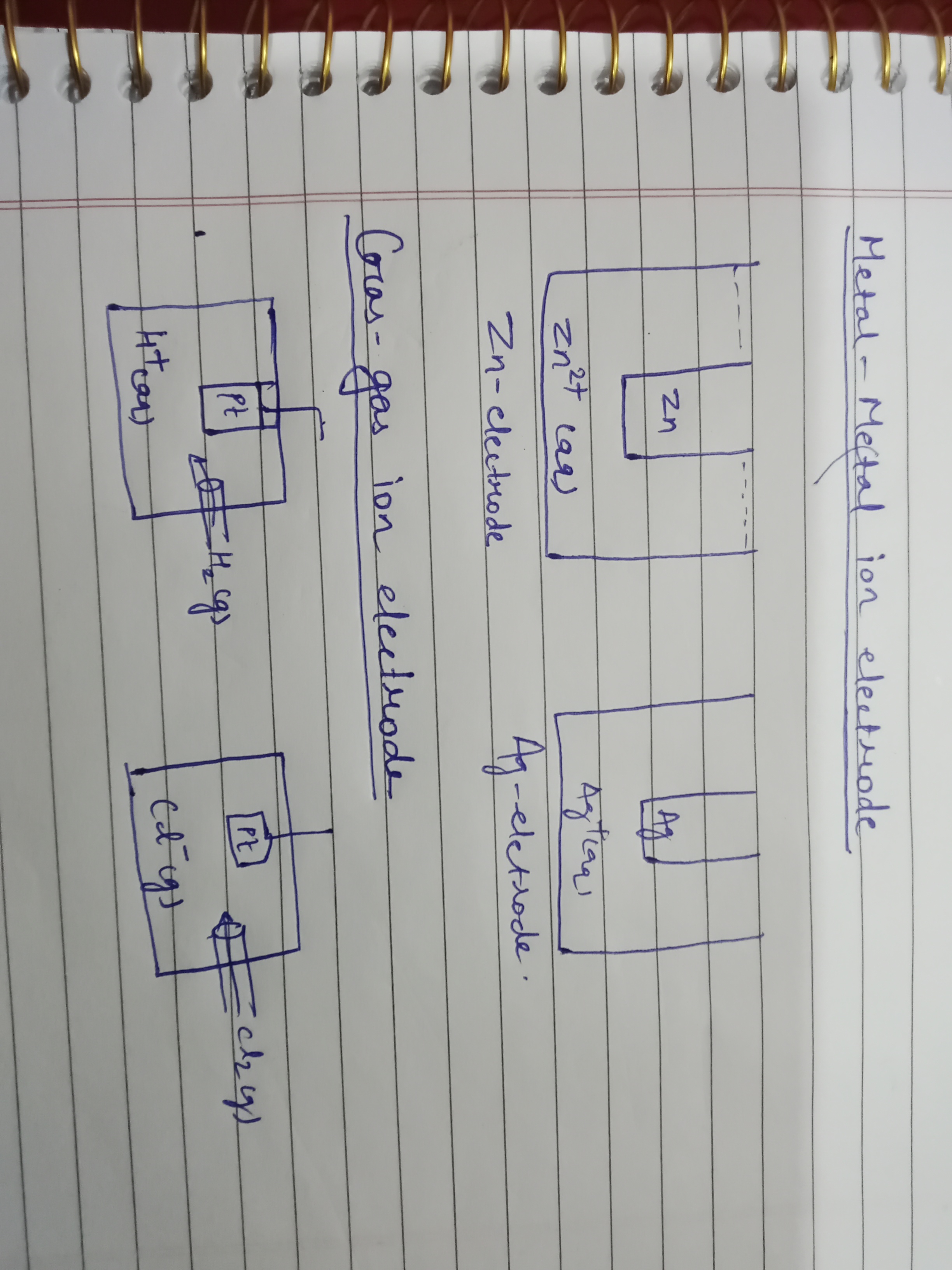
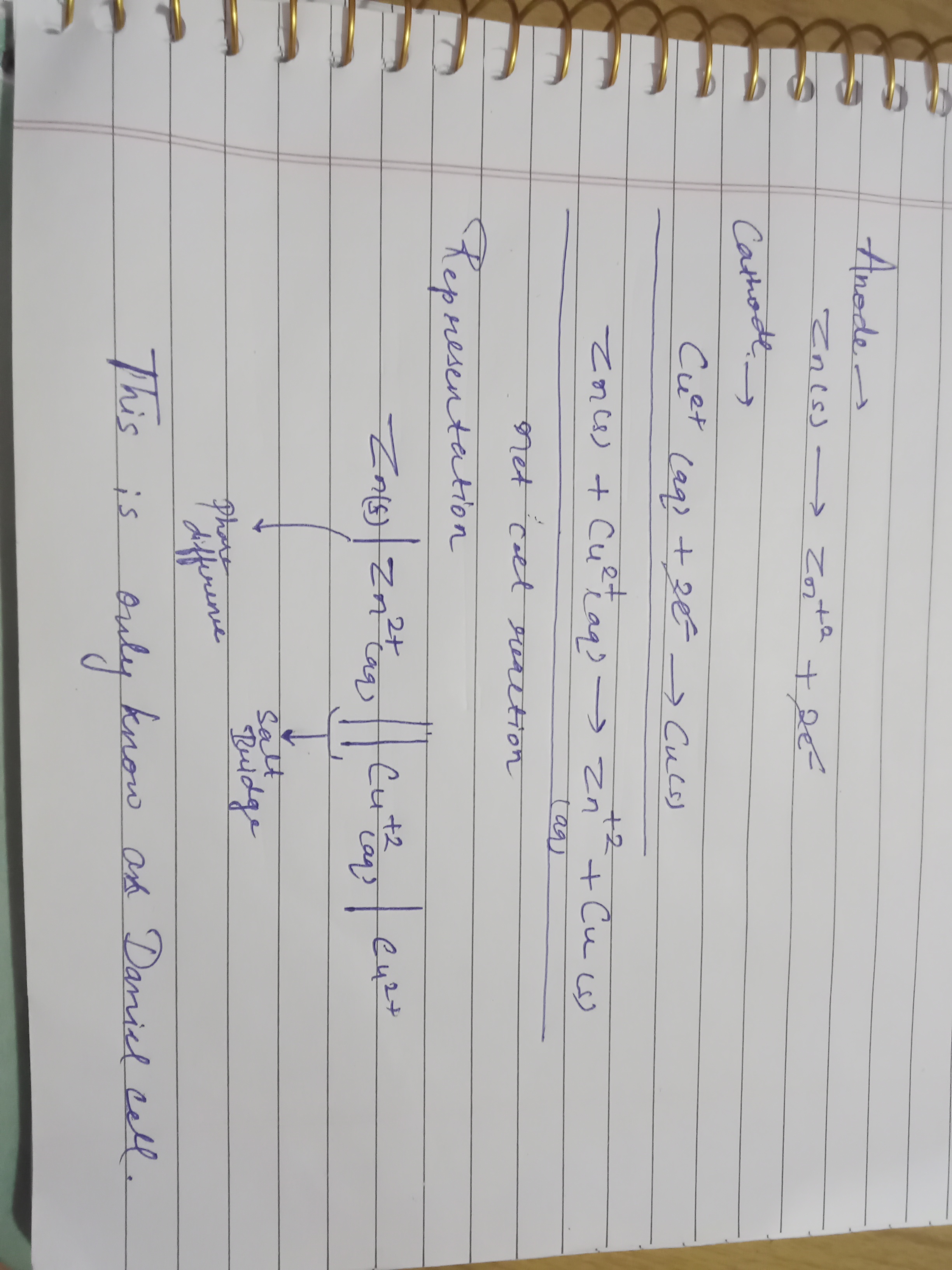
those devices in which certain chemical reaction occur and current is generated that is chemical energy gets converted into electrical energy
Galvanic cell consists of two electrodes
Electrode is any arrangement which either undergoes oxidation as well as reduction when attached to similar arrangement

Question: In a Galvanic cell, the salt bridge:
Option 1: Does not participate chemically in the cell reaction.
Option 2: Stops the diffusion of ions from one electrode to another.
Option 3: Is necessary for the occurrence of the cell reaction.
Option 4: Ensures mixing of the two electrolyte solutions.
Question: A saturated solution of KNO₃ is used to make a salt bridge because:
Option 1: The velocity of K⁺ is greater than that of NO₃⁻.
Option 2: The velocity of NO₃⁻ is greater than that of K⁺.
Option 3: The velocities of both K⁺ and NO₃⁻ are nearly the same.
Option 4: KNO₃ is highly soluble in water.

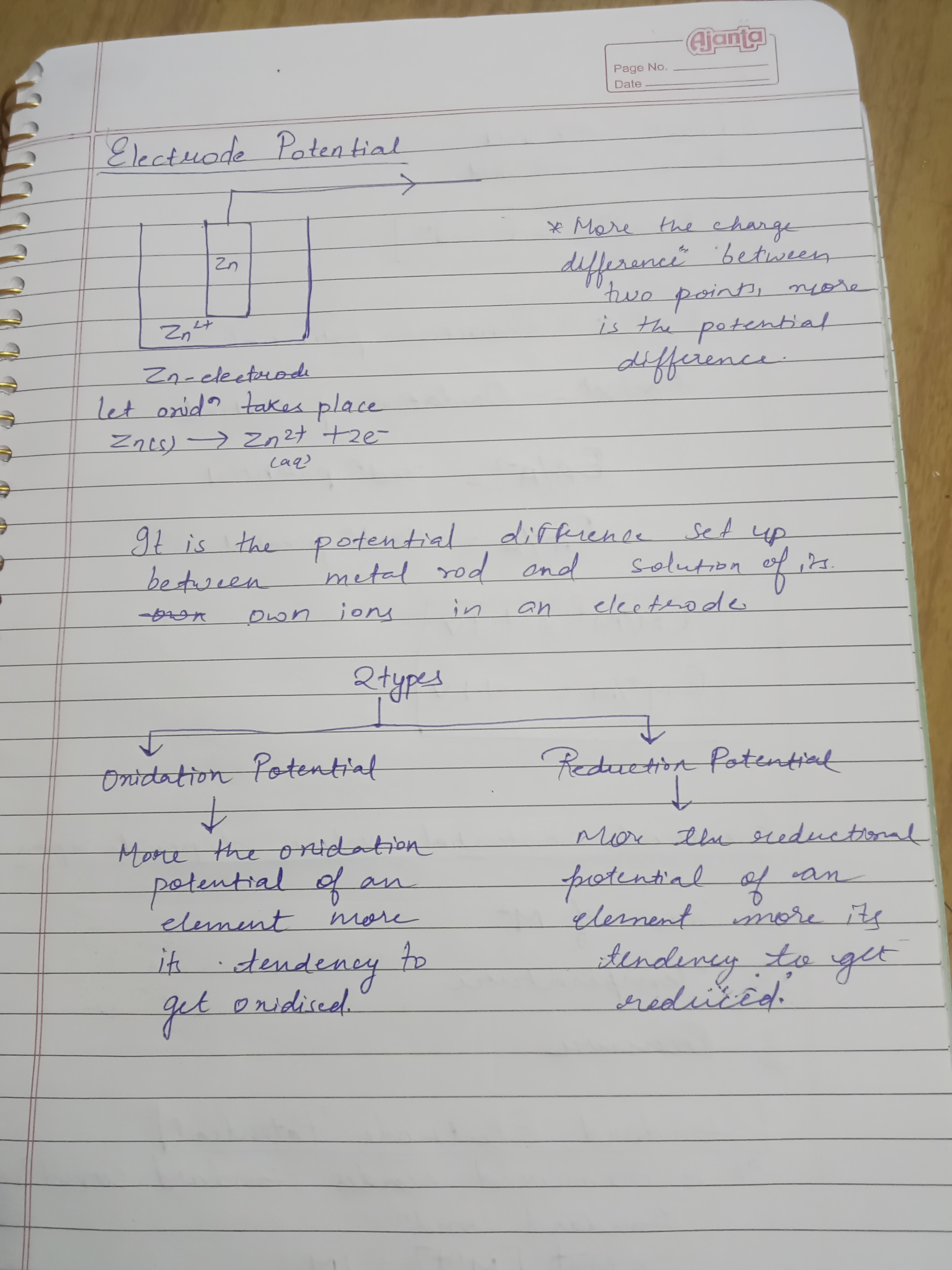


Q1. The standard reduction potentials at 298 K for the following half-cells are given below:
(i) Zn²⁺(aq) + 2e⁻ → Zn(s) E° = −0.762 V
(ii) Cr³⁺(aq) + 3e⁻ → Cr(s) E° = −0.740 V
(iii) 2H⁺(aq) + 2e⁻ → H₂(g) E° = 0.000 V
(iv) Fe³⁺(aq) + e⁻ → Fe²⁺(aq) E° = +0.770 V
Which of the following is the strongest reducing agent?
Option 1: Zn(s)
Option 2: Cr(s)
Option 3: H₂(g)
Option 4: I₂(aq)
Q2. The standard reduction potential values of three metallic cations X, Y and Z are +0.52 V, −3.03 V and −1.18 V, respectively. The order of reducing power of the corresponding metals is:
Option 1: Y > Z > X
Option 2: X > Y > Z
Option 3: Z > Y > X
Option 4: Z > X > Y
Q3. Gas X at 1 atm is bubbled through a solution containing a mixture of 1 M Y⁺ and 1 M Z⁻ at 25°C. Given that the order of reduction potentials is:
E°(Z/Z⁻) > E°(Y⁺/Y) > E°(X⁺/X)
Which of the following statements is correct?
Option 1: Y will oxidize X and not Z.
Option 2: Y will oxidize Z and not X.
Option 3: Y will oxidize both X and Z.
Option 4: Y will reduce both X and Z.
Q4. The standard reduction potentials of the following half-cells are given below:
(i) Zn²⁺ + 2e⁻ → Zn(s) E° = −0.76 V
(ii) Ca²⁺ + 2e⁻ → Ca(s) E° = −2.87 V
(iii) Mg²⁺ + 2e⁻ → Mg(s) E° = −2.36 V
(iv) Ni²⁺ + 2e⁻ → Ni(s) E° = −0.25 V
The reducing power of the metals increases in the order:
Option 1: Ca < Zn < Mg < Ni
Option 2: Ni < Zn < Mg < Ca
Option 3: Zn < Mg < Ni < Ca
Option 4: Ca < Mg < Zn < Ni
Q5. Given that the standard electrode potentials are:
(i) O₂/H₂O = +1.23 V
(ii) S₈²⁻/SO₄²⁻ = +2.05 V
(iii) Br₂/Br⁻ = +1.109 V
(iv) Au³⁺/Au = +1.40 V
The strongest oxidizing agent is:
Option 1: Br₂
Option 2: S₈²⁻
Option 3: Au³⁺
Option 4: O₂
Q6. The standard reduction potentials at 298 K for the following half-cells are given below:
(i) NO₃⁻ + 4H⁺ + 3e⁻ → NO(g) + 2H₂O
E° = +0.97 V
(ii) V²⁺(aq) + 2e⁻ → V(s)
E° = −1.19 V
(iii) Fe³⁺(aq) + 3e⁻ → Fe(s)
E° = −0.04 V
(iv) Zn⁺(aq) + e⁻ → Zn(s)
E° = +0.80 V
(v) Au³⁺(aq) + 3e⁻ → Au(s)
E° = +1.40 V
The number of metals that will be oxidized by NO₃⁻ in aqueous solution is ______.
Q7. For the electrochemical cell:
M | M²⁺ || X²⁻ | X
If the standard electrode potential for M²⁺/M is +0.46 V and the standard electrode potential for X/X²⁻ is +0.34 V, which of the following statements is correct?
Option 1: E°cell = 0.00 V
Option 2: M + X → M²⁺ + X²⁻ is a spontaneous reaction.
Option 3: M²⁺ + X²⁻ → M + X is a spontaneous reaction.
Option 4: E°cell = 0.80 V

Electrochemical series
It is the ordered arrangement of different elements or electrodes in decreasing or increasing order of their standard electrode potentials
Q1. The standard electrode potential of Ag⁺/Ag is +0.8 V, and the standard electrode potential of Zn/Zn²⁺ is +0.7 V. Calculate the standard EMF of the cell formed by combining these two electrodes.
Options:
(A) 0.1 V
(B) 1.5 V
(C) 1.6 V
(D) None of the above
Q2. The standard electrode potential of Cu/Cu²⁺ is −0.34 V, and the standard electrode potential of Mn/Mn²⁺ is +0.1 V. Calculate the standard EMF of the cell formed by combining these two electrodes.
Options:
(A) 0.44 V
(B) 0.24 V
(C) 0.5 V
(D) None of the above
Q3. The standard electrode potential of Cu²⁺/Cu⁺ is +0.4 V, and the standard electrode potential of Cu⁺/Cu is +0.1 V. Calculate the standard electrode potential of Cu²⁺/Cu.
Q1. Given that the standard electrode potentials of Cu²⁺/Cu and Cu²⁺/Cu⁺ are 0.34 V and 0.52 V, respectively, the standard electrode potential of Cu²⁺/Cu⁺ is:
(A) −0.15 V
(B) 0.12 V
(C) 0.18 V
(D) −0.18 V
Q2. In an electrochemical reaction involving lead at standard temperature, the standard electrode potentials are E°(Pb²⁺/Pb) = M V and E°(Pb⁴⁺/Pb) = N V. The standard electrode potential E°(Pb⁴⁺/Pb²⁺) is given by M − XN. The value of X is ______.
Q3. For the given reactions:
Sn²⁺ + 2e⁻ → Sn
Sn⁴⁺ + 4e⁻ → Sn
The standard electrode potentials for the above reactions are −0.140 V and +0.010 V, respectively. The magnitude of the standard electrode potential for Sn⁴⁺/Sn²⁺ is ______ × 10⁻² V.


Q1. Calculate the reduction potential of an Ag electrode containing a 0.01 M AgNO₃ solution, given that the standard electrode potential of Ag⁺/Ag is +0.8 V.
Options:
1. 0.70 V
2. 0.74 V
3. 0.34 V
4. None of these
Q2. Calculate the electrode potential of Zn/Zn²⁺ if the electrode contains a 0.01 M ZnSO₄ solution. The standard electrode potential of Zn²⁺/Zn is −0.7 V.
At 298 K, the standard reduction potential for the Cu²⁺/Cu electrode is 0.34 V. Given that Ksp of Cu(OH)₂ is equal to 1 × 10⁻²⁰ and 2.303 RT/F = 0.059 V, the reduction potential at pH = 14 for the above couple is x × 10⁻² V. The value of x is ______.
Assume the following reaction:
Cu(s) + 2Ag⁺ (concentration = 1 × 10⁻³ M) → Cu²⁺ (concentration = 0.250 M) + 2Ag(s)
The standard electrode potential of the cell is 2.97 V. The standard electrode potential for the above reaction is _____ V.
Given: log 2.5 = 0.3979 and temperature = 298 K.
Q1. Assume a cell with the following reaction:
Cu(s) + 2Ag⁺ (concentration = 1 × 10⁻³ M) → Cu²⁺ (concentration = 0.250 M) + 2Ag(s)
The standard electrode potential for the cell is 2.97 V. The standard electrode potential for the above reaction is _____ V.
Given: log 2.5 = 0.3979 and temperature = 298 K.
Q2. The hydrogen electrode is dipped in a solution of pH = 3 at 25°C. The potential of the electrode will be _____ × 10⁻² V.
Given: 2.303 RT/F = 0.059 V.
Q3. At 298 K, the standard electrode potential for the Cu²⁺/Cu electrode is 0.34 V. Given Ksp [Cu(OH)₂] = 1 × 10⁻²⁰ and 2.303 RT/F = 0.059 V, the reduction potential at pH = 14 for the given couple is _____ × 10⁻² V. The value of x is _____.
Q4. Consider the cell:
Pt(s) | H₂(g, 1 atm) | H⁺(aq, 1 M) || Fe³⁺(aq), Fe²⁺(aq) | Pt(s)
The potential of the cell is 0.712 V at 298 K. The ratio [Fe²⁺]/[Fe³⁺] is _____ (nearest integer).
Given:
Fe³⁺ + e⁻ → Fe²⁺
Standard electrode potential, E°(Fe³⁺/Fe²⁺) = 0.771 V
2.303 RT/F = 0.06 V.
Q5. The cell potential for the cell involving Zn²⁺/Zn and Sn²⁺/Sn is 0.801 V at 298 K. The reaction quotient of the above reaction is 10⁻². The number of electrons involved in the given electrochemical cell reaction is _____.
Given:
Standard electrode potential, E°(Zn²⁺/Zn) = −0.763 V
Standard electrode potential, E°(Sn²⁺/Sn) = −0.008 V
2.303 RT/F = 0.06 V.
The equilibrium constant for the reaction:
Zn(s) + Sn²⁺(aq) → Zn²⁺(aq) + Sn(s)
is 1 × 10²⁰ at 298 K. The magnitude of the standard electrode potential of Sn²⁺/Sn, if the standard electrode potential of Zn²⁺/Zn is equal to −0.76 V, is _____ × 10⁻² V.
Given: 2.303 RT/F = 0.059 V.
The cell potential for the given cell at 298 K,
Pt | H2(g, 1 bar) | H+(aq) || Cu2+(aq) | Cu(s)
is 0.31 V. The pH of the acidic solution is found to be 3, whereas the concentration of Cu2+ is 10^(-x) M. The value of x is _____.
Given: E°(Cu2+/Cu) = 0.34 V and 2.303RT/F = 0.06 V.


Battery
The no. of galvanic cells connected in series constitute a battery
These are of two types
Primary cell
Which cannot be recharged
Have to be discarded after single use
Eg Dry cell Mercury cell
Secondary cell
Which can be recharged again and again
Eg lead storage battery
Nickel cadmium cell
A different type of cell known as fuel cell
DRY CELL
construction
Anode


