Heart Block
 Call Kai
 Learn
 Practice Test
 Spaced Repetition
 Match
 Flashcards
 Knowt Play
1/18

There's no tags or description
Looks like no tags are added yet.
19 Terms
How does 1st degree heart block show on an ECG?
PR interval of over 200ms (5 small squares)

When is 1st degree heart block ‘marked’?
When the PR interval is longer than 300ms (7.5 small squares)
What can marked 1st degree block lead to?
Heart failure in the long term
What can cause 1st degree heart block?
enhanced vagal tone, post MI, myocarditis, electrolyte imbalances, medication such as beta-blockers
What is the management of 1st degree block?
No action needed unless symptomatic or marked
If marked, refer to GP
What are the types of 2nd degree heart block?
Mobitz 1 and Mobitz 2
What is Mobitz 1 also called?
Wenckebach
How does Mobitz 1 show on an ECG?
progressive prolongation of the PR interval until the impulse is not conducted and a QRS is dropped
What can cause Mobitz 1?
increased vagal tone, inferior MI, myocarditis, cardiac surgery, drugs such as beta-blockers/calcium channel blockers
What are symptoms of mobitz 1?
Usually asymptomatic
May present with bradycardia, pre-syncope, and syncope
What is the management for Mobitz 1?
convey if symptomatic and/or bradycardic
refer to GP if history of cardiac disease
How does Mobitz 2 show in an ECG?
intermittent non-conducted P waves without progressive prolongation of the PR interval, typically following a cycle of every 3rd or 4th p wave

What can cause Mobitz 2?
Structural damage to the conduction system such as MI, fibrosis, cardiac surgery
Or myocarditis, electrolyte imbalance, drugs such as beta-blockers
What is the risk of Mobitz 2?
Progression to third degree block or asystole
What is the management of Mobitz 2?
conveyance
How does 3rd degree block show on an ECG?
Independent atrial and ventricular contractions
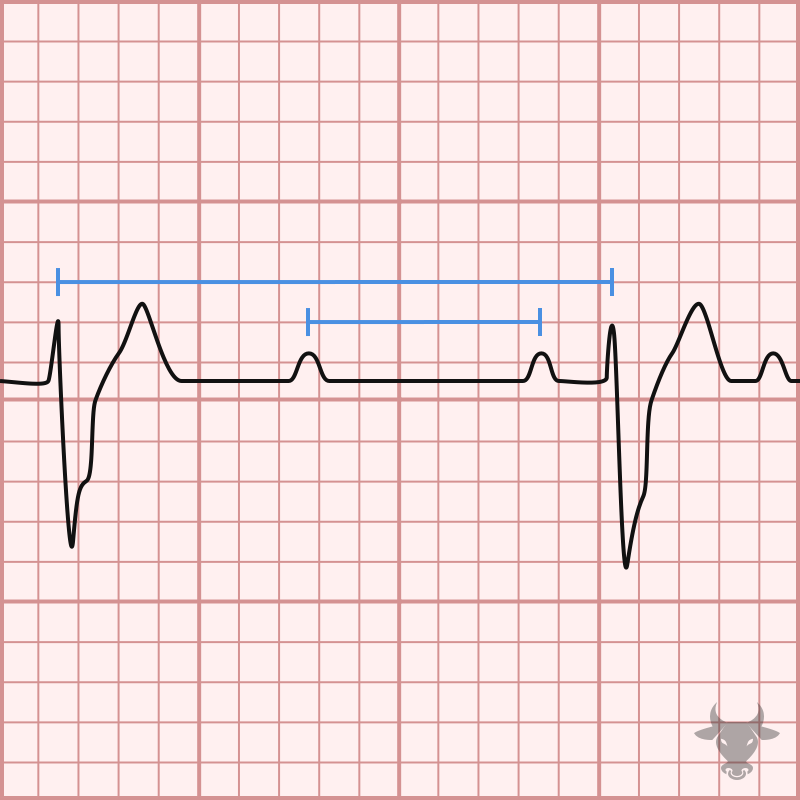
What can cause 3rd degree block?
inferior MI, AV nodal blocking drugs, idiopathic degeneration of the conducting system
What is the risks of third degree block?
high risk of ventricular standstill and sudden cardiac death
What is the management of third degree block?
urgent coveyance