CH 6 AXIS
 Call Kai
 Learn
Learn Practice Test
 Spaced Repetition
 Match
Match Flashcards
 Knowt Play
1/50

There's no tags or description
Looks like no tags are added yet.
Name | Mastery | Learn | Test | Matching | Spaced | Call with Kai | Chat |
|---|
No analytics yet
Send a link to your students to track their progress
51 Terms
What are the two main divisions of the skeleton?
Axial skeleton and appendicular skeleton.

How many bones are in the human skeleton?
206 separate bones.
How many bones are in the axial skeleton?
80 bones.
What bones make up the axial skeleton?
Skull bones, auditory ossicles, hyoid, vertebral column, thoracic cage.

What bones make up the appendicular skeleton?
Limbs, pectoral girdle, pelvic girdle.
How many individual bones are in the face?
14 individual bones.
How many individual bones are in the cranium?
8 individual bones.
How many associated bones are there in the skull?
7 individual bones.
What is a suture in the context of the skull?
A suture is made of dense fibrous connective tissue.
What is the lambdoid suture?
The suture between the occipital bone and the two parietal bones.

What is the sagittal suture?
The suture between the two parietal bones.
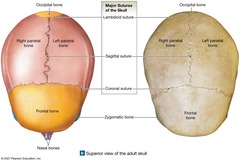
What is the coronal suture?
The suture between the frontal bone and the two parietal bones.

What is the squamous suture?
The suture between the temporal bone and the parietal bone.
What is the frontonasal suture?
The suture between the nasal bones and the frontal bone.
What is the foramen magnum?
An opening in the occipital bone for the spinal cord.

What are the occipital condyles?
Rounded projections on the occipital bone that articulate with the first cervical vertebra.
What is the function of the ethmoid bone?
It forms part of the nasal cavity and contains the cribriform plate for olfactory nerve passage.
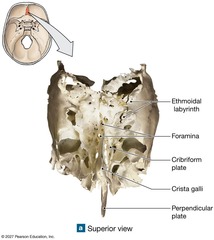
What are the cranial fossae?
Curving depressions in the cranial floor that cradle parts of the brain.

What bones form the anterior cranial fossa?
Frontal bone, ethmoid, and lesser wings of the sphenoid.
What bones form the middle cranial fossa?
Sphenoid, temporal, and parietal bones.
What bones form the posterior cranial fossa?
Primarily the occipital bone, with parts of the temporal and parietal bones.
What is the significance of the maxillae?
Contains the upper teeth and forms part of the bony palate.
What is the role of the palatine bones?
They make up part of the roof of the mouth.
What do the nasal bones articulate with?
The frontal bone.
What are the zygomatic bones?
Bones that articulate with the zygomatic process of the temporal bone.
What forms the zygomatic arch?
The zygomatic bone and the temporal bone.
What is the function of the lacrimal bones?
They are found in the medial portion of the orbit of the eye and contribute to the lacrimal groove leading to the nasolacrimal canal.
What does the vomer bone form?
The inferior portion of the nasal septum.
What are the components of the mandible?
Body, ramus, angle, condylar processes, head, coronoid process, mental foramina, mandibular notch, alveolar part, mylohyoid line, submandibular fossa, mandibular foramen, and mandibular canal.
What mnemonic helps remember the bones of the face?
Virgil Can Not Make My Pet Zebra Laugh! (Vomer, Conchae, Nasal, Maxilla, Mandible, Palatine, Zygomatic, Lacrimal).
How many bones are in the adult vertebral column?
26 bones: 24 vertebrae, 1 sacrum (5 fused vertebrae), and 1 coccyx (3-5 fused vertebrae).
What are the four major curves of the vertebral column?
Cervical curve (secondary), thoracic curve (primary), lumbar curve (secondary), and sacral curve (primary).
What is the function of the spinal curves?
They help maintain balance and align body weight with the body's axis and center of gravity.
What is the vertebral body?
The anterior structure of a vertebra that supports weight along the axis of the body.
What is spina bifida?
A malformation of the vertebral arch where it fails to close completely.
What distinguishes cervical vertebrae?
They have transverse foramen and bifid spinous processes, except for C7 (vertebral prominens).
What is unique about the atlas vertebra?
It articulates with the occipital condyles of the skull and does not have a body.
What is the role of the axis vertebra?
It has a dens that allows the head to move in a 'no' manner.
What are the characteristics of lumbar vertebrae?
They are the largest vertebrae, support the most weight, and have thick, oval-shaped bodies.
What is the structure of the sacrum?
It is composed of five fused vertebrae and includes features like the apex, base, and sacral canal.
What is the coccyx?
It consists of three to five fused vertebrae and points anteriorly in males and inferiorly in females.
What is the thoracic cage's primary function?
To protect the heart, lungs, and thymus, and serve as an attachment site for muscles involved in respiration.
What are true ribs?
Ribs 1-7 that connect directly to the sternum via their own costal cartilage.
What are false ribs?
Ribs 8-12 that do not connect directly to the sternum.
What is the structure of the sternum?
A flat bone composed of three parts: manubrium, body, and xiphoid process.
What is the jugular notch?
A feature of the manubrium that articulates with the clavicles and the costal cartilages of the first pair of ribs.
What is the function of the ribs during breathing?
Ribs move like a bucket handle, increasing the volume of the thoracic cage.
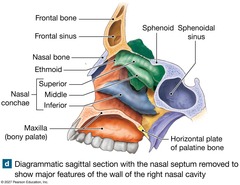
What are the components of the nasal complex?
Anterior nostrils, posterior nasal apertures, nasal septum, vomer, perpendicular plate of the ethmoid, nasal wall, and nasal conchae.
What are paranasal sinuses?
Air-filled chambers that open into the nasal cavity, including frontal, sphenoidal, maxillary sinuses, and ethmoid air cells.

What is the hyoid bone?
A bone suspended by the stylohyoid ligaments that does not articulate with any bones and serves as a point for muscle and ligament attachments.

What are fontanelles?
Membranous areas in the infant skull where sutures will eventually form, allowing for distortion during childbirth.
