BIOL 265-61 Exam 3 Preparation
 Call Kai
 Learn
 Practice Test
 Spaced Repetition
 Match
 Flashcards
 Knowt Play
1/224

Earn XP
Description and Tags
CH20 and CH8: Parts 1-4.
225 Terms
Antibiosis
Inhibition of one microorganism by another.
Antibiotics
Substances produced by microorganisms that inhibit bacteria in small amounts.
Antimicrobial Drugs
A broader term that includes naturally produced antibiotics and synthetic drugs.
Sulfa Drugs (Sulfonamides)
Synthetic antimicrobial drugs that inhibit bacterial folic acid synthesis.
Ex. Prontosil Red (1932) found to control Streptococcal infections in mice.
Streptomyces
Filamentous soil bacteria that produce more than half of useful antibiotics.
Antibiotic Resistance
Occurs when bacteria become less susceptible to drugs that
previously controlled them.
Selective Toxicity
A drug harms the pathogen while causing minimal damage to the human host.
Differences between bacterial cells (prokaryotes) and human cells (eukaryotes):
Cell Wall
Ribosomes
Metabolism
Antifungal, antiprotozoal, and antihelminthic drugs are more difficult to develop because:
They are also eukaryotes and resemble human cells.
Antiviral drugs are also difficult to develop because:
Viruses reproduce inside host cells and use their cellular machinery to produce more viruses.
Narrow-spectrum Antibiotic
Acts against a limited group of microorganisms.
Ex., Penicillin G primarily affects Gram-positive bacteria.
Broad-spectrum Antibiotic
Acts against a wide range of bacteria, including many Gram-positive and Gram-negative species.
Ex., broad-spectrum antibacterial drugs.
Porins
Water-filled channels in the outer membrane, containing lipopolysaccharide (LPS).
Superinfection
Overgrowth of an unaffected microorganism or persistence of an infection due to antibiotic resistance.
Bactericidal
Kill microorganisms directly.
Bacteriostatic
Stop or inhibit microbial growth. The host's immune system (phagocytosis, antibody production) usually eliminates the microorganisms.
Inhibition of Cell Wall Synthesis:
Prevents proper formation of peptidoglycan.
Weakens the cell wall, causing lysis.
Primarily affects actively growing bacteria.
Human cells lack peptidoglycan walls, providing selective toxicity.
Ex. Penicillin.
Inhibition of Protein Synthesis:
Bacterial ribosomes are 70s.
Eukaryotic cytoplasmic ribosomes are 80s.
These differences allow selective toxicity.
Some antibiotics can also affect the host’s mitochondria, which contain bacterial-like ribosomes.
Ex. Chloramphenicol, erythromycin, streptomycin, and tetracyclines.
Injury to Plasma Membrane:
Some polypeptide antibiotics disrupt membrane permeability of Gram (-) bacteria, causing essential metabolites and ions to leak out.
Antifungal Drugs
Bind to sterols in fungal membranes, disrupting membrane function.
Lonophores
Allow uncontrolled movement of cations across membranes.
Inhibition of Essential Metabolite Synthesis: Antimetabolites
Resemble normal enzyme substrates and competitively inhibit metabolic reactions.
Mechanism of action: A competitive inhibitor.
Resembles para-aminobenzoic acid (PABA) (bacteria use it to synthesize folic acid), limiting growth.
Humans obtain folate from ____________.
Diet
Sulfonamides and Trimethoprim (SMZ-TMP)
Blocks two successive steps in bacterial folate metabolism.
Used for selected UTI’s and other susceptible bacterial infections.
Silver Sulfadiazine: Used in burn patients to help prevent or treat infections.
Ergosterol
A major sterol in fungal cell membranes; human cell membranes primarily contain cholesterol.
Penicillins
Natural Penicillins: produced naturally by Penicillium molds.
Semisynthetic Penicillins: produced to improve resistance to β-lactamases or broaden the spectrum.
B-lactam Antibiotic Family
They kill bacteria by binding to penicillin-binding proteins (PBPs) (transpeptidases), which stops the bacteria from building their cell walls and causes them to rupture.
Defined by a core beta-lactam ring in their chemical structure.
β-glucan
An important component of fungal cell walls that is absent from human cells.
High-yield Distinction
Polyenes bind to ergosterol; azoles and allylamines inhibit its synthesis; echinocandins inhibit fungal cell wall synthesis.
Penicillins + Beta-lactamase Inhibitors
Clavulanic acid inhibits certain beta-lactamases and protects the partner penicillin.
Amoxicillin + Clavulanic Acid (Augmentin).
Penicillinase-resistant Penicillins
Beta-lactamases break the beta-lactam ring and inactivate susceptible antibiotics.
Methicillin and oxacillin. Not good against MRSA.
Antiviral Drugs: Acyclovir
Herpesvirus DNA replication.
Antiviral Drugs: Remdesivir
Viral RNA polymerase.
Antiviral Drugs: Oseltamivir
Influenza neuraminidase.
Antiviral Drugs: Nirmatrelvir
SARS-CoV-2 protease.
MRSA (Methicillin-resistant Staphylococcus aureus)
Gram-positive bacterium. Vancomycin specifically targets and kills Gram-positive bacteria.
Metronidazole
Protozoa and anaerobic bacteria.
Praziquantel
Tapeworms and flukes.
Albendazole
Helminth microtubules
Ivermectin
Paralysis of susceptible parasites.
Isoniazid (INH)
Inhibits mycolic acid synthesis. Important TUBERCULOSIS DRUG.
Note: Tuberculosis is treated with multiple drugs to reduce the development of resistance. An example of one that would be combined with others is Ethambutol.
Aminoglycosides
30S; mRNA misreading.
Tetracyclines
30S; block tRNA attachment.
Glycylcyclines
30S; block protein synthesis and resist certain efflux mechanisms.
Pleuromutilins
Ribosome; interfere with protein synthesis.
Antimicrobial susceptibility testing helps determine _____________________________________________________.
Which drug is most likely to inhibit or kill a specific pathogen.
MIC (Minimum Inhibitory Concentration)
The lowest concentration of an antimicrobial drug that prevents visible microbial growth under defined test conditions.
MBC (Minimum Bactericidal Concentration)
The lowest concentration of an antimicrobial drug that kills a defined proportion of the original bacterial population (at least 99.9%).
Disk Diffusion (Kirby-Bauer)
Classifies susceptibility using zone diameter.
Muller-Hinton Agar medium is inoculated with a microorganism → antimicrobial discs are placed on the surface → incubate → measure the diameter → Resistant, Intermediate, Susceptible.
E Test
Uses an antibiotic gradient strip to estimate the MIC, read from the scale at the point where the edge of the inhibition ellipse intersects the strip.
Genetic Tests
Detect specific resistance genes but cannot rule out all other resistance mechanisms or directly provide an MIC.
Beta-lactamase
Enzymes that can inactivate beta-lactam antibiotics by opening their beta-lactam ring.
Antibiogram
A report of antimicrobial population-level susceptibility patterns in a healthcare institution.
How does resistance develop?
Antibiotic Exposure
Resistant Bacteria Survive
Natural Selection
Resistant Population Increases
Vertical Gene Transmission
Genetic mutation is already present → Binary fission → Offspring inherit the resistance trait.
Horizontal Gene Transfer
Conjugation: DNA is transferred via cell-to-cell contact.
Transduction: Bacteriophage transfers DNA from one cell to another.
Transformation: Bacterium takes up DNA from environment.
Resistance genes may be carried on through the following:
Plasmids: Small independent DNA molecule that can carry resistance genes.
Transposons: DNA segments that can move from one location to another within DNA molecules.
Enzymatic Destruction or Inactivation
Bacteria produce enzymes that destroy or chemically modify the antibiotic, making it ineffective.
Prevention of Drug Entry:
Changes in the bacterial envelope or porin channels prevent sufficient antibiotic from entering the cell.
Alteration of the Drug's Target Site
The antibiotic can no longer bind effectively to its target, so the bacterium continues functioning.
Active Efflux
Membrane proteins pump the antibiotic out of the cell before it can reach an effective concentration.
Superbugs
Microorganisms resistant to multiple antimicrobial drugs.
Important examples include:
MRSA
Acinetobacter Baumannii
Pseudomonas Aeruginosa
Enterobacteriaceae
Therapeutic Benefit
The drug reaches a level sufficient to treat the infection.
Polymyxin B
Binds to the gram-negative outer membrane and disrupts membrane integrity.
Polymyxin E (Colistin)
Disrupts gram-negative bacterial membranes.
Triclosan
Inhibits bacterial fatty acid synthesis.
Isoniazid
Inhibits mycolic acid synthesis.
Potential Toxicity
The drug may cause harmful effects if its concentration, exposure, or individual susceptibility creates excessive risk.
Synergism
Drugs work together to enhance the effect.
Antagonism
One drug interferes with another drug's effect.
Childhood Development
Children may respond differently to medications than adults, and certain antibiotics can affect their development.
(i.e., Tetracyclines and permanent tooth discoloration).
Side Effect
An unintended effect of a medication that occurs in addition to its desired therapeutic effect.
Toxicity
The capacity of a substance to cause harm.
Hypersensitivity Reaction
An excessive or inappropriate immune response to a substance, including a medication.
Drug Interaction
A situation in which one drug changes the effect, concentration, or toxicity of another.
Therapeutic Index
A measure of the relationship between a drug's effective dose and its toxic dose.
Contraindication
A condition or circumstance in which a particular treatment should not be used, or should be used only under specific precautions.
Genome
The complete genetic information of a cell, including its chromosomes and plasmids.
Genomics
The study and sequencing of genomes
Chromosome
A DNA structure that carries hereditary information.
Gene
A segment of DNA that encodes a functional product, usually a protein or a functional RNA molecule.
Gene Expression
The process by which information in a gene is used to produce a functional product.
Central Dogma- the central dogma describes the usual flow of genetic information:
DNA: Stores hereditary information.
mRNA: Transcription- DNA information is copied into RNA.
Protein: Translation- RNA information is decoded into an amino acid chain.
Cellular Function: Metabolism, structure, growth, and other activities.
Inducible Operon
Usually switched on when a specific inducer is present. It commonly controls pathways for catabolism.
Repressible Operon
Usually active but switched off when a particular corepressor or end product is present. It commonly controls pathways for anabolism.
______________________ determines a cell's potential characteristics, but ______________________ determines when and how that information is expressed.
Genetic Information; Gene Regulation
DNA is composed of repeating units called nucleotides, each containing:
Nitrogenous Base:
Adenine (A)
Thymine (T)
Cytosine (C)
Guanine (G)
Deoxyribose Sugar
Phosphate Group
A–T pairs through _________ bonds.
Double (2 Hydrogen)
C–G pairs through _________ bonds.
Triple (3 Hydrogen)
The strands are complementary and antiparallel:
One strand’s base sequence determines the other.
The base sequence stores genetic information.
Complementary base pairing allows DNA to copy itself accurately.
Genetic Code
The rules by which nucleotide sequences determine amino acid sequences in proteins.
Bacterial genomes may also contain plasmids, _________________________________________________________.
Small DNA molecules that replicate independently of the chromosome.
Short Tandem Repeats (STRs)
Repeated sequences of 2–5 bases that can be used in genetic identification and testing.
Open Reading Frame (ORF)
A DNA region potentially encoding a protein, generally identified by its start and stop codons.
Genotype
Genetic information an organism possesses.
Represents genetic potential. Includes genes that may or may not be active.
Phenotype
Characteristics that are physically expressed and observable.
Represents the observable or functional result. Depends on gene expression and other influences.

Replication- Vertical Gene Transfer
DNA is copied before cell division. Each daughter cell receives a chromosome derived from the parent cell.
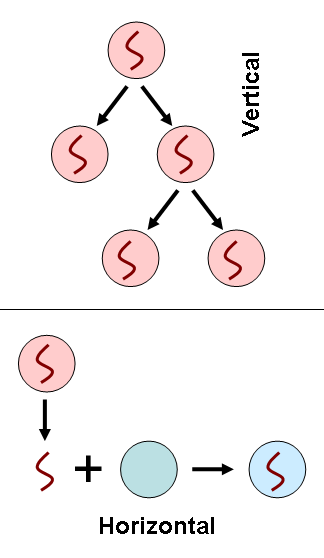
Recombination- Horizontal Gene Transfer
Genetic material is acquired or exchanged between cells, creating new combinations of genes.
Replication is ____________________: each daughter DNA molecule contains one original parental strand and one newly synthesized strand.
Semiconservative
Why is semiconservative replication important?
Each original DNA strand serves as a template for the synthesis of a complementary strand. This preserves the original genetic information and supports accurate inheritance during cell division.