Viral Hepatitis
 Call Kai
 Learn
 Practice Test
 Spaced Repetition
 Match
 Flashcards
 Knowt Play
1/66

There's no tags or description
Looks like no tags are added yet.
67 Terms
what is
Hepatitis
inflammation of the liver tissue
Major causes of hepatitis (5)
infectious (bacteria, parasites, viruses
metabolic (alcohol, toxins, drug-induced, herbal or dietary supplements)
autoimmune (genetic predisposition, association with HLA antigens, auto-antibodies)
genetic (α-1 antitrypsin deficiency, hemochromatosis, Wilson’s disease)
ischemic (shock, heart failure, or vascular insufficiency)
what are Three types of hepatitis (based on clinical pattern)
● Acute hepatitis: infection then recovery (eg HAV)
● Fulminant hepatitis: massive hepatic cell death,
rare, life-threatening (eg HBV)
● Chronic hepatitis: after acute phase, >6 months
what are the Different types of viral hepatitis
A
B
C
D
E
Characteristics of different types of viral hepatitis
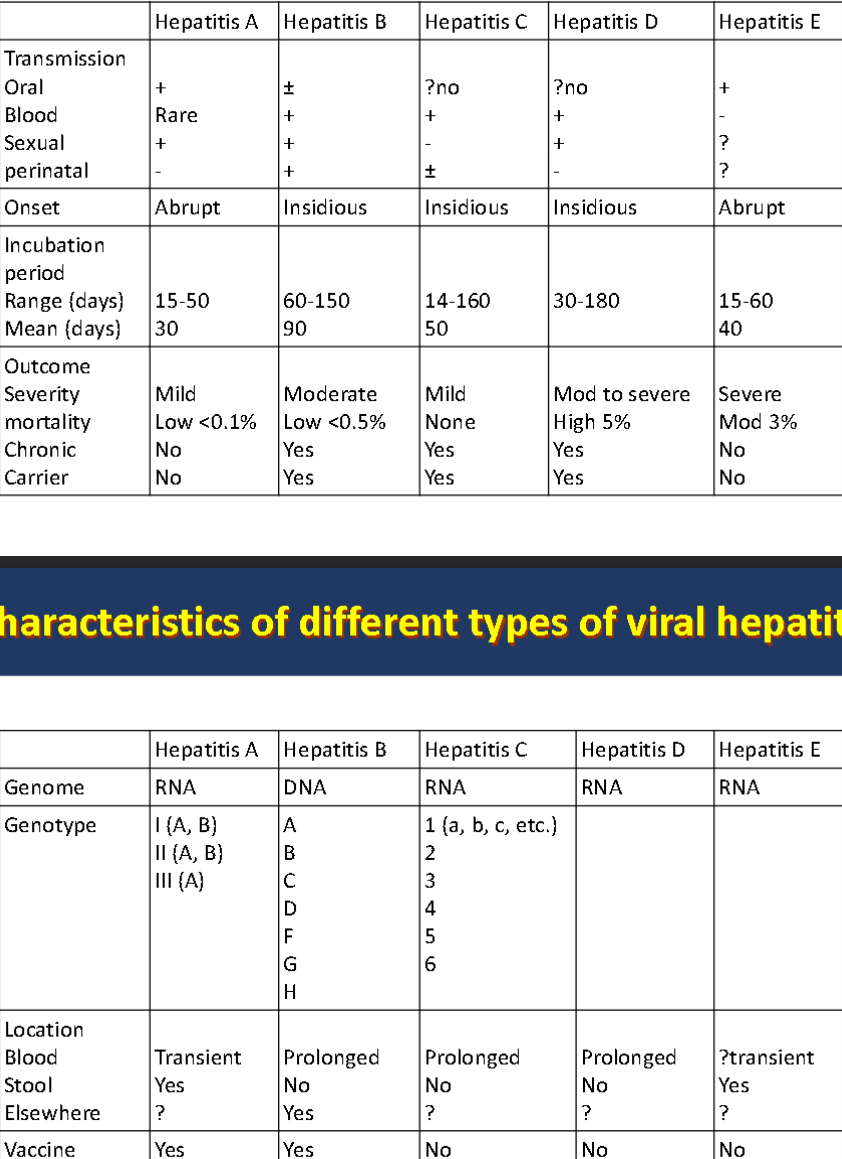
what is Viral Hepatitis A
● A small non-enveloped RNA- containing virus
● It contains a positive-sense, single-strand of RNA packaged in a protein shell
what family does Viral hepatitis A belong to?
belongs to Picornavirus family
how stable is viral hepatitis A
● Stable in environment for at least one month
● Inactivation: heat foods (≥85°C (185°F); 1 min) or disinfect with bleach (1:100 dilution in water)
how does hepatitis infection usually begin what can it lead to
● Hepatitis A infection is usually a benign, self-limiting disease
● It can cause fulminant hepatitis and hepatic failure leading to death (not common)
how can you get infected by hepatitis A
● fecal-oral route
● direct: person-to-person
● indirect:
what is the indirect route?
- water/food ingestion, contaminated with fecal
material of infected person (even microscopic amount)
- drinking contaminated milk, water, shellfish from
infected waters
Populations at high risk for HAV infection
● Anyone who has not been vaccinated or previously infected
can get infected with HAV.
● In areas where the virus is widespread (high endemicity),
most HAV infections occur during early childhood.
Risk factors include
● Travelling to areas of high endemicity without being immunized (44-55% cases in Canada linked to travel)
● Poor sanitation; lack of safe water supply
● Living in a household with an infected person
● Use of recreational drugs
● sexual partner of someone with acute hepatitis A;
oral/anal sexual contact
● Inmates in prisons or jails
Clinical presentations of acute hepatitis A
● may be asymptomatic (age <5 years)
● non-specific flu-like symptoms (fever, fatigue, malaise, anorexia)
● nausea, vomiting, diarrhea
● dark urine, pale stool
● pruritus, abdominal pain
● jaundice: skin, eyes (scleral icterus)
● fulminant hepatitis (rare)
● full recovery <2 months (up to 9 months)
Signs and symptoms of hepatitis A
Pre-icteric phase - Nonspecific flu-like symptoms consisting of anorexia, nausea, fatigue, and malaise
Acute illness - Abrupt onset of anorexia, nausea, vomiting, malaise, fever, headache, and right upper quadrant abdominal pain with acute illness
Icteric hepatitis - Generally accompanied by dark urine, acholic (light- colored) stools, worsening of systemic symptoms, pruritus is often a major complaint of icteric patients
what Laboratory tests can you do to diagnose acute hepatitis A
● positive serum anti-HAV (IgM, IgG)
● ↑ serum bilirubin (mild)
● ↑ liver enzymes
● total bilirubin in patients with cholestatic illness
what liver enzymes?
– alanine transaminase (ALT); aspartate transaminase (AST)
– alkaline phosphatase (ALP); γ-glutamyl transferase (GTT)
what Physical examination help diagnose of acute hepatitis A
● icteric sclera, skin, and secretions
● mild weight loss (2-5 kg)
● hepatomegaly
how can you prevent hepatitis A
● Washing hands before eating and drinking
● Avoid contaminated food and water
● Avoid uncooked foods, shellfish and salads
● Avoid unpasteurized dairy products
● Avoid food from street vendors
● Avoid swimming, wading, bathing or washing cloths
in polluted or contaminated water
when are HAV vaccines recommended

what are two HAV vaccination and what age can you take them
Havrix - 1-18 ≥19
Vaqta - 1–18 ≥19
how can you treat Hepatitis A
● Typically, no specific treatment is needed
● Symptoms are usually resolved within 2 months
● Almost all patients recover within 6 months (up to 9 months in some patients)
what are possible complications of Hepatitis A
● relapsing hepatitis
● cholestatic hepatitis
● fulminant hepatitis
what is the strucutre of Hepatitis B virus
● HBV has a circular, partially double-
stranded DNA
● Along with DNA polymerase
contained in an inner nucleocapsid
surrounded by an outer envelope
what family is hepatitis B part of
It is a prototype virus of the
Hepadnaviridae family
● A small DNA virus with unusual
features similar to retroviruses
what does HBV mainly infect and where else can it be found
● Infects mainly hepatocytes but it is also found in kidney,
pancreas and mononuclear cells
whats the immune resposne to HBV
● Immune response to the virus is cytotoxic to hepatocytes
(elevated ALT due to destruction of hepatocytes)
● Antigen non-specific inflammatory responses are
triggered by T cells
● Includes MHC class I CD8 cytotoxic T cells and class II CD4
T-helper cells
what is Cytotoxic T cells so significant in the respnse?
Cytotoxic T-cell response is important for viral clearance
___ immune response: more likely to develop ____
Weak immune response, more likely to develop chronic infection
Epidemiology & prevalence of HBV

what type of infection can HBV cause
HBV can cause both acute and chronic infection
HBV is a It is a leading cause of ___, ____, and ____ worldwide
chronic hepatitis
liver cirrhosis
cancer
who is most at risk of developing HBV
● Risk of development of chronic HBV is higher in children
● About 90% of children infected during or shortly after birth develop chronic HBV
● Risk of chronic HBV if infected at age of ≥5 years is <10%
what symptoms are possible with HBV
● Most patients with chronic HBV have no symptoms
● About 25% of patients with chronic HBV eventually develop cirrhosis and liver cancer
how is HBV transmitted
HBV is transmitted mainly by contact with contaminated blood, blood products, and other body fluids (e.g. semen)
what are the major routes of transmission
Percutaneous or mucosal contact with infected body fluids
Percutaneous insertion
Perinatal infection
Sexual contacts (most common source reported in MB)
what type of body fluids?
high concentration in blood and serum
- moderate in semen/vaginal fluid
- saliva (kiss: unlikely; damaged skin)
what does Percutaneous insertion mean
- IV drug use, tattoos, acupuncture, body piercing
- health care workers (accidental needlestick)
what is
Perinatal infection?
- HBV+ mother to newborn during delivery; 10-85%
- infected infants: 90% risk of being chronic carriers
Clinical presentation depends on?
age at which the first infection occurs
- immune system response to the virus
Children ____ and newly infected _____ adults are usually ____
Children <5 years and newly infected immunosuppressed adults are usually asymptomatic
About ____ of infected patients _____ have signs/symptoms
About 30-50% of infected patients >5 years have signs/symptoms
Signs and symptoms of HBV infection
• fever
• fatigue
• loss of appetite
• joint pain
• nausea, vomiting
• abdominal pain
• jaundice
• dark urine
• clay-colored stool
how can you prevent Hepatitis B
HBV vaccination
• Provides long-term protection
what does the CDC recommends vaccination for
• all children <19 years
• high risk individuals (HIV, injection drug users, etc)
• household contacts and sex partners of persons with
chronic HBV infection
• healthcare/public safety workers (exposure to blood)
• international travelers who plan to spend >6 months
in countries with ↑HBV rate (close contact with local)
• recipients of clot factor concentrates, dialysis patients
how many HBV vaccines exist
• Recombivax HB (Merck)
• Engerix-B (GSK)
• Genevac B (Serum Institute)
• Shanvac B (Sanofi)
• Twinrix (against HAV and HBV)
which route are vaccines given and how many doses are given
• These vaccines are given by intramuscular route
• Three doses at different time intervals based on age
what is the treatment goal of HBV
Minimize further liver damage and prevent progression
of liver disease (cirrhosis, cancer)
Prevent transmission to others
Achieve sustained suppression of HBV replication an
increase chances for seroclearance
is their a cure for HBV?
• No cure because virus integrates into the cell genome
• Treatments do not cure HBV but control the virus to prevent further damage to liver
Treatment strategies for HBV infection
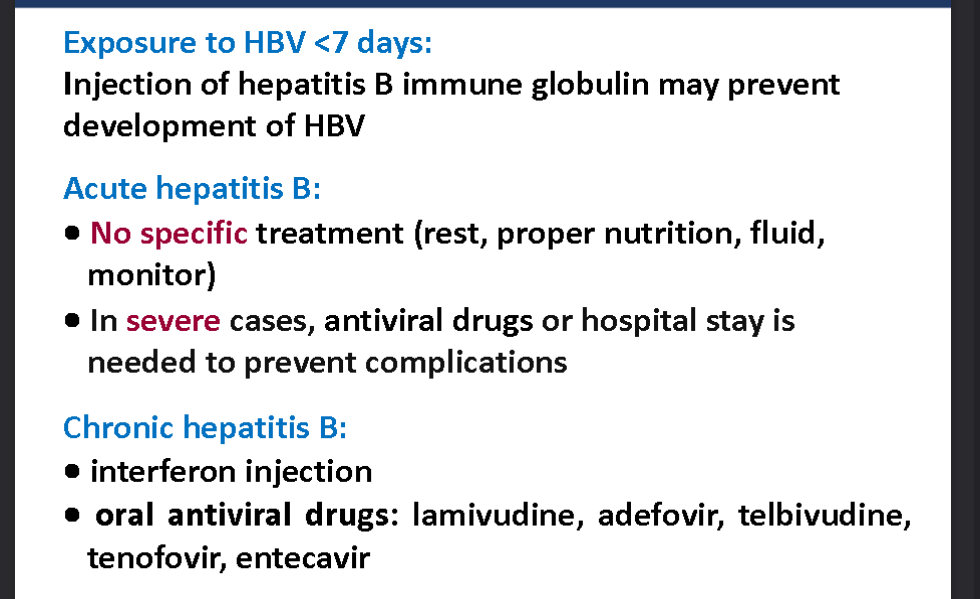
what is HBC, what is its incubation period?
HBC is a single stranded RNA virus with various genotypes
Incubation period: 50 days (14-160 days)
___ infection ___ or ___ symptoms
Initial infection mild or no symptoms
Most people with chronic HBC are ____
asymptomatic
About ___ of those exposed to HCV develop ____ infection
About 80% of those exposed to HCV develop chronic
infection
Viral hepatitis C is the most common cause of what condition?
Most common cause of chronic hepatitis, cirrhosis,
hepatocellular carcinoma
does HVC have a vaccine
Currently no vaccine against HCV
Transmission of HCV

Clinical presentation of HCV infection
No clinical symptoms
May have fatigue, lethargy, nausea, reduced appetite, abdominal pain, jaundice
In about 25% of HCV infected patients, ______
In about 25% of HCV infected patients, virus disappears
on its own (no longer infected)
In about 75% of HCV infected patients, ____
In about 75% of HCV infected patients, virus remains >6 months (chronic HCV
features of Chronic HCV
- 75% of patients: mild/moderate liver damage over time
- 25% of patients: may lead to serious problems over
time (25-30 yrs) such as cirrhosis, liver failure, cancer
Laboratory tests for diagnosis of HCV
Hepatitis C antibody
Hepatitis C RNA test (if antibody is positive)
HCV genotyping
what is Hepatitis C antibody
• Negative: not infected with HCV
• Positive: infected with HCV in past but does not tell you:
- if infection is new
- how long patient has had infection
- if infection is still present
what does neg and pos result of Hepatitis C RNA test (if antibody is positive) mean
• Negative: infected with HCV but virus has been cleared
from body (no current infection)
• Positive: has HCV infection
what is HCV genotyping
Identify HCV genotype (1-6; 1 most common in Canada)
what are the primary goals of HCV treatment
• The primary goal of therapy: eradicate HCV infection
• Prevent development of chronic HCV infection
what is direct acting antivirals
(DAAs
New therapy can be used on HCV
• act on virus to eradicate it from body
• reported success rate is >90%
• require shorter treatment period (8-24 weeks)
• appear to be effective at all stages of disease
• less side effects than older drugs
• expensive