media and memory exam 2
 Call Kai
 Learn
 Practice Test
 Spaced Repetition
 Match
 Flashcards
 Knowt Play
1/38

There's no tags or description
Looks like no tags are added yet.
39 Terms

The Cave of Hands — Unknown, c. 7000 BCE
- What: Hand outlines sprayed onto cave walls in Patagonia, Argentina.
- How: People placed their hands against the rock and sprayed pigment around them.
- Importance: Early example of humans preserving their existence and experiences through images.

Boulevard du Temple — Louis Daguerre, 1838-1839
What: A Paris street that looks almost completely empty.
Why it's empty: Moving people disappeared during the long exposure, but a man getting his boots polished stayed still long enough to appear.
Importance: One of the earliest photographs to show a recognizable person.

Photogenic Drawing — William Henry Fox Talbot, c. 1835
What: A white plant silhouette against a darker background.
How: Placed the plant directly onto light-sensitive paper.
Importance: Talbot helped develop paper-negative photography, making multiple prints possible.
Know: Calotype = negative-positive process using paper.

Self-Portrait as a Drowned Man — Hippolyte Bayard, 1840
What: Bayard pretending to be dead.
Why: He was frustrated that his contributions to photography weren't being recognized.
Importance: Early example of staged photography used to communicate a fictional story and personal message.

Boy with Parrot — Antoine Claudet, 1856
- What: Two nearly identical images of a boy sitting near a parrot.
- How: Two cameras captured slightly different perspectives.
- Importance: Demonstrates stereoscopy, which creates a three-dimensional illusion when the images are viewed together.

Two Girls Smiling — Jeremiah Gurney, 1852-1858
What: Two young girls wearing matching dresses and smiling.
Importance: Challenges the belief that people never smiled in nineteenth-century photographs.
Connection: Shorter exposure times made capturing natural expressions easier.

La Porte Rouge, Notre-Dame — Charles Marville, 1852
What: Gothic architecture at Notre-Dame Cathedral in Paris.
Importance: Documented historic architecture before major restoration work.
Technique: Salted paper print, an early photographic process using treated paper.

Daguerreotypomania — Théodore Maurisset, 1839
What: Chaotic illustration showing crowds obsessed with getting their portraits taken.
Importance: Satirizes how quickly photography became popular and commercialized.
Know: This is an illustration about photography, not an actual photograph.

Sign Painter — John Kurtz, c. 1870
What: A man sitting in a chair, painting a sign.
Technique: Tintype — an inexpensive photograph produced on a thin metal plate.
Importance: Shows how photography became more affordable and accessible to ordinary people.

Queen Victoria and Prince Albert — John E. Mayall, 1860
What: Formal portrait of the British royal couple.
Technique: Carte de visite — a small photographic portrait mounted on a card.
Importance: Royal portraits became popular collectibles and contributed to early celebrity culture.

Frederick Douglass — Samuel J. Miller, c. 1847-1852
What: Frederick Douglass wearing a suit and looking directly at the camera.
Who: Formerly enslaved abolitionist who fought to end slavery.
Importance: Douglass believed photography could challenge racist stereotypes and present Black Americans with dignity and authority.

Chimney Sweeps Walking — Charles Nègre, 1851
What: Three working-class laborers walking down a street.
Importance: Rather than wealthy people posing in studios, this photograph captures everyday working-class life.
Connection: Industrialization, social class, and early street photography.

The Scourged Back — McPherson and Oliver, 1863
What: An escaped enslaved man, Gordon, showing severe scars from whippings.
Importance: Widely circulated during the Civil War as visual evidence of slavery's brutality.
Connection: Photography could influence public opinion and political movements.

Self-Portrait — Robert Cornelius, 1839
What: A young man with messy hair looking toward the camera.
Importance: Widely considered the first known American photographic self-portrait.
Technique: Daguerreotype, made on a silver-coated copper plate.
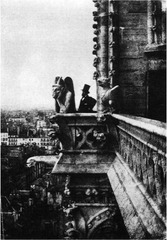
The Vampire — Charles Nègre, 1853
What: A gargoyle overlooking Paris from Notre-Dame.
Importance: Demonstrates creative composition and photographic illusion rather than straightforward architectural documentation.
From your notes: Nègre used a fabricated paper gargoyle head to create an unusual visual effect.

Philip Henry Delamotte — Crystal Palace, Central Nave, 1854
What: Huge indoor exhibition space with a glass-and-iron roof.
Importance: Delamotte documented the Crystal Palace's reconstruction in London.
Connection: Photography became a tool for recording architectural history and public spaces.

Joseph-Philibert Girault de Prangey — Ramesseum, Thebes, 1844
What: Large ancient Egyptian stone columns and ruins.
Technique: Daguerreotype.
Importance: One of the early examples of photography being used to document archaeological sites and historic monuments.

Napoleon Sarony — Oscar Wilde, 1882
What: Writer Oscar Wilde posing dramatically in a chair.
Importance: Sarony sued a company that reproduced his portrait without permission.
Know: The resulting copyright case helped legally establish that photographs could qualify as creative works of art.

Nadar — George Sand, 1877
What: A woman with styled hair wearing a loose, striped garment.
Importance: Nadar became famous for portraits emphasizing personality and expression rather than elaborate props.
Extra: Experimented with aerial photography using hot-air balloons.

Augustus Washington's Portrait of John Brown, 1846-1847
What: Abolitionist John Brown holding up his hand and a flag.
Importance: Shows Brown years before his famous raid at Harpers Ferry.
Connection: Augustus Washington was an important African American daguerreotypist.

Alexander Gardner — Portrait of Abraham Lincoln, 1863
What: Close-up of Lincoln showing his beard and serious expression.
When: Shortly before the Gettysburg Address.
Importance: The portrait reflects Lincoln's public image during the Civil War.
Connection: Photography helped shape how political leaders were remembered.

Home of a Rebel Sharpshooter, Alexander Gardner 1863
What: Dead Confederate soldier lying among rocks at Gettysburg.
Controversy: Historical evidence suggests Gardner repositioned the soldier's body and staged the scene.
Importance: Challenges the idea that documentary photographs are always completely truthful.

The Valley of the Shadow of Death — Roger Fenton, 1855
What: Empty road with cannonballs scattered around it.
War: Crimean War.
Importance: Captured the atmosphere and danger of war without showing dead bodies.
Controversy: Different versions show cannonballs in different positions, raising questions about staging.

Fire in the Ames Mills, 1853
What: Large factory building burning in Oswego, New York.
Technique: Daguerreotype.
Importance: An early example of news photography documenting a real, unexpected event rather than a posed subject.

The Burial Party, John Reekie, 1865
What: Men collecting human remains after a Civil War battle.
Importance: Shows the consequences of war rather than the fighting itself.
Connection: Photography exposed people to the destruction and loss caused by war.

Fading Away, Henry Peach Robinson, 1858
What: A young woman dying in bed while her family mourns around her.
Technique: Combination printing — several negatives combined into one photograph.
Importance: The staged death scene caused controversy and demonstrated how photography could create emotional, fictional narratives.

Photographic Study, early 1860s
What: Young woman wearing a large dress, leaning beside a table.
Importance: Used clothing, poses, interiors, and lighting to explore identity and femininity.
Style: Theatrical and artistic, almost like a painting.

Mary Lincoln with the Ghosts of Her Husband and Son, 1872
- What: Mary Lincoln seated with a faint ghostlike figure behind her.
- Technique: Double exposure — layering photographic images.
- Importance: Mumler claimed to photograph spirits, showing how photography could be manipulated to deceive viewers.
- Connection: Spiritualism and grief after the Civil War.

Grotto — Thomas Demand, 2006
What: A realistic-looking cave with detailed rock formations.
What's actually happening: Demand built an artificial cave using cardboard and then photographed it.
Importance: Questions whether photographs necessarily capture real places and events.

Untitled, 2005
What: Strange interior scene with furniture, debris, and dramatic lighting.
Technique: Carefully staged photography using sets, actors, lighting, and production crews.
Importance: Creates cinematic scenes meant to provoke emotion and interpretation.
Remember: Looks like a movie still.
Daguerreotype:
Photograph on a silver-coated copper plate.
Calotype
Paper-negative process that allows multiple prints.
Tintype
Inexpensive photo made on metal.
Carte de visite
Small collectible portrait card
Stereoscopy
Two images creating a 3D illusion
Combination printing
Combining multiple negatives into one picture
Double exposure
Two images layered in one photograph
Scanography
Making images with a scanner
Digital manipulation
Altering or combining images using technology