Genetics Exam 4
 Call Kai
 Learn
 Practice Test
 Spaced Repetition
 Match
 Flashcards
 Knowt Play
1/92

There's no tags or description
Looks like no tags are added yet.
93 Terms
What are the constituents for Hardy-Weinburg equilibrium?
No mutation
Random mating
No selection
No migration
Large population
What is Directional Selection? (Additive Effects)
Favors one extreme or the other, homozygous after infinite number of generations
What is Disruptive selection? (Underdominance)
Advantage for both extremes, leads toward bimodal population, both alleles remain in population
Stabilizing Selection (Overdominance)
Heterozygotes favored, both alleles remain in population
Given a starting population with starting genotypic frequencies and fitness values for each genotype, we want to determine what?
Frequency of survivors after selection
Frequency of offspring of these survivors
Genetic drift
random loss and fixation of alleles, due to small population size and sampling error
Founder population
small population that colonizes a new area; allele frequencies may differ from those in the original population since different environment
Inbreeding
mating between relatives (consanguinity), is more likely in a small population; changes frequency of genotypes, not allele frequency and results in more homozygotes in population over time (affects all loci in organism)
Assortative mating
mate based on phenotype
Positive: mating like individuals together results in more homozygotes but only for loci under selection
Negative: Opposites attract would keep diversity in the population and results in more heterozygous for loci under selection
How does inbreeding alter Hardy-Weinburg equilibrium?
F is inbreeding coefficient which measures probability that two alleles are identical by descent
F=0 when no inbreeding
0<F<1 when inbreeding in ==s occurring
What is migration?
Change in gene frequency depends on migration rate and on gene frequency of immigrants vs natives
What are the migration variables?
P= frequency of A allele in donor population (mainland)
m= proportion of migrants after immigration occurred=probability that a parent will come from mainland (m=immigrants/total)
p= frequency of A allele on island initially
1-m= probability that a parent will come from island = proportion of total population after migration that was from island
p’= frequency of A allele after migration (p’=(1-m)p+ mP)
What affects variation within populations and increase in genetic variation?
Mutation, Migration, Some types of natural selection
What affects variation between populations and increase in genetic variation?
Mutation, Genetic Drift, Some types of natural selection
What affects variation within populations and decrease in genetic variation?
Genetic drift, some types of natural selection
What affects variation between populations and decrease genetic variation?
Migration, some types of natural selection
What is evolution?
Genetic changes in composition of population including:
Emergence of species
Divergence of species
Extinction of species
Two step process- Genetic variation arises (mutation, recombination) and alleles decrease or increase in frequency in gene pool
T/F: Evolution naturally contains genetic variation
True
What is the neutralist theory?
Many mutations are neutral, causes polymorphisms to be maintained in population since neither has an advantage nor disadvantage
What is selectionist theory?
Many polymorphisms are maintained in population due to selection
What is a species?
Group of individuals that actually or potentially can reproduce
When does a species become distinct?
When they no longer exchange genes (Reproductive Isolation)
What is prezygotic?
Don’t choose to mate with each other or cannot mate with each other
What is Postzygotic?
Progeny are sterile or inviable
What is the biological species concept?
Members of a species are capable of inter-mating and producing fertile progeny
What are some examples of Prezygotic reproductive isolation?
Ecological- differences in habitat and can’t meet
Behavioral- differences in mating behavior and prevent mating
Temporal- reproduction takes place at different times
Mechanical- anatomical differences prevent mating
Gametic- gametes are incompatible or not attracted to each other
What are some examples of post zygotic reproductive isolation?
Hybrid inviability- zygote does not survive to reproduction
Hybrid sterility- hybrid is sterile
Hybrid breakdown- F1 hybrids are viable and fertile, but F2 are inviable or sterile
What is allopatric speciation?
Geographic barrier initiates speciation by blocking gene flow; ex. Darwins finches living on Galapagos islands and having different beaks based on food on islands
What is sympatric speciation?
Within a single interbreeding population without geographical barriers to gene flow; ex. apple maggot fly with mutating to eat more apples, so would mate on more apple trees
What is another mechanism for sympatric speciation?
Hybridization that leads to allopolyploidy
What is phylogenetics?
Study of relationship between species, individuals, or genes/alleles based on their characteristics
Define anagenesis
Evolution within a lineage over time
Define Cladogenesis
Splitting of one lineage into two (leads to biological diversity)
What are some things measured to evaluate evolutionary divergence?
Morphology, Chromosome structure, Protein sequences, DNA sequences
What are paralogs?
Homologous sequences found in same species and arrive between gene duplication
What are orthologs?
Homologous sequences found in different species
What has the most nucleotide substitutions?
Pseudogenes because they don’t really code for anything
Why does synonymous coding sequences have a lot of nucleotide substitutions?
They code for same amino acids, they have the least effect on function
What is an unrooted tree?
Only the distance between Operational Taxonomic Units is known, but not the order of divergence throughout evolutionary time
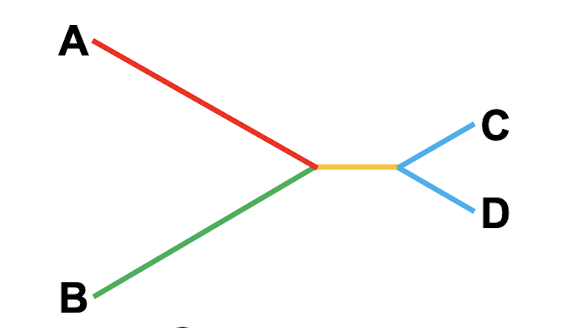
What is a rooted tree?
Distance between Operational Taxonomic Units is known and order of divergence is inferred by comparing OTU that is considered an outgroup
What is an outgroup?
OTU known to have diverged earlier than other OTUs; roots the tree such that all other OTUs share a common ancestor

What is the distance approach?
Computing differences to infer relationships based on overall similarity of organisms, typically, by using multiple phenotypic characteristics or gene sequences
What is Parsimony Approach?
Infers phylogenetic relationships based on minimum number of evolutionary changes in sequence that must have taken place since organisms had a common ancestor
What is maximum likelihood/Bayesian Approach?
Infers relationships based on which gives the maximum probability of obtaining the set of characteristics in the organisms
What does UPGMA stand for?
Unweighted Pair Group Method with Arithmetic Mean; constructing phylogenetic tree based on computing differences in DNA sequences that does not require an outgroup
What is DNA sequence alignment?
Identification of homologous genes and properly aligning their sequences is critical in determining an accurate tree; calculate based on fraction of nucleotides that are different between the OTUs
Why is cancer genetic, but rarely heritable?
Changes in the DNA structure
What is cancer?
Cells with unlimited potential to divide/grow and serves no useful function in body; occurs during cell cycle in 1 cell and increases number of affected cells through mitosis
What are some cell division checkpoints that cancer cells may bypass?
G1/S- monitors for proper cell size and undamaged DNA
G2/M- holds up cycle until replication and DNA repair are complete
M- proper spindle formation and attachment
What is the definition of a tumor?
Distinct mass of abnormal cells that do not have normal controls on cell division
What is the definition of benign?
Abnormal cells remain localized and don’t invade surrounding tissue
What is the definition of malignant?
Cancer cells invade surrounding tissue
What is the definition of metastatic?
Cancer cells spread and establish secondary tumors in other sites in the body (take away nutrients from other cells)
What are some genetic influences that can cause cancer?
Mutations typically in somatic cells, a single defective gene, polygenic (more than 1 defective gene), chromosome aberration, viruses
What are some environmental influences that can cause cancer?
Can cause mutations, can alter gene expression
What does it mean when cancer is a multi-hit disease?
It is a result of many different mutations as opposed to one mutation
T/F: Most cancers are sporadic and influenced by the environment
True
T/F: Siblings are rarely affected by the same cancer
True
T/F: Cancers develop over time
True
What is the correlation between cells and causing cancer?
Thought that cells that have a higher number of divisions have an increased risk of cancer
What is the one phase that is thought to be the cause of mutations leading to cancer?
2/3 of mutations leading to cancer are a result in replication?
What are the two types of genes that can cause cancer?
Tumor suppressor genes- prevent “bad” cells from dividing
Proto-oncogenes- allow “good” cells to divide
What are the two effects of DNA Mutations at the Protein Level?
Loss of function- complete or partial absence of protein function (recessive acting mutations)
Gain of function- cell produces protein that is not normally present (usually dominant acting mutations)
What is the definition of a tumor suppressor gene?
Normal gene that prevents uncontrolled growth; abnormal gene- no inhibition- results in tumor if no normal allele present
Recessive acting, so both copies of the gene are disrupted to lose cell cycle regulation
What are some examples of tumor suppressor genes?
BRCA1, p53, RB
What is the RB gene?
Tumor supressor (Retinoblastoma), 40% of cases are inherited, 1 mutant allele in zygote; RB is a normal protein at G1/S checkpoint
Controls Initiation of DNA Replication in S Phase, where a mutation causes RB unable to bind to E2F and block replication for occurring uncontrollably
What is the function of the BRCA1 and BRCA2 gene?
Repair double strand breaks, account for 5-10% of all breast cancers
What is the function of the p53 gene?
Functions at G1 checkpoint; if DNA is damaged, p53 delays cell division until damage is repaired or programs cell to die
If not working properly, cell division occurs even though DNA is damaged
What are proto-oncogenes?
Normally promote cell division, must be activated to be regulated properly; mutation results in oncogene that allows uncontrolled cellular division; need mutation only in 1 copy of photo-oncogene to get a tumor (dominant mutation)
What is an example of an oncogene in Burkitt’s lymphoma
Abnormal function of B cells; Reciprocal translocation between chromosomes 8 and 14 places c-myc next to enhancer
What are retroviruses?
Insert strong promoter near photo-oncogenes, mutate and rearrange proto-oncogenes
What is clonal evolution?
Over time, tumor cells acquire more mutations that allow them to be progressively more aggressive in proliferation