Health Occ
 Call Kai
 Learn
 Practice Test
 Spaced Repetition
 Match
 Flashcards
 Knowt Play
1/37

There's no tags or description
Looks like no tags are added yet.
38 Terms
What are the four main vital signs?
Temperature, pulse, respiration, and blood pressure.
Why must vital signs be measured accurately?
To assess health, identify problems, and monitor changes in a patient's condition.
What should you do if a vital sign is abnormal or changes?
Report it to the nurse or healthcare provider immediately and document it.
What should you do if you cannot obtain a correct vital sign reading?
Repeat the measurement, check the equipment and technique, and ask for help if needed.
What is homeostasis?
The body's ability to maintain a stable internal environment.
What does ADL stand for? Give examples.
Activities of Daily Living; bathing, dressing, eating, using the restroom, and walking.
What is temperature?
The measurement of the body's degree of heat.
What are three factors that affect body temperature?
Age, physical activity, and time of day.
What is an oral temperature?
Temperature taken in the mouth, under the tongue; average is 98.6°F.
What is a rectal temperature?
Temperature taken in the rectum; average is 99.6°F.
What is an axillary temperature?
Temperature taken in the armpit; average is about 97.6°F.
What is an aural temperature?
Temperature taken in the ear with a tympanic thermometer; average is 98.6°F.
What is a temporal temperature?
Temperature taken at the forehead using a temporal artery thermometer; average is 98.6°F.
What are the most and least accurate temperature methods?
Most accurate: rectal. Least accurate: axillary.
What is hyperthermia?
An abnormally high body temperature.
What is hypothermia?
An abnormally low body temperature, generally below 95°F.
How do you prevent cross-contamination when using an electronic thermometer?
Use a new disposable probe cover for each patient and discard it after use.
Why ask whether a patient recently ate, drank, or smoked before taking an oral temperature?
These activities can temporarily change mouth temperature and cause an inaccurate reading.
What is a pulse?
The rhythmic expansion of an artery as the heart pumps blood.
What is the difference between an apical and radial pulse?
Apical: heard with a stethoscope over the heart. Radial: felt at the wrist on the thumb side.
What three factors are assessed when checking a pulse?
Rate, rhythm, and strength (volume).
What is the normal adult pulse range?
60–100 beats per minute (bpm).
What is the normal school-age pulse range?
75–110 bpm.
What is the normal infant pulse range?
100–160 bpm.
What is the normal newborn pulse range?
120–160 bpm.
What are three factors that increase pulse rate?
Exercise, fever, and stress or anxiety.
What are three factors that decrease pulse rate?
Rest or sleep, certain medications, and improved physical conditioning.
What is tachycardia?
An abnormally fast heart rate; over 100 bpm in adults at rest.
What is bradycardia?
An abnormally slow heart rate; under 60 bpm in adults at rest.
What is arrhythmia?
An irregular heartbeat or abnormal heart rhythm.
What are the seven main pulse sites?
Temporal, carotid, brachial, radial, femoral, popliteal, and dorsalis pedis.

What is A
Temporal

What is B
Carotid

What is C
Bracial

What is D
Radial

What is E
Femoral
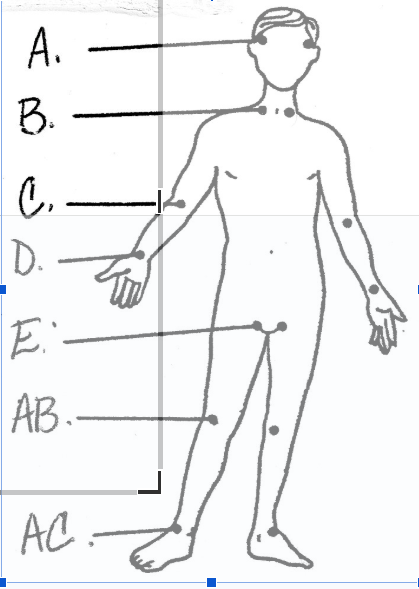
What is AB
Popliteal

What is AC
Dorsalis