The Geology of Running Water

0.0(0)
Studied by 0 people
call kaiCall Kai
learnLearn
examPractice Test
spaced repetitionSpaced Repetition
heart puzzleMatch
flashcardsFlashcards
GameKnowt Play
Card Sorting

1/25

flashcard set

Earn XP

Description and Tags

C15

26 Terms

1
New cards

Where does water go when it rains?

  • Accumulates

  1. Velocity - Slope

  2. Discharge - How far down a stream you are?

  3. Deposits


<ul><li><p>Accumulates</p></li></ul><ol><li><p>Velocity - Slope</p></li><li><p>Discharge - How far down a stream you are?</p></li><li><p>Deposits</p></li></ol><p></p>
2
New cards

Stream Order

  • Numbers on stream indicate stream order

  • Dashed Lines are drainage divides (not all divides and basins are shown)


<ul><li><p>Numbers on stream indicate stream order</p></li></ul><ul><li><p>Dashed Lines are drainage divides (not all divides and basins are shown)</p></li></ul><p></p>
3
New cards
<p>What is stream discharge?</p>

What is stream discharge?

  • The volume of water that passes through an imaginary cross section across a stream.

    • Expressed at some volume per time

  • Generally, increases downstream

  • controls amount of material a river can carry


4
New cards
<p>What is stream velocity?</p>

What is stream velocity?

  • The rate of flow (not amount of water)

  • Discharge and velocity not equivalent


5
New cards

What is competence?

The degree of resistance of a rock to deformation, erosion, or flow, essentially its relative mechanical strength. (Maximum clast size a stream can carry.)

6
New cards

What is the Thalweg?

  • The deepest part of the channel (an usually the highest current velocity)

  • Produces turbulence


<ul><li><p>The deepest part of the channel <em>(an usually the highest current velocity)</em></p></li><li><p>Produces turbulence</p></li></ul><p></p>
7
New cards

Why is flow in channels usually turbulent?

  • Streams occur, break, abrade, and dissolve material → possible ways to do it

  • More discharge = More materials (Size depends on Velocity)
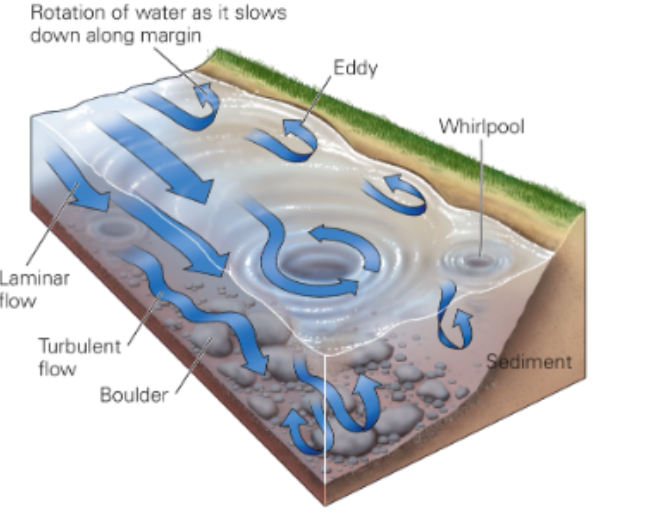

<ul><li><p>Streams occur, break, abrade, and dissolve material → <em>possible ways to do it</em></p></li><li><p>More discharge = More materials (Size depends on Velocity)</p></li></ul><p></p>
8
New cards

What are the three types of sediment transport (definitions)?

  • The material moved by streams is the sediment load

  1. Suspended Load - consists of tiny, solid grains (generally silt or clay) that swirl along with the water without settling to the streambed.

  2. Bed Load - consists of large clasts (sand, pebbles, or cobbles)

    1. Uses Traction move by rolling or slipping along the streambed

    2. Saltation a process during which grains bounce along in the direction of flow.

  3. Dissolved Load - consists of the ions that a stream carries in solution.
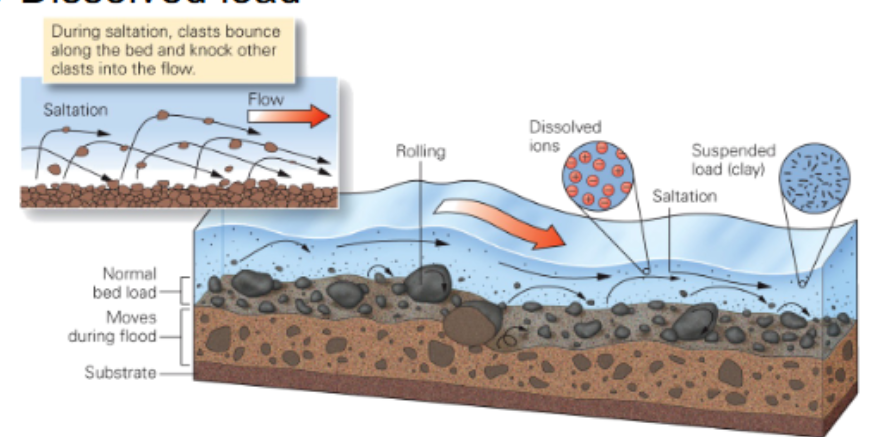

<ul><li><p>The material moved by streams is the sediment load</p></li></ul><ol><li><p>Suspended Load - consists of tiny, solid grains (generally silt or clay) that swirl along with the water without settling to the streambed.</p></li><li><p>Bed Load - consists of large clasts (sand, pebbles, or cobbles)</p><ol><li><p>Uses <strong><em>Traction </em></strong>move by rolling or slipping along the streambed</p></li><li><p><strong><em>Saltation </em></strong>a process during which grains bounce along in the direction of flow.</p></li></ol></li><li><p>Dissolved Load - consists of the ions that a stream carries in solution.</p></li></ol><p></p>
9
New cards

Why do cross section change with discharge?

A stream’s cross section changes with discharge because the channel’s width and depth adjust in response to the volume of water flowing, driven by hydraulic balance, erosion, and sediment transport processes

<p>A stream’s cross section changes with discharge because the channel’s width and depth adjust in response to the volume of water flowing, driven by hydraulic balance, erosion, and sediment transport processes<span> </span></p>
10
New cards

What is the long profile?

  • long profile of a river is a side view showing how its gradient decreases from the steep source in the upper course to the gentle slope at the mouth.

    • Lake Travis

    • Cannot erode pass base level


<ul><li><p>long profile of a river is a side view showing how its gradient decreases from the steep source in the upper course to the gentle slope at the mouth.</p><ul><li><p>Lake Travis</p></li><li><p>Cannot erode pass base level</p></li></ul></li></ul><p></p>
11
New cards

What is the longitudinal profile?

  • Toward the mouth of a stream, the gradient flattens, discharge increases, sediment grain sizes are smaller, and channels develop broad meander belts.

  • (C) flooding

  • Base Level - the lowest point to which a stream can erode


<ul><li><p>Toward the mouth of a stream, the gradient flattens, discharge increases, sediment grain sizes are smaller, and channels develop broad meander belts.</p></li><li><p>(C) flooding</p></li><li><p>Base Level - the lowest point to which a stream can erode</p></li></ul><p></p>
12
New cards

What is base level?

  • Base level is the lowest point to which a stream can erode.

  • Base-level changes cause stream readjustments. Raising base level results in an increase in deposition. Lowering base level accelerates erosion.


<ul><li><p>Base level is the lowest point to which a stream can erode.</p></li><li><p>Base-level changes cause stream readjustments. Raising base level results in an increase in deposition. Lowering base level accelerates erosion.</p></li></ul><p></p>
13
New cards

Why does the base level happen?

Steep makes water erosive … Smooth → Longitudinal

14
New cards
<p>What is the relationship between base levels and waterfalls?</p>

What is the relationship between base levels and waterfalls?

Waterfalls often form where a river encounters a local base level — a temporary “floor” that limits downward erosion — creating a sudden drop in elevation in the river’s profile

<p>Waterfalls often form where a river encounters a local base level — a temporary “floor” that limits downward erosion — creating a sudden drop in elevation in the river’s profile</p>
15
New cards
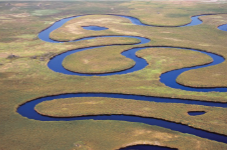
<p>What are meandering streams?</p>

What are meandering streams?

Channels from intricately looping meanders along the lower gradient portion of the longitudinal profile

<p>Channels from intricately looping meanders along the lower gradient portion of the longitudinal profile</p>
16
New cards
<p>How do meandering streams happen?</p>

How do meandering streams happen?

  • erosion on the cut bank

  • cutting of the meander neck


<ul><li><p>erosion on the cut bank</p></li><li><p>cutting of the meander neck</p></li></ul><p></p>
17
New cards

What are the different features of cut bank and point bar?

Cut Bank - outside bank of a curve or meander, along a stream, where erosion takes place.

Point Bar - wedge-shaped deposit of sediment on the inside bank of a meander.

<p>Cut Bank - outside bank of a curve or meander, along a stream, where erosion takes place.</p><p>Point Bar -  wedge-shaped deposit of sediment on the inside bank of a meander.</p>
18
New cards

How is incision driven by changes in base level?

knowt flashcard image
19
New cards

What are alluvium’s in stream deposits?

Leaves - New Orlean hurricane natural vs man made

<p>Leaves - New Orlean hurricane natural vs man made</p>
20
New cards

What are Deltas?

  • When rivers enter open water such as an ocean, they deposit sediment as they lose energy

  • Greek historians originally termed these deltas because the Nile river delta is roughly shaped like the Greek letter delta. Deltas can have many shapes


<ul><li><p>When rivers enter open water such as an ocean, they deposit sediment as they lose energy</p></li><li><p>Greek historians originally termed these deltas because the Nile river delta is roughly shaped like the Greek letter delta. Deltas can have many shapes</p></li></ul><p></p>
21
New cards

What is a river dominate delta?

  • Mississippi

  • River sediment exceed removal delta prograde out rapidly subject to

  • deliver so much water, lots of sediment


<ul><li><p>Mississippi</p></li><li><p>River sediment exceed removal delta prograde out rapidly subject to</p></li><li><p>deliver so much water, lots of sediment</p></li></ul><p></p>
22
New cards

What is a wave dominated delta?

  • High wave energy, Chanel prograde slowly sand is well sorted, parallel beach ridges of redistributed Seds


<ul><li><p>High wave energy, Chanel prograde slowly sand is well sorted, parallel beach ridges of redistributed Seds</p></li></ul><p></p>
23
New cards

What is a tide dominated delta?

High tidal range distributary channels are widened by tides

<p>High tidal range distributary channels are widened by tides</p>
24
New cards

How do you classify deltas (marine)?

  1. sediment delivery (rivers)

  2. sediment redistribution (waves)

  3. sediment removal/erosion (tides)


<ol><li><p>sediment delivery (rivers)</p></li><li><p>sediment redistribution (waves)</p></li><li><p>sediment removal/erosion (tides)</p></li></ol><p></p>
25
New cards

What is Delta evolution?

knowt flashcard image
26
New cards

What is subsidence at deltas?

knowt flashcard image



