Aquatic flora and fauna L24-31
 Call Kai
 Learn
 Practice Test
 Spaced Repetition
 Match
 Flashcards
 Knowt Play
1/131

There's no tags or description
Looks like no tags are added yet.
132 Terms
The global marine environment
71% of the Earth’s surface is ocean
46% Pacific Ocean's one of the largest oceans
23% Atlantic Ocean
Ave depth of the ocean = 4 km
Mariana Trench 11 km (deepest trench)
Global Conveyor Belt = a system of ocean currents that transport water around the world
Surface currents: primarily propelled by winds
Deep currents: driven by differences in water densities (thermohaline circulation; thermo = temperature, haline = salinity)
What oceans are around Australia and what are the main currents around Australia?
Oceans around Australia include:
Pacific Ocean (east)
Indian Ocean (west)
Southern Ocean (south)
Main currents around Australia:
Indonesian Throughflow
⭐ East Australian Current (EAC)
⭐ Leeuwin Current
Antarctic Circumpolar Current
East Australia Current (EAC)
Source: Coral Sea (up in the North)
Tracks down the east coast of Australia
Brings warmer ocean water southward
adds several degrees of temperature to the coastal waters
strengthening with climate change
warmer water moving further south into areas that typically hasn't experienced warm water before
Fish and other marine animals carried south from warmer, nothern waters
Tropical sp. meet temperate sp (as temperate sp. move further south)
EAC: Tropical meets temperate
Australia’s eastern and western coastlines extend from warmer tropical to cooler temperate regions
Many coastal species are confined to northern or southern parts of the coast
Some species extend from tropical or warm temperate zones into overlap zones
E.g. Green turtle (tropic sp.) alongside Bubbleweed (temperate sp.)
EAC: Temperate species move further south
EAC has intensified, moving poleward and warming coastal waters
Long-spined sea urchin (Centrostephanus rodgersii)
historical range: NSW
larvae require specific temperatures (>12 °C) to develop
usually they would be carried south but the water would be too cold so they'd stop developing
but with climate change, eastern Tasmanian waters are warmer, supporting sea urchin larval development
Problem: C. rodgersii dominates Tasmanian waters, removing kelp and creating urchin barrens
Leeuwin Current
Source: North West Cape
Tracks down the west coast of Australia
Acts as a single current during winter
Brings tropical water to Western Australia
Tropicalisation of temperate waters causes range contraction and expansion
Leeuwin current: Brings tropical water to Western Australia
transports tropical species south
E.g. Salmon, Tuna — use current to transport their young down the coast to cooler waters and then across to more permanently cooler waters
Salmon: juveniles and young are swept by the current and avoids warm water (circles around the southern tip of Western Aus and continues around to South Aus) where there's cooler waters — Uses Leeuwin current during winter where that current continues around the corner and across to South Australia
Tuna: Spawned between Aus and Indonesia. Juveniles are transported to an area west, and then down and east again to South Aus so they can grow.
Leeuwin current: Tropicalisation of temperate waters
Range contraction
Reduced range/habitat of sensitive cool water species
Species endemic to southwest Australia
it has nowhere else to go, it is at the coolest extent of its range and it can't really move any further south
as cooler water becomes restricted (their needed habitat), they're pushed into that smaller area
Range expansion
Southward mvt / poleward extension of tropical species to cooler waters in the south
Tropicalisation of temperate marine ecosystems
Might get too hot in tropical waters with some organisms
they move further south to water that's the appropriate temperature for them / resources (e.g. seaweed, algae) that they use is moving further south
as warmer water moves further south and it can now inhabit that

Use of ocean currents
Larvae use ocean currents
Larva = a free-living organism, morphologically distinct from the embryo and adult life stages
E.g. Fish larvae
Fish spawn gametes
Larvae hatch and drift along ocean currents
Ocean currents affect:
speed at which fish eggs and larvae drift
this varies through the year
Migrating juveniles use ocean currents
E.g. Green sea turtle (Chelonia mydas) juveniles
Hatchlings live for several years in pelagic (far from the shore and the bottom) habitat
use oceanic currents to move around the world
Passive swimming: juveniles spend most of their time riding prevailing ocean currents
Active swimming: when targeting distant coastal waters (maybe they're transitioning from a juvenile to an early adult and they're ready to lay some eggs)
Some migrating adults do not use ocean currents
E.g. Leatherback turtle (Dermochelys coriacea)
Widest global distribution of any reptile
Mostly swim actively during migration despite their routes closely following currents
E.g. Humpback whale (Megaptera novaeangliae)
Seasonal migration (10,000 km)
migration north June to August (winters: breeding)
migration south September to November (summers: feeding on krill)
What are tides?
The alternating rise and fall of surface water levels along coastlines — primarily caused by the gravitational pull of the moon
What are the types of tides? Which ones are dominant?
Semidiurnal tides (most common): two low, two high tides per day of about the equal height
Mixed semidiurnal tides: two high and two low tides of different heights per day
Diurnal (least common): one high, one low tide per day
Dominant type of tides:
semidiurnal (light blue)
mixed semidiurnal (purple)
At a few coastal locations:
diurnal (red)
At most locations there is variation E.g. a mixed semidiurnal tide that occasionally experiences diurnal tides
Tide types in Australia
semidiurnal: east and southeast coast, northwest coast
mixed semidiurnal: northeast coast, south coast
diurnal: southwest tip of WA, Gulf of Carpentaria
What is tidal range? Define low & high tide, and flood/flow & ebb tide.
The difference in height between high tide and low tide = difference between maximum and minimum water levels during a typical tidal cycle
Low tide: water recedes to its further extent from the shoreline
High tide: water advances to its furthest extent onto the shoreline
“flood tide” or “flow”: low —> high tide
“ebb tide”: high —> low tide
Physical factors in coastal waters (at low and high tide)
Low tide: Higher desiccation risk
Exposed to air and wind for longer
Temperature – more extreme, more variable
Light – greater exposure to solar radiation
High tide: Lower desiccation risk + greater exposure to pressure, density
Temperature – less variable
Light – lower exposure to solar radiation
Breaking waves, water movement, covered by water
Adaptations to physical factors in coastal waters
Organisms bleach with light exposure:
algae, coral
Water depth alters light conditions (UV wavelengths): zonation of algae
Mobile organisms resist pressure
rigid body form e.g., shell
hold on e.g. muscular foot
Sessile organisms move with pressure
flexible body form “go with the flow”
floats to stay upright
How do physical factors change as you move deeper down the ocean?
As you move deeper…
light availability decreases
pressure increases
Using one example, state adaptations to low light conditions
E.g. Anglerfish — Humpback Blackdevil (Melanocetus johnsonii)
Found along the east coast of Australia, around Tasmania, and some in southern Australia
Female: 18 cm; male: 2.9 cm
Deep-sea fish: watery flesh, light bones
water supports them
Waits for passing prey (ambush predators)
Female: lure with a light organ in the tip projects from head to attract
prey
mates
Using one example, state adaptations to high pressure environments
E.g. “Blobfish” Fathead sculpin (Psychrolutes phrictus)
Deep-sea fish (600-1,200 m):
Water pressure holds their body shape
soft bones, very little muscle
Adapted for high pressure environments
high water and fat content to withstand pressure
gelatinous blob at surface
What do deeper water fish have to deal with high pressure environments?
Gas / swim bladder (flexible-walls, gas-filled)
Found in ‘dorsal cavity’
Controls fish’s buoyancy
Not permeable to gases
Barotrauma: when bottom-dwelling fish are removed rapidly from deep water (>10 m)
gases in the swim bladder and other tissues rapidly expand
signs: bloated abdominal area, bulging eyes
E.g. Porcupine fish “puffer”
Types of feeding in marine animals
Carnivore: An organism that feeds on animal material
Scavenger: an organism that feeds on decaying biomass, such as animals or rotting plant matter
Usually consumes animals that have either died of natural causes or been killed by another carnivore
Many scavengers are a type of carnivore
Herbivore: An organism that feeds on plants or algae
Omnivore: an organism that regularly consumes a variety of material i.e. plants, algar, animals, and/or fungi
Deposit feeder: an organism that ingests substrate (sand, soil, mud) and assimilates the organic fraction
Suspension feeder: An organism that collect small food of any size from the surrounding fluid (sea water)
Filter feeder: an organism that strains food particle of a particular size from the surrounding fluid (sea water)
What are Eukaryotes and what are animalia?
Organisms with cell(s) containing a nucleus, other membrane-bound organelles
May be single-celled (unicellular) or multicellular
K: animalia All multicellular organisms that feed by ingestion of food particles
Types of symmetry
Radial symmetry: Any plane along main body axis
Mouth: at one end of longitudinal axis
Usually sessile or free-floating
Limited mobility
E.g. Cnidarians, Echinoderms (5-arm / penta-radial)
Bilateral symmetry: A single plant through the anterior-prosterior midline
Strongly linked to cephalisation – concentration of nervous and sensory systems in the “head”
Allows directional movement
Most animals
P: Porifora
Sponges
Latin: Pore-bearing
Simplest multicellular animals:
No symmetry (quite globulous)
Lack true tissues and organs
transport is done by simple diffusion
Fibrous material (spongin) provides structural support
Spicules (within the tissue, quite spiky)
support most sponges
made of silica or calcium carbonate
sharp – deter predators
used to identify species
Shapes (forms): crusts, tubes, cups, fans, spheres
Usually florescent colours
Sponges thrive where light is limited, water flows well (compete with algae which grows where light is abundant)
Filter feeding
Sea water (with food particles) passes through small holes
Key cell type in sponges: Choanocytes = funnel or collar cells
line inner surface
have flagella that circulate and directs sea water, capture food (particles) (and sperm if its reproducing)
P: Cnidaria
Stinging
Greek, cnidaria = stinging thread
Stinging cells (cnidocytes)
Radial symmetry
Tentacles surround mouth
Two body forms:
Medusa (free-swimming) E.g. jellyfish
Polyp (sessile) E.g. corals, anemones, hydroids
P: Annelida
Segmented worms
Annulus = Latin: ring
Segmented body
Bilateral symmetry
Vermiform (worm-shaped), soft-bodied
Longer than wide
At least one pair of bristles (chaetae or setae)
C: Polychaeta (is the most abundant)
Greek: poly + chaeta = many chaeta
≥1 pairs chaetae
2 different forms:
Errantia: Active, mobile
free-living, generally carnivorous
E.g. Ragworm, scaleworm
Sedentaria: Burrowing or tube-dwelling
suspension feeder, detritivores (in mud burrows)
E.g. Fan worm, tube worm
P: Mollusca — 4 classes
Mollusca = Latin: soft
Key features:
Head
Muscular foot
Mantle: fleshy layer; covers gut cavity, protects gills, secretes shell(s)
Radula (in the mouth): toothed tongue for scraping (rasping) or drilling food
1. C: Gastropoda — nudibranch, slugs, limpets, snails
2. C: Polyplacophora — 8 plates
3. C: Bivalvia — mussels
4. C: Cephalopoda — squid, octopus
P: Mollusca C: Gastropoda
Nudibranch, slugs, limpets, snails
Greek: gastro + poda = stomach foot
Nudibranch: no shell with obvious external gills
Sea slug: reduced shell
Limpet: wide hat shell
Snail: spiral shell with trap door (operculum)
Active at high tide: explore (sensory tentacles), move (crawl on foot), feed (radula)
Gastropod feeding
Herbivores:
Aperture is large and round
Head protrudes when feeding
Operculum ‘trap door’ protects snail (predators, desiccation)
Radula scrapes algae / films from rocks — acts like ‘broom’, brushing loose algae
Carnivores / scavengers:
Aperture is narrow, long, tapered
Siphon = tube-like extension of mantle (draws water into mantle cavity (taste organs) to locate prey)
Some species drills hole into shell of prey and poisons them

P: Mollusca C: Polyplacophora
8 plates
Greek: poly + placo + phora = many plate bearing
Flattened, elongated body
8 separate shell plates
Herbivore: radula
Often under boulders

P: Mollusca C: Bivalvia
2 shells joined by hinge
Latin = 2-valved
Two shells, joined at the bottom by a hinge
Sedentary but can move slowly
Filter feeder: plate-like gills open

P: Mollusca C: Cephalopoda
Squid, octopus
Greek: Cephalo + poda = head foot
Limbs form a ring around head (and beak)
Reduced shell (highly modified): chalky cuttlebone (cuttlefish), transparent pen / quill (squid), two small rod-like stylets (octopus)
Carnivore: arms (manipulate prey), beak (bite food), radula (grind food)

P: Arthropoda, Subphylum Crustacea — 1 class and subclass
Greek: Arthro + poda = jointed foot
Jointed legs
Segmented body
Hard exoskeleton covering the body
Bilateral symmetry
Subphylum crustacea
Latin: Crusta = crust
Hard shell (exoskeleton)
Two pairs of antennae
Generally carnivorous
Pair of mandibles – shear, crush food
Two pairs of maxillae – generate water currents to push food into mouth
Crabs eat juvenile sea stars
C: Maxillopoda, subclass: Cirripedia

C: Maxillopoda, subclass: Cirripedia
Barnacles
Class Maxillopoda, Subclass Cirripedia
Latin: maxilla + poda = jaw foot
Latin: Cirri + pedia = hairy foot
Feathery legs (cirri) filter plankton and food particles from sea water
Sessile: adults cannot move
Modified to attach to hard substrates
Body is surrounded by multiple hard plates
Barnacle feeding
Modified legs here coming out of the shell plates and flicking water and any food towards their mouth

P: Echinodermata — 5 classes
Sea star, urchins
Greek: Echino + dermata = spine skin
Penta-radial symmetry – built around a five-sided pattern
Ossicles: Skeleton of interlocking plates (calcium carbonate)
in different locations depending on species e.g. sea star, the ossicles float in the tissue over their body, in a sea urchin they're fused to form a covering
Tube feet: Small fluid-filled tubes — uses seawater internally to help drive feet
Exclusively marine (not freshwater or terrestrial)
1. C: Asteroidea
2. C: Echinoidea
3. C: Ophiuroidea
4. C: Crinoidea
5. C: Holothuroidea
P: Echinodermata C: Asteroidea
Greek: aster + oidea = star-like
Radial star-like symmetry — Generally, with 5 arms
In southern Australia, some have: 6, 7, 8, or 11 arms
Sometimes reduced and cushion-like
Sea star feeding
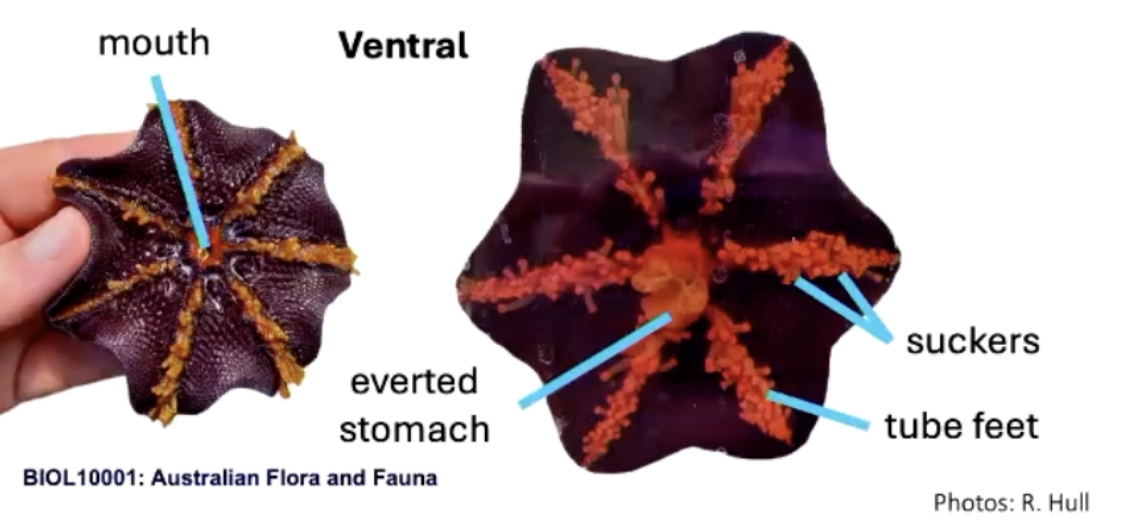
Underside (ventral): mouth and tube feet in rows under each arm
Use tube feet (and suckers) to open bivalves
Typically carnivorous (some omnivorous)
Ventral mouth, at the centre of arms
External digestion – mouth (jelly-like mass) pushed from body to digest prey
P: Echinodermata C: Echinoidea
Gr: echin + oidea = spine-like
Spines: vary in length, shape
Ossicles (calcareous plates) interlock to form test (rigid exoskeleton)
Sea-urchin feeding
Generally herbivorous
Spines capture algae; spines and tube feet pass food to mouth
Jaws (Aristotle’s lantern): ossicles, muscles
Jaws protrude from mouth for chewing
Scrape algae from hard substrate

P: Echinodermata C: Ophiuroidea
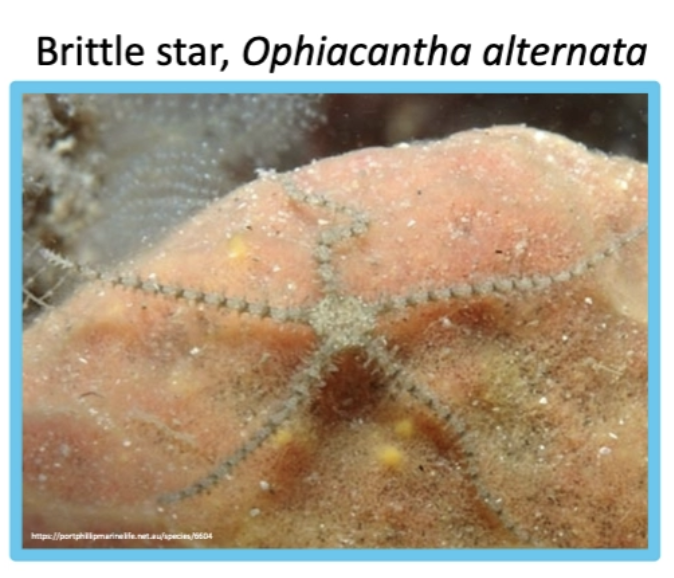
Greek: ophiur + oidea = snake-like
moves each arm in a snake-like manner
Five long flexible arms
Use arms to move
Small, circular central disc
P: Echinodermata C: Crinoidea
Greek: crin + oidea = lily-like
≥5 long feathery arms
Arms: consist of jointed calcareous ossicles; bendable with comb-like branches (pinnules)
hard to the touch
Tropical reefs: many crinoids
in more temperate areas and shallow water

P: Echinodermata C: Holothuroidea
Sea cucumber
Soft-bodied; vermiform: long, cucumber/worm-like
Either end: mouth, anus
Calcareous discs: ossicles reduced and embedded in body wall
compared to other echinoderms: ossicles over body
Penta-radial (5-rayed) symmetry (view end-on): tube feet in 5 radial rows along body
P: Chordata — 4 classes
Greek: chord = string
Key features:
Notochord / backbone: skeletal rod, depedning on organism might be replaced by vertebrae (most vertebrates)
Nerve cord: dorsal, hollow
Pharyngeal slits
Post-anal tail
Vertebrates
1. C: Aves — birds
2. C: Chondrichthyes — cartilaginous fishes (sharks, rays)
3. C: Actinopterygii — ray-finned fishes
4. C: Mammalia — mammals
P: Chordata C: Aves
Feathers, wings, beak
Numerous birds depend on sea forpart of their existence
Shorebirds: are mostly confined to nearshore coastal waters
E.g. gulls, cormorants
Seabirds: birds of the Southern Ocean, rare in nearshore waters
E.g. Albatross, petrels
E.g. Little penguin (Eudyptula minor) – may remain at sea for many weeks (mostly seabirds), but use land for breeding, moulting
P: Chordata C: Chondrichthyes
Cartilaginous fishes: sharks, rays
Skeleton made of exclusively cartilage
Only a few of the larger shark species eat mammals
Sharks are piscivores: cut, tear with teeth
Skates, rays eat invertebrates: crush with jaws

P: Chordata C: Actinopterygii
Ray-finned (and bony) fishes
Skeleton made (predominantly) of bone with some cartilage
Huge variety in form and lifestyle

O: Cetacea — 2 suborders
Suborder Mysteceti
Baleen whales
E.g. Blue whale, southern right whale, humpback whale
Use baleen to filter large quantities of plankton — modified hairs form sieve plates around mouth
Suborder Odontoceti
Toothed whales
E.g. Dolphins, porpoises, killer whales, porpoises
Feed on fish, squid
P: Chordata C: Reptilia
Rely on sun to maintain body temperature
Few reptiles reach cool waters of southern Australia
No marine reptiles breed in southern waters — Gives birth to live young at sea
33 sea snakes in Australia (70 known species worldwide)
Eats small fish; venom immobilises fish
Only yellow-bellied sea snake (Pelamis platurus) is a rare visitor to Victorian waters
Travels in pulses of warm water coming down east coast from tropics
What is a community? What is a habitat and microhabitat?
Community: a group of potentially interacting species that occur together in space and time
Habitat: the environment of the organism, or the place where it is usually found
Microhabitat: a precise location within a habitat where an individual species is normally found
Example:
Biome: rocky intertidal reef
Habitat: rock or boulder
Microhabitat: top, crevice, etc.
What is intertidal zone?
The region on the seashore or in a coastal region b/w lowest and highest tidal levels, exposed alternately to air and water.
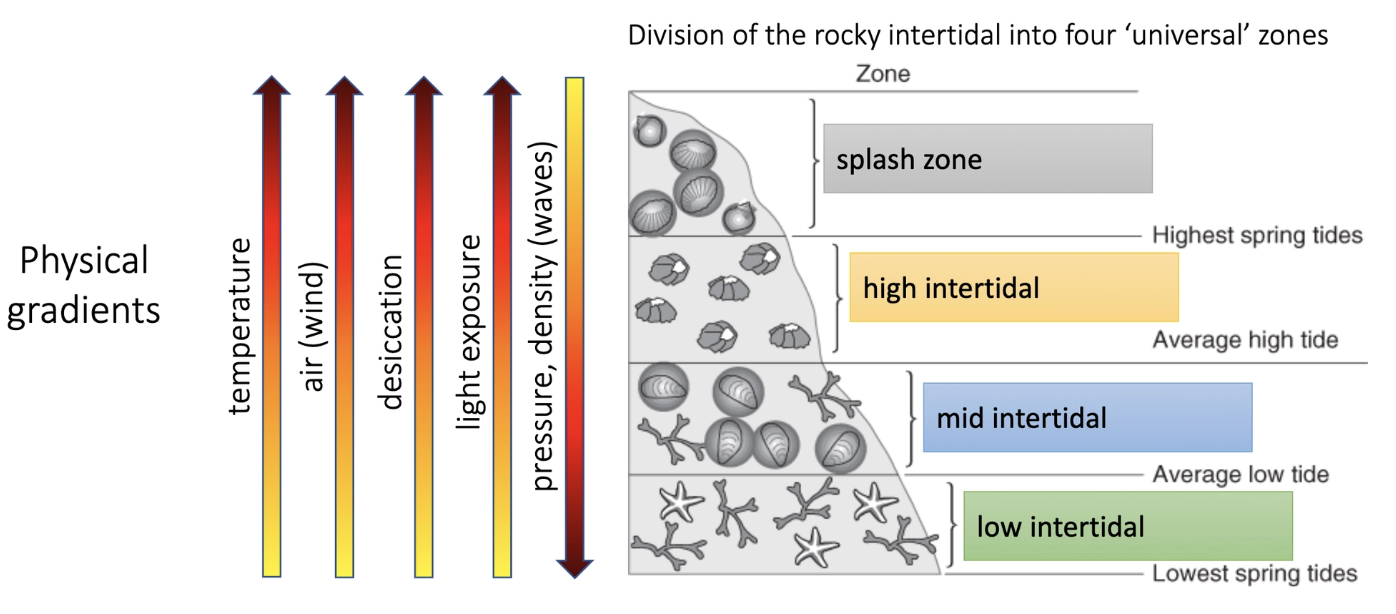
Physical environment factors form physical gradients on rocky intertidal shores. What are the 4 intertidal zones?
Splash zone
High intertidal
Mid intertidal
Low intertidal
Splash zone organisms:
Gastropods
Highest and driest rocks
Sea-spray makes the rocks salty
E.g. Little blue periwinkle, Austrolittorina unifasciata
Feeds on lichen
Live in clusters
High zone organisms:
Barnacles
Slightly lower than the splash zone (high intertidal)
Filter feeders = strain suspended matter from water using cirri
E.g. Six-plated or acorn barnacle, Chthamalus antennatus
Six side plates
Deed only during unusually high tides
E.g. Honeycomb barnacle, Chamaesipho tasmanica
Four side plates
Shells fuse to form dense masses
Herbivorous gastropods
Upper intertidal, rocky reef
E.g. False Limpet, Siphonaria diemenensis
“lung breathing” – trap air under shell
E.g. Striped-mouth Conniwink, Bembicium nanum
Form groups in crevices and rock depressions
Jawbone Marine Sanctuary: Bembicium melanostoma
Splash & high zone organisms: Predators
Gulls
E.g. Kelp Gull, Larus dominicanus (<60 cm)
Bill yellow with red tip on lower bill
Feeds mainly on fish, crustaceans, but also scavenges
E.g. Pacific Gull, Larus pacificus (<66 cm)
Bill yellow with red tip
Feeds on fish, molluscs, birds, other marine life
Drop molluscs onto rocks to break shells
Waders
E.g. Sooty Oystercatcher, Haematopus fuliginosus
Eats molluscs, worms, jellyfish, crustaceans, echinoderms, small fish
Long bill: stabs at prey or levers, prises or hammers open food
Mid intertidal organisms:
Herbivorous gastropod molluscs
E.g. Ribbed top shell, Austrocochlea constricta
Shell: white or grey, sometimes with lines
Jawbone Marine Sanctuary: Austrocochlea porcata
E.g. Common limpet, Cellana tramoserica
Shell: conical, with ridges and orange-brown markings
Traps water under their shell during low tide
Returns to home scar to rest (feed at high tide and go back to the same spot)
E.g. Black nerite, Nerita atramentosa
Shell: black, smooth, rounded
Strong shell
Live in clusters
E.g. Turban snail, Turbo undulatus
Shell: green with white zigzag stripes
Strong operculum
Grazes on large seaweeds
Food for Pacific gulls and humans
Carnivorous / scavenging gastropods
E.g. Chequerboard whelk, Cominella lineolata
Shell: smooth, chequered pattern
Found: rock pools, under rocks, on sand
Uses long siphon to locate prey, and proboscis to probe into dead prey
E.g. Dog whelk, Dicathais orbita
Shell: white, short spire, rough ridges
Found: crevices on rocky reef
Drills into mussels and barnacles
Filter feeders
E.g. Intertidal tube worm, Galeolaria caespitosa
Lives in calcareous tubes
Tube can solitary, or colonial
Operculum protects worm (when low tide, exposed to air — protect from heat, desiccation and predators)
E.g. Predatory snail: oyster drill snail or wine-mouthed lepsiella, Lepsiella vinosa
Very small
Sometimes on boulders near Galeolaria
Small crabs
Very active, sheltering when disturbed
Scavengers
Can survive several hours out of water (but are usually found under rock)
E.g. Purple-mottled Shore Crab, Cyclograpsus granulosus
Mid to high intertidal
E.g. Four-toothed Shore Crab, Paragrapsus quadridentatus
Above low intertidal (also mudflats)
Low intertidal organisms:
Sessile filter-feeder
E.g. Sea mussel, Mytilus sp. (P: Mollusca)
Sessile predator
E.g Sea anemone, Oulactis sp., Aulactinia sp. (P: Cnidaria)
have stinging cells on their tentacles and they'll sting to immobilise their prey and then bring it to their mouth
if they're disturbed or during low tide when they're exposed to air, they'll retract their tentacles in again to lock in moisture
Mobile predator
E.g. Southern blue-ringed octopus, Hapalochlaena maculosa (P: Mollusca)
Low intertidal organisms (on the open coast):
Sessile alga
E.g. Bull kelp, Durvillaea potatorum (P: Ochrophyta)
Sessile filter-feeder
E.g. Sea tulip, Pyura gibbosa (Subphylum Urochordata)
E.g. Cunjevoi, Pyura spp. (Subphylum Urochordata)
Mobile grazer
E.g. Elephant snail, Scutus antipodes (P: Mollusca)
E.g. Giant chiton, Plaxiphora albida (P: Mollusca)
Mobile predator
E.g. Eastern blue groper, Achoerodus viridis (P: Chordata)
Introduced species of Port Philip Bay
250 invasive species in Australia’s waters
100 invasive species in Port Phillip Bay
Introduced species are a threat to biodiversity
Competition
Prey on native species
Few native predators
Shipping brings new species from elsewhere
ballast waters (juveniles)
ship (adults)
Boating help to spread introduced species post-arrival
Introduced predators
Scallops are prey:
Detect the native predatory sea star Coscinasterias muricata
but do not detect the invasive predatory sea star Asterias amurensis
Native species are at increased risk of predation
Marine life variations and adaptations:
Individuals of the same species may vary
Phenotypic plasticity: variation in physical appearance (phenotype)
Individuals’ phenotype may differ with environmental conditions, age
Colour variation in echinoderms
E.g. Eight-armed Cushion Star, Meridiastra calcar
colour varies
patterns may also differ
E.g. Purple Sea urchin, Heliocidaris erythrogramma
colour of spines and test varies
Colour variation in gastropods
E.g. Zebra snail, Austrocochlea porcata
striped pattern is unique
pattern changes with environmental conditions, diet
black bands: periodic excretion into shell
Phenotypic plasticity: morphology and colour
E.g. Common limpet, Cellana tramoserica
Morphology
shell height : length varies with age
flatter to taller
Colouration
shell erodes with age
colour and growth lines reduce
Phenotypic plasticity: algal and shell morphology
Neptune’s necklace different when exposed vs sheltered
Dog whelk
Evading predators
Safety in numbers
E.g. Giant Spider Crab, Leptomithrax gaimardii
form large groups (>100) when breeding
congregate before the winter moulting season
moult at a similar time
soft shell is an easy target for predators
large group reduces chance of predation
Camouflage (crypsis)
E.g. Seaweed Crab, Notomithrax spp.
‘decorates’ its body
glues or hooks other organisms to its exoskeleton
E.g. Southern Dumpling Squid, Euprymna tasmanica
sticks sand to skin
day: buries in the sand; night: cancels silhouette
E.g. Longnose weedfish, Heteroclinus tristis
small well-camouflaged fishes
cryptic colouration to resemble surroundings
found: amongst algae, sand on rocky reefs
E.g Common Seadragon, Phyllopteryx taeniolatus
elaborate weed-like appendages
cryptic colouration to resemble surroundings
found: with kelp, macroalgae, seagrass
What are algae?
An umbrella term that includes wide range of organisms:
Microscopic
E.g. Diatoms (secrete mucus and creates biofilm), Dinoflagellates, Silicoflagellate, Coccolithophore
Macroscopic
E.g. Neptune’s necklace aka bubbleweed, Giant kelp
Algae (and marine plants) form the basis of many marine food webs
algae are eaten by herbivores
herbivores are eaten carnivores
Major PP (produce C through photosynthesis) in freshwater and marine environments
Algae have high NPP — especially, macroalgae (seaweed vegetation)
2-3 x more productive than microalgae (oceanic and lake phytoplankton)
comparable, or higher productivity, than terrestrial ecosystems
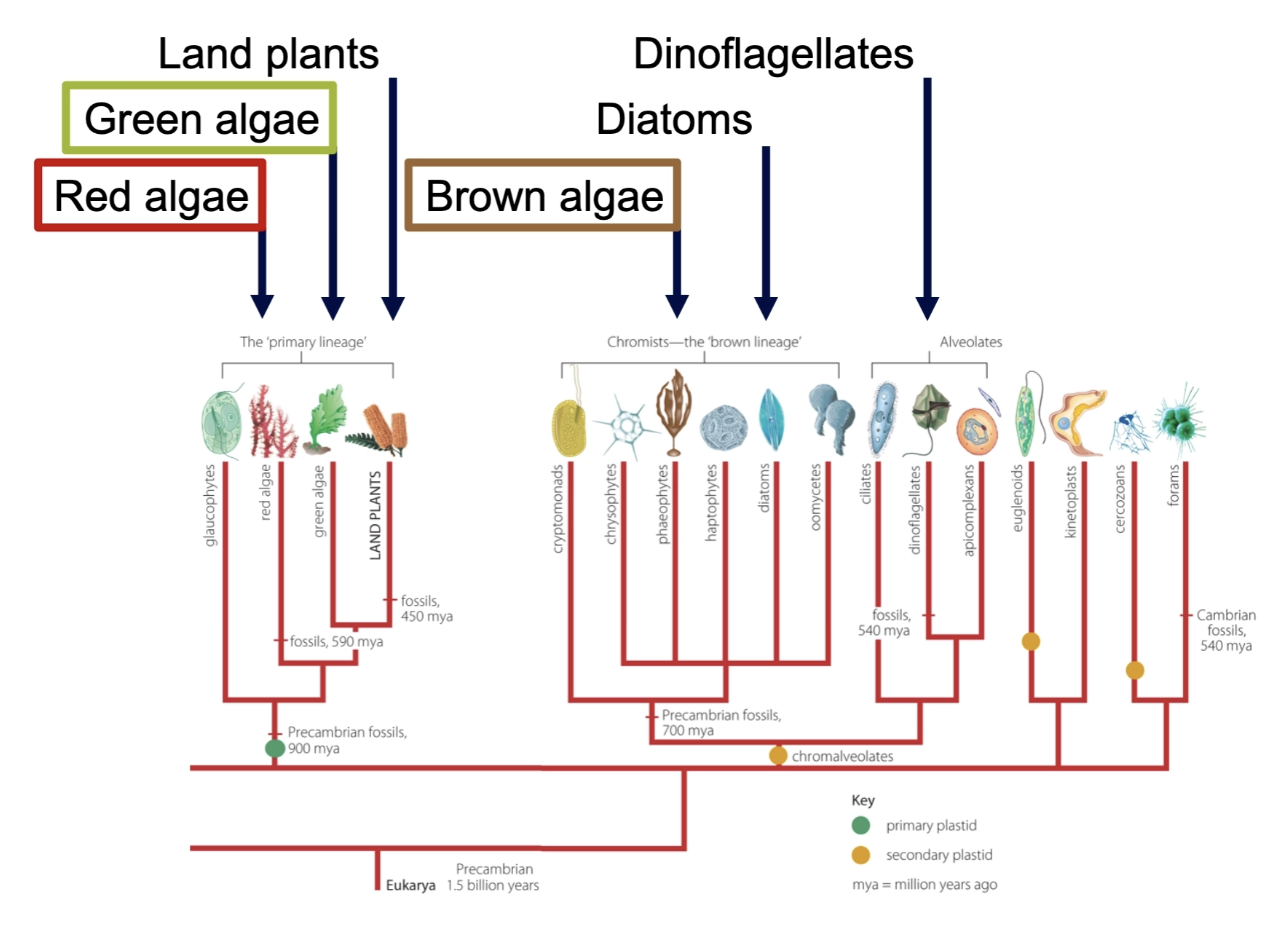
Phylogeny of eukaryotes: Algae have different evolutionary backgrounds
Organisms with cell(s) containing a nucleus, other membrane-bound organelles
May be single-celled (unicellular) or multicellular
Land plants are thought to have evolved from green algae – chlorophylls a, b
Seagrasses evolved from algae in the sea to plants on land, then back to the sea
Brown algae evolved more recently
Seaweeds share some similar features in response to shared environments – convergent evolution
What are seaweeds?
Seaweeds are marine macroalgae (generally macroscopic)
Algae have different evolutionary backgrounds
3 major groups:
Green algae (division Chlorophyta)
Red algae (division Rhodophyta)
Brown algae (division Phaeophyta)
Grow firmly attached to solid surfaces
Structurally simple photosynthetic organisms (compared to land plants)
Have primitive methods of reproduction
Vary in size, structure
General structure of seaweed
Do not have roots, stems and leaves, but equivalent structures:
Holdfast = roots — purely for attachment (to rocks, pebbles, shells)
Thallus = stipe + fronds
Stipe = stem — purely for support
Fronds = leaves — photosynthesis + nutrient absorption
Seaweeds vary in size
Smaller: flat sheets, fixed at single point
E.g. Sea lettuce
Smallest are microscopic
Larger: more complex stipe (stem-like) and frond (leaf-like) structures, fixed with holdfast
Largest: Giant kelp, >30 m length
Seaweeds vary in structure
May have additional structures, E.g.
air bladders e.g in Giant kelp
veins
midribs
Pneumatocysts e.g in Giant kelp
contain oxygen and nitrogen
hold up fronds near the surface (light is most abundant there, kelp very long)
Seaweed reproduction
Do not have flowers, fruits or cones, but reproduce via gametes and/or spores
Types of reproduction: sexual, asexual, vegetative
Some species have different growth forms at different stages of life
Alternation of chromosome numbers (haploid, diploid)

Seaweed zonation with water depth
Seaweeds are photosynthetic:
rely on light
have different pigments that capture different light wavelengths
With increasing depth, light levels and quality
changesred light (longer wavelength interval) almost completely absorbed by shallow water
blue light (shorter wavelength interval) penetrates deeper waters
Thus, the abundance and type of seaweed change with water depth
Shallow: Green algae
Deeper: Brown algae
Deepest: Red algae
Green algae, Division Chlorophyta
Contain green pigments (Chlorophylls a & b, β-carotene)
absorb red light
most efficient in shallow water
No accessory pigments masking chlorophyll (that’s why green colour)
Found where light is abundant:
intertidal rocky shores
shallow subtidal reefs
Mostly freshwater
7,000 described species (huge), ~10% are seaweeds
140 species from Australia, >1/3 are endemic
Habitat for many small animals; eaten by many animals (E.g. caulerpa and small sea slug Edenttelina typica)
Eaten by humans as fresh sea vegetables E.g. Caulerpa, Ulva
Taxon identification / species classification:
Taxon: green colour
Species: shape
Range of forms:
Linked discs
Tufts
Long filaments
Flat sheets
String of beads
Green algae genera
Codium spp.
Wide variety of forms
Internal structures are similar between species
Coenocytic: composed of only one cell, with many nuclei
Utricles that make up tip of fronds are unique to species
Forms:
Large sphere
Lobes
Branching fonds
Caulerpa spp.
All algae grow attached to hard surfaces, but this is an EXCEPTION
stolons run under soft sediments of sand and fronds will emerge
Fronds arise from rhizomes in soft sediment
Common tropical species – but many species in southern Australia
Coenocytic (multinucleate)
Forms:
Flattened, unbranched fronds
Unbranched fronds
Club-shaped vesicles
Brown seaweed, Division Phaeophyta
Yellow-to-red accessory pigments (chlorophylls a and c, β-carotene, fucoxanthin, etc)
mask green pigments (Chlorophyll a), thus brown colour
absorbs longer wavelengths (green) in deeper water
Found:
low intertidal – strong wave action (they have adaptations to cope with strong wave action)
subtidal
Nearly all marine, predominantly large marine algae
2,000 formally described species worldwide
240 species from Australia, many endemic
Provide habitat for other organisms – more complex fronds and holdfasts
Form dense mats (intertidal), and beds or forests (subtidal)
Harvested for alginates (thickening agent), animal feed, and fertilisers
Taxon identification / species classification:
Taxon: brown colour
Species: shape
Range of forms:
Thin crusts
Small tufts
Globular
Flattened fronds
Branched fronds
Bull kelp water carrier
Maker: Eva Richardson
Durvillea grows quickly (up 10-12cm per day), so is abundant and a sustainable source of seaweed
Durvillea is flexible when wet, but stiffens when dry
In deeper waters, Durvillea is a darker colour and grows thicker
Red seaweed, Division Rhodophyta
Red accessory pigments (chlorophyll a, β-carotenes, phycoerythrin, others)
mask green pigments (Chlorophyll a)
absorb longer (green), and longest wavelengths (blue, purple) in deeper water
Accessory pigments produce array of colours: red, yellow, brown, orange, purple, black, white
Found:
shallow waters (intertidal, subtidal), but bleached or underneath other algae
deeper than brown seaweeds, > 200 m
Nearly all marine
7,300 described species (underestimate)
1,300 species from Australian, most endemic
Harvested for food (Nori, Porphyra), laboratory work (agar), and as stabilisers and texture-enhancers (carrageenans)
Taxon identification / species classification:
Taxon: any trace of red colouration
Species: shape, microscopic detail (e.g. reproductive structures)
Range of forms:
Knobby clusters
Flattened fronds
Branched fronds
Turfs
Filaments
Unlike brown algae, it won't form giant mats or forests, it will often be smaller individual algae
E.g. Coralline algae
Resemble animal corals in appearance
Build calcium carbonate skeletons – hard, rigid, crusty
2 key growth forms:
Encrusting coralline: thin film over rock
Articulate coralline: calcified segments (stipe and fronds), uncalcified joints
Global production of seaweed
Algae are major primary producers in marine environments
Great Southern Reef is powered by algae
Algal forests have particularly high NPP
especially, large brown algae — 2-3x more productive than oceanic phytoplankton
comparable, or higher productivity, than terrestrial ecosystems (depending on lat)
NPP is high for intertidal algae and subtidal brown algae
especially, large brown seaweeds E.g. Bull kelp Durvillaea antarctica
NPP is high for green-tide — floating macroalgae
especially, Ulva sp. bloom
Seaweed sisters
Lucy Moore, Lucy Cranwell, Nancy Adams, Eileen Willa, Wendy Nelson
Showed a passion for the botanical world from an early age
Learned from and supported one another in their careers as phycologists
Made important contributions to seaweed science in Aotearoa New Zealand
Some of the biggest collectors (and identifiers) of specimens
Their collections continue to be used for research today
Women phycologists contributed many algal specimens to Te Pappa:
5,704 Wendy Nelson
2,286 Nancy Adams
Together, Wendy Nelson, Nancy Adams identified ~15,000 algae specimens — about 50% of the Te Papa algae collection
Seaweed taxonomy
In the past: Identification in the field and pre-molecular techniques
by eye and hand
using features like colour, texture, smell
microscopic sections
Presently: + Identification with molecular technology
used to update and refine the seaweed family tree
researchers have repeatedly found that one ‘species’ is several different species
changing how new compounds for health, materials and climate solutions are discovered
What is symbiosis and mutualism? Use 2 examples of microalgae.
Symbiosis: Interactions in which two organisms (symbionts) live together in a close relationship that is beneficial to at least one of them
Mutualism: Symbiotic interaction between two species where both benefit from the association (a type of symbiosis)
Lichen: fungi and algae
Coral: polyp (P: Cnidaria, C: Anthozoa) and ‘zooxanthellae’ (Division Dinoflagellata, F: Symbiodiniaceae, G: Symbiodiunium)
What are lichen (P: Ascomycota) ?
Crusty, plant-like organisms
Symbiotic relationship between fungus and alga
Each ‘species’ of lichen is a partnership
Fungus: at least one species of fungus
Classification based on fungus species
Provides algal cells favourable environment; shelter, growing framework
Alga: at least one species of green algae (less commonly cyanobacterium)
Makes food via photosynthesis; fungus takes a share of this food
Alga can grow by itself, but fungus needs the alga to survive
Non-marine species
Grow on bare rock in spray/splash zone
Wider range of lichens grow on sand dune trees, mangroves, and woody salt marsh plants
Maritime species
Nearly all crustose – crust-forming, look like flaking paint
Often circles/arcs, grow outwards from centre
Some species of maritime zone in Australia:
Xanthoria species – usually yellowish
Caloplaca species – yellow to orange
Lichina confinis – black tufted lichen; extensively grazed by little blue periwinkle Austrolittorina unifasciata
Algae have different evolutionary backgrounds:
Red and green algae closely related
Land plants are thought to have evolved from green algae – chlorophylls a, b
Seagrasses evolved from algae in the sea to plants on land, then back to the sea
Brown algae evolved more recently
Diatoms: unicellular brown algae with silica walls
Alveolates: diverse, monophyletic group (protists collectively is paraphyletic)
Photosynthetic, parasitic, predatory organisms
Dinoflagellates
Mangroves
Intertidal
All flower
Fertilised egg develops into seed OR seed develops into ‘live plant’ (seedling) on parent
seedling falls away from parent plant
carried by water, lodges into sediment; roots, stem quickly grow
Adapted to life in anoxic, saline sediments – roots, leaves, bark
Seagrass
Subtidal (under permanent water)
Seagrasses have
Roots, stems, leaves
Ribbon-like, grassy leaves
Pollen, tiny flowers, fruits, seeds
But are not true grass
More species in tropics than in temperate zones
Dinoflagellates
Greek: dinos + flagellum = whirling whip
Cells spin or whirl through water when swimming
Vigorous swimmer; swim up to 1 m per hour
Swim using two whip-like tails:
Posterior flagellum: directed towards back; steers cell
Transverse flagellum: spiralled and encircles cell; generates forward movement and spinning
Tiny single-celled planktonic organisms
Microscopic; <0.01 mm (or 10 μm) in length
2 groups:
Planktonic “animals” they feed (zooplankton) OR planktonic “plants” they photosynthesise (phytoplankton)
Drift OR free-float in surface waters
Free-living ones are often armoured; bodies covered with ornamented plates (cellulose)
Exception: If it is a symbiont such as zooxanthelle (living in corals) — no flagella and armoured plate
What is algal bloom?
A rapid increase (reproduce) in population size when conditions are favourable
Usually occurs when there is:
Nutrients are available to feed microalgae — support growth
E.g. following heavy rains, upwelling of nutrients
Warmer waters
E.g. higher than average sea surface temperatures
Little water movement — must be dense and not dispersed
E.g. consistent periods of low winds and calm seas
Bioluminescence = ability of some living things to give off light
Red tides = algal blooms that colour the water red
Describe bioluminescence
Marine bioluminescence is generally blue
Blue light (short wavelengths) travels well through water
Glowing seas (“ocean glows”) are usually produced by dinoflagellate blooms (sometimes other protist species)
Dinoflagellate species multiply rapidly and aggregate, creating blooms
Need to be disturbed: When waves crash on shore or organisms hit water, dinoflagellates are agitated and create bioluminescence
A common species is Noctiluca (night light, “sea sparkle”):
Widespread, found in all oceans
Bioluminescent and congregate in surf, creating phosphorescence
Describe red tides
Formed by some dinoflagellate species
Cells densely aggregate
Contain red photosynthetic pigment (β-carotene)
Can be highly toxic (to humans and resident marine organisms)
Produce neurotoxins; use dissolved oxygen
Killing marine life, sometimes over large areas
Accumulate in tissues of marine life
filter feeding organisms E.g. bivalve molluscs —> causing diarrhetic shellfish poisoning in humans
certain warm-water fish, causing “ciguatera poisoning” that can kill humans
Harmful algal bloom = species of microalgae that in high concentration can be harmful to humans and deadly to marine organisms
Case study: South Australian algal bloom
One of Australia’s worst marine environmental disasters:
Began 2025, persisting for >12 months
Affecting ~20,000 km2, almost 30% of South Australia’s coastline
Chlorphyll a is an indirect measure of how much microalgae there is
Species responsible: Karenia cristata (C:Dinophyceae - a dinoflagellate)
Dominant species; found in high concentrations, 90% of samples
Causing severe marine and acute human impacts via brevetoxins
Produce substantial amounts of brevetoxins
Brevetoxins have toxicological effects / are potent toxins
Resulting in deaths of >10 million marine animals, >600 taxa affected
Marine mammals, fishes, birds, molluscs, other invertebrates
Among the most toxic species to marine life ever studied
Just 5,000 cells L-1 (or 5 cells mL-1) sea water can kill zooplankton
During SA algal bloom: >1 million cells L-1 in coastal sea water
What caused the algal bloom:
Nutrients promote microalgae growth
Murray River flooded
In 2022/2023, nutrients flushed from Murray River into Southern Ocean during major flood
Unusually large upwelling
In 2023/2024, large cold upwelling brought nutrient rich water to surface
Higher sea temperatures promote microalgal growth
Marine heatwave
From September 2024, sea surface temperatures were >2 °C above normal
Low wind, calm seas
Waters relatively still, algae not washed out with series of high pressure systems
What were the effects of the algal bloom?
From March 2024:
Surfers, beachgoers reported illnesses
Brown foam, dead sea life found
Beginning of >12 month crisis along South Australia’s coastlines
Scientists are conducting research, to better understand unprecedented and widespread impact
Overview of corals P: Cnidaria, C:Anthozoa
Soft corals, hard corals, sea anemones
Hard corals extract calcium from seawater to make calcium carbonate outer skeletons
Reef-building corals
Some corals feed themselves, but most corals starve without dinoflagellate symbionts
Many symbiotic algae within tissues: up to 30,000 algal cells per m3 coral tissue
Colonial organisms: many individual polyps live and grow while connected to one another
Made up of many repeating units that can each function separately — each coral polyp can feed and reproduce but they transfer nutrients and metabolites between colony members
Polyp: tube-shaped structure, with ring of tentacles surrounding mouth, attached to reef at base
Each coral polyp lives in a cup it built form calcium carbonate
Mutualism in corals
Mutualism: symbiotic relationship where both partners benefit
Symbiont: “zooxanthellae” (Division Dinoflagellata, F: Symbiodiniaceae, G: Symbiodinium)
Live inside coral polyp tissues (clear)
Have yellow-brown pigments, giving coral its colour (coral cells are clear)
Supplies host animal with nutrition
Uses waste products from animal host (carbon dioxide,phosphorus, nitrogen)
Provides >90% of nutrition via photosynthesis (oxygen, sugars, fatty acids, lipids, amino acids) to host to grow and build reefs
Host: coral (Phylum Cnidaria, Class Anthozoa)
Grow where light is sufficient for their symbionts to photosynthesise
Protects symbiont – symbionts live, reproduce, photosynthesise within cells of coral polyps
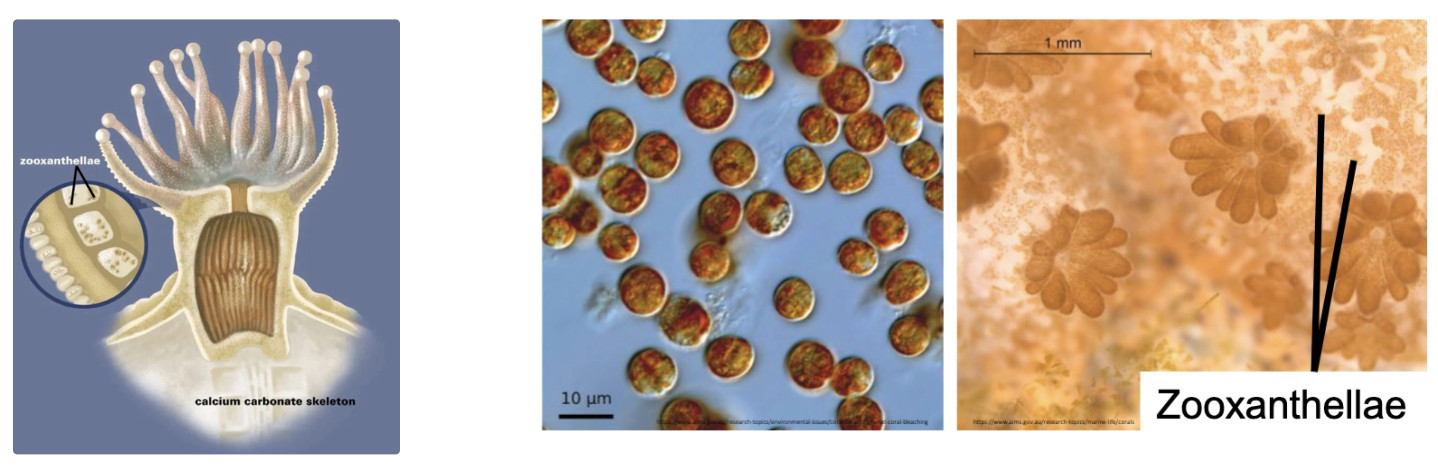
Describe the process of coral bleaching
Corals may bleach when exposed to stressful conditions
Bleaching: gradual loss of zooxanthellae over time
When sea surface temperatures increase ≤1 °C corals may become heat stressed
Dinoflagellates cannot use the sun’s energy as efficiently for photosynthesis —> turn excess energy from sunlight into toxins (reactive oxygens species)
Toxins damage dinoflagellates and their coral host
When stressed, corals
expel their dinoflagellates through their mouth
dinoflagellates are coloured
dinoflagellates provide 90% of food to corals
so they become white and starve
body tissues become transparent
white coral skeleton is exposed
Heavily bleached corals
Very stressed, starving
No remaining symbiotic microalgae (zooxanthellae)
Pure white bleaching
Some colonies produce sunscreen-like chemicals
Fluorescent pigments help to protect coral against UV light
Appear bright yellow, pink, blue or purple

What are the possible outcomes of coral bleaching? What are other taxa with symbionts that can also bleach?
Corals may bleach and recover OR die
Corals may recover if stressor ceases
If conditions return to normal
If corals regain their dinoflagellates
But, corals may be affected in other ways:
Slower growth
Reduced reproductive capacity (maybe lower quality egg and sperm)
Greater susceptibility to disease
If corals do not recover, bleaching leads to:
Coral mortality – no food from zooxanthellae
Overgrowth by macroalgae (seaweeds)
Erosion of the calcium carbonate skeleton
habitat complexity for other organisms is lost
Other taxa with symbionts can also bleach:
Anemones (P: Cnidaria, C: Anthozoa)
Giant clams (P: Mollusca, C: Bivalvia)

Describe mass coral bleaching and an example
At a local level, many stressors can cause corals to bleach E.g. storms, disease, sediments, changes in salinity
At a regional level, increased sea temperatures can cause widespread coral bleaching
Marine heatwave (MHW) = sea temperatures are warmer than normal, for an extended period
temperatures 1-2 °C above normal summer maximum
5 days, or a few weeks
Cause widespread coral bleaching through heat stress
Mass coral bleaching has widespread effects
Corals provide food for organisms
Affect species that feed directly on coral E.g. coral herbivorous fish
Corals form complex habitats for many marine reef animals
Affect species that use complex reef structure of coral for habitat E.g. to shelter, to hide
Mass coral bleaching: Great Barrier Reef
Due to climate change, marine heatwaves are now: more widespread, more intense, more frequent, longer-lasting
Mass bleaching events on Great Barrier Reef documented with full-scale surveys:
1998, 2002, 2006, 2010, 2016, 2017, 2020, 2022, 2024, 2025
6 mass bleaching events in <1 decade, 2 of these were 1 yr apart

What is disturbance and what are common aquatic physical disturbances?
Disturbance: environmental fluctuations that affect biological communities generally in a negative way
Wave action
Wave forces can bring up sand into the water (abrasive, can break fragile organisms, and fleshy organisms like kelp can tear)
E.g. Port Campbell, great ocean road in 2016 — cold front brought strong persistent winds (ave. wave 2.5m, became 7m)
Rainfall
Storms — large amount of freshwater being brought into a marine environment through heavy rainfall and changing salinity levels
Introduces sediments and pollutants into the marine environment from the terrestrial environment or freshwater environment
E.g. 2022 storm over port philip bay over several days (expected 30mm rain into Port Philip Bay, and the terrestrial environment would collect and then flush water into the bay, bringing sediments and any pollutants)
Sea water temperature
Seawater can increase or decrease either locally or regionally
E.g. Marine heatwave in southeastern Aus 2024 — 2.5 higher than ave. persisted for many months rom sep 2023-feb 2024, brought warmer water further south, bringing potential propagules and organisms to move into areas where they weren't or aren't usually found
Competition and Intermediate Disturbance Hypothesis
Diversity: species richness; the number of species in a specified unit area or volume
When organisms compete, disturbance may remove some competitive species, creating space for new colonists
Generally, intermediate disturbance results in maximum species diversity to occur
Factors:
Time since the disturbance
Frequency (how often) of disturbance
Intensity (how extreme) of disturbance
are important for the overall diversity of a community
Frequency of disturbance is important for overall community diversity:
Low: infrequent disturbance, or few disturbances
strong competitors may takeover e.g. long-lived coral species
long-lived species exclude shorter-lived species e.g. more weedy species
As result, diversity is low
A group of competitive species may dominate, e.g., slow growing, long- lived corals on a coral reef
High: frequent disturbance, or many disturbances
long-lived or highly competitive species may be removed
‘weedy’ (early succession) species likely dominate
As a result, diversity is low
When disturbance is intermediately frequent, the community has:
early succession species, and late succession species
As a result, diversity is high
Disturbance can maintain diversity (when intermediate), by preventing competitive exclusion
CS: Intermediate disturbance of Great Barrier Reef
2006 pre disturbance: intact reef
2008 and 2009 disturbance (storms): reduced the coral cover really low down to rubble
2012 3 yrs post disturbance: some recovery via recruitment, growth, and fragmentation
recruitment: larvae of coral move in, settle, and if they survive, they grow into a polyp that then grows into a small colony and a large colony
2014 5 yrs post disturbance: the reef recovered and coral exceeded pre-disturbance levels (did better following disturbance)
usually takes 10-15 yrs before recovery
How many different species would we expect if we increase the frequency (hypothetically)…
If there was another disturbance 3 years after initial disturbances (2008, 2009)
Another disturbance would:
remove any surviving long-lived species
introduce more “weedy” or early succession species — recruitment from local and/or distant corals
If it experiences too many disturbances in close succession, it will never get a chance to recover, and it would solely rely on propagules or larvae moving in for recovery.
If there was another disturbance 20 yrs later:
At 2014, coral had recovered — if left for even longer, those dominant, slow growing, big competitively dominant coral would overtake the surrounding corals, and reduce the number of weedy species
Another disturbance would:
fragment or remove long-lived, competitive species
introduce “weedy” or early succession species again (recruitment from local and/or distant reefs)
Disturbance can maintain diversity by preventing competitive exclusion
Neptune’s necklace / bubbleweed Hormosira banksii overview
Southern Australia, New Zealand
Mid intertidal zone
tends to grow on / attach to boulders or rock
Fronds (thalli) grow from holdfast
Beads or receptacles
resistant to desiccation
with ‘warts’: conceptacles (where gametes are produced)
Dioecious — separate sexes
Forms a canopy
tends to be a dominant alga
is an autogenic ecosystem engineer = changes the environment via its physical structure — provides shade, locks in moisture under the talllae
provides habitat on rocky, intertidal shores
provides refuge
for a lot of invertebrates and smaller seaweeds
without Hormosira, species are excluded or only occur in low abundances

Hormosira banksii as a habitat
Varies in abundance
Creates a patchwork or mosaic of habitats
full canopies: buffer light intensity and temperature; shaded, cool refuges
patchy canopies: some protection form light and/or temperature
no canopy = bare rock; no protection from light and/or temperature
Species assemblages changed in response to canopy cover
carnivorous or scavenging snails need to be able to find their prey — tend to like open spaces because they can move around and can move into Hormosira, that's where their prey will be (mostly Austrocochlea or Turbo species)
Intermediate disturbance hypothesis — Species diversity may be greatest with semi-frequent disturbance to create mosaic of habitats

Hormosira banksii is an ecosystem engineer
When Hormosira banksii has lower abundance, herbivorous gastropods:
are excluded or only occur in low abundances
can no longer seek refuge
When Hormosira banksii abundance varies, the type of gastropods found (species assemblages) varies too
Mid intertidal species found in dense, full canopies – lower light, lower temperature
High intertidal and splash/spray species are found in patchy canopies or no cover – higher light, higher temperature
Carnivorous or scavenging gastropod species need access to prey; move on bare rock to access herbivorous gastropods in Hormosira banksii
Threats to Hormosira banksii
Desiccation – browning of receptacles
Rotting seaweed (decomposing fronds)
Human trampling
can burst beads — long-term damage
Storms
can rip fronds
Sand
covers access to sun
abrasion in water can wear away at soft tissue
Where is the subtidal zone?
The marine habitat, from the low intertidal tide mark further down into the water — permanently covered by water
Red and brown algae (particularly in deep waters) are characteristic
Rocky subtidal shores: sea anemones, sea urchins, sea squirts
Sandy subtidal shores: shrimps, crabs, flounders
Benthic organisms on or in sediment:
Epifauna: benthic organisms that live on the surface of the seabed, either attached to objects on the bottom (sessile or sedentary) or free-moving
Infauna: benthic organisms that dig into the seabed or construct tubes or burrows (bottom dwelling, in the sediment)

Vertebrate predators of benthic organisms
Pied Oystercatcher, Haematopus longirostris
intertidal mudflats, sandbanks
feeds on worms, crustaceans, insects
uses bill to cut adductor muscles of bivalves — shell will then open
prey capture: sight, probing bill
Port Jackson Shark, Heterodontus portusjacksoni
rocky reefs; sandy and seagrass areas
feeds on molluscs, crustaceans, echinoderms (things with hard exoskeletons or shells)
crushing, molar teeth
Elephantfish, Callorhinchus milii (C: Chondrichthyes)
searches sea floor for prey: invertebrates, small fishes
has a hoe-shaped snout
head: sensory canals and pores to detect prey
Smooth Stingray, Dasyatis brevicaudata
largest of all Australian stingrays
bottom-dwelling
feeds on benthic invertebrates, fishes
Seagrass
Sea nymph, Amphibolis antarctica
Important habitat
Stem: pale brown, segmented multibranched
Leaves: at end of branches in groups, overlapping at the base
Rhizome: creeping
Found: sandy bottoms, subtidal rocky reefs and tidal pools, moderate-strong water movement
Seagrasses, Zostera spp
Important nursery habitat (for developing larvae or juvenile fishes and invertebrates)
Zostera mullerei
leaves: medium green; linear, 2-4 leaves per shoot
found: soft sediment, intertidal, shallow subtidal, sheltered waters
Zostera nigricaulis
leaves: flat and long, rounded tip, cluster (5-12) at top of stems
found: soft sediment, tidal pools, shallow subtidal waters
Seagrasses as habitats for:
Hydroid (Phylum Cnidaria), Pycnotheca producta
Colony: many individual polyps joined by a network of stolons
Found: leaves of seagrass in shallow water
filter feeder: plankton, particles
Lace coral (Phylum Bryozoa), Celleporaria cristata
Colony: smaller zooids make-up colony
Feed via lophophore (tentacles)
Found: anchored on structures, including seagrass
Filter feeder: plankton, particles
Seagrass wrack
Seagrass has limited lifespan
leaves: 90 days
rhizome: days to years
Turnover rate per day: high — 2.6% of seagrass lost from the plant
loose seagrass may accumulate on shore as wrack
Seagrass wrack
important food and habitat for sandy beach fauna (birds, small organisms, inverts)
nutrients for dune vegetation
formation of coastal dunes — traps sand and binds sand tgt
Wrack availability
affects diversity and abundance of intertidal animals
small (vs medium, large) patches of Saccorhiza polyschides had:
lower diversity
lower abundance
colonisation of wrack patches was rapid for most species
Seagrass wrack as habitat
Pheasant shell, Phasianella australis
variable pattern and colour
found: among fronds of seaweeds, seagrasses
herbivore: feeds on seaweeds, seagrasses
Moon snail, Polinices sp.
shell: round at base, aperture semi-circular (BUT is a carnivore)
found: intertidal sand flats
carnivore: bivalves, other gastropods
radula drills into shell of prey
hole: countersunk (narrow at the bottom wider at the top)
muscular foot prevents prey escaping