ACCT Exam 2 (Ch 4-7)
 Call Kai
 Learn
 Practice Test
 Spaced Repetition
 Match
 Flashcards
 Knowt Play
1/77

There's no tags or description
Looks like no tags are added yet.
78 Terms
2 Kinds of Merchandiser
Wholesaler: buys products from manufacturers and sells them to retailers
Retailer: buys products from manufacturers or wholesalers and sells them to consumers
Net Income for Service Companies
Revenues - Expenses = Net income
Service companies sell TIME to earn revenue (ex: accounting, law firms, and plumbing services)
Net Income for Merchandising Companies
Net Sales - Cost of Goods Sold = Gross Profit
Gross profit - expenses = Net income
Merchandise companies sell PRODUCTS to earn revenue (ex: sporting goods, clothing, etc)
Inventory Cost
Cost to buy the goods, ship them to the store (freight-in), and make them ready for sale
CURRENT asset with DEBIT balance
NOT INCLUDED: freight-out (ship to customer), selling and administrative costs (advertising, sales, commissions)
Operating Cycle for Merchandiser
Cash purchases of merchandise
Inventory for sale
Credit sales
Accounts receivable
Receipt of cash
Try to keep as SHORT as possible (assets in inventory and accounts receivable are not productive)
DIFFERS depending on company:
Department stores: 2-5 months
Grocery stores: 2-8 weeks
Cash sales SHORTEN operating cycle
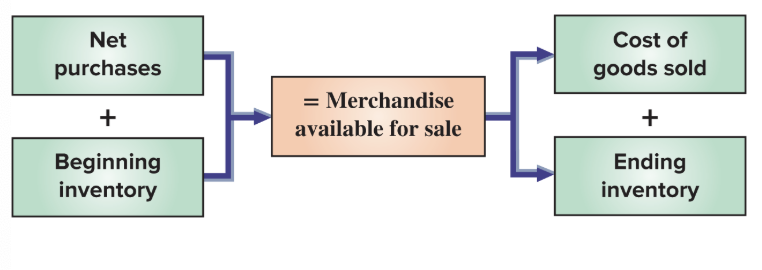
Merchandise Inventory System Cost Flows
Cost of Goods Sold (COGS)
The expense of buying and preparing merchandise
EXPENSE on Income Statement (Debit balance)
FORMULA:
Net purchases + beginning inventory - ending inventory = COGS
2 Ways for Companies to Account for Inventory
Perpetual: record cost of goods sold at the TIME OF EACH SALE (continuously)
More expensive but more accurate (increases profit)
Tech has increased use of perpetual
Every purchase, return, discount, entered immediately
NO temporary accounts
Periodic: records cost of goods sold at END OF THE PERIOD
Cheaper
TEMPORARY ACCOUNTS:
DR: purchases, transportation-in, sales R&A
CR: purchase discounts, purchase R&A
Credit terms
Description of the amounts and timing of payments that a buyer (debtor) agrees to make in the future
Ex: n/60 = net 60 days
seller requires full payment within 60 days after invoice
Cash discount
reduction in price of merchandise granted by a seller to a buyer when payment is made within discount period
Purchase discount = BUYER’s POV
Sales discount = SELLER’s POV
EX: 2/10, n/30
2% discount within first 10 days, net amount due in 30 days after initial invoice date
WHY?
encourages buyer to pay EARLIER
Gross Method
Records purchases at FULL invoice price (gross amount) WITHOUT DEDUCTING any cash discounts
Don’t anticipate discount; record discount LATER if paid within discount period
Often used because it complies with revenue recognition rules, used more in practice, easier and less costly to apply
Net Method
Records invoices WITH DISCOUNT
Assumes ALL DISCOUNTS are TAKEN
Any discounts not taken are recorded in “Discounts Lost Expense Account”
When do cash managers want to pay their invoices?
THE LAST DAY
Buyer can use that money until last payment is required
Purchase Returns
Merchandise a buyer purchases and then returns
DEBIT CASH
CREDIT MERCH INVENTORY
Purchase Allowances
Seller granting a reduction (allowance) in price to a buyer of defective or unacceptable merchandise
Customer KEEPS product and gets partial refund
DEBIT LIABILITIES
CREDIT MERCH INVENTORY
FOB point (Free on Board)
Point when ownership transfers to the buyer
2 Kinds of FOB points
FOB Shipping point
BUYER accepts ownership when the goods depart the seller’s place of business
BUYER pays shipping costs and has RISK of loss in transit
“FREIGHT-IN” or transportation-in
Goods are part of buyer’s inventory during transit
FOB Destination
Ownership of goods transfers to the buyer when goods arrive at buyer’s place of business
SELLER pays shipping costs
SELLER has risk of loss in transit
Seller does not record revenue until goods arrive at the destination
“Freight-out” (transportation-out) = Delivery expense
Supplementary Records
refers to info outside the usual ledger accounts
2 entries required for perpetual inventory system for EACH transaction
Revenue recorded
Cost of goods sold
Sales Discount Account
Contra account for Sales
Normal DEBIT balance
Sales Returns and Allowances Account
Contra account to Sales
Normal DEBIT balance
Returns (non-defective and can be resold)
DR: Merch Inventory
CR: Cost of Goods sold
Allowances (inventory is not returned)
DR: Sales R&A
CR: Cash/Accounts Receivable
Net Cost of Merchandise Purchases Formula
Invoice cost + transportation cost - purchase discounts - purchase R&A
Shrinkage
Loss of inventory (ex: theft and deterioration)
Computed by comparing a physical count of inventory with recorded amounts
DR: Cost of Goods sold, CR: Merch Inventory
Used by PERPETUAL inventory systems
Closing Entries for Merchandisers
Close credit balances by DEBITING them to income summary
Temporary Account: Sales
Close debit balances by CREDITING them to income summary
Temporary Accounts: Sale Discounts, sale returns and allowances, and cost of goods sold
Close Income Summary
Close Dividends
DR. Retained Earnings, CR Dividends
DIFFERENCE BETWEEN MERCHANDISER AND SERVICE COMPANY:
Only merchandisers have the temporary accounts
Multiple-Step Income Statement
Details net sales and expenses, and reports subtotals for various types of items
3 MAIN PARTS:
Gross profit
Income from operations (gross profit - operating expenses)
Net income (income from operations ± nonoperating items)
OPERATING EXPENSES (separated into 2):
Selling expenses: costs to market and distribute products and services (ex: advertising)
General and Administrative expenses: costs to administer a company’s overall operations (ex: office salaries and equipment)
NONOPERATING EXPENSES:
Other expenses, revenues, losses, gains that are unrelated to a company’s operations
Single-Step Income Statement
Total revenues - total expenses (inc. COGS)
expenses are commonly grouped into categories
net income is same under single and multiple step income statement so companies choose the format that best informs users
Current Ratio
Current assets/Current liabilities
Gross margin and gross margin ratio
Gross margin: net sales - COGS
Gross margin ratio: (net sales - cost of goods sold) / net sales
Balance Sheet
Reports inventory as a CURRENT asset AFTER accounts receivable according to how quickly they can be converted to cash (liquidity)
inventory after acc. rec. because it is converted slower since inventory has to be sold before cash can be received
Acid-test ratio
FORMULA: (cash and cash equivalents + short-term investments + current receivables) / (current liabilities)
a way to measure a merchandiser’s ability to pay its current liabilities
quick assets/current liabilities
answer should be at LEAST 1.0
Allowance for Sales Discounts Account
Contra account for accounts receivable
normal CREDIT balance
Sales Refund Payable Account and Inventory Returns Estimated Account
Sales Refund Payable Account: Current LIABILITY showing amount expected to be refunded to customers
normal CREDIT balance
Inventory Returns Estimated Account: Current ASSET showing inventory estimated to be returned
ACCOUNTS ARE ONLY CHANGED DURING ADJUSTING PROCESS, remains unchanged during active period
Freight-In vs Freight-Out (both for FOB shipping)
Freight-In:
Shipping costs paid to bring inventory INTO store
Account used: Merch Inventory (or freight-in)
Recorded at time of purchase
AFFECTS BALANCE SHEET
Freight-Out:
shipping costs paid to deliver merch to customers
Account used: Delivery expense (freight-out)
Recorded at time of sale
AFFECTS INCOME STATEMENT
NO freight in or out for FOB destination because SELLER pays
What items does Merchandise Inventory include?
ALL GOODS that a company owns and holds for sale
REGARDLESS of where the goods are located when inventory is counted
Special attention directed towards:
Goods in transit
Goods on consignment
Goods that are damaged or obsolete
Goods on Consignment
Consigner: owner of goods sent to consignee
Consignee: sells goods for the owner
Merchandise is in consigner’s inventory
Consignee NEVER reports consigned goods in inventory
Goods Damaged or Obsolete
damaged or obsolete goods are NOT reported in inventory (if they can not be sold)
if they CAN be sold, they are included in inventory at “Net realizable value” (NVR)
NRV = sales price - selling costs
LOSS is recorded
Inventory Costs
ALL expenditures necessary to bring an item to a salable condition and location
INVENTORY COST: invoice cost - discounts + other costs
Other Costs:
shipping
storage
insurance
import duties
How often do you take a physical count of inventory?
At LEAST ONCE a YEAR
4 Methods of Inventory Costing under a PERPETUAL System
Specific Identification (SI): when each item in inventory can be matched with a specific purchase and invoice
RECORD: Date, goods available for sale, COGS, and ending inventory
Common for custom-made inventory such as jewelry
First in, first out (FIFO): assumes that inventory items are sold in the order acquired
Last in, first out (LIFO):assumes the most recent purchases are sold first
Weighted Average (WA):requires that we use the weighted average cost per unit of inventory at the time of each sale
→ Formula: (cost of goods available for sale at each sale) / (# units available for sale at each sale)
Physical flow and cost flow do NOT have to be the same
Financial and Tax Reporting Effects of Different Inventory Costing Methods
RISING COSTS EFFECTS:
FIFO reports lowest COGS yielding HIGHEST GROSS PROFIT AND NET INCOME
LIFO reports highest COGS yielding LOWEST gross profit and net income
WA reports value b/w FIFO and LIFO
LOWERING COSTS EFFECTS:
FIFO reports highest COGS yielding LOWEST gross profit and net income
LIFO reports lowest COGS yielding HIGHEST GROSS PROFIT AND NET INCOME
Many companies use LIFO to gain temporary tax advantage (b/c it has less income to be taxed)
LIFO Conformity Rule:IRS requires that when LIFO is used for tax reporting, it is also used in financial reporting
4 Inventory Costing Methods and their Advantages
FIFO: Ending inventory on the balance sheet APPROXIMATES its CURRENT COST; follows actual cash flow for most businesses
LIFO: COGS on income statement APPROXIMATES its CURRENT COST; better matches current costs with revenues
WA: smooths out any price changes
SI: matches the costs of items with the revenues they generate
Lower of Cost or Market (LCM) and Lower of Cost or Net Realizable Value (LCNRV)
LCM: Required method to report inventory at market replacement cost when that market cost is lower than recorded cost
Applies to firms using LIFO
Applied to individual units, major categories, or entire inventory
LCNRV: required method to report inventory at net realizable value (NRV) when that value is lower than recorded cost
Applies to firms using: FIFO, WA, SI
NRV = sales price - selling costs
WHEN:
Cost > Market → USE MARKET
Cost < Market → USE COST
HOW:
DR: COGS
CR: Merchandise Inventory
*Inventory is adjusted DOWNWARD when LCM or LCNRV < Total cost of inventory
Why are inventory errors believed to be self-correcting?
They only affect year 1 and year 2 periods
Effects of Inventory Errors on the Income Statement

Balance Sheet Effects of Inventory Errors

Inventory Turnover Formula
FORMULA: (COGS) / Average Inventory
*Avg inventory = (beg inv + end inv) / 2
HIGH ratio is preferred
Shows short-term liquidity
# of times a company turns over (sells) its inventory in a period
Day’s Sales in Inventory
FORMULA: (Ending Inventory / COGS) * 365
Key idea: # of days one can sell from existing inventory if no new items are purchased; useful in evaluating how quickly inventory is being sold
4 Inventory Costing Methods for PERIODIC Inventory Systems
SI (same as perpetual)
FIFO (same as perpetual)
LIFO (begin with very last units purchased)
WA (take average of entire inventory then use that for all sales)
2 methods to estimate inventory
Retail inventory method: based on RATIO of amount of goods for sale at cost at amount of goods for sale at retail
STEPS:
Good avail. for sale @ retail - net sales retail = End inventory retail
Goods avail. for sale @ cost / good avail. for sale retail = Cost retail ratio
Ending inventory ratio / Cost retail ratio = Estimated ending inventory
Gross Profit Method: applies gross profit ratio to net sales (at retail)
STEPS:
(Net sales @ retail) x (1.0 - gross profit) = Estimated cost goods sold
Goods avail for sale @ cost - est. cost of goods sold = Estimated ending inventory
Internal Control System (IMPORTANT)
Policies and procedures used to:
Protect assets
Ensure reliable accounting
Promote efficient operations
Uphold company policies
WHY?
Prevent avoidable losses
Plan operations
Monitor company and employee performance
Sarbanes-Oxley Act (SOX)
Requires managers and auditors of companies whose stock is traded on an exchange to document and verify internal controls
must have effective internal controls
auditors must evaluate internal controls
violators recieve harsh penalties (up to 25 years in jail)
Committee of Sponsoring Organizations (COSO)
5 components of internal control that increase quality of accounting info:
Control environment (company structure, ethics, integrity)
Risk assessment
Control activities (policies and procedures to reduce risk)
Info and communication (report to internal and external parties)
Monitoring (regular review of internal control effectiveness)
7 Principles of Internal Control (IMPORTANT)
Establish responsibilities (easily determine who is at fault)
Maintain adequate records
Insure assets and bond key employees
Separate record keeping from custody of assets (ex: person with access to cash must not have access to cash’s accounting records)
Divide responsibility for related transactions (“separation of duties”)
Apply technological controls (ex: cash registers, time clocks, VPNs, 2FA)
Perform regular and independent reviews (done by ind. auditors)
Blockchain
New, more secure type of accounting ledger that continuously and simultaneously updates and verifies
makes it difficult for changes to be made without people noticing
Limitations of internal control
human fraud (deliberate action)
human error (carelessness)
fraud triangle (opportunity, rationalization, pressure)
cost-benefit constraint
3 basic guidelines for control of cash
Person handling cash is separate from record keeping of cash
Cash receipts are promptly deposited in bank
Cash payments are made by check or electronic funds transfer (EFT)
Liquidity and liquid assets definition
Liquidity: company’s ability to pay for its current liabilities
Liquid assets: cash and similar assets that can readily be used to pay for liabilities
Cash and cash equivalents definitions
Cash: currency, coins, deposits in bank accounts, money orders, and customer, cashier, and certified checks
Cash equivalents: short-term, highly liquid investment assets that are:
readily convertible to a known cash amount
close enough to their due date so their market value won’t greatly change
ex: US treasury bills
Over-the-Counter Cash (cash receipt)
Should be recorded on a cash register after each sale, and customers should get a receipt
Transactions should be stored in the cloud/on file
Anyone with access to cash should NOT be able to access cash records and vice versa
No one can make a mistake or steal cash without being noticed
Cash Over and Short
Income statement account used to record cash overages and shortages arising from errors in cash receipts or payments
Normal DEBIT balance (expense)
Control of Cash Payments
Require ALL payments to be made by check (except for petty cash payments)
Limit access to accounting records except for those with authority to sign checks or make EFTs
Cash budget
Projected cash receipts and cash payments are summarized here
if enough cash for operations, companies try to minimize the cash they hold to reduce risk of theft
Voucher system
A set of procedures and approvals designed to control cash payments and the acceptance of liabilities that consist of:
Verifying, approving, and recording liabilities for cash payment
Issuing checks for payment of verified, approved, and recorded liabilities
Enterprise Resource Planning (ERP) System
Used to streamline electronic cash receipts and payments
Petty Cash System
Small payments for items including shipping fees, minor repairs, and low cost supplies
DEBIT to INCREASE
CREDIT to DECREASE
6 basic bank services
bank accounts
signature checks
deposit ticket
check
EFT
Bank statement (once a month sent to user)
Bank Reconciliation (IMPORTANT)
a report prepared periodically to explain the difference between cash reported on bank statement and cash balance on company’s books
BANK BALANCE ADJUSTMENTS:
ADD: Deposits in transit (deposits made and recorded in depositor’s books but not yet listed on bank statement)
SUBTRACT: Outstanding checks (checks not yet turned into the bank for payment by bank statement close)
ADD/SUBTRACT: Bank errors
BOOK BALANCE ADJUSTMENTS:
ADD: Interest earned and unrecorded cash receipts
ADD: Bank fees and NSF checks (non-sufficient funds)
ADD/SUBTRACT: Book errors
ONLY ITEMS that ADJUST BOOK BALANCE need journal entries
Days’ sales uncollected
(Accounts receivable / net sales) * 365
Indicates how much time is likely to pass before we receive cash receipts from credit sales
measure of liquidity
shorter time = BETTER
Documents and Verification used to Control Cash Payments
Purchase requisition
Purchase order
Invoice
Receiving report
Invoice approval
Accounts receivable
amounts due from customers for credit sales
sales on credit
Why do sellers allow customers to use credit cards?
Doesn’t have to decide who gets credit and how much
Avoids risk of customer not paying
Receives cash faster
More credit options = more sales
Direct Write-Off Method
Records the loss of an uncollectible account receivable when it’s determined to be collected
NO attempt at predicting bad debts expense
Recording Bad Debt Expense:
DR: Bad debt expense
CR: Account receivable
NO ALLOWANCE DW ACCOUNT USED
To Recover a Bad Debt:
DR: accounts rec., CR: bad debt expense
DR: cash, CR: Accounts rec.
Advantages:
simple
no estimates needed
Disadvantages:
Receivables and income temporarily become overstated
Bad debts expense often not matched with sales
Allowance Method
Matches estimated loss from uncollectible accounts receivable against sales they helped produce
ESTIMATES TOTAL BAD DEBT EXPECTED
Recording Bad Debt Expense:
DR: Bad debt expense
CR: Allowance for Doubtful Accounts
Writing off a Bad Debt:
- DR: Allowance DA
- CR: Accounts Rec.
Recovering a Bad Debt:
DR: Accounts Rec. , Cr: Allowance DA
DR: Cash, CR: Accounts Rec.
Allowance for Doubtful Accounts: contra ASSET account with normal CREDIT balance
Advantages:
Records estimated bad debt expense in period when related sales are recorded
Reports account receivable on balance sheet at estimated amount to be collected
Disadvantages:
Estimates needed
3 Methods to Estimate Bad Debts for Allowance Method
Percent of Sales Method (Income statement)
assumes percent of CREDIT SALES for the period is uncollectible
FORMULA: (current period sales * bad debt percent)
Percent of Accounts Receivable Method (balance sheet)
assumes percent of COMPANY’S RECEIVABLES are uncollectible
FORMULA:
Total Estimated Bad Debt Expense: (Total Receivables * Bad Debt %)
Current Bad Debt Expense: (Total Est. Bad Debt Expense - Previous Balance of Allowance Account)
Aging of Accounts Receivable Method (balance sheet)
applied like percent of receivables except several percentages are used to establish allowance
Each receivable is CATEGORIZED by HOW LONG PAST DUE DATE (longer = more likely to be uncollectible)
Each group is multiplied by its established debt percentage
All groups are totaled
→ MOST ACCURATE METHOD
Notes receivable (promissory note)
Promissory Note: a written promise to pay a specific amount, usually with interest ,either on demand or at a stated future date
Maker: person making/signing the note (borrower of money)
Payee: person to whom the note is payable
Maturity date: day the note (principal and interest) must be repaid
Interest Computation: (Principal * Annual interest rate * Time expressed in fraction of days) (←ex: x/360)
Recoding Honored and Dishonored Notes + End-of-Period Interest Adjustment
Honored:
Dr: Cash
Cr: Notes receivable (principal) and interest revenue (interest)
Dishonored:
Dr: accounts receivable
Cr: Notes receivable (principal) and interest revenue
End-of-Period Interest Adjustment
Dr: Interest receivable
Cr: Interest revenue
How Receivables can be Converted to Cash BEFORE their Maturity
Selling Receivables
Buyer = “factor”
acquires ownership
Seller is charged “factoring fee”
gets cash earlier
transfers risk of bad debts to factor
avoids costs of billing and accounting
Pledging receivables
Pledge receivables as security for the loan
company retains ownership and risk of receivables
Accounts Receivable Turnover
Measures how often, on average, receivables are collected during the period
FORMULA: Net sales / Avg accounts receivable
*Avg accounts rec. = (beg balance + end balance) / 2
HIGH turnover = use LESS STRICT credit terms to increase sales
LOW turnover = use MORE STRICT credit terms and MORE AGGRESSIVE collection efforts to avoid having assets tied up in accounts receivable