CHEMISTRY BONDING AND STRUCTURE
 Call Kai
 Learn
 Practice Test
 Spaced Repetition
 Match
 Flashcards
 Knowt Play
1/64

Earn XP
Description and Tags
Year 1
65 Terms
What is bonding?
The study of the forces that hold atoms, ions and molecules together in matter.
What is structure?
The study of the 3-dimensional geometric arrangement of particles (atomic, ions & molecules) in matter.
what are types of strong bonds?
Ionic, covalent and metallic.
What is an ionic bond?
Ionic bonding is the electrostatic attraction between oppositely charged ions.
Electrons are transferred from the metal to the non-metal to achieve full outer shells.
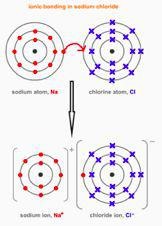
When does ionic bonding occur (electronegativity)?
It occurs with elements with widely differing electronegativities.
What is the structure of ionic compounds like?
Ionic compounds consist of a giant lattice of alternate positive and negative ions held together by electrostatic attraction
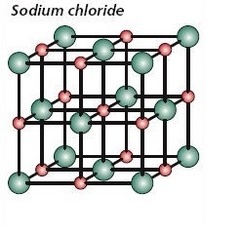
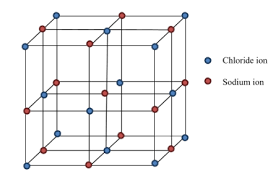
Describe the structure of sodium chloride.
Each sodium ion is co-ordinated to 6 chloride ions.
Each chloride ion is co-ordinated to 6 sodium ions.
Electrostatic attractions hold the lattice together strongly.
Why cant ionic substances conduct electricity when solid?
The ions aren’t free to carry charge through the structure to conduct electricity.
Why do ionic substances have high melting and boiling points?
The electrostatic attraction between the ions are very strong and require a lot of energy to break.
Why are ionic compounds brittle?
The lattice structure consists of alternating layers of positive and negative ions.
When a force is applied, these layers shift, bringing ions of like charges into contact.
These like charges then repel which shatters the lattice.
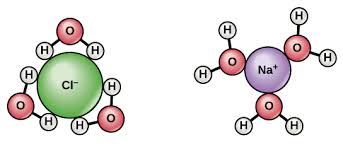
Why do ionic compounds tend be soluble in polar substances, e.g water?
When we dissolve the ionic compound in water, the water molecules surround the ions (see: example image). This can overcome the electrostatic attraction between the ions.
What are the two factors that increase the strength of an ionic bond?
The smaller the ionic radius
The greater the charge of the ion.
Compare the MP of NaCl with KCl.
The ionic radius of the Na+ ion is smaller than the K+ ion (larger charge density). This gives rise to stronger electrostatic interactions in NaCl than in KCl so more energy is required to overcome the forces and a higher melting point results.
What is a covalent bond?
A shared pair of electrons between atoms. There is an electrostatic attraction between the shared electrons and the positive nucleus.
Covalent bonds are stronger if...
…the bond is shorter.
…there are more shared pairs of electrons.
What is a dative/coordinate bond?
Where one atom donates 2 electrons to an atom or ion to form a bond. Once formed, co-ordinate bonds are identical to other covalent bonds
What is electronegativity?
The ability of an atom to attract electrons towards itself in a covalent bond.
What is the trend of electronegativity across the periodic table? What are the 3 most electronegative elements?
The further up and right you go in the periodic table, the more electronegative. 1) Fluorine 2) Oxygen 3) Chlorine.
What is the name of the scale that helps us to quantify how electronegative an element is?
The Pauling scale.
What are the 3 factors affecting electronegativity? Explain why.
Nuclear charge- the more protons, the stronger the attraction from the nucleus to the bonding pair of electrons.
Atomic radius- the closer the bonding pair of electrons to the nucleus, the stronger the attraction from the nucleus to a bonding pair of electrons.
Shielding- The less shells of electrons shielding the bonding electrons, the stronger the attraction from the nucleus to the bonding pair of electrons.
Trend of electronegativity down a group
Electronegativity decreases
Atomic radius increases
More shielding
Less attraction between the nucleus and the bonding pair of electrons
Trend of electronegativity across a period
Electronegativity increases
Atomic radius decreases
Nuclear charge increases
Stronger attraction between nucleus and bonding pair of electrons
What happens if two atoms of equal electronegativity bond together?
The bonding pair of electrons will be found, on average, half way between both atoms. Not polar.
Describe how a polar bond is formed?
There is a covalent bond between atoms with different electronegativities, causing the shared electron pair to move toward the more electronegative atom.
This results in a slight separation of charge. The more electronegative atom has a partial negative charge (δ-) and the other atom has a partial positive charge (δ+).
The electron density is asymmetrical. This is a permanent dipole so the bond is polarised.
What is a dipole?
A slight separation of charge due to different electronegativities.
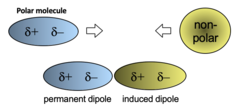
Induced dipoles
Form when the electron orbitals around a non-polar molecule are influenced by a polar molecule with a permanent dipole
As difference in electronegativity increases, bonds change from...
Pure covalent to polar covalent (electrons not equally shared) to polar ionic (distorted ions) to pure ionic
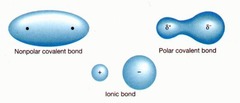
The greater the electronegativity difference, the greater the...
Bond polarity.
As you go across a period, the positive ion gets...
Smaller and more highly charged, so the negative ion is polarised more
What does the polarity of a molecule depend on?
The shape of the molecule.
The polarity of the bonds of the molecule.
The presence of a lone pair.
For a molecule to be polar it must have a net dipole
Non-polar molecules...
Have all identical bonds and no lone electron pairs on the central atom (are symmetrical). Any dipoles on the individual bonds cancel out, so there is no net dipole moment
Polar molecules...
Have non-identical bonds or have lone electron pairs on the central atom (are asymmetrical).
The individual bonds themselves must be polar.
The individual dipoles don't cancel out and there is a net dipole moment.
How can we tell whether an unknown substance is polar?
Fill a burette with the unknown substance.
Open the tap to let it run.
Place a charged rod near the stream.
If the stream bends towards the rod, it is polar (due to the electrostatic attraction between them).
What is a metallic bond?
The electrostatic attraction between a lattice of cations and a sea of delocalised electrons. This is a giant crystal structure
Why are metals good conductors of heat?
Metals have delocalised electrons that are free to move and transfer thermal energy through the structure.
Why are metals good conductors of electricity?
They have delocalised electrons that can carry charge and move through the structure.
Why are metals malleable and ductile?
Layers of ions are free to move
Ions can move without the electrostatic attractions to the delocalised electrons being broken.
Why do metals have high melting points + strong?
Metals have high melting points as metallic bonds are very strong due to the many strong electrostatic attractions between cations and delocalised electrons, which require a lot of energy to overcome
Why are solid metals insoluble?
The metallic bond is too strong to break.
Affect of ionic charge on metallic bonding
The stronger the ionic charge, the more delocalised electrons. This means there is a stronger electrostatic attraction between the positive ions and the delocalised electrons, so the metallic bond is stronger
Affect of ionic radius on metallic bonding
The smaller the ionic radius, the closer the delocalised electrons are to the nucleus, the stronger the electrostatic attraction between the cations and the delocalised electrons, the stronger the metallic bond
Does Na or Al have a higher MP + BP
Higher charge on ions + smaller ionic radius (greater charge density)
More delocalised electrons
Stronger electrostatic attractions between cations and delocalised electrons.
More heat energy required to overcome these attractions.
Higher melting point
What is meant by a simple molecular substance?
Atoms are covalently bonded to each other and are held together by weak van der waals force.
Why do simple molecular substances have low melting and boiling points?
They have weak intermolecular forces that don’t require a lot of energy to overcome.
What does the solubility of simple molecular substances depend on?
Whether the substance is polar or non-polar.
Simple molecular substances are brittle because...
There are no strong bonds to hold them together, only the weak forces between the molecules.
What is the electrical conductivity like in simple molecular substances?
Simple molecular substances do not contain mobile charge carriers, therefore they cannot conduct electricity.
Macromolecular (giant covalent) substances consist of...
A giant lattice, with each atom making multiple covalent bonds
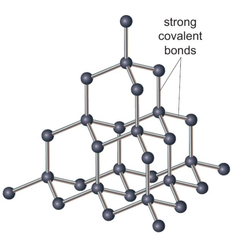
Diamond properties
Each carbon makes 4 covalent bonds to other carbon atoms in a giant covalent structure.
Very high melting and boiling points as a lot of energy is needed to break the multiple strong covalent bonds each atom makes.
Doesn't conduct electricity as it contains no mobile charged particles.
Tetrahedral shape-109.5- Very hard because it has a rigid, three-dimensional tetrahedral network.
Insoluble.
What is the structure like in graphite?
The carbon atoms form layers of planar hexagonal structures with a bond angle of 1200. It is a giant covalent lattice (structure).
Each atom makes 3 covalent bonds
Very high melting and boiling points as a lot of energy is needed to overcome the multiple strong covalent bonds each atom makes
Conducts electricity as the delocalised electrons can move through the substance to carry the charge. 1 delocalised per carbon
Brittle as there are only weak intermolecular forces between the layers, so they can slide over each other
Insoluble
Bonding and lone pairs are...
Charge clouds that repel each other
What is electron pair repulsion theory?
The shape of a molecule is determined by the electron pairs surrounding the central atom.
This is based on the fact that pairs of electrons repel all of the other electron pairs.
The electron pairs now move as far apart as possible to minimise this repulsion-bond angles are as large as possible between pairs.
Steps on deciding molecular shape and bond angles
1. What is the central atom?
2. How many outer shell electrons does it have?
3. How many atoms is it bonded to? (A double or triple bond behaves just as a single pair for these purposes)
4. Is it an ion? Positive - Subtract electron(s), negative - add electron(s)
5. How many electron pairs are there in total?
6. How many bonding and lone pairs are there?
What are intermolecular forces?
Forces of attraction that act between all simple covalent molecules.
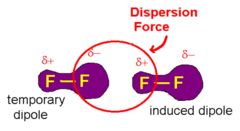
How are Van der Waals formed?
There is an uneven distribution of electrons in every atom/molecule.
This causes a temporary dipole on an atom/molecule.
This then causes an induced dipole on another atom/molecule.
The force of attraction between these dipoles is called a Van der Waals force.
What is the strength of Van der Waals like?
Weak and easily broken.
Why does every single atom/molecule experience Van der Waals?
Because it is caused by random electron movement.
How does the number of electrons affect the strength of Van der Waals forces?
The higher the number of electrons, the stronger the Van der Waals.
Affect of shape of molecule on van der Waals forces
Straight chain molecules can pack closer together than branched molecules, therefore they have stronger van der Waals forces that require more energy to break.
How are dipole-dipole forces formed?
They only act between molecules that have permanent dipoles.
The δ+ and δ- regions attract each other and hold the molecules together in a lattice-like structure
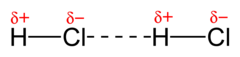
What is hydrogen bonding?
It occurs between molecules which contain hydrogen bonded directly to an electronegative atom-fluorine, oxygen and nitrogen.
When bonded to one of these atoms, a hydrogen atom will be δ+, so forms a bond with a lone pair on a fluorine, oxygen or hydrogen atom on another molecule, shown with a dotted line
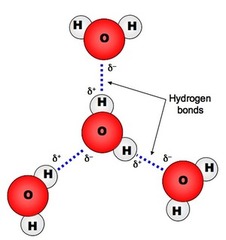
Rules for drawing hydrogen bonds
1. Show partial charges
2. Show lone pairs
3. Show the hydrogen bond as a dotted line
4. Show the atoms involved in the hydrogen bond in a linear arrangement
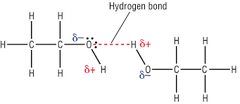
Why does ice have a relatively high meltint point?
In ice the intermolecular forces contain hydrogen bonds.
When we melt ice, we have to break these hydrogen bonds.
These hydrogen bonds require a lot of energy to break.
What are the two conditions we need for hydrogen bonding?
We need a hydrogen atom bonded to a strongly electronegative element.
The electronegative atom must have at least 1 lone pair.
Why is ice less dense than water?
In ice, the molecules are arranged in a lattice due to hydrogen bonds
but, in water, the molecules are not in a lattice so are closer together.