Year 11 Psychology Visual Perception
 Call Kai
 Learn
 Practice Test
 Spaced Repetition
 Match
 Flashcards
 Knowt Play
1/19

There's no tags or description
Looks like no tags are added yet.
20 Terms
Sensation
The detection of light energy produced by stimulation of the visual receptors in the eye.This is a biological process that is the same (for healthy people).

Reception
First stage in the sensory process. Sensory information from the environment is received and processed by our sensory organs.
Perception
Organising, interpreting and giving meaning to what the sense organs initially process. This is an individual process due to different history/ interpretations, languages, culture.

Transduction
Process by which electromagnetic energy (light) received from the environment is converted into electrochemical energy (nerve impulse).

Transmission
Transfer of neural info from the eye to the brain via optic nerve
Selection
The detection and coding of particular features of a stimulus such as size, colour and movement. Process of sorting out or selecting the important messages from the senses and discarding any excess information. Done by feature detector cells in brain
Photoreceptors
Light-sensitive receptor cells in the retina. A cone or rod cell in the retina of the eye that responds to light by converting light energy (electromagnetic energy) into nerve impulses (electrochemical energy) so they can be transmitted to the brain.

Lens
Transparent flexible structure in the eye that focuses light on the retina by changing shape.

Receptors
Body cells that are specialised to detect and respond to sensory information
Visual illusions
Discrepancies that sometimes occur between objects in the real world and how we perceive these objects. It is a misinterpretation (error or distortion) of real visual sensory stimuli.

Rods
125 million in each retina are specialised photo-receptors for night vision and peripheral vision. Do not provide clear detail in the object. Mostly outside the fovea.

Optic nerve
This is the nerve that is involved in transmission of the electrochemical signals from the photoreceptors in the retina to the visual cortex in the occipital lobe of the brain.

Retina
Layers of specialised neurons that line the rear inner surface of the eye. It receives and absorbs light, processes images and transmits neural messages to the visual cortex of the brain. Contains photoreceptors -rods and cones.
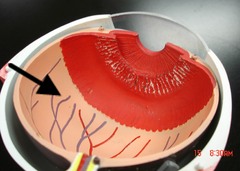
Blind spot
There are no rods or cones at this part of the retina so it doesn't receive any information from this part of the visual field. It is where the Optic nerve leaves the retina.

Cones
Important for daylight vision, detection of fine detail (acuity) and colour vision.
Don't operate well in dim light.
Most numerous in the fovea
6.5 million cones

Perceptual set
Perceptual set is the predisposition, or 'readiness', to perceive something in accordance with what we expect it to be
Due to prior experience, motives, mood and context. Can help us to interpret it more quickly.

Photoreceptors
Light-sensitive receptor cells in the retina. A cone or rod cell in the retina of the eye that responds to light by converting light energy into nerve impulses so they can be transmitted to the brain.

pupil
the adjustable opening in the center of the eye through which light enters

Cornea
The clear tissue that covers the front of the eye. It helps to focus light onto the lens

ciliary muscle
muscle that helps focus light on the retina by controlling the curvature of the lens of the eye
