ceutics radiopharm 1 and 2
 Call Kai
 Learn
 Practice Test
 Spaced Repetition
 Match
 Flashcards
 Knowt Play
1/94

There's no tags or description
Looks like no tags are added yet.
95 Terms
t/f: radiopharmaceuticals must be sterile and non-pyrogenic, but may have particles
false. particle free. most RPs are parenterals/injected
t/f: most RPs are used for therapies such as cancer treatment
false. most RPs are used for diagnosis (90%)
what is a radionuclide/ radioisotope/ radiotracer
any element with an excess of either neutrons or protons in the nucleus= makes it unstable and likely to emit energy to go back to the stable form (aka radioactive decay)
why do radioisotopes go through radioactive decay
they have an excess amount of neutrons/protons that makes them unstable. when they release that energy (aka radioactive decay) they become stable
most radionuclides emit __________ radiation
gamma
t/f: typically, radionuclides lack pharmacological effects
true. primarily used for diagnostics
t/f: RPs have a low safety rating due to their dangerous adverse effects
false. high safety rating. incidence of adverse events is extremely low
roles of a nuclear pharmacist
1. preparation, procurement, compounding, storage, dispensing
2. quality control and quality assurance
3. consultation and safety
what is half life (t1/2)
time needed for half of the original amount of radioactive atoms to decay
what is the decay constant
lambda
- probability that a particular nucleus will decay per unit time
the larger the decay constant/lambda, the ___________ is the decay and _____________ the half life
larger lambda= faster decay= shorter half life
given lambda= ln2/ (t1/2), relate lambda to half life
- inversely related
- as lambda increases, half life decreases (decays faster)
Q: after 24 days, 2mg of an original 128mg radioisotope sample remains. what is the half life of the remaining sample?
initial: 128 mg
24 days later: 2mg
1. begin by reducing in halves
one half life= 64mg
two half lifes= 32mg
three= 16mg
four= 8mg
five= 4mg
six= 2mg
so 24 days has six half lives.
24/6= *4 days* per half life
Q: given uranium238 has a half life of 4.5x10^9 years and a decay constant of 5.0x10^-18, if there were 100mg of U238 then how much would remain after 4.5x10^9 years?
4.5x10^9 is the half life. so after 4.5x10^9 years, half of the amount would remain. 100/2 = 50mg
gamma rays vs x-rays
gamma: high energy and highly penetrating, come from INSIDE the nucleus
x-ray: longer wavelength, come from OUTSIDE the nucleus
rank the types of radiation vs penetration
alpha: paper
beta: wood/aluminum
x-ray: lead, iron
gamma: lead, iron
neutron: water, concrete
Which type of radiation is the most penetrating?
neutron, followed by gamma and x-ray
t/f: PPE made of aluminum is sufficient enough to block gamma rays
false. must be lead/iron/ metals
t/f: PPE made of lead/iron is sufficient enough to block gamma rays and x-rays
true
alpha particles
alpha: very energetic *He nucleus*
- limited ability to penetrate tissue, highly toxic
2 protons, 2 neutrons
written as He 2+ or 4(mass)alpha2(charge)

t/f: alpha particles have a very high ability to penetrate tissues
false. cant even get past paper
alpha particle: how many protons? neutrons? nucles?
2 protons, 2 neutrons, He nucleus
beta particles
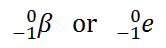
beta (negatron): identical to electrons, negatively charged
- NO mass, just negative charge
positron particles
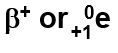
positively charged particle with NO mass

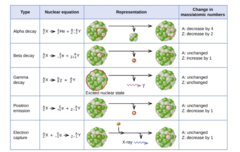
beta/negatron vs positron decay
what is emitted?
atomic number change?
beta/negatron decay: N-> PEA
neutron---> proton (remains)+ electron (emitted)+ antineutrino (emitted)
-atomic number is *increased* by 1
positron decay: P-> NPN
proton----> neutron (remains)+ positron (emitted) + neutrino (emitted)
- atomic number is *decreased* by 1
t/f: in positron decay, the atomic number is increased by 1
false. proton is converted to neutron
so while mass is the same, the atomic number decreases by 1 (fewer protons)
t/f: in beta decay, the atomic number is increased by 1
true. neutron is converted into proton
so while mass is the same, the atomic number increases by 1 (more protons)
superscript denotes ________
subscript denotes __________
superscript: mass
subscript: charge
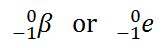
how is an electron denoted

how is an alpha particle denoted

how is a beta particle denoted
how is a positron denoted
how is a gamma particle denoted

Q: what is the atomic mass (208) and atomic number (84) of Polonium after alpha decay?
204 Pb 82
alpha decay= forming 4He2
initial: 208Po84
removing 4 from mass and 2 from charge
final: 204X82 (this would be lead-Pb)
Q: initial is 239Pu94
final is 235U92
what is the other product and what type of decay is this?
mass: 239-235= 4
charge: 94-92= 2
4He2 is emitted, this is alpha decay
Q: what is the atomic mass (14) and atomic number (6) of carbon after it has undergone beta decay
beta decay: neutron-> proton, electron, antineutrino
gains proton= atomic number increases
mass remains the same
mass: 14-> 14
atomic number: 6-> 7 (becomes N)
final: 14N7 + electron + antineutrino
why are alpha particles so toxic
has 2 protons and 2 neutrons= therefore very large and very positive
- causes a lot of damage to negative DNA
- not used for diagnostics
210Po (polonium) is a common ________-emitting radioisotope
alpha (4He2)
_____ particles are ejected from an unstable nucleus after transformation of a *neutron* into a *proton*
beta particles
(going from neutral to positive charge, therefore electron is ejected)
t/f: beta particles come to a stop when stopped by nuclei of heavy atoms like Pb (lead)
true
t/f: beta emissions are not absorbed by the dead layer of skin
false. sufficiently absorbed by dead layer of skin
common ______-emitting radioisotopes include 32P, 14C, 3H, and 22Na
beta
how do positrons differ from beta particles
have the same size and mass, but positrons are POSITIVELY charged. a beta particle is negative
rank the amount of DNA damage as a result of alpha, beta, and positron particles from least to most
(least damaging) beta (neg)-> positron-> alpha (most)
why are positron emitters of particular concern
when positron interacts with neg-charged electron, they "annihilate" eo to produce gamma rays= highly penetrating
______________________ are electromagnetic radiation released from the nucleus of an unstable atom. no mass or charge. highly penetrating
gamma rays
t/f: gamma rays may be formed after alpha and beta decay
true
since gamma rays are highly penetrating, what can be used in PPE
lead
common ____________-emitting radioisotopes include 125I, 51Cr, 137Cs, and 60Co
(chromium, cesium, cobalt)
gamma
what is radioactivity defined as
number of nuclear transformations occurring per unit time
units of radioactivity
Curie (Ci)= mCi, microCi, nanoCi
Becquerel (Bq)- megabecquerel (MBq)

what does REM stand for
Radiation Equivalent in Man
which dose measures are used to estimate REM and potential health effects of ionizing radiation
1. equivalent dose
2. effective dose
3. committed dose
generally, RPs should have a half life short enough to __________ and long enough to ___________
=short enough to minimize radiation exposure to patient
= long enough to allow collection of imaging formation
diagnostic imaging vs therapeutic use
which form of radiation is used?
diagnostic= majority (90%)
- short half life
- GAMMA radiation
therapeutic use (10%)
- BETA particles
t/f: RPs used for diagnostic imaging have no physiological effect
true
dynamic vs static imaging
dynamic= provides info through the rate of accumulation and removal of the radiopharmaceutical from a specific organ
static imaging= provides perfusion and morphologic info (blood flow, organ size, shape, position, lesions)
therapeutic RPs use ________-emitting nuclides. how are they used for therapy?
beta
- used to damage DNA and tissue- targets cancer cells
which drugs and factors can interfere with nuclear imaging?
- cardiovasc drugs w cardiac imaging (beta blockers)
- renal eliminated drugs with renal imaging
- psychotropic drugs with brain imaging
give examples of how RPs are used in cardiology, oncology, and neurology
cardiology: myocardial perfusions
oncology: tumor imaging and localization
neurology: cerebral perfusion
which 99mTc is used in
bone imaging:
liver imaging:
cerebral perfusion:
renal imaging:
bone imaging: oxidronate(bone= dronate)
liver imaging: mebrofenin (liveR= bRo)
cerebral perfusion: exametazime (think of brain= exam)
renal imaging: pentetate (penetRate, r=renal)
90% of RPs compounds used for diagnostic imaging uses which nuclide?
technetium-99m (99mTc)
t/f: technetium-99m is often used for bone,renal,thyroid imaging and radiolabeling of monoclonal antibodies
true
radiolabeled molecules used to deliver radiation to a specific target use ______ radiation and a _________ dose than imaging/diagnostics
beta radiation; larger dose
what is often used to deliver radionuclides selectively to tumors and reduce non-specific side effects
monoclonal antibodies
Yttrium-90
monoclonal antibody labeled with 90Y to treat non-Hodgkin's lymphoma
=ibritumomab tiuxetan (Zevalin)
sodium-iodide 131
- gamma AND beta emitter= both diagnostics and therapeutic
- beta emission kills thyroid cancer tissue
tositumomab
CD20 mAB labeled with sodium iodide 131 (Bexxar)
- non-Hodgkins lymphoma
what is the use of technetium-99m
medical radioisotope used for imaging of bone, liver, cerebral perfusion, and renal function
what radiopharmaceutical is the best choice for thyroid cancer treatment
131I (sodium iodide 131) or 125iodine
which is a widely used metabolic tracer coupled with PET for tumor imaging
18F- fluorodeoxyglucose (FDG)
t/f: radiopharmacy was the last pharmacy specialty recognized by the board in 1978
false. first one recognized
what do the following stand for
SPECT
PET
SPECT= single-photon emission computed tomography
- gamma particles
PET= positron-emission tomography
- positrons
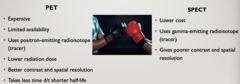
anatomic vs functional imaging
anatomical: physical structures
- X-ray/CT, MRI, ultrasound
functional: biochemical processes
- radioisotopes
- NM/SPECT, PET
which emitting radioisotopes are used in SPECT vs PET
SPECT= gamma
PET= positron
which gamma emitting tracers are often used in SPECT
99mTc and I123
is PET or SPECT more advantageous? why?
PET
- better image quality
- better certainty
- higher accuracy
- lower pt dosimetry
- shorter imaging protocols (30 mins vs hours in SPECT)
PET is often performed with ________ to obtain both function and anatomical info
CT
PET tracers are usually radionuclides containing which elements?
N, C, O, F
in PET, radionuclide decay leads to emission of a _________
positron
which PET tracer is widely used for tumor imaging
18F (fluorodeoxyglucose) (FDG)
18F half life
110 minutes
after generating a radionuclide, what is it often linked with before pt injection and detection
glucose-> will go to the active cells that need it for energy= shows tumor location
radionuclides with positron decay used in PET often have __________ half lives
very short
what is 18F used for? dose?
PET
-cerebral, myocardial, and tumor glucose metabolism
-a lower dose bc it has a long half life compared to other PET isotopes
t/f: FDG (18F) PET scans are often used to both detect and monitor disease
true
what is the drug antidote for radiation exposure to Cs and Th
prussian blue (PB) (radiogardase)
how is PB used as an antidote for RPs
traps Cs and Th in the GI tract= is not absorbed
why is acetazolamide used in nuclear medicine?
DIAMOX
- increases cerebral blood flow 23%
- used to identify ischemic regions
why is cimetidine used in nuclear medicine?
enhances visibility of ectopic gastric mucosa
why is adenosine used in nuclear medicine?
coronary vasodilator used as stress agent to identify stenosed arteries
why is VitB12 used in nuclear medicine?
to identify B12 deficiency via malabsorption through gut. higher renal excretion
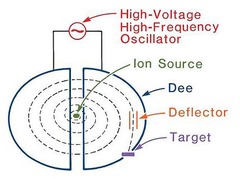
which machine is used on-site in hospitals to form radioisotopes with short half lives
cyclotron
radioactive concentration vs molar concentration vs specific activity
radioactive: total amount of radioactivity per unit volume
molar: total concentration of both labeled/hot and unlabeled/cold product per unit volume
SA: amount of radiolabeled mass in a sample (changed by adding more unlabeled/cold)
common equipment used in nuclear pharmacy
-geiger counters
-lead and tungsten syringes
- dosimeter
-shield containers