PSB 3004C exam 3
 Call Kai
 Learn
 Practice Test
 Spaced Repetition
 Match
 Flashcards
 Knowt Play
1/180

There's no tags or description
Looks like no tags are added yet.
181 Terms
functions of a living organism that display a rhythm of about 24 hours (e.g., human sleep-wake cycles, hormone secretion, body temperature fluctuations).
circadian rhythm
internal mechanisms operating on an annual or yearly cycle, often cued by day length (e.g., bird migratory patterns, Siberian hamster seasonal coat color changes).
circannual rhythms
within-day cycles occurring more than once every 24 hours (e.g., ~90-minute human sleep cycle)
ultraradian rhythms
biological cycles lasting longer than 24 hours (e.g., menstrual cycle)
infradian rhythms
animals that are active during the day and sleep at night
diurnal
animals that sleep during the day and are active at night
nocturnal
patterns of diurnal vs nocturnal animals reflect what?
adaptations to an animal’s ecological niche
the process of synchronizing an endogenous biological rhythm to an external environmental cue
entrainment
the external environmental cue (“time-give,” such as light) that an animal uses to synchronize its internal clock with the environment
zeitgeber
when an animal maintains its own endogenous cycle in the absence of external time cues
free-running
a shift in the timing of activity in response to a synchronizing stimulus, such as changes in when lights turn on or off
phase shift
how do mammals receive light information for entrainment?
via the light reception pathway
what is the light reception pathway?
the way that mammals receive light information for entrainment
light information travels from the eye directly to the suprachiasmatic nucleus via the retinohypothalamic tract
light information travels from the eye directly to the ___ via the ____.
suprachiasmatic nucleus
retinohypothalamic tract
the ____ is the master circadian clock located where?
suprachiasmatic nucleus (SCN)
located in the hypothalamus just above the optic chiasm
what specialized cells project to the SCN?
specialized retinal ganglion cells that do not rely on rods and cones; they contain their own photopigment (melanopsin), making them directly light-sensitive
what wavelength of light has peak sensitivity for melanopsin?
shorter (blue) wavelengths within the visible spectrum
what happened to the circadian period after SCN transplantation in hamsters? what does this tell us?
SCN transplant from fetal hamster w/tau mutation (~20hr period) —> hamster w/lesioned SCN (abolished circadian rhythm)
result: adult hamster circadian rhythm was restored but matched the 20 hr period bc of tau mutation. showed that the period of the clock is determined within the SCN
how do amphibians and birds detect light for circadian entrainment?
In amphibians, reptiles, and birds, the pineal gland (or related third eye structures) is sensitive to light, either directly or through the thin skull, and sets the rhythms
in mammals, light information goes from the eye to the ____ via the ___-
SCN
retinohypothalamic tract
What do you know about the making/translocation/gene activation of the following family of proteins: CLOCK/CYCLE/PER/CRY
SCN cells make two proteins: CLOCK and CYCLE/BMAL1, that bind together to form a dimer
dimer promotes transcription of period (PER) and cryptochrome (CRY) genes
PER and CRY proteins dimerize and inhibit the CLOCK/CYCLE dimer form promoting PER and CRY
No new PER/CRY proteins are made until the PER/CRY proteins degrade; the cycle takes ~24 hrs
Light entrains the molecular clock
how is PER produced in mammals?
retinal ganglion cells detect light with melanopsin, axons in retinohypothalamic tract release GLU onto neurons in SCN; promotes PER protein production; synchronizes molecular clock to day-night cycle
what proteins likely differ between “morning larks” and “night owls”?
likely carry different alleles for the CLOCK and PER proteins
what happened to the study participant isolated from time cues?
the person displayed a free-running sleep-wake rhythm that was a bit longer than 24 hours, getting the equivalent of 74 “nights” of sleep over the 77 days
Do humans still entrain to light as a zeitgeber? How do we know?
yes, because people living on the western edge of a time zone go to bed later than those on the eastern edge despite sharing the exact same clock time because the sun sets later in the west.
What kinds of measures are taken to study sleep?
electrical brain potentials together with other measures (polysomnography) can be used to classify levels of arousal and states of sleep
EEG brain waves, eye movements (EOG), muscle tension (EMG), HR, & respiration
records electrical activity in the brain
electroencephalography (EEG)
records eye movements
electro-oculography (EOG)
records muscle activity
electromyography (EMG)
what characterizes the EEG of an awake/vigilant person?
mixture of frequencies but dominated by beta waves: desynchronized EEG, 13-30 Hz, low amplitude
EEG pattern of activity in an awake person contains many frequencies; known as
beta activity or desynchronized EEG
what characterizes the EEG of a relaxed/drowsy person?
alpha waves, 8-12 Hz

List the three stages/brain waves of non-REM sleep and their characteristics.
stage 1: some alpha waves, mostly theta waves, along w/sharp vertex spikes
stage 2: mostly theta waves, interrupted by sleep spindles and K-complexes
stage 3: large, slow delta waves reflecting alternating cortical neuron down states (hyperpolarized/silent) and up states (depolarized/high firing)
How do amplitude and frequency change as you move through non-REM stages?
as you progress from stage 1 through stage 3 NREM sleep, EEG wave amplitude increases while frequency decreases
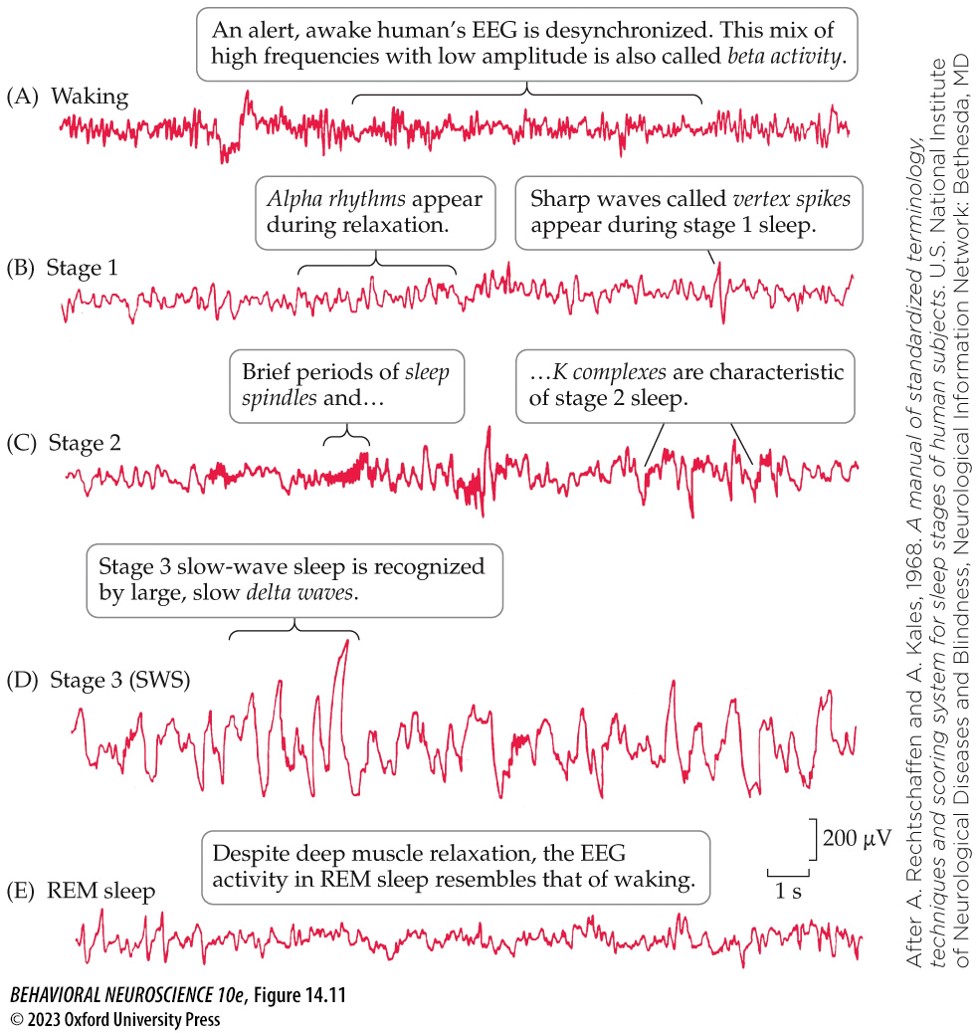
which stages of sleep do we see vertex spikes, k-complexes, or sleep spindles?
vertex spikes: stage 1
k-complexes & sleep spindles: stage 2

stage 1 early markers of sleep onset (may continue into stage 2)
vertex spikes
occur 2-5 times per minute; involved in memory consolidation, filtering external stimuli, and modestly correlate with IQ
sleep spindles (stage 2)
occur ~1 time per minute; serve as precursors to delta activity and perform sensory gating (suppressing arousal unless a stimulus is important enough to wake the sleeper)
k-complexes (stage 2)
what are the characteristics of REM sleep?
rapid eye movement under closed lids
irregular HR and breathing
impaired thermoregulation
high cerebral blood flow
low-amplitude/high-frequency desynchronized EEG resembling wakefulness
vivid story-like dreams
profound muscle relaxation
what percentage of total sleep is REM?
~20% of total adult sleep
what happens to REM duration as the night progresses?
episodes progressively lengthen in later sleep cycles toward morning
near-total loss of skeletal muscle tone (paralysis) caused by brainstem regions (specifically the subcoeruleus) profoundly inhibiting spinal motor neurons to prevent acting out dreams
atonia
each sleep cycle lasts ____ and humans typically complete ___ per night
~90 minutes
4-5 cycles per night

sleep cycles early in the night are dominated by ____. it disappears in later cycles and ___ episodes grow progressively longer (with the final episode occurring right before waking).
stage 3 slow-wave sleep (SWS)
REM

can vivid dreams occur during non-REM sleep?
yes
high-frequency EEG activity in the ____ predicts vivid dreaming during NREM sleep
posterior cortex (parietal/visual association areas)
difference b/w nightmares and night terrors?
nightmares are long, frightening dreams that awaken the sleeper from REM sleep
night terror are sudden arousals from NREM stage 3 (SWS) marked by intense fear and strong autonomic activation without full dream recall
when do babies develop a rhythm?
infants develop a consolidated 24-hour circadian rhythm by about 16 weeks of age; newborns sleep ~16hrs/day with shorter cycles and spend ~50% of sleep in REM
how does the circadian rhythm shift at puberty?
rhythms shift later (phase delay), causing adolescents to stay up later and wake later in the morning
how does total sleep time and stage percentages change with age?
total sleep time declines and nighttime awakenings increase

which stage suffers the most dramatic change in sleep time and percentage with age?
stage 3 SWS: by age 60, SWS drops to half the amount seen at age 20, and by 90, stage 3 nearly disappears

what are the immediate effects of sleep deprivation?
increased irritability
difficulty concentrating
memory lapses
impaired moral judgment
episodes of disorientation
what do lab studies show about sleep deprivation in rats?
total sleep deprivation is fatal to rats within 2-3 weeks (as fast as total starvation)
what is the effect of staying awake 17-19 hours compared to alcohol?
produces cognitive and motor impairment equivalent to a BAC of 0.05%
brief, involuntary episodes of sleep lasting up to ~15 seconds while the person appears awake
microsleeps
what does the case of Randy Gardner demonstrate about sleep deprivation?
after staying awake for 11 dyas, he slept ~15 hours on night 1 (rebounding primarily in stage 3 SWS) and recovered mostly REM sleep on night 2, returning to normal baseline sleep within a week with no permanent ill effects

how does chronic sleep loss affect the immune system?
weakened immune system, increased risk for heart disease, diabetes, and obesity
sleeping longer and deeper than normal following sleep deprivation, characterized by prioritizing stage 3 SWS rebound on the first recovery night and REM rebound on subsequent nights
sleep recovery
sleep recovery involves prioritizing ____ rebound on the first recovery night and ___ rebound on subsequent nights
stage 3 SWS
REM
nearly all terrestrial mammals display both REM and NREM sleep, except ___ which show little or no REM sleep (why?)
marine mammals like dolphins
because muscle atonia is incompatible with surfacing to breathe
how do dolphins manage to sleep while swimming (and birds while flying)?
dolphins (and flying birds) enter SWS in only one cerebral hemisphere at a time while the other hemisphere remains awake, enabling them to continue swimming/flying and breathing
main proposed functions of sleep
energy conservation
niche adaptation (predator avoidance)
physiological restoration of body and brain (e.g., protein replenishment and growth hormone release during SWS)
memory consolidation
why might small herbivores sleep more than large?
small have higher metabolic rates and lose heat faster, sleep more to conserve energy
large eat low-calorie plant matter and must spend most of day foraging
the unique assortment of environmental opportunities and challenges to which a species is adapted (determining whether an animal is nocturnal or diurnal to stay safe when most vulnerable)
ecological niche
function of the glymphatic system during sleep?
flushes metabolic waste products out of the brain faster during sleep than during wakefulness
which type of sleep helps consolidate nondeclarative memory? declarative memory?
REM sleep consolidates nondeclarative (implicit) memory
SWS (NREM) consolidates declarative (explicit) memory
nondeclarative memory- LTM acquired and used unconsciously. e.g., motor skills and physical habits
declarative memory- LTM involving the conscious, intentional recollection of facts, events, and general knowledge
what happened with no nap versus SWS+REM nap on the visual discrimination task?
subjects with no nap performed worse than at the end of training
SWS-only naps maintained baseline performance
SWS + REM naps significantly improved performance above training levels
what happened after a nap with only SWS on declarative versus nondeclarative tasks?
produced extra improvement on declarative learning task, but yielded no extra improvement on a nondelcarative task
what happens when people are exposed to learning cues while asleep?
re-exposing sleepers to sensory cues (such as an odor) associated with prior learning during SWS reactivates memory traces and significantly improves retrieval performance upon waking
what challenges do short sleepers pose to sleep theories?
rare healthy individuals thrive on as little as ~1 hour of sleep per night without cognitive or physical deficits, suggesting sleep’s vital functions can be compressed
how do short sleepers differ from average sleepers?
they sleep more efficiently by spending substantially less time in lighter stage 1 and stage 2 sleep while preserving core deep/REM functions
the ____ generates SWS by _____.
basal forebrain; releasing the inhibitory NT GABA
what type of receptors do most anesthetics act on?
most act as agonists at GABAa receptors, producing unconsciousness and slow delta-like EEG waves that mimic natural GABA-driven SWS
which other 3 regions contribute to the neural systems of sleep?
reticular formation (brainstem): promotes wakefulness
subcoeruleus (pons): triggers REM sleep and mediates REM muscle atonia
hypothalamic system (lateral hypothalamus): orexin/hypocretin neurons stabilize wakefulness and coordinate transitions between waking
what are the main categories of sleep disorders?
insomnias
sleep-related breathing disorders
central disorders of hypersomnolence
circadian rhythm sleep-wake disorders
parasomnias (NREM- and REM-related)
sleep-related movement disorders
sleep-related medical/neurological disorders
symptoms of narcolepsy
frequent daytime sleep attacks, excessive daytime sleepiness, direct entry into REM upon falling asleep, and loss of ~90% of hypothalamic hypocretin/orexin neurons
a sudden, brief loss of muscle tone (atonia) during wakefulness triggered by strong emotion, causing physical collapse
cataplexy
a temporary inability to speak or move occurring just before falling asleep or immediately upon waking, when subcoerulus-induced REM atonia persists into wakefulness
sleep paralysis
physically acting out vivid dreams during REM sleep due to a failure of normal REM paralysis; typically begins after age 50 and frequently precedes Parkinson’s disease or Lewy body dementia
REM behavior disorder (RBD)
which sleep disorders are most related to childhood?
sudden infant death syndrome (SIDS)
night terrors
sleep ensuries (bed-wetting)
somnambulism (sleepwalking)—the latter three occurring during SWS
reporting severe sleeplessness despite objective EEG recordings showing normal sleep
paradoxical insomnia
difficulty falling asleep, often caused by situational/circadian disruptions like shift work or jet lag
sleep-onset insomnia
difficulty staying asleep throughout the night, often caused by medications, drugs, or underlying neurological factors
sleep-maintenance insomnia
breathing repeatedly stops or slows down during sleep, causing blood oxygen levels to drop rapidly and triggering brief awakenings to gasp air
episode mechanics (type of sleep apnea)
throat muscles relax excessively and the physical airway collapses (treated with a CPAP machine)
obstructive sleep apnea
brainstem respiratory pacemaker neurons fail to send proper rhythmic signals to breathing muscles
central sleep apnea
what do most sleeping pills bind to?
GABAa receptors, broadly inhibiting neural activity across the brain
when is melatonin released and under what conditions?
melatonin is released from the pineal gland at night in the dark
what is sleep hygiene?
behavioral habits and environmental practices that promote consistent, healthy sleep (preferable to sleeping pills; paired with CBT-I as first-line treatment for chronic insomnia)
what are the main components of emotion?
a subjective mental state
distinctive behavioral expressions
involuntary physiological (autonomic) changes
a bottom-up theory stating that a stimulus triggers specific autonomic bodily changes first, and our perception of those bodily responses produces the emotion
james-lange theory

limitation to james-lange theory
there is no unique, distinct autonomic pattern for every specific emotion
a top-down theory proposing that the cerebral cortex simultaneously decides on the emotional feeling and triggers general autonomic arousal (differing from James-Lange because emotion and bodily reaction occur concurrently rather than sequentially)
cannon-bard theory
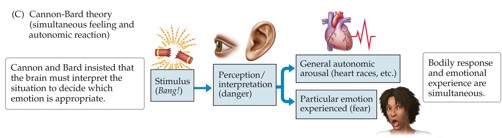
proposes that physiological arousal determines the intensity of an emotion, while cognitive appraisal of the surrounding context determines which specific emotion is experienced
Schachter-Singer model (Two-Factor Theory)

how does cognition play a role in the experience of emotion (review the experiment used by Schachter and Singer)?
participants injected with epi (inducing autonomic arousal) were placed in a room with either a playful or an angry confederate; participants unaware of the drug’s effects interpreted their arousal based on the confederate’s behavior, reporting either elation or anger
consistent, lifelong individual differences in emotional reactivity and autonomic response patterns to emotional situations
individual response stereotypy
what is the polygraph test based on and what is its limitation?
records multiple physiological measures (respiration, skin conductance, heart rate) based on the assumption that lying elicits emotional guilt/fear and corresponding autonomic arousal
limitation: physiological arousal from lying is indistinguishable from the autonomic responses of an anxious but truthful person
the study of how natural selection has shaped behavior and mental processes
evolutionary psychology
how might emotions have evolved and what adaptive function do they serve?
emotions evolved as rapid preprogrammed responses to solve recurring survival challenges (avoiding predators, securing mates, finding food, cooperating in groups) and to signal internal states to conspecifics
what does similarity in facial expressions suggest about emotions across species?
nonhuman primates possess similar facial musculature and produce homologous expressions (e.g., fear grimace, tense mouth, play face), suggesting that core emotional expressions share a common evolutionary origin across species