BRAINSTEM, CEREBELLUM, DIENCEPHALON.
 Call Kai
 Learn
 Practice Test
 Spaced Repetition
 Match
 Flashcards
 Knowt Play
1/35

Earn XP
Description and Tags
CRS101
36 Terms
Midbrain (Mesencephalon)
smallest and topmost region of the brainstem located just superior to the pons
Tectum of the midbrain
contains the corpora quadrigemina
Corpora quadrigemina
a collection of four nuclei located on the dorsal surface of the midbrain consisting of 1 pair of superior colliculi and 1 pair of inferior colliculi
Superior colliculi
receives sensory input from visual auditory and tactile sensory systems and are involved in the reflex movements of the head eyes and body toward these stimuli such as loud noises flashing lights or startling pain
Inferior colliculi
involved in hearing and are an integral part of the auditory pathways in the CNS conducting action potentials from the structures of the inner ear
Tegmentum of the midbrain
largely consists of ascending tracts such as the spinothalamic tract and the medial lemniscus that carry sensory information from the spinal cord to the brain and also contains the red nuclei the cerebral peduncles and the substantia nigra
Cerebral peduncles
the portion of the midbrain ventral to the tegmentum consisting primarily of descending tracts which carry motor information from the cerebrum to the brainstem and spinal cord
Red nuclei
aids in the unconscious regulation and coordination of motor activities
Substantia Nigra
involved in maintaining muscle tone and coordinating movements
Pons
contains ascending and descending tracts several nuclei the pontine sleep center which initiates rapid eye movement sleep and the pontine respiratory center which works with the respiratory centers in the medulla oblongata to help control respiratory movement
Medulla oblongata
the most inferior part of the brainstem and is continuous inferiorly with the spinal cord containing sensory and motor tracts cranial nerve nuclei and related nuclei functioning as centers for vital reflexes
Pyramids
two prominent enlargements on the anterior surface of the medulla oblongata at the side of the ventral median sulcus composed of corticospinal fibers formed by the large descending motor tracts involved in the conscious control of skeletal muscles where most of the fibers of the descending tracts cross to the opposite side or decussate near their inferior ends
Olives
two rounded oval structures that protrude from the anterior surface of the medulla oblongata just lateral to the superior ends of the pyramids being nuclei involved in functions such as balance coordination and modulation of sound from the inner ear
Reticular formation
neurons that are loosely scattered in the brainstem that play roles in arousal and awareness controlling the state of alertness and consciousness including the sleep-wake cycle and coordinating the rhythmic activities of swallowing breathing and the heart rate
Lobes of the Lateral Cerebellar Hemispheres
Anterior Lobe, Middle/Posterior Lobes
3 Major Regions/Lobes in the Cerebellum
Flocculonodular lobe, Anterior lobe, Posterior lobe
Cerellar Peduncles
connect the cerebellum to the brainstem; midbrain, pons, and medulla oblongata, respectively
The Cerebellar Peduncles has:
Superior, Middle, Inferior
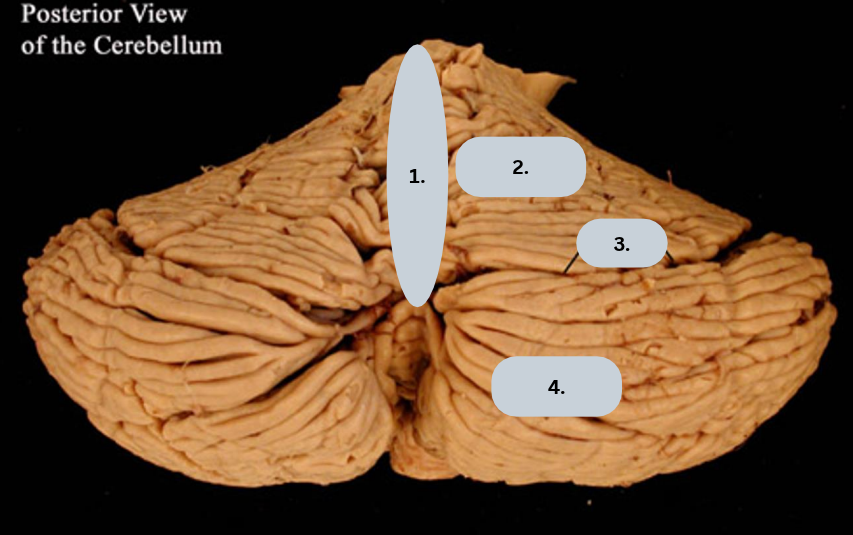
Cerebellum - What is number 1?
Vermis

Cerebellum - What is number 2?
Anterior Lobe

Cerebellum - What is number 3?
Primary Fissure

Cerebellum - What is number 4?
Posterior Lobe
Purkinje cells
functional unit of the cerebellar cortex
Mossy fibers
ascending tracts from elsewhere in the brain that will branch within the cerebellum
Dentate nucleus
largest intracerebellar nuclei
Fastigial nucleus
intracerebellar nuclei that lies near the midline in the vermis
Diencephalon
forms a central core of brain tissue superior to the midbrain. It contains numerous nuclei involved in a wide variety of sensory and motor processing between higher and lower brain centers. Surrounded by the third ventricle.
The Diencephalon consists of:
Thalamus, Hypothalamus, Epithalamus, Subthalamus
Thalamus
“sensory relay station/center for information” coming into cerebral cortex. It consists of bilateral nuclei and forms the superolateral wall of 3 rd ventricle
The Thalamus is the largest part of diencephalon (makes up __ of it).
80%
Hypothalamus
central controller of endocrine system and major coordinating center of the autonomic nervous system forming the most inferior portion of the diencephalon
Infundibulum
a stalk that connects the pituitary gland to the base of hypothalamus
Subthalamus
small area immediately inferior to the thalamus containing subthalamic nuclei involved in controlling motor function
Epithalamus
small area superior and posterior to the thalamus consisting of the habenula and pineal gland
Habenula / Habenular nucleus
involved in motivational control of behavior
Pineal gland / body
involved in modulation of sleep-wake cycle and other biorhythms