3) Binocular Summation
 Call Kai
 Learn
 Practice Test
 Spaced Repetition
 Match
 Flashcards
 Knowt Play
1/57

There's no tags or description
Looks like no tags are added yet.
58 Terms
What are the 2 theories of sensory fusion?
Alternation (suppression) theory
Fusion theory
What does Alternation theory propose?
→ conscious perception switches b/w right- and left-eye images
never simultaneous
How do monocular views interact in alternation theory?
mutually inhibit each other
When can Alternation theory apply?
Artificial conditions with dissimilar images causing binocular rivalry
What does Fusion theory propose?
Similar right- and left-eye images are processed simultaneously
What supports fusion theory?
Rivalry develops slowly
Light/contrast from both eyes combine
How do binocular detection thresholds compare with monocular thresholds?
↓ threshold for:
luminance
contrast detection
acuity
What are exceptions to Fusion theory?
Dissimilar images can rivalry
some separate monocular information remains accessible
Define Binocular summation.
→ Adding info from both eyes to improve binocular over monocular performance
seen in
VA
contrast sensitivity
color vision
light detection
brightness matching
reading
CFF
rxn time
What are 2 explanations for binocular summation?
Neural summation — partial, complete, facilitation, inhibition
Probability summation — benefit to 2 eyes even if they are independent of each other
What does Neural summation improve? Why?
Signal-to-noise ratio (SNR) - b/c signals correlate and sum across eyes, largely uncorrelated neural noise doesn’t sum
How does SNR improvement scale with detector number?
Square root of # of detectors
e.g., 2 eyes: √2 ≈ 1.4
How does retinal image averaging demonstrate improved image quality?
Single image = limited clarity
AO image = improved optical correction
Averaging 61 AO images = reduced noise and sharper resolution

How is binocular summation evaluated?
By comparing monocular and binocular:
luminance detection
acuity
contrast detection
How are degrees of binocular interaction classified?
→ Compare binocular performance with monocular performance:
greater
equal
less

Name the 5 degrees of binocular summation. Mention what they mean.
1) Binocular Facilitation:
Visual performance with both eyes is greater than the sum of each eye's monocular performance
OU > OD + OS
2) Complete Binocular Summation:
Binocular performance is exactly equal to the sum of each eye's monocular performance (full neural summation)
OU = OD + OS
3) Partial Binocular Summation:
Binocular performance is less than the sum of both eyes, but better than either eye alone
OU < OS + OD but OU > OS & OU > OS
4) No Summation:
Binocular visual performance is no better than using one eye alone
OU = OS or OU = OD
5) Binocular Inhibition:
When used together, performance in one eye is degraded by the other eye; visual performance with both eyes is less than using either eye alone.
OU < OS or OU < OD
What stimulus was used in the first summation experiment?
Independent square-wave flicker signals presented to each eye
What happens when binocular flicker signals are in phase vs out of phase?
In-phase = signals add
↑ perceived amplitude
↑ CFF
Out of phase = signals subtract
↓ perceived amplitude
↓ CFF
What determines the degree of flicker summation?
Temporal frequency
What improvement does the contrast-sensitivity graph show?
Binocular sensitivity about 1.4× monocular sensitivity, or 40% higher
Binocular improvement over monocular is constant from low to high frequency

Does absolute light detection show complete summation?
No it shows partial summation
Does visual resolution show complete summation?
No it shows partial summation
What are the 2 theories of binocular summation?
Independence (probability) theory
Interaction (summation) theory
Define Independence/probability summation theory.
→ 2 independent eyes can improve detection probability without neural interaction
Formula: P(OU) = P(OD) + P(OS) − P(OD)P(OS)
Are probability summation models perfectly accurate?
No - statistical models don’t precisely predict actual visual performance
Under what conditions do Binocular Summation Occur?
Binocular summation occurs ONLY IF both eyes are stimulated:
within short interval (100ms)
within corresponding areas retinal points or points within Panum's area
similar stimuli
What happens as the interstimulus interval grows?
Binocular advantage decreases toward the probability-summation level
Which stimuli demonstrate true binocular summation?
Light flashes
Grating stimuli
Define Interaction/Summation theory.
→ Neural combination of eye signals produces sensitivity greater than probability summation alone
↓ detection threshold more than probability summation alone predicts
How can binocular summation be assessed in young infants?
VEP
Does binocular summation occur above visual threshold?
Yes, but the benefit may be smaller than at threshold
What tasks show suprathreshold binocular benefit?
Increment thresholds
Orientation discrimination
Grating rxn times
What is Fechner's paradox?
→ Closing the eye viewing a dimmer image makes the target appear brighter
e.g., when OD sees a brighter target than OS, the binocular target looks less bright than the OD-only target
demonstrates binocular brightness averaging

What are the 3 Fechner's paradox hypotheses?
Independence - each eye acts independently; closing the dimmer eye doesn’t change brightness ❌
Summation - binocular brightness equals OD + OS and exceeds either eye alone (OU > OD; OU > OS) ❌
predicts extra binocular brightness + dimming when the dim eye closes
Averaging - binocular brightness lies between the brightness perceived by each eye alone ✅
How can Fechner's paradox be demonstrated?
Place a neutral-density filter before one eye
Close that dimmer eye → cause target to appear brighter
Define a Visual aftereffect.
biased percept after an adapting stimulus fatigues tuned cortical visual neurons (cortically mediated)
What is the Motion aftereffect?
After adapting to motion in one direction, motion appears reversed (a visual illusion)
What are examples of nonmotion aftereffects?
Orientation adaptation → tilt aftereffect
Spatial-frequency adaptation → size aftereffect
What is interocular transfer of an aftereffect? What does interocular transfer prove?
→ Adapt one eye, test the other, and still perceive an aftereffect
2 eyes interact and are not fully independent
Does the tilt aftereffect transfer between eyes?
Yes, but the transferred effect is weaker than the monocular effect
What produces a Monocular tilt aftereffect?
Fatigue of orientation-tuned neurons biases the perceived tilt of a test pattern
Which cortical areas are linked to transferred tilt aftereffects?
V1
V2
Which has more binocularly driven cells, V1 or V2?
V2
Does the motion aftereffect transfer between eyes?
Yes, but the transferred effect is weaker than the monocular effect
Which cortical areas are cited for Motion aftereffects?
V1
V2
How does random-dot motion transfer compare with moving gratings?
Random-dot motion shows greater interocular transfer b/c area MT has many binocularly driven cells important for motion coherence
Define Visual masking.
A mask presented before, during, or after a target ↓ target visibility
Define Dichoptic masking.
test target goes to one eye and the masking stimulus to the other
When is dichoptic masking stronger?
When the mask is presented to the dominant eye
Define Crowding effect.
→ Nearby flanking contours reduce target visibility
form of simultaneous masking
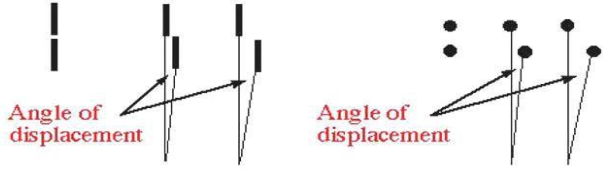
How does crowding affect Vernier acuity?
Nearby parallel lines ↑ Vernier thresholds & ↓ vernier sensitivity
Define Metacontrast masking.
subsequently presented mask ↓ visibility of an earlier target
When is metacontrast masking strongest?
When the mask is presented to the dominant eye
Which disorders can cause abnormal binocular interactions and stereoblindness?
Strabismus
High anisometropia
Aniseikonia
Amblyopia
What summation can stereoblind patients still show?
Probability summation - but not extra neural summation beyond that prediction
Which group is more affected: stereoblind strabismics or anisometropic amblyopes?
Stereoblind strabismics
How is interocular transfer affected in stereoblind patients?
reduced or absent - esp with early-onset strabismus and ↑ spatial freq
How can excitatory and inhibitory interactions differ in amblyopia?
Excitatory Subthreshold summation = absent
Inhibitory dichoptic masking = remains