Lymphatic system
 Call Kai
 Learn
 Practice Test
 Spaced Repetition
 Match
 Flashcards
 Knowt Play
1/143

There's no tags or description
Looks like no tags are added yet.
Name | Mastery | Learn | Test | Matching | Spaced | Call with Kai | Chat |
|---|
No analytics yet
Send a link to your students to track their progress
144 Terms
What is Lymph
a fluid that is similar to plasma but has no plasma proteins
helps maintain fluid balance
fights infections
absorbs fats
Where are Lymphocytes produce in?
Lymphoid tissues → tonsils
Lymphoid organs → spleen, thymus, lymph nodes
Red bone marrow
What are the Primary Lymphoid Tissues and Organs?
sites where the lymphocytes are formed and mature
Red Bone Marrow → formed
Thymus → T-cells mature
What are the Secondary Lymphoid Tissues and Organs?
sites where the lymphocytes are activated
Tonsils → intercepts inhaled or ingested pathogens
MALT (Mucosa Associated Lymphatic Tissue) → scattered around mucous membranes
Lymph nodes → filter lymph fluid & activates immune cells
Spleen → largest secondary organ
What is the function of Lymphatic system?
produce, maintain, distribute lymphocytes and other lymphoid cells
return excess fluid from tissues to bloodstream → help maintain normal BP
regulates composition of interstitial fluid → transports hormones, nutrients, wastes
What do Lymphatic Vessels (Lymphatics) do?
carry lymph from peripheral tissues to venous system
What are Meningeal lymphatics?
network of vessels → in the Dura mater
drains CSF to Cervical lymph nodes
removes wastes
transports immune cells
What are Lymphatic capillaries?
smallest lymphatic vessels → present at almost every tissue of the body
What are Lymphatic lacteals?
lymphatic capillaries in the Small Intestine → transports lipids absorbed by digestive tract
What are the differences between Lymphatic and Blood capillaries?
L: originates as pockets
has a larger diameter → for easier travel
thinner walls → in order to have large diameter
irregular shape in cross section
has lymphatic valves → for unidirectional flow
Within Lymphatic capillaries, why do they have gaps present?
Allows entry of large molecules, excess fluid, immune cells that are too large to enter to re-enter blood capillaries
What do Small to Medium Lymphatic vessels contain?
3 layers in vessel wall → similar to veins
Valves → prevent backflow of Lymph
Shares same path with Blood vessels
What is Lymphedema
chronic condition which causes localized swelling (arms or legs) → due to obstruction of lymphatic vessels
prevents lymph drainage
can become permanent
interferes w/ immune system function!
What is Superficial Lymphatics?
Vessels within the Subcutaneous layer, Areolar layer of Mucous membranes and Serous membranes
collects interstitial fluid, antigens, and immune cells
What is Deep Lymphatics?
Network of larger vessels that accompany arteries and veins
located deeper in the body
drains → muscles, bones, joints within limbs and torso
What does the Superficial and Deep lymphatics converge into?
forms large Lymphatic Trunks
empties into 2 major collecting vessels→ Thoracic Duct & Right Lymphatic duct

What is the Thoracic Duct?
Collects lymph from all body regions which are inferior to diaphragm and the left side of the body superior to diaphragm
collects ¾ of total lymph fluid (75%)
empties into Left Subclavian Vein
What is the Cisterna chyli?
an expanded chamber at the base of the Thoracic duct
receives lymph from the inferior parts of the abdomen, pelvis, lower limbs
sends them upwards into Thoracic Duct

What is the Right Lymphatic Duct?
Collects lymph from the Right side of the body, superior to the diaphragm
collects ¼ of total lymph fluid (25%)
empties into the Right Subclavian Vein
What area does the Thoracic Duct drain from?
Lower limbs, Pelvic cavity, Abdomen, Left side of Thorax, Left upper limb, and Left side of Head and Neck
What area does the Right Lymphatic Duct drain from?
Right side of the Head and Neck, Right upper limb, and Right side of the Thorax
Where does the Thoracic Duct enter the venous system and drains lymph?
Left Subclavian Vein → Superior Vena Cava → R. Atrium
Where does the Right Lymphatic Duct enter the venous system and drains lymph?
Right Subclavian Vein → Superior Vena Cava → R. Atrium
What is the percentage of Lymphocytes from WBC?
20-40%
What are T-cells?
Thymus-dependent cells
key fighters in adaptive immune system
What are Cytotoxic T-Cells?
aka killer T cells or CD8+ T Cells
WBC → attack cells which are infected by Viruses
produce Cell-Mediated immunity
What is Cell-Mediated Immunity?
Adaptive Immune response → which protects the body w/o using antibodies
relies on → T-cells, Macrophages, Natural Killer cells
which help destroy infected/abnormal cells
What are Helper T-cells?
aka CD4+ cells
type of WBC that act as master coordinators of the adaptive immune system
Activated when their T-cell receptor binds to antigen fragments→ thanks to Antigen-presenting cells (ex. Dendritic cells, B cells, Macrophages)
release Cytokines to stimulate & activate → T-cell and B-cells
What are Suppressor T cells?
help inhibit the activity of T cells and B cells
What are Memory T cells?
Long-lived type of WBC that persists in the body after an infection or vaccination
remembers a specific pathogen and launches a faster & stronger immune response
What are B-cells?
Bone marrow-derived cells
forms vital part of body’s adaptive immune system
Adaptive: slow start, takes days to activate & highly specific to pathogen
recognize foreign pathogens/invaders → produce antibodies to destroy or neutralize them
What do B-cells provide?
Antibody-mediated immunity
contain B-cell receptors → spot and bind foreign pathogens
once activated can turn into: Plasma cells (antibody factories) or Memory cells
What is the lifespan of B cells?
4-20 years
How much do B cells make up in circulating lymphocytes?
10-15%
What are Natural Killer cells?
aka Large Granular Lymphocytes
act as immunological surveillance
rapidly destroy virus infected, stressed, or malignant tumor cells w/o prior exposure or activation
part of Innate immunity → acts immediately & non specific
How much do Natural Killer cells make up in circulating lymphocytes?
5-10%
What is the flowchart of Lymphocyte production from Red Bone Marrow?
Hemocytoblasts → Lymphoid stem cells → NK cells or B cells
What is the flowchart of Lymphocyte production in the Thymus?
Hemocytoblasts → Lymphoid stem cells →Thymosins→ Mature T-cells
Where are Lymphoid Tissues without fibrous capsules located in?
Lymphoid Nodules:
Respiratory tract
Digestive tract → Peyer’s Patches, Appendix (MALT)
Urinary tract
Tonsils:
Adenoid (Pharyngeal) → single
Palatine → pair [R & L]
Lingual → pair [R & L]
Where are Lymphoid Organs covered with capsule located?
Thymus, Spleen, Lymph nodes
What is Mucosa-Associated Lymphoid Tissue (MALT)?
Lymphoid tissues associated with the digestive, respiratory, urinary and reproductive tracts
WIth Tonsillitis, which tonsil is more commonly affected?
Palatine tonsil → inflammation of the tonsil pair
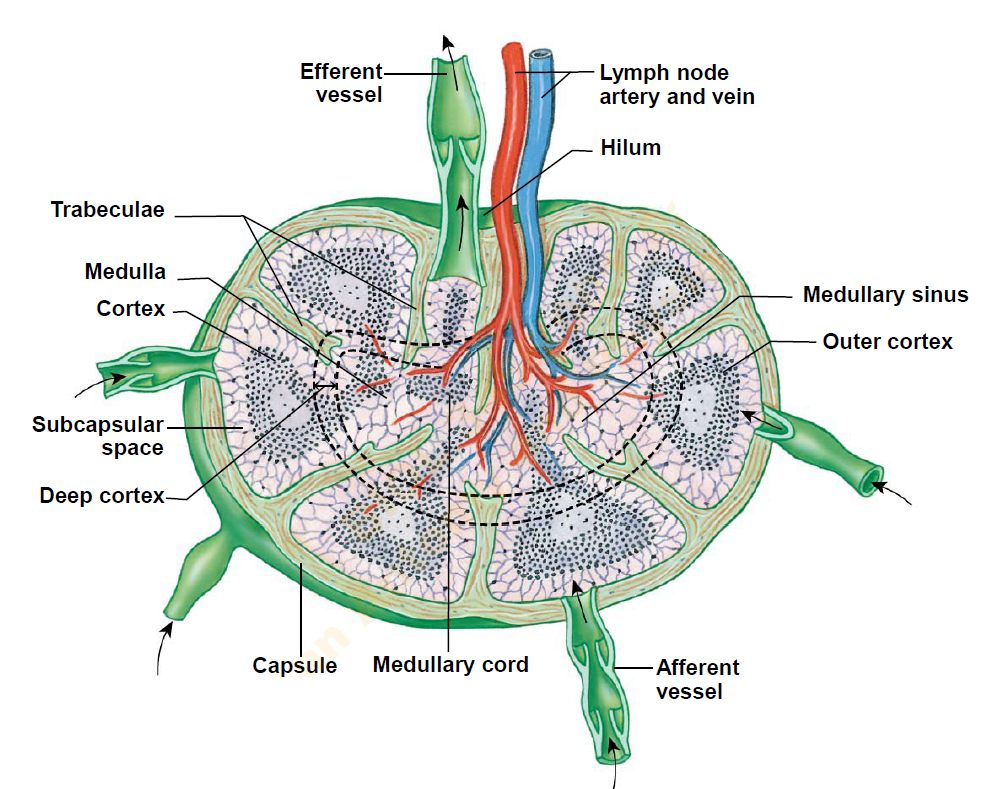
In a Lymph node, what is the Outer cortex primarily composed of?
packed with D-cells and B-cells
stores B lymphocytes → quickly catch and respond to antigens flowing in the lymph

In a Lymph node, what is the Germinal center mainly composed of?
B cells
dedicated region for B lymphocytes to multiply, mutuate, and refine their antibodies against specific pathogens

In a Lymph node, what is the Deep cortex composed of?
T cells
sits right next to special blood vessels that bring in T cells from the bloodstream
houses Dendritic cells that present pathogens to them

What is the Trabeculae in a Lymph node?
Bundles of collagen fibers that extend from the capsule into the interior of the node

What is the Hilum in a Lymph node?
Shallow indentation → blood vessels & nerves reach the node

What is the Afferent Lymphatics in a Lymph node?
Vessels that carry Lymph into the node from peripheral tissues

What are Efferent lymphatics in a Lymph node?
Vessels that carry Lymph away from the node
What is the purpose of D-cells (Dendritic cells)?
Help initiate an immune response
What is the functions of our Lymph nodes?
help filter Lymph before entering venous system
provide early warning system for immune responses → thanks to D-cells
produce antibodies → B cells & plasma cells
What is Lymphadenopathy?
The abnormal enlargement of Lymph nodes
sign of: infection, cancer, or endocrine disorder
What can Lymph Node act as for Cancer cells?
Way stations→ since these vessels offer little resistance to their passage
Where are the largest Lymph nodes located in?
Groin, Axillae, and base of the Neck
What is the Thymus?
located in the Mediastinum (above the Heart)
weighs: 40 g (2 yr old) → 12g (50 yr old)
gradual shrinking due to tissue wasting away → sex hormones and wear/tear
to mature (in the medulla) and train T-cells
What do Reticular Epithelial Cells in the cortex of the Thymus do?
surrounds immature lymphocytes
maintain blood-thymus barrier
secrete thymosins
What does Reticular Epithelial Cells in the medulla of the Thymus do?
forms concentric layers (aka Thymic Corpuscles or Hassall’s Corpuscles)
mature T-cells can enter or leave bloodstream
no blood thymus barrier
What is the function of Epithelial Reticular cells?
maintain the blood-thymus barrier in the Cortex → to separate developing T-cells from general circulation
Where is the Spleen located in the body?
Lateral border of the stomach (upper left quadrant of abdomen)
connected by Gastro-splenic ligament
What is the function of the Red Pulp in the Spleen
Recycles RBCs
filters the blood and destroys old/damaged/abnormal RBCs
contains → majority of Macrophages, RBCs, and some lymphocytes
What is the function of White Pulp in the Spleen?
acts as a key immune hub→ detects blood-borne pathogens
makes antibodies to fight them
contains → majority of Lymphocytes, some Macrophages, and Dendritic cells
What is the blood pathway towards the Spleen?
Splenic Artery → Hilus → White pulp → Capillaries (Sinusoids) → Red pulp → Small veins → Hilus→ Splenic vein
What site is considered to have the largest collection site of Lymphoid tissues?
Spleen
internal structure is heavily packed with White pulp
dedicated to filtering blood
macrophages & lymphocytes aggressively monitor bloodstream for pathogens
What are some functions of the Spleen?
Remove abnormal blood cells & fragments (Red pulp)
Store recycled iron from old RBCs (Red pulp)
initiate immune response by T & B cells (White pulp)
What is Innate (NONSPECIFIC) Defenses?
type of defense that is against pathogens
born with it
always works the same way
against anytime of pathogen
nonspecific
kicks right away or within hours
What is Adaptive (SPECIFIC) Defenses?
specific type of defense against pathogens
depend on activities of lymphocytes → T or B cells
B cells: mature and differentiate into plasma cells → make antibodies
T-cells: mature and act directly against infected/abnormal cells
creates specific resistance (immunity)→ after exposure to infections/vaccine
retains as memory T cells
What are some Nonspecific defenses we have?
Physical barriers (skin), Phagocytes, Immunological surveillance (NK cells), Interferons, Complement, Inflammatory response, and Fever
What helps differentiate Lymphoid stem cells into B cells or NK cells?
Interleukin-7
What helps differentiate Lymphoid stem cells into mature T-cells?
Thymosins
mature and travel within the bloodstream and tissues
Within Non-specific defenses, what type of Microphages does it contain?
Neutrophils and Eosinophils
In Non-specific defenses, what type of Macrophages does it contain?
Monocytes
fixed or free
Within Phagocytes, what are the Fixed macrophages?
Histiocytes
WBC that permanently reside in specific organs/tissues
Bone marrow
Microglia→ in CNS
Stellate Macrophages or Kupffer cells → in liver sinusoids
Within Phagocytes, what are the Free macrophages?
Wandering macrophages
mobile WBC within the bloodstream, lymphatic system, etc → hunt down pathogens
Alveolar macrophages → Dust cells in the Lungs
How do Free Macrophages and Microphages (neutrophils) move around?
Emigration→ moving through capillary walls
Chemotaxis→ attracted or repelled by chemicals in surrounding fluids
Adhesion → phagocytosis attaching to target, forming vesicle to internalize it
What are Interferons?
chemical messengers that coordinate the defenses against viral infections
released by activated lymphocytes, macrophages, or virus infected cells
considered a Body alarm (SOS signal)!
How do Natural Killer cells activate?
Recognition & Adhesion→ identify abnormal membrane components & adheres to them
Realignment of Golgi apparatus→ moves the face of the cell & produce Perforins
Secretion of Perforins→ via exocytosis (moving material from inside to outside the cell)
Lysis of cell→ Perforins help kill the cell
What are Interferons?
small proteins released by activated lymphocytes & macrophages + tissue cells infected w/ viruses
are considered Cytokines→ chemical messengers released by cells
What are the types of Interferons?
Alpha, Beta and Gamma
What is Interferon Alpha (α)?
protein produced by cells infected w/ viruses
- signals neighboring cells to put up antiviral defenses
interferes w/ viral replication
stimulates NK cells
What is Interferon Beta (β)?
protein secreted by Fibroblasts
slows inflammation in the damaged area
What is Interferon Gamma (γ)?
secreted by T-cells and NK cells
help stimulate Macrophage activity
helps coordinate a strong defense
What are Complement (C) proteins?
proteins in the blood
against bacteria
stimulates inflammation; Histamine released by Mast cells
attracts phagocytes & enhance phagocytosis
Produced → by Liver
What is the Complement System and how many routes of activation?
group of 30 special proteins in Plasma
assists/boosts the work of Antibodies-→ in the destruction of pathogens
Classical, Lectin, and Alternative
What is the Classical Pathway of Complement System?
Most rapid & effective mode of activation
begins → binding of complement protein C1 to 2 Antibodies attached to an antigen
protein→ acts as enzyme and catalyzes a chain reaction in prod. of C3b
What is the Lectin Pathway of Complement System?
Mannose-binding lectin→ binds to Carbs on pathogen surfaces
acts as an enzyme to prod. C3b
fast acting system→ fights off pathogens by recognizing carbs on surfaces of pathogens
What is Alternative Pathway of Complement System?
Properdin (factor P), Factor B and D → interact in plasma to produce C3b
fast acting → spots and destroys pathogens without needing Antibodies
What causes Inflammation (Inflammatory response)?
thanks to Mast cells (mobile connective tissue cells) → release Histamine & Heparin
causes swelling, redness, heat and pain→ within localized tissues
What are considered unwanted effects of Inflammation?
Necrosis → local tissue destruction or death in area of injury
Pus → mix of dead tissue cells, debris, fluid
Abscess → accumulation of Pus in an enclosed space
With a Fever, what causes the increase of temperature?
Macrophages → release Pyrogen and Interleukin-1
help inhibit growth of bacteria/virus
increases body metabolism
increases tissue repair
increase WBC movement
What are the 2 ways of Acquired Immunity someone has?
Active and Passive Immunity
What is Active Immunity in Acquired Immunity?
Develops after exposure to antigen
Induced → vaccination
Natural acquired
What is Passive Immunity in Acquired Immunity?
Produced by transfer of antibodies from another source
Induced p.i → injecting antibodies
Natural acquired→ via mother’s milk
What is Inactivated vaccines?
type of vaccine that contains a killed pathogen
What is Live-attenuated vaccines?
type of vaccine that uses a live weakened form of the pathogen
What is Messenger RNA vaccines?
type of vaccine that stimulates the synthesis of viral proteins→ triggers an immune response
What is Subunit, Recombinant, Polysaccharide and Conjugate vaccines?
type of vaccine that uses pieces of a pathogen
What is Toxoid vaccines?
type of vaccine that uses altered or weakened forms of bacterial toxins
What is Viral Vector vaccines?
type of vaccine that uses modified versions of a different virus to deliver protection
What are the properties of Adaptive Immunity?
Specificity, Versatility, Memory, and Tolerance
What is Specificity as one of the Properties of Adaptive Immunity?
T-cells or B-cells responding only to a specific antigen and ignores all others