Chapter 13: Vesicle Part 2
 Call Kai
 Learn
 Practice Test
 Spaced Repetition
 Match
 Flashcards
 Knowt Play
1/28

There's no tags or description
Looks like no tags are added yet.
Name | Mastery | Learn | Test | Matching | Spaced | Call with Kai | Chat |
|---|
No analytics yet
Send a link to your students to track their progress
29 Terms
Lysosome
Membrane-enclosed organelles filled with soluble hydrolytic enzymes that digest macromolecules
Lysosomes digest and recycle cellular materials, including:
Damaged organelles and proteins.
Materials brought into the cell through endocytosis or phagocytosis.
-Macromolecules such as proteins, lipids, carbohydrates, and nucleic acids.
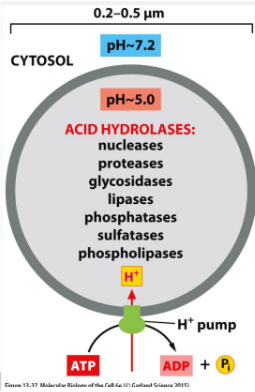
How is the acidic environment of the lysozyme maintained?
A V-type H⁺-ATPase (proton pump) uses energy from ATP hydrolysis to pump hydrogen ions (H⁺) from the cytosol into the lysosome.
This increases the H⁺ concentration inside the lysosome, maintaining its low pH.

acid hydrolases
this is the part of the lysozyme that actually breaks down the macromolecules
Lysosome = the organelle that carries out digestion and recycling. Think of it as the recycling center.
Acid hydrolases = the enzymes that actually break down the materials. Think of them as the workers doing the recycling.
Why do we call lysosomes heterogeneous?
they vary in size, shape, and internal content, reflecting their dynamic role in multiple degradation pathways and their fusion with different vesicle types
Endolysosomes
formed when lysosomes fuse with late endosomes
When do Endolysosomes mature into lysosomes?
once hydrolases complete digestion
Endocytosis
cells take up PM components, fluid, solutes, macromolecules
Material ingested is enclosed by small portion of PM, which first invaginates and then pinches off, forming an endocytic vesicle
Cell regulates its membrane composition in response to changing extracellular conditions

Micropinocytosis
cells internalize small amounts of extracellular fluid and dissolved molecules through tiny vesicles formed by membrane invagination.

Phagocytosis
How the cell engules a large particle
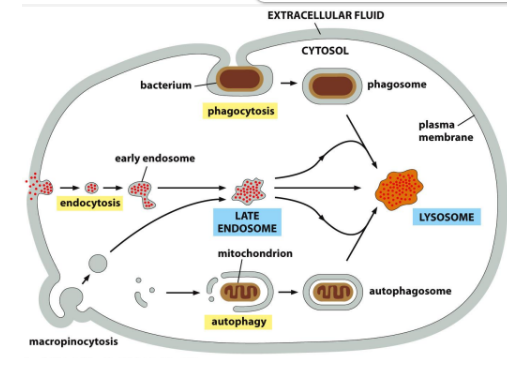
Autophagy
Self eating
Important in growth and development (helps restructure differentiating cells
Unlike proteasome, can digest large object
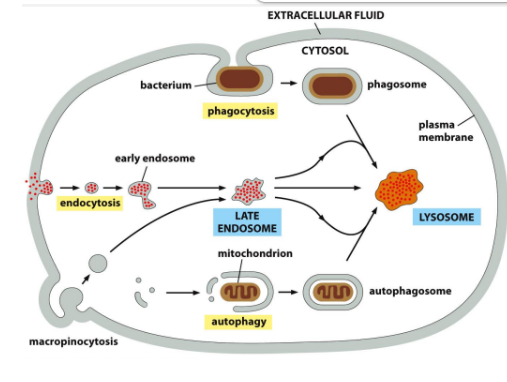
Nonselective Autophagy
bulk portion of cytoplasm is sequestered in autophagosomes.
Selective Autophagy
autophagosomes tightly enclose specific cargo and mostly exclude the surrounding cytosol

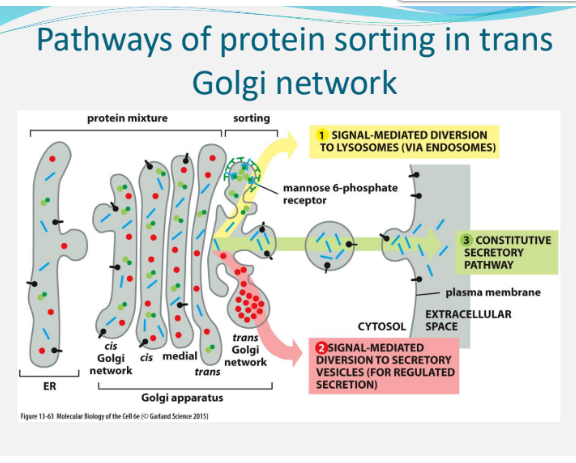
Sorting and Transport of lysosomal hydrolases from the trans-golgi network to lysosomes using the mannose-6-phosphate
Tagging: Lysosomal hydrolases receive a mannose-6-phosphate (M6P) tag in the Golgi.
Recognition: M6P receptors in the trans-Golgi network recognize and bind the tagged hydrolases.
Transport: Clathrin-coated vesicles carry the hydrolases to an endosome.
Release: The acidic environment of the endosome causes hydrolases to dissociate from M6P receptors.
Receptor recycling: M6P receptors return to the Golgi to be reused.
Endosome maturation: The early endosome matures into a late endosome, becoming more acidic and accumulating active hydrolases. The early endosome primarily sorts cargo and recycles materials; the late endosome receives cargo destined for degradation.
Lysosome fusion: The late endosome fuses with a lysosome to form an endolysosome, where hydrolases digest the contents.

What does Mannose-6-phosphate do?
M6P labels the enzymes, the receptor recognizes the label, and the endosome releases and sorts the cargo
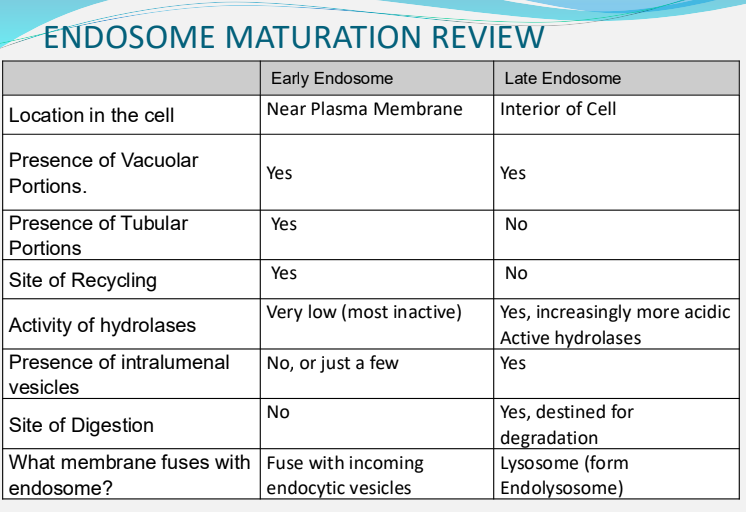
Early endosome
Binds endocytic vesicles near PM
Sorts incoming cargo
Receiving compartment for endocytic vesicles
major site of recyling
very low hydrolase activity, high pH (less acidic)
fuse with incoming endocytic vesicles
more intralunina vesicles
Late endosome
Smaller, no tubular domains
farther from PM, movement (deeper in the cell)
directs cargo towards degradation
little to no recycling
Increased acidity and hydrolase activity (more acidic)
binds lysosome
fuses w lysosomes to form endolysosomes
more intraluminal vesicals
I-cell disease mutation
Almost all hydrolytic enzymes are missing from lysosomes of many cell types. Undigested material accumulates in lysosomes, formation of large inclusions in cells
In I-Cell disease, most of the hydrolases are missing due to defect in GlcNAc phosphotransferase.
No M6-P tag
M6-P receptors fail to sort and target hydrolases lacking tag
Hydrolases are secreted (found in blood)
What do most endocytic vesicles fuse w near the cell periphery?
early endosomes
Endosomal maturation
early endosomes sort incoming cargo; some is recycled to the plasma membrane, while other cargo is sent for degradation. As early endosomes mature into late endosomes, they become more acidic, accumulate hydrolases and intraluminal vesicles, and lose recycling tubules. Late endosomes then fuse with lysosomes to form endolysosomes, where cargo is digested.
receptor-mediated endocytosis of LDL
Receptors bind specific macromolecules in extracellular space
Clathrin coated pits form and uptake to the early endosome
LDL carries cholesterol into cells this way
Exocytosis
Fusion of the vesicles with plasma membrane:
From trans golgi to the cell exterior
Transport vesicles destined for PM leave Trans Golgi network in steady stream as irregularly shaped tubulesMembrane proteins and lipids inside vesicles provide new components for PM. Soluble proteins are secreted to the extracellular space
constitutive secretory pathway
In unpolarized cells (cells w no defined orientation of specialized regions; likely a single-cell organism, could be certain differentiated liver cells
a constitutive secretory pathway delivers proteins with no special features to the cell surface.
What kinds of cells use the regulated secretory pathway?
Convenient for secreting products rapidly on demand—such as with hormones, neurotransmitters, or digestive enzymes.
Operates continuously in all cells
release their contents in response to a specific stimulus, often an increase in intracellular Ca²⁺ concentration.

3 pathways of protein sorting in trans Golgi network
Signal-mediated diversion to lysosomes (via endosomes)
Signal-mediated to secretory vesicles (fore regulated secretion)
Constitutive secretory pathway

Secretory vesicle: Synaptic vesicle
Synaptic vesicle stores neurotransmitters
When an action potential arrives ar a presynaptic site, depolarization of the membrane opens thevolatge gared Ca 2+ channels
Ca2+ influx triggers release of neurotransmitters, which are
stored in synaptic vesicles and released by exocytosis

Steps of exocytosis of synaptic vesicles
Vesicle docks at presynatptc plasma membrane
SNAREs partly paired, helices not fully wound. Complexins freeze the SNARE complex, prevents fusion to membrane
Action potential arrives at nerve terminal, influx of Calcium ions through voltage-gated Ca2+ channels
Rise in calcium: triggers binding of Synaptotagmin (contains calcium binding domains) to phospholipids and SNAREs, displacing complexins.
Fusion pore opens and neurotransmitters are released

How are lysosomal hydrolases transported to endosomes?
They are tagged with mannose-6-phosphate in the Golgi, recognized by specialized receptors, and transported in clathrin coated vesicles to endosomes
Complexin
has to be removed in order to complete the membrane fusion of the synaptic vesicle and presynaptic membrane in the regulated secretion of neurotransmitters
Synaptotagmin
acts as a calcium sensor that triggers rapid neurotransmitter release by mediating synaptic vesicle fusion with the presynaptic membrane.