BIOCHEM EXAM 4: TCA Cycle
 Call Kai
 Learn
 Practice Test
 Spaced Repetition
 Match
 Flashcards
 Knowt Play
1/107

There's no tags or description
Looks like no tags are added yet.
108 Terms
TCA is a central pathway that connects…
anabolic and catabolic processes
What catabolic processes other than glycolysis can produce Acetyl-CoA that feeds into glycolysis?
oxidative deanimation of amino acids and beta-oxidation of fatty acids
What molecule is combined w/ oxaloacetate to restart the TCA Cycle?
Acetyl-CoA
Is the main function of the TCA Cycle anabolic or catabolic?
catabolic
What are the main products of the TCA Cycle?
ATP, NADH, FADH2
Where do NADH and FADH2 feed into for ATP Production?
OXPHOS
Acetyl-CoA + 3NAD+ + FAD + ADP + Pi - 2H2O →
2CO2 + 3NADH + 3H + FADH2 + ATP + CoA
What is the overall delta G of TCA Cycle?
-40 kJ/mol
Pyruvate Dehydrogenase Complex (Substrate to Product)
Pyruvate + CoA + NAD+ → acetyl-CoA + CO2 + NADH
What is the Pyruvate Dehydrogenase Complex?
a multi-enzyme complex that requires 5 coenzymes
What are the 3 enzymes involved in the PDC?
Pyruvate dehydrogenase
Dihydrolipoyl transacetylase
Dihydrolipoyl dehydrogenase
What are the 5 coenzymes involved in the PDC?
CoA
NAD+
Thiamine (B1)
Lipoic Acid
FAD
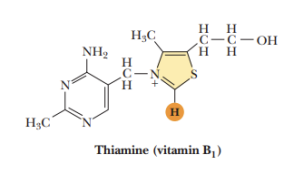
Thiamine Structure

Lipoic Acid Structure
FAD does what in the PDC?
participates but is not reduced
Where is Thiamine (B1) Deficiency or “beriberi common?
Asia after industrial processing of rice (thiamine leeches out of the husk)
What disease do the following symptoms align with?
Weight loss
Emotional disturbances and impaired sensory perception
Weakness and pain in the limbs
Heart rate issues
Edema
Thiamine (B1) deficiency
Arsenite and mercury have very similar…
poisoning symptoms
In eukaryotes, what transports Pyruvate into the mitochondrial matrix?
the Mitochondrial Pyruvate Carrier (MPC)
What is Step 1of the TCA Cycle?
Oxaloacetate + Acetyl-CoA → Citrate
Describe Step 1 of the TCA Cycle.
Oxaloacetate (Citrate Synthase→) Citrate
What is the commitment step for the entire TCA Cycle?
Step 1
What kind of rxn is Step 1 of the TCA Cycle?
Group Transfer (condensation)
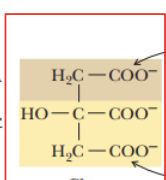
What is the name of this structure?
Citrate
What is unique about citrate?
it is pro-chiral (it can be converted to chiral molecule in one step)
Which Carboxylic Acid Groups on Citrate are pro-S arm and the pro-R arm?
C1 (pro-S arm)
C3 (pro-R arm)
What is significant about the pro-S and pro-R arms of Citrate?
allow for the molecule to be “passed “ in specific orientation despite symmetry
What is Step 1 of the TCA Cycle inhibited by?
ATP
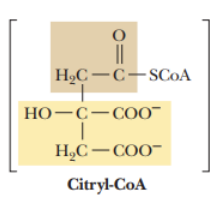
What is Citryl-CoA?
the intermediate of Step 1
What is different about the compartmentalization of TCA in prokaryotes?
everything happens in the same cytosolic compartment
What is Step 2 of the TCA Cycle?
Citrate → Isocitrate
Describe Step 2 of the TCA Cycle.
Citrate (Aconitase → ) Isocitrate
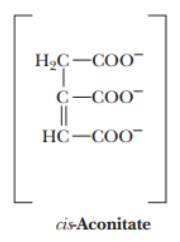
What is cis-Aconitate?
the intermediate of Step 2

What kind of rxn is Step 2 of the TCA Cycle?
Isomerization
Which arm loses water in Step 2?
pro-R arm
What is the consequence of pro-chirality?
Because aconitase acts specifically on the pro-R arm of citrate, the 2 Cs from acetyl-CoA are not released as CO2 during the first turn of the TCA
Why is Fluroacetate referred to as a trojan horse inhibitor?
it is not a direct inhibitor of any of the enzymes in isolation BUT once inside of the mitochon. → metabolizes into irreversible inhibitor of aconitase, fluorocitrate
What is an alternative to the PDC for making Acetyl-CoA?
Acetyl-CoA synthetase
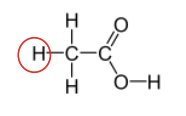
If you replace the H in red with a F, what did you make?
Fluoroacetate
Fluorocitrate is highly…
poisonous
What is Step 3 of the TCA Cycle?
Iso-Citrate → Alpha-Ketoglutarate
Describe Step 3 of the TCA Cycle.
Isocitrate (Isocitrate dehydrogenase →) Alpha-Ketoglutarate
Which Step of the TCA Cycle loses 1 C?
Step 3

What kind of rxn is Step 3 of the TCA Cycle?
redox

What is Oxalosuccinate?
the intermediate of Step 3
What steps are key regulatory points in eukaryotes along w/ PDH Complex?
Step 3 (Isocitrate Dehydrogenase)
Step 4 (Alpha-Ketoglutarate Dehygrogenase)
What is Step 3 of the TCA Cycle inhibited by?
ATP and NADH
What is Step 3 of the TCA Cycle stimulated by?
ADP
What 2 Steps lose just 1 C?
Steps 3 + 4
What is Step 4 of the TCA Cycle?
Alpha-Ketoglutarate → Succinyl CoA
Describe Step 4 of the TCA Cycle.
Alpha-Ketoglutarate (Alpha-Ketoglutarate dehydrogenase →) Succinyl CoA + NADH
Alpha-Ketoglutarate dehydrogenase is a complex of 3 enzymes that also
employs same 5 coenzymes as PDH Complex
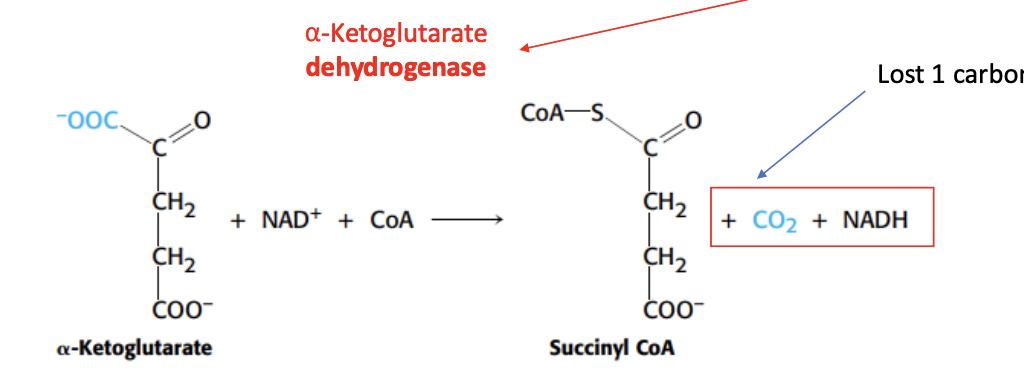
What type of rxn is Step 4 of the TCA Cycle?
redox
What is Step 4 of the TCA Cycle inhibited by?
ATP, NADH, and succinyl-CoA
Which step of the TCA Cycle produces ATP?
Step 5
Which steps of the TCA Cycle produces NADH?
Steps 3, 4, & 8 (redox)
Which step of the TCA Cycle produces FADH2?
Step 6 (redox)
All steps of the TCA Cycle are extremely thermodynamically favorable except?
Step 2
What is Step 5 of the TCA Cycle?
Succinyl-CoA → Succinate
Describe Step 5 of the TCA Cycle.
Succinyl CoA (Succinyl CoA Synthetase →) Succinate + ATP

What type of rxn is Step 5 of the TCA Cycle?
ligation
Which Step of the TCA Cycle loses chirality?
Step 5
What is confusing about succinyl CoA synthetase ?
its named backward; breaks down succinyl CoA instead of making it
Which Step’s mechanism of action depends on Histidine?
Step 5
In the liver, the ATP made in Step 5 is
GTP
What is Step 6 of the TCA Cycle?
Succinate → Fumurate
Describe Step 6 of the TCA Cycle.
Succinate (Succinate dehydrogenase →) Fumarate

What type of rxn is the Step 6 of the TCA Cycle?
redox
Why is FAD used in Step 6 of the TCA Cycle?
bc the rxn does not have enough redox potential to reduce NAD+
All enzymes of the TCA Cycle are soluble proteins in the matrix of the mitochondria EXCEPT.. from Step…
Succinate dehydrogenase; Step 6
Which enzyme is an integral membrane protein on the inner mitochondrial matrix?
Succinate dehydrogenase
What Complex is Succinate dehydrogenase a part of?
Complex 2
What is Step 7 of the TCA Cycle?
Fumurate → Malate
Describe Step 7 of the TCA Cycle.
Fumurate (Fumarase →) L-Malate
What is the specific stereoisomer that Step 7 of the TCA Cycle produces?
L-Malate
What is Step 8 of the TCA Cycle?
Malate → Oxaloacetate
Describe Step 8 of the TCA Cycle.
Malate (Malate dehydrogenase →) Oxaloacetate

Step 8 can go in either…
direction
Malate can be shuttled out of the mitochondria for…
gluconeogenesis
Steps 1-4 have Cs from…
Acetyl-CoA
After 1 turn of the TCA Cycle, what happens to the carboxyl carbon of acetate?
None lost on 1st turn, but position changes
After 2 turns of the TCA Cycle, what happens to the carboxyl carbon of acetate?
Completely lost as CO2
What is the fate of the methyl carbon of the acetate?
it will become more and more diluted with each turn but can never be “fully lost” as CO2
Why can the methyl carbon of the acetate never be “fully lost” as CO2?
because of the specific chemistry of the pro-S and pro-R arms of
Entry into the TCA Cycle is …
highly controlled
What are the downregulators that allosterically control the PDH Complex at high E charge?
NADH, Acetyl-CoA, ATP
What are the upregulators that allosterically control the PDH Complex at low E charge?
NAD+, FAD, ADP, Pyruvate
Once Active PDH is phosphorylated by Kinase it becomes?
Inactive PDH
Once Inactive PDH is dephosphorylated by Phosphatase it becomes?
Active PDH
What positively regulates PDH in the liver?
epinephrine
Regulation can be…
tissue dependent

What structure is this?
Epinephrine/adrenaline
Intermediate TCA Enzymes are also…
highly controlled
Negative Regulators of Isocitrate Dehydrogenase
ATP and NADH
Positive Regulators of Isocitrate Dehydrogenase
ADP
Negative Regulators of Alpha-Ketoglutarate Dehydrogenase
ATP, succinyl CoA, and NADH
Intermediate TCA Products can be used as…
precursors
What is citrate used to synthesize, and which TCA step produces it?
Fatty acids and sterols; Step 1
What is alpha-ketoglutarate used to synthesize, and which TCA step produces it?
Glutamate → Other amino acids and purines; Step 3
What is succinyl-CoA used to synthesize, and which TCA step produces it?
Porphyrins, heme, and chlorophyl; Step 4