Geo Midterm
 Call Kai
 Learn
 Practice Test
 Spaced Repetition
 Match
 Flashcards
 Knowt Play
1/78

There's no tags or description
Looks like no tags are added yet.
79 Terms
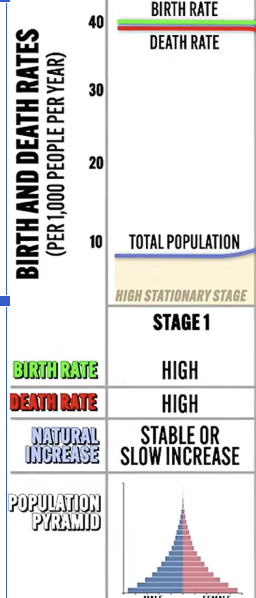
Demographic Transition stage 1
Birth Rate : High / Death Rate: High / Natural Increase : Stable or slow increase
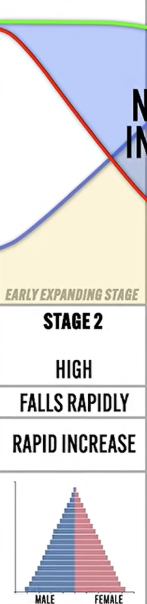
Demographic Transition Model Stage 2
Birth Rate: High / Death Rate: Falls Rapidly / Natural Increase: Rapid Increase
Demographic Transition Model Stage 3
Birth Rate : Falling / Death Rate : Falls slower / Natural Increase: Increase Slows Down

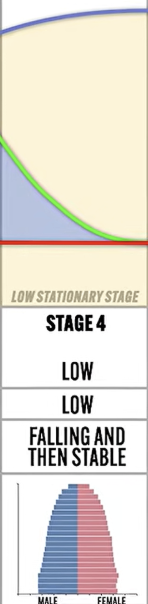
Demographic Transition Model Stage 4
Birth Rate: Low / Death Rate: Low / Natural Increase: Falling and then stable
Demographic Transition Model Stage 5
Birth Rate : Falling / Death Rate : Low / Natural Increase : slow decline

Describe stage 1 Epidemiological Transition Model
Famine stage/ high death rate= low life expectancy/ Population can grow but its in small bursts and not sustained
Describe stage 2 Epidemiological Transition Model
Receding Pandemic Stage/ Increased life expectancy 30→50 = decreased death rate / (They figured out better medication, sanitation etc) / People are mainly dying in large numbers from pandemics |
Describe stage 3 Epidemiological Transition Model
Degenerative and Human-created disease stage / Increased Life expectancy= low death rate / People are mainly dying from diseases of old age like heart disease or cancer rather than infectious diseases
Describe stage 4 Epidemiological Transition Model
Delayed Degenerative Disease Stage / Highest Life Expectancy / Infectious diseases from the third stage now have effective medical interventions |
Describe stage 5 Epidemiological Transition Model
Re-emergence of Infectious Disease Stage / Decreased Life expectancy / Infectious Disease come back by developing an immunity to our drugs and antibiotics |
Limitations of the Epidemiological Transition Model
Oversimplification of demographic change based ONLY on death rates and disease / Does not account for poverty as significant cause of spread of disease
Factors that affect population
CLIMATE
-landforms (easier to farm ppl dont choose top of mountain unless its mountains in equator)
- bodies of water (survival and trade etc)
-culture
-economics
-history
-politics
Population Density vs. population distribution
population distribution tells you WHERE populations exist while density tells us HOW MANY people live in those place
Arithmetic Density
total population/ total land area
(limitation: assumes all land is habitable but in real life it isn't)
Physiological density
total population divided by total amount of arable land (land used for agriculture) it shows how well a population can feed itself (the higher the number, more pressure for farms to produce food)
Agricultural Density
total farmers divided by total arable land (how labor intensive a place is) lower number=lower amount of farmers= more mechanization on farms
How Density Number affects economic processes:
-census taken every decade to decide how representation in congress
-government decides where to allocate money for infrastructure projects based on whether populations are growing or declining
How Density Number affects social processes:
- cities tend to be safer and have better education opportunities
How Density Number affects the Environment:
-big cities LA, Delhi= pollution
-climate and agricultural productivity affects the number of the carrying capacity (wealthy population tend to use more than needed)
Population composition
Describes the demographic makeup of various populations
Demographic
Distinct and individual traits among people (income, level of education, age, gender)
Population composition is made up of
1) Age structure -refers to cohorts (groups determined by age) 2)Sex Ratio- males to female
Dependency Ratio
number of people in dependent age (younger than 15, older than 65) / number of people in working age group x 100
why is dependency ratio important to know
Dependency ratio is important to know because it tells us how much pressure the working age population carries to support others
why is s*x ratio important to know
S*x Ratio is important to know because it gives us insight on the gender equality and birth rate and regional s*x ratio
Elements Geographers considering when studying trends in population:
fertility rates, mortality rates, migration
Fertility rates:
population ability to reproduce = gov wants to know so they can better allocate money and resources effectively
→ Ways to measure fertility rates: crude birth rate and total fertility rate
Crude birth rate
number of live births per 1,000 ppl/yr (called crude because it's not the most accurate measure of fertility rate because it compares births to the entire population (men and women of all ages)
Total Fertility Rate:
measures average number of children one woman will have during her child bearing years (15-49 years old) more accurate because it only considers women who are capable of bearing children
Replacement level fertility of total fertility rate
2.1 because that's what you need to replace the parents
Mortality Rate:
indication of population’s rate of deaths
→ ways to measure Mortality Rate: 1) crude death rate 2) infant mortality rate
Crude Death Rate:
number of deaths per 1000 people
Infant Mortality Rate:
number of children who die before they reach 1 yrs old per 1000 live births
Rate of Natural Increase:
the crude birth rate - the crude death rate
If more people are born than dying = high RNI
If RNI is lower or close to 0= population is stable
If RNI is negative = population is declining
Limitation of Rate of Natural Increase (RNI):
does not account for population growth or decline due to migration, only people being born and dying
Doubling time
amount of time it will take for a population to double if current growth remains the same
Growth/ Decline Factors:
1) Social and Culture 2) political 3) Economic
Malthusian Theory
Thomas Malthus wrote principle population made the following claims: food is necessary for life, passion between the sexes is constant, thought the more people multiple= the less food there is which means famines wars and plagues
New Tech to help sustain growing population:
mechanized farming and chemical fertilizers
Critiques to Malthusian Theory:
growing population they will find a way to produce more food
Industrial Revolution Population:
1) Birth Rates were slowly increasing 2) death rates were falling sharply because new medicines were introduced that helped more ppl live longer
Anti-Natalist Policies can be either
Voluntary (there are incentives) or Coercive ( there are punishments)
Immigration policies:
gov may allow/restrict more immigrants
Guest workers:
where immigrants from other country come to new country to work there
Women’s Status:
the level of equality between men and women that exists in a particular society
Traditional Gender Roles:
more babies being born
Egalitarian Gender Roles:
less babies being born
Ravensteins
studied why people migrate etc
Ravenstein's 6th law:
women are more likely to migrate within their home country while men are more likely to migrate to other countries
Aging population effect on politics
hey have more voting power because they vote more consistently and will vote in interest to the older population
Aging population effect on social:
as aging population go to nursing homes = significant financial burden for families
Aging population effect on economic:
dependency ratio
Migration:
movement of people from one place to another
Emigrating
leaving country
Immigrant
arriving country
Obstacles and Opportunities Migrants face:
1) Intervening Obstacles -challenges they encounter, immigration policy (chinese exclusion act) 2) Intervening Opportunities -opportunities migrants encounter on their journey that may affect their ultimate destination
Push and Pull factors
1) cultural (mormons going to salt lake city), demographic (aging population need new ppl) economic (ppl migrate for work) environmental (hurricanes, climate is more desirable) political (oppressive dictator)
cultural traits
food, architecture, land use,
attitudes toward cultural differences:
cultural relativism ; evaluating another culture by the cultures own standards (like a hug) ethnocentrisms evaluating another culture by a group’s own standards (like a punch)
cultural landscape
how people modify a physical landscape in a way that reflects their culture - agricultural and industrial practices/ religion- churchs, mosques etc / linguistic charcteristics - signs in different langauges / sequent occupence - cultural mark left from people who were there throughout history/ traditional and post modern aritecture
how people shape vlaues and cultural landscape
ethnicity, gender, presence of ethnic communities, idengenious communities
placemaking
process of ppl modifying the landscape to live in a place
sense of place
when people think about a place and fill it with meaning
sense of place examples
language -dialect/religion/ethnicity/
centripetal forces
brings ppl together
centrifugal forces
drives ppl apart
cultural diffusion
process by which cultural traits spreads from one place to another
cultural hearth
place where people of particular ethnic and cultural identities originate
2 types of diffusion
relocation diffusion - spread of cultural traits as people migrate/expansion diffusion -culutural trait spread but ppl remain
types of expanision diffusion
contagious - cultural trait spreading rapidly adjacent no regard to class, race etc/ hierarchical - trait starts with higher class and moves down / stimulus - stimulate creation of new trait
historical causes of diffusion
colonialism - powerful state est. settlements in other place/ imperialism - powerful state enacts policies in other place/ trade routes
effects of cultural diffusion
lingua franca - single language adopted by people of many different languages that facilitates communication / creolization - when 2 languages are combined to form a new, distinct language /
cultural convergence
as two cultures interact they adopt traits from each other (two cultures become more similar this happens more quickly with new tech and as time goes by)
cultural divergence
sees all the traits and still upholds traits form before (like amish ppl)
language family
share a common ancestoral langauge taht no longer exists
language branch
has similar grammar and syntax but speakers cannot understand languages from other branches
language dialects
spain spanish vs mexico spanish
caterogories of religions
universalizing religions- religions that appeal to wide variety of ppl
ethnic religions - dont spread as well because they are closely tied to ethnic groups
effects of cultural diffusion
acculturation - when ppl adopt some traits of another culture while simutaneously maintain their own cultural traits / assimilation - when people assume almost all the charcteristics of the culture around them (forced vs voluntary)/ syncretism- when 2 or more cultural traits blend together to create a new cultural trait/ multiculturalism- members of cultural dont fully assimilate but still maintian cultural identities