Transport Across Cells Membranes
 Call Kai
 Learn
 Practice Test
 Spaced Repetition
 Match
 Flashcards
 Knowt Play
1/57

There's no tags or description
Looks like no tags are added yet.
Name | Mastery | Learn | Test | Matching | Spaced | Call with Kai | Chat |
|---|
No analytics yet
Send a link to your students to track their progress
58 Terms
What does it mean to say that membranes are “semipermeable”?
What kinds of molecules would be permeable in a lipid bilayer?
Why do water-soluble molecules and ions difficulty have crossing a lipid bilayer?
What are the properties that govern the rate at which a given solute can cross a protein-free lipid bilayer?
What are the difference and similarities between simple diffusion and facilitated transport?
What are the differences and similarities between transporters and channels?
What is the difference between Active Transport and Passive Transport and indicate which type of membrane transport protein carries out each?
How does the concentration of ions in the cell differ from the outside of the cell?
What is resting membrane potential?
What is an electrochemical gradient? How is it harnessed to do to “work”? (Think of an analogy)
Compare the electrochemical gradients for sodium and potassium ions and recall how the membrane potential and concentration gradient for each ion combine to influence its movement across the plasma membrane.
In what ways can water move across cell membranes and explain what governs whether water will enter or exit a cell.
How do animal cells maintain osmotic equilibrium?
List three sources of energy used by transmembrane pumps to actively transport a solute against its concentration gradient.
Describe how the sodium pump in animal cells uses the energy from ATP hydrolysis to maintain the concentration gradients of sodium and potassium ions.
Explain how the toxin ouabain affects the operation of the sodium pump.
Explain why—and how—cells keep the cytosolic concentration of calcium ions low.
Describe how the sodium–proton exchanger in the plasma membrane allows animal cells to control the pH of their cytosol.
How do proton pumps provide the energy for the transport of solutes in plants, fungi, and bacteria?
What is the difference between a symport, an antiport, and a uniport?
Why do you need three transporters to move glucose from the intestinal lumen to the bloodstream?
What is the mechanism for uniport?
What is the mechanism for a symport?
What is the mechanism for an antiport?
How does the asymmetrical localization of the transporters help in transcellular movement of Glucose?
What would happen if the location of the transporters changed?
How does the glucose transporter in the plasma membrane of mammalian cells imports glucose after a meal and exports glucose to provide fuel for other tissues in the body?
Compare the uniport glucose transporter and the glucose-sodium symport in terms of their activities and roles in glucose transport in intestinal epithelial cells.
How does the structure of ion channels lead to their ion selectivity?
The potassium channel is an example of a gated channel that can selectively pass a single ion. Why is it specific for potassium?
Distinguish between mechanical, ligand, or voltage-gated receptors.
What triggers opening and closing in a mechanical receptor?
What triggers opening and closing in a ligand receptor?
What triggers opening and closing in a voltage-gated receptor?
Identify and describe two characteristics of electrochemical gradients and explain how cells maintain these gradients.
Explain the roles of different membrane transport proteins in establishing and maintaining electrochemical gradients.
Discuss the concept of dynamic equilibrium and how it relates to the balance of ion concentrations and membrane potential.
How is a resting membrane potential is generated?
How do potassium leak channels participate in establishing the cell’s resting membrane potential?
Distinguish an ion’s equilibrium potential from the resting membrane potential of a cell.
How can changes in membrane potential can affect cellular processes and functions, such as muscle contraction and cell migration?
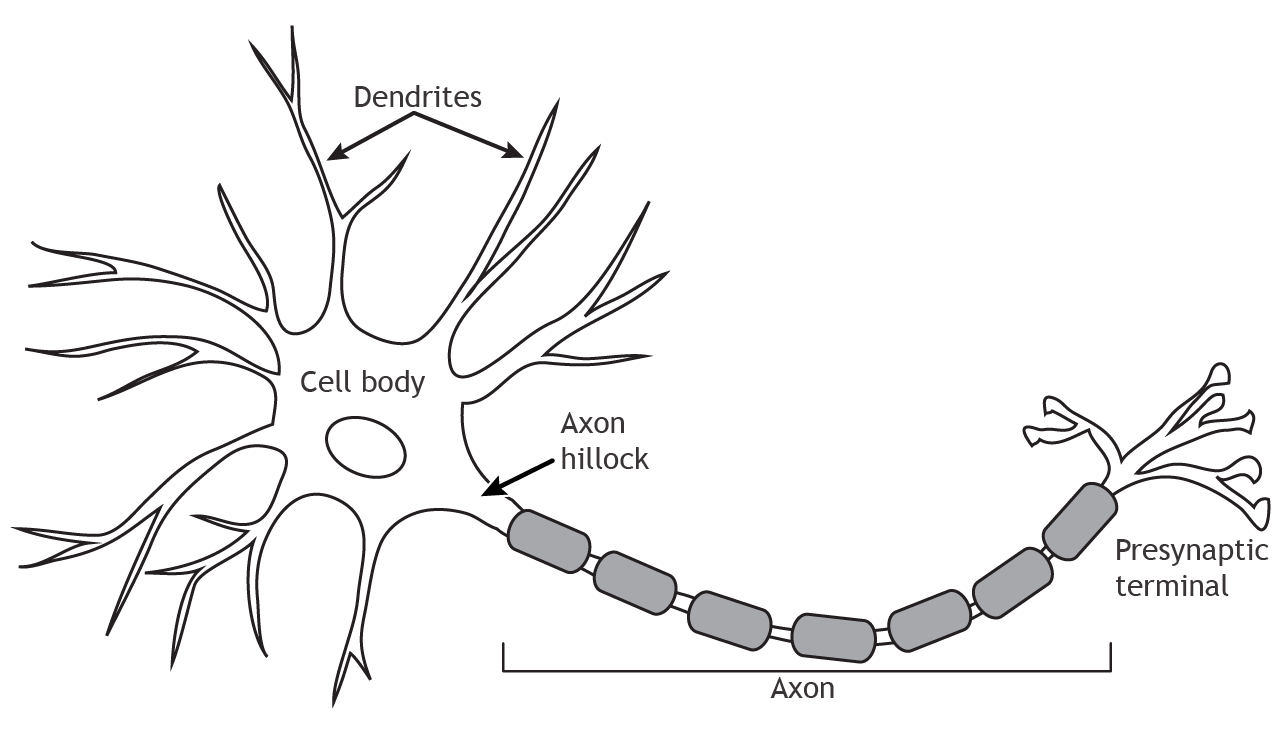
Identify the cell body, dendrites, axon, nerve cell terminal, and synapses between nerve cells.
What lets a voltage-gated sodium channel allow sodium to flow into a cell down a concentration gradient, what happens to the voltage across the membrane when it fires, and how does the membrane return after a neuron fires?
Open conformation for a voltage-gated sodium channel

Closed conformation for a voltage-gated sodium channel

Inactivated conformation for a voltage-gated sodium channel

How do voltage sensors allow voltage-gated ion channels to respond to changes in membrane potential?
How did studies using the squid giant axon reveal the different roles of potassium and sodium ions in establishing the resting membrane potential and propagating an action potential?
Why are action potentials unidirectional and don’t dissipate over distance?
How does a nerve impulse stimulate a muscle cell to contract? Which channels open, how are they stimulated to open, and does the influx of the ion through that channel stimulate other channels?
Why can channel rhodopsin be used to artificially manipulate the activity of neurons and neural circuits?
How can optogenetics be used to study the role that particular neurons play in the behavior of an animal?
Why do glucose uniporters have different binding affinities? (Explain using examples discussed in class)
What does a small Km mean?
What does a high Km mean?
What types of tissues will have small Km?
When would it be useful to have a high Km?
What is the physiological basis for rehydration therapy?