Post-Impressionism II: Vision, Memory, Expression,emotion 8/8!
 Call Kai
 Learn
Learn Practice Test
 Spaced Repetition
 Match
Match Flashcards
 Knowt Play
1/26

There's no tags or description
Looks like no tags are added yet.
Name | Mastery | Learn | Test | Matching | Spaced | Call with Kai | Chat |
|---|
No analytics yet
Send a link to your students to track their progress
27 Terms

Vincent Van Gogh, Open Bible, 1885
Open bible, way bigger than everything else, disproportionate
Bible dominates the composition
Representing the FEELING of religion to him- he was raised by very religious parents
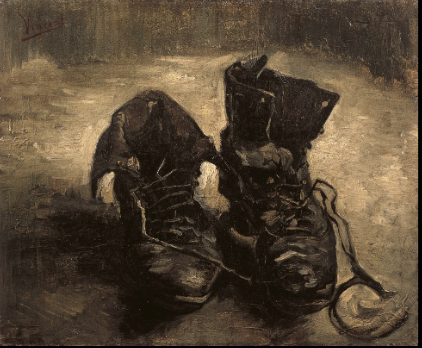
Vincent van Gogh. Shoes. 1886
Looking intensely at something worn and used
Traces of labor, movement body expression
Mundane object becoming a larger vehicle for questions about human existence
What does an object make us feel?

Vincent van Gogh (Holland/France). Self-Portrait with a Felt Hat. 1886
Very visible brushstrokes
Own face was free, models were extremely expensive

Vincent van Gogh. The Potato Eaters. 1885
Large, distorted faces. Their faces and hands are rough and exaggerated,
Just like the shoes, the bible, it is very dark in color
The painting is communicating the harshness of their existence
Rough lives represented through rough forms
Colors match the potatoes themselves
In Urban Realism and in this type of Post-Impressionism, monumental seriousness is granted to people normally excluded from academic history painting
Compare to Daumier’s Third-Class Carriage from 1865First of all, the subjects are all from the working-class, they are ordinary people
the color palette is fairly dark;
the interiors have some sort of compressed look;
and going back to the subjects, in both cases they are given by the artists some sort of dignity without idealized beauty.


Constantin Meunier’s The Puddler of 1887:
A puddler, who was an industrial ironworker involved in the extremely strenuous process of refining pig iron in a furnace. It was hot, dangerous, intensely physical work.
It is important to note that Meunier became particularly associated with representations of miners, metalworkers, and other industrial laborers

Vincent van Gogh. Self-Portrait with a Gray Hat. 1887
Painted after his move to Paris and introduction to impressionists
Brushstrokes become more fragmented, more and more similar to the brushstroke of pointilist painters

Vincent van Gogh. Portrait of Père Tanguy. 1887-88
Portrait of an art shop owner and the art he sells behind him
Artistic community he was in in Paris

Vincent van Gogh. The Sower. 1888
Took inspiration from Millet’s the Sower 1850 (Rural realism)
Taking basic motifs like the grass and fields and transforming them through color and marked brushstrokes
Post-Impressionism in Van Gogh’s terms, we increasingly ask “What can color make me feel? What feeling does it communicate?”

Van Gogh, Starry Night, 1889
The sky is built out of rhythmic, directional strokes.
The stars are surrounded by halos.
The moon radiates.
The cypress rises dramatically from the bottom of the composition.
The landscape seems to move.
He starts from observed reality and then subjects it to an expressive transformation. He is painting the feeling of looking at a starry night sky.
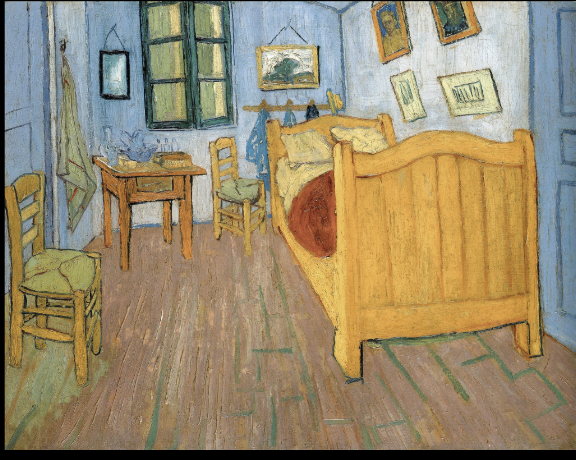
Vincent van Gogh. The Artist’s Bedroom at Arles. 1888
Something is wrong with the painting's perspective. The bed seems to tilt upward.
The furniture does not sit comfortably in a unified Renaissance perspectival box.
Flattened space - A painting can function as a surface, not a window
Compare to HIROSHIGE Utagawa (Japan). Night View of Saruwaka Street. From 100 Views of Edo. 1856
Japanese influence with Strong diagonals,
Flat planes,
Unusual viewpoints

Paul Gauguin. Still Life with Three Puppies. 1888
The organization is strange.
The scale relationships feel unusual.
The tabletop does not behave entirely as we expect.
The understanding of the picture does not depend on naturalistic spatial coherence.

Paul Gauguin (France). Still Life with Fruit. 1890
The painting does not need to provide a completely coherent illusion of space
Objects begin to operate as shapes and colors
The background helps us grasp some idea of what we are looking at, but if we look more closely, nothing that is represented in the window makes sense. We are looking at an idea, at a memory.

Alphonse Legros (France). The Calvary. 1874
representation of religion and women praying
their faces are blurred

Paul Gauguin. The Yellow Christ. 1889
Gauguin increasingly wants painting to represent what people believe, imagine, remember, or experience internally.
This relates to religion, what people believe
Historical scene of Christ surrounded by women from 19th-century Brittany - historical collapse
Christ is yellow- color has been liberated from obligation
Yellow like the trees, making the scene very cohesive

Self-portrait with Yellow Christ, Gaugin, 1889
Gaugin’s expression. He gives himself an intense, almost confrontational presence.
Gauguin increasingly cultivated an image of himself as an outsider—an artist misunderstood or rejected by conventional society. And so he confronts said society with his presence and stare

Jules Bastien-Lepage. Joan of Arc. 1879
The supernatural vision is incorporated into a relatively naturalistic environment.
The garden is convincingly rendered.
Joan occupies believable space.
The supernatural figures almost materialize within that space
Fantastical rendering, as this historical figure is dressed in modern clothing

Paul Gauguin. Vision after the Sermon. 1888 (Janson 26.12)
Look at the huge red field. It is not a believable ground. And that is precisely the point: the red separates us from ordinary naturalistic space.
The Breton women have heard a sermon about Jacob wrestling with the angel, and what we see is their imagined vision of that biblical episode.
The diagonal tree divides the composition.
So Gauguin is giving us two levels: the women VS the vision produced in their minds.
He uses color, scale, flattening, and composition.
This is what Gauguin called a move away from simply painting from nature: the artist can paint what is remembered, imagined, believed, or mentally constructed.

Paul Gauguin. Night Café at Arles. 1888-89
immediately recognize elements of the same café—the billiard table, the interior, the figures—but the experience of space is very different.
Gauguin’s composition feels flatter and more compressed. He doesn’t give us Van Gogh’s dramatic rush into deep space. Instead, the forms are arranged more deliberately across the surface.
And importantly, Gauguin brings a woman into the immediate foreground: Madame Ginoux, the proprietor of the Café de la Gare. She becomes the dominant presence in Gauguin’s painting. The café is almost transformed into a setting around her.

Vincent van Gogh. The Night Café. 1888
Flattened and distorted
2D, unrealistic perception,
feeling of being in a late night cafe
dramatic rush into deep space.

Vincent van Gogh. L’Arlesienne (Woman of Arles). 1890
Painted the same woman as Gauguin
So in this slide we not only see two versions of the same place, but two artists working within the same small social world in Arles, painting the same people and environments, but interpreting them differently
Van Gogh vs Gauguin
Van Gogh: emotion through the physical act of painting—brushstroke, color, distortion.
Gauguin: emotion and meaning through synthesis—memory, simplified forms, flattened color, symbolic construction.

Vincent van Gogh. Dr. Paul Gachet. 1890
The figure’s emotional state seems to be carried by pose, contour, and color.

Vincent van Gogh. Church at Auvers. 1890
The building almost seems unstable.
Architecture—which normally represents solidity—is transformed into something wavering.
The contours bend.
The road divides.
The sky presses around the structure.
It looks wobbly, churches are one of the most stable things

Vincent van Gogh.Crows over a Wheat Field. July 1890
This painting creates extraordinary tension through formal means:
the contrast between yellow and blue;
the abrupt recession of the paths;
the dark birds;
the forceful directional brushwork.

Gaugin, What are you jealous?, 1892
in 1891 he travels to Tahiti
The bodies here are represented nude, as if these people live in some sort of imaginary natural state of freedom.
The landscape is extremely flattened and abstracted and color organizes the composition. It almost looks like this composition represents one of Gaugin’s dreams about this land.
These figures are integrated into a highly decorative pictorial structure and thus we should resist reading these paintings as transparent ethnographic descriptions of Tahitian life. They are constructed images.

Paul Gauguin.Spirit of the Dead. 1892
In 1891, he travels to Tahiti, presenting it as an escape from modern Europe—a supposedly simpler, more spiritual, more “primitive” world.
But Tahiti was not outside modernity. It was part of the French colonial empire.\
Gauguin repeatedly presented Tahiti as exotic, mysterious, sensual, spiritual, and supposedly untouched by European civilization.
Yet this image is being constructed by a European male artist within a colonial context.
The title—Spirit of the Dead Watching—encourages a supernatural reading.
The colors create an atmosphere very different from Manet.
Purple, yellow, dark blue are not descriptive.
Whose tahiti are we actually seeing??

Paul Gauguin. Where Do We Come From? What are We? Where are We Going?
And the title itself tells you that Gauguin wants this painting to operate on a very different scale from simple observation.
The title is composed of existential questions.
The painting gathers different figures, gestures, ages, and symbolic elements into a composition that does not operate like a snapshot of one particular instant.
The colors create a sort of spiritual and dream like setting.
This painting works almost like a philosophical meditation constructed through images.
Rather than assuming that everything belongs to one moment, think about the composition as a sequence of states or ideas.