Week 4: Chapters 5, 6, 7, and 11 - NRSE 2122 Baker/Cox
 Call Kai
 Learn
Learn Practice Test
 Spaced Repetition
 Match
Match Flashcards
 Knowt Play
1/47

There's no tags or description
Looks like no tags are added yet.
Name | Mastery | Learn | Test | Matching | Spaced | Call with Kai | Chat |
|---|
No analytics yet
Send a link to your students to track their progress
48 Terms
What is mental status?
a person's emotional and cognitive functioning
What is an organic mental disorder?
due to brain disease of known specific organic cause
What is a psychiatric mental disorder?
"organic" cause has not yet been accepted (ex: anxiety disorder, or schizophrenia)
At what age do you screen to identify cognitive issues early?
From birth to 5 years old
What things must be considered when screening older adults?
- Slower response time
- Sensory decline (eyesight, hearing, etc.)
- Older adulthood contains more potential for loss
What is developmental competence?
- Ability to adapt to one's environment.
- Ability to use internal and external resources successfully.
A full mental status examination is a systemic check of...?
Emotional and cognitive functioning
What is A-B-C-T?
- appearance
- behavior
- cognition
- thought process (ex, "what they are thinking)
What are some components of the mental status exam?
- Posture
- Body Movements
- Dress (appropriate for setting)
- Grooming/hygiene
What are some examples of objective data regarding appearance? (A-B-C-T)
- Level of consciousness
Alert -> lethargic -> obtunded -> stupor
- Facial expressions or Affect
Appropriate -> flat -> bunted
- Speech
- Mood
What are some examples of objective data regarding behavior? (A-B-C-T)
- Orientation (ex, A&OX4)
Person, place, time, and purpose
- Attention Span
- Recent Memory
- Remote Memory
What are thought processes? (A-B-C-T)
Judgment, though content, perceptions, hallucinations, and delusions
(ex, what the patient is thinking)
Explain delirium vs dementia
- Delirium: rapid onset, usually acute (reversible)
- Dementia: slow onset, usually chronic (irreversible)
What are delusions?
false beliefs
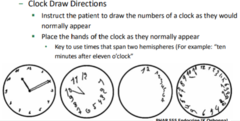
What is the Mini-Cog?
Test pt's executive function, ability to plan, manage time, organize activities, manage working memory
What does alcohol do to adolescents?
- Stunts brain growth
- Risky behavior
In the question, "How many times in the past year have you had >5 drinks a day?", what is being assessed?
Binge drinking
In the question, "On average, how many drinks per week?", what is being assessed?
What does CAGE stand for?
cut down, annoyed, guilty, eye opener
What does the CAGE questionnaire assess?
It asks questions to determine how clients perceive their current alcohol use.
What is alcohol tolerance?
Regular consumption of alcohol can result in a tolerance. Consumption of more alcohol will produce the same effects as previously with lesser amounts.
What does the 'C' in the CAGE questionnaire stand for?
Have you ever (or in the last month) felt you should Cut
down on your drinking?
What does the 'A' in the CAGE questionnaire stand for?
Have people Annoyed you by criticizing your drinking?
What does the 'G' in the CAGE questionnaire stand for?
Have you ever (or in the last month) felt bad or Guilty
about your drinking?
What does the 'E' in the CAGE questionnaire stand for?
Have you ever (in the last month) had a drink first thing in the morning to steady your nerves (Eye-opener)?
What are some signs that a patient may be using substances? (other than alcohol)
- Altered mental status
- Pupils constricted or dilated
- Signs of tolerance or withdrawal
How is addiction to cigarettes measured?
Time to First Cigarette
What are the four types of domestic violence?
- Intimate partner
- Child abuse and neglect
- Elder abuse and neglect
- Human trafficking
When must nurses report suspicion of domestic violence?
Below 18 y.o. and above 65 y.o.
What is physical abuse?
violent acts that result or could result in injury, pain, impairment, or disease
What is physical neglect?
failure of family or caregiver to provide basic goods and services such as food, shelter, health care, and medications
What is psychological abuse?
behaviors that result in mental anguish
What is psychological neglect?
failure to provide basic social stimulation
What is financial abuse?
intentional misuse of elderly person's financial and material resources
What is financial neglect?
failure to use elderly person's assets to provide needed services
Documentation of IPV, child abuse, and elder abuse must include what?
- Detailed non-biased notes
- Use of injury maps
- Written documentation of histories of IPV and elder abuse needs to be verbatim (within reason)
- Critical to document statements made by the victim that identify the perpetrator and severe threats of harm made by the perpetrator
What are some examples of health-related social needs?
- Living situation
- Food
- Safety
Is pain subjective or objective?
subjective - its whatever that patient says it is
Explain acute vs chronic pain
Acute - Rapid onset, usually goes away when the problem is fixed
Chronic - Lasts over 6+ months, doesn't go away
Why are pain assessment tools used?
Pain is subjective. Cultural and gender differences may be useful to compare over time.
At what age can a child report pain and point to its location? Can they give a scale of pain?
- Around ~2 years old
- They CANNOT rate pain at this age
At what age can pain scales be introduced to children?
~ Age 4 to 5
What is the FLACC scale?
face, legs, activity, cry, consolability
What age does the FLACC scale measure?
Measures up to 7 years old
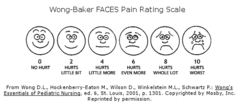
What are some examples of pain rating scales?
- Numeric rating scale 1-10
- Verbal descriptor scale
- Faces Pain Scale
- Visual Analogue Scale (VAS)
In nonverbal patients, how does a nurse identify pain?
Behavioral cues
What is PQRST?
Provoke or palliative
Quality or quantity
Region or radiation
Severity scale 1-10
Timing
What does the 'E' in the CAGE Qu