517 Test #3: Receptors
 Call Kai
 Learn
 Practice Test
 Spaced Repetition
 Match
 Flashcards
 Knowt Play
1/43

There's no tags or description
Looks like no tags are added yet.
44 Terms
bonds that lead to binding (4)
covalent
ionic
hydrogen
hydrophobic
covalent strength kcal/mol
50-150
ionic strength kcal/mol
5-10
hydrogen strength kcal/mol
2-5
hydrophobic strength kcal/mol
0.5-1
covalent binding example
drug name
receptor
result
duration
phenoxybenzamine
a-adrenergic receptor
irrecersible inactivation
several days needed to synthesis of new R
phenoxybenzamine mechanism
yes

dose response relationship plots
relationship btwn dose/concentration and magnitude of biological response
why is response vs dosage not a straight line
hyperbolic because of receptor saturation
why is response plotted agains log[D]
converts hyperbolic curve to sigmoidal. creates relatively linear central portion. makes quantitative comparison easier
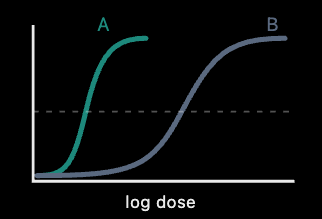
which one is more potent/efficacious
potency: A

which one is more potent/efficacious
efficacy: A
EC50?
Conc need to produce 50% of max response
theories of D-R interactions (5)
occupancy, rate, induced fit, macromolecular perturbation, activation/aggregation
occupance theory
response directly proportional to #R occupied by D
rate theory
response depends on #D-R interactions per time.
induced fit theory
D binding induces conformational changes in the R needed for biological response
macromolecular perturbation theory
combines induced fit and rate theory to explain partial agonists
activation/aggregation theory
receptor is in dynamic equilibrium between active and inactive state
signal transduction def
process by which R activation leads to bio response
signal transduction pros
communication: extracellular molecules affect cells without entering
amplification: initial weak signal can be amplified/duration of response can be prolonged
integration: multiple signals can be used to facilitate or inh response
signal transduction cons
changes in membrane polarity, metabolic changes, gene activation
GPCR schematic
yes

GPCR extracellular region
N-term. ligand binds to loops
GPCR intracellular region
C-term. G-protein binds on 3rd loop between 6th and 7th. close to C-term are Ser and Thr that can get ATP phosphorylated. Activation leads to phosphorylation, impairs G-protein binding
GPCR ligands (3)
acetylcholine, neorepinephrine, serotonin
GPCR aa neurotransmitters: (2)
E, G
GPCR peptide hormones
angiotensin II, somatostatin
GPCR classification
which ligand binds, how signal is transduced, physiologic response.
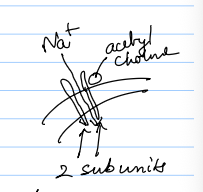
Ligand gated ion channels (LGIC) speed and components (picture)
fast. membrane spanning proteins, mult subunits

nicotinic acetylcholine R is which type of R (picture)
LGIC
other types of LGIC
GABA, Gly, Glu, serotonin
specificity vs selectivity for LGIC
specificity of binding site for L vs selectivity of the channel for particular ions
effect of LGIC
membrane depolarization
cytoplasmic receptors structure (pic)
single polypep with 3 func domains. N-term: HSP-90 associated region. middle: DNA binding. C-tem: ligand binding

cytoplasmic R mech
L binds, HSP-90 release, translocate to nucleus, bind to DNA, activate gene, transcription
cytoplasmic R response
slow, around 30 min. long lasting duration of response
intrinsic activity
ability of bound D to activate R and produce response
why do cells have spare receptors
allow cell to produce max response without occupying all R
spare receptor example
full agonist: norepinephrine and phenylephrine may produce max response with only 5-10% R activation
partial: ephedrine may require 100% R occupancy to reach its own max response
3 was cells alter R function
#R, response of R, modify transducing systems
chronic administration of B-andrenoceptor agonist produces what: (name of it)
(isoproterenol) desensitization
chronic administration of B-andrenoceptor antagonist produces what:
(propranolol) supersensitivity or upregulation
is the adaptation from an antagonist or agonist worse?
anatgonist