4.2. Energy, Power and Resistance
 Call Kai
 Learn
 Practice Test
 Spaced Repetition
 Match
 Flashcards
 Knowt Play
1/14

There's no tags or description
Looks like no tags are added yet.
Name | Mastery | Learn | Test | Matching | Spaced | Call with Kai | Chat |
|---|
No analytics yet
Send a link to your students to track their progress
15 Terms
Potential Difference (P.D.)
Electromotive Force (E.M.F)
Defenitions
Symbols
Units → defenition
Measured using (x2)
P.D. (V)→ the energy transferred per unit charge that is lost from electrical to other forms as charge passes between two points (components)
E.M.F (E)→ the energy transferred per unit charge that is gained from other forms to electrical as charge passes between two points (power supplies / cells)
Measured in Volts (V) (1 volt = 1 joule per coulomb)
Measured using a voltmeter
Must have a very high resistance → only a negligible current flows through it → does not disturb circuit
Must be connected in parallel
Kirchoff’s Second Law (defenition x3)
In any closed loop within a circuit → sum of EMFs = sum of PDs
This is a special case of the law of the conservation of energy → it is only true because energy is conserved
In the case of closed loops without EMFs (no cells / power supplies) → some components experience the current in the opposite direction → PDs are negative → they all sum to 0
Resistance (defenition, unit → defenition)
Potential difference per unit current
Measured in Ohms (Ω) (1 ohm = 1 volt per amp)
Ohm’s Law (x5)
At constant external conditions (temp)
Current flowing through a component is directly proportional to the PD across it
I.e. the resistance of the component is always constant
The I-V graph of the component is a straight line through the origin
If a component is ohmic → follows ohm’s law
Fixed Resistor: V-I Characteristics
Ohmic → a straight line through the origin

Filament Bulb: V-I Characteristics
Non-Ohmic → a curve with a decreasing gradient which passes through the origin#
Because as current increases → filament heats up → resistance increases

Diode: V-I Characteristics
Only allows current to flow in one direction → no current for negative voltages
At threshold voltage → resistance suddenly decreases → current begins to increase rapidly

Thermistor: V-I Characteristics
Non-Ohmic → a curve with an increasing gradient that passes through the origin
As current increases → temperature increases → resistance decreases

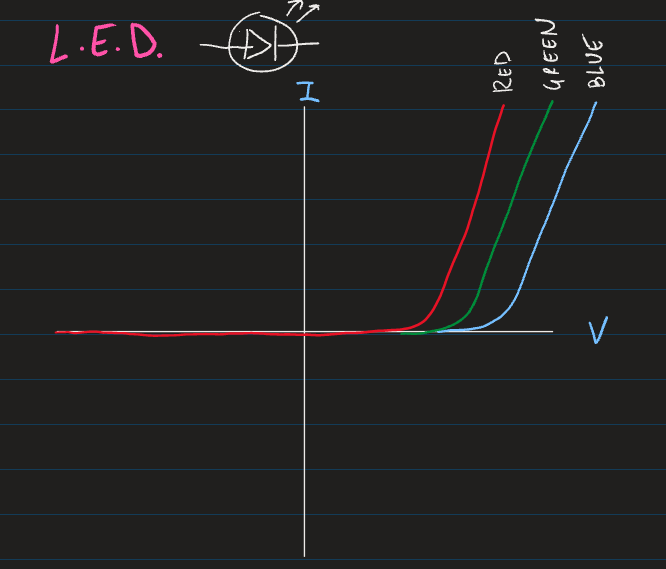
LED: V-I Characteristics
(same as normal diode)
Different colour LEDs have different threshold voltages
LDR: Resistance Characteristics
Resistance is inversely proportional to light intensity
As light intensity increases → resistance decreases
(Semiconductor: more energy input → more available e- (n increases) → resistance decreases)

NTC Thermistor: Resistance Characteristics
Resistance is inversely proportional to temperature
As temperature increases → resistance decreases
(Semiconductor: more energy input → more available e- (n increases) → resistance decreases)

Resistivity (defenition x4, units, equation)
A measure of how electrically conductive a material is
All objects of the same material will have the same resistivity (but not necesarily the same resistance)
Measured in Ohm-metres (Ωm)
Resistivity = (Resistance x cross-sectional area) / Length
1 Ωm means a 1m³ block of that material has a resistance of 1Ω
Resistivities for conductors tend to be very small → 1m³ of material has a very large surface area and a relatively low length → thus a very low resistance
How does Resistivity vary with Temperature for Metals & Semiconductors (x4)
Metals → + temp → fixed metal ions vibrate with greater frequency & amplitude → increased frequency of collisions between e- and ions → increased resistance
Semiconductors →+ temp → n increases → resistance decreases
Resistivity is a constance for the material → links resistance to object’s shape
So resistivity will change in the same way as resistance with temperature for that material
Power (defenition, units → defenition, equations x4)
Rate of transfer of energy (energy transferred per unit time)
Measured in Watts (W) → 1 watt = 1 joule per second
P = E/t
P = IV
P = I²R
P = V²/R
Kilowatt-hours (defenition x2, why it is used x3)
1kWh = 1000W * 3600s = 3.6MJ
The energy transferred when a power of 1kW is maintained for 1h
The S.I. Unit for energy is Joules (J)
But this is a very small measure of energy
So when measuring energy used for domestic or industrial purposes →kWh are used instead