Week 9 Urology and Nephrology
 Call Kai
 Learn
 Practice Test
 Spaced Repetition
 Match
 Flashcards
 Knowt Play
1/74

Earn XP
Description and Tags
Urology and Nephrology
75 Terms
What are something that the kidneys do for your body?
maintains blood volume and proper balance of water, electrolytes, pH (acid • base balance)
ensures key substances such as glucose remain in bloodstream and removes toxic wastes from blood.
Define Uremia
When urine backs up into the body.
A condition characterized by an excess of waste products in the blood due to kidney failure, leading to symptoms like fatigue, nausea, and confusion.
How does the RAAS system work?
Renin from kidneys plus Angiotensinogen = angiotensinogen 1
Angiotensinogen + ACE in the lungs = Angiotensin 2
Angiotensin 2 causes vasoconstriction and stimulates aldosterone release, increasing blood pressure and sodium retention.
180 mg/dL is the cut off point for kidney retention
AEIOU TIPS
a mnemonic used to remember the indications for initiating dialysis: Acidosis, Electrolyte imbalances, Intoxication, Overload of fluids, Uremia, and Toxins.
Urinary system in women versus men how do they differ?
Wemon have a shorter urethra than men, which affects urinary tract infections and other urinary conditions.
What is Urology?
Urology is a branch of medicine that focuses on the diagnosis and treatment of urinary tract disorders in both men and women, as well as male reproductive system issues.
What is Nephrology?
Nephrology is the branch of medicine that deals with the study, diagnosis, and treatment of kidney diseases and disorders, including issues related to electrolyte balance and hypertension.
What is the medical term for urination?
Micturition
Causes of end stage renal failure:
Poorly controlled diabetes mellitus (both type I and type II)
Uncontrolled or inadequately controlled hypertension.
Among acute, or sudden onset, disorders, renal calculi (kidney stones) very common.
Woman complaining of burning pain on urination =?
infection in urinary system.
Man complaining of burning pain on urination =?
infection from urinary system or sexually transmitted disease.
Noncancerous enlargement of prostate gland
(benign prostatic hypertrophy) affects 60% of men by age 50; 80% by age 80.
Urinary system has four major structures:
-Kidneys
-Uriters
-Urinary bladder
-Urethra
Where are the kidneys located?
• Between the 12th thoracic and 3rd lumbar vertebra.
• Retroperitoneal space.
-The right kidney sits a little lower than the left.
What so the Ureters do?
Transport urine from the kidneys to the bladder
Whatis the function of the Urinary Bladder?
The urinary bladder stores urine until it is excreted from the body, allowing for the controlled release of urine during urination. Has stretch receptors that signal the need to urinate when the bladder reaches a certain volume.
What is the average urine output for an adult?
The average urine output for an adult is about 800 to 2000 milliliters per day, depending on fluid intake and other factors.
What is the Urine output of urine for a pediatric?
The average urine output for a pediatric patient varies by age, typically ranging from about 1 to 2 milliliters per kilogram of body weight per hour.
What is the job of theUrethra
The urethra is a tube that carries urine from the bladder to the outside of the body. In males, it also serves as a passage for semen during ejaculation.
You lose 10 of kidney function every 10 years after 40
You lose 1% of kidney function every year after age 40
What is the functional unit of the kidney?
The Nephrons
How many nephrons do your kidneys contain?
Each kidney contains approximately 1 million nephrons.
Re nal artery and vein, nerves, lymphatic vessels, ureter, pass into kidney through?
The notched region called hilum. You also have a pulmonary hilum. in thg ehilum your uriter will also branch out of
Ti ssue of kidney visibly divided into two regions:
The inner region (medulla) need to be saltyThe inner region (medulla) is responsible for concentrating urine, while the outer region (cortex) contains the nephron structures.
The outer region (cortex)
Medullary tissue divided into fan shaped regions called the ?
renal pyramids. They are located within the renal medulla and play a role in urine production.
Each pyramid ends in portion of tissue called
papilla;projects into hollow space of renal pelvis.
Neproons are
–Tubule divided into different portions and capillaries that form net of vessels covering surface of tubule.
Define osmosis
The movement of water across a selectively permeable membrane from an area of lower solute concentration to an area of higher solute concentration until equilibrium is reached.
what is the current movment of the nephrons?
Afferent renal arteriole → Glomerular capsule → Proximal convoluted tubal → Descending limb → Capillary network Loop of Henle (only permeable to water) osmosis → Medulla → Observed into the capillary network → Ascending limb (not permeable to water) salty → Distal convoluted tubule → Collecting duct pyramids hilum renal pelvis. → GFR= 180 L per day 60 passages of plasma.
3 major classifications of diuretics?
Furosemide works by? loop diuretics.
Sutting down with pumping of sodium in the loop of Henle in the ascending loop, leading to decreased reabsorption of sodium leading to more water in the urine.
within the ascending loop of henle
Potassium sparing works by? Collecting ducts.
inhibiting sodium channels or blocking aldosterone, resulting in potassium retention while promoting sodium excretion. Causing more water to
thyasode in the compual tubial
inhibiting sodium and chloride reabsorption, leading to increased diuresis.
ADH Vasopressin works by?
regulating water reabsorption in the kidneys by increasing permeability of the collecting ducts, allowing more water to be reabsorbed into the bloodstream.
Forming and eliminating urine is the basis for two of kidneys ' major functions:
Maintaining blood volume with proper balance of water, electrolytes, pH.
Erythropoietin Regulating blood pressure and secreting hormones to control red blood cell production.
Retaining key compounds such as glucose while excreting wastes such as urea.
Blood urea nitrogen test (BUN)
directly measures blood concentration of urea; indirect indicator of GFR. Normal blood level: 7-20 mg/ dL. Your BUN test GFR the concentration of Uriah the amount reabsorbed or excreated The Blood Urea Nitrogen test (BUN) is a medical test that quantifies the level of urea nitrogen in the blood, serving as an indirect marker of kidney function and the glomerular filtration rate (GFR). Normal levels range from 7 to 20 mg/dL, with low levels potentially indicating liver disease or overhydration, while high levels may suggest dehydration, a high protein diet, or kidney issues.
Low could be from conditions such as liver disease or overhydration.
High could be from dehydration, excessive protein intake, or kidney dysfunction.
A direct indicatory text for diney function is the?
Creatinine, another waste product of metabolism, has larger molecules than urea; is not reabsorbed. This is a DIRECT indicator of GFR Normal blood level: 0.6 1.2 mg/ dL
What is the function of Testes
Produce testosterone, Sperm 200 300,000,000
located In the scrotum
Sperm cells from testis into
epididymis, small sac on top of the testies where they are stored.
Sperm are channeled from epididymis into
vas deferens, muscular duct that carries them into pelvis, through prostate gland to urethra.
Sperm cells mix with
seminal fluid to form semen futos, which nourishes and transports sperm during ejaculation.
special fluid before passing into urethra for ejaculation.
The prostat releases a fluid callled
PSA prostate-specific antigen, which helps to liquefy semen and enhances sperm motility.
Two different types of Kidney Failure
Acute
Chronic
Common causes Kidney Failure
–Diabetes mellitus (both types)
–Uncontrolled or inadequately controlled hypertension
Acute Renal Failure (ARF)
Sudden (often over period of days) drop in urine output • Patient may c/o oliguria or anuria • Account for 30% of all ICU patients (5% of all hospitalizations) • Overall mortality rate is 50% Reversible if diagnosed and treated early!
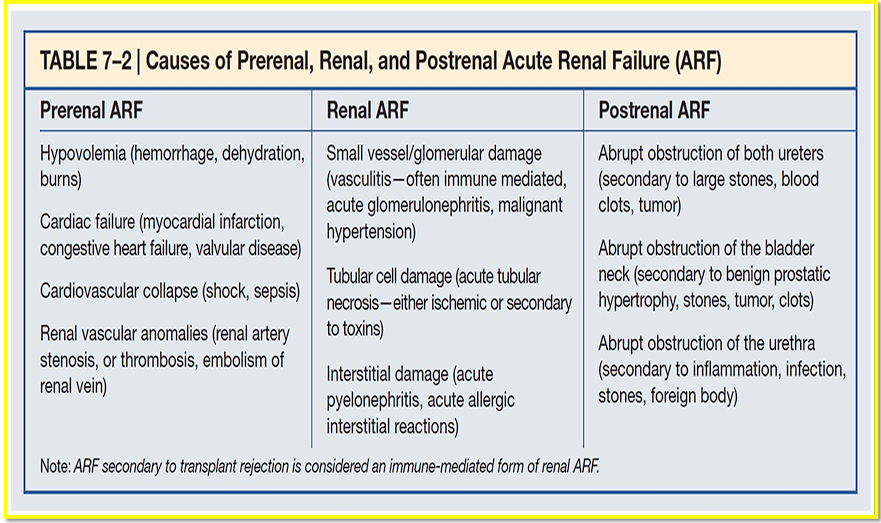
3 types of Acute Renal Failure (ARF)
-Prerenal
-Renal
-Postrenal
What do you think is the leading cause of ACUTE renal failure?
Hypovolemic Shock
What is the most common metabolic cause of death in ARF?
Hyperkalemia tall peaked t waves
Maintain a MAP of?
60-65
How to find MAP?
MAP can be calculated using the formula: MAP=31×SBP+32×DBP, where SBP is systolic blood pressure and DBP is diastolic blood pressure.
Signs and symptoms of Acute Renal Failure
Signs/symptoms:
–Tachycardia and hyperkalemia.
–Peripheral edema in face, hands, feet
.–Decrease in urine output
–Dyspnea
–Hyperkalemia

What is wrong with this ECG?
Hyper calemia
calcium chloride
albuteral
sodium bicarb
What si Chronic Renal Failure?
-In adequate kidney function due to permanent loss of nephrons (70%)
-Metabolic instability does not occur until 80% of nephrons destroyed (end stage renal failure)
-Must have dialysis or kidney transplant to survive
in Chronic Renal Failure (CRF) there are Three pathological processes initiate nephron damage:
–Microangiopathy or glomerular capillary injury.
–Tubular cell injury.
–Inflammation or infection in interstitial tissue.
Signs and symptoms of Chronic Renal Failure?
–Jaundice may be present Ictoris.
–Skin pale, moist, cool.
–Scratches and ecchymosis common skin changes with CRF
–Skin condition (uremic frost) appears when excessive amounts of urea eliminated through sweat
–AMS–HTN
What is the treatment for Chronic Renal Failure?
–Monitoring and supporting ABCs vital
–Supplemental oxygen if hypoxic
–Small IV bolus for fluid resuscitation if hypovolemia
–Monitor electrocardiogram (ECG) readings closely
–Expedite transportation to appropriate facility
What are the two types of technologies for Dialysis?
Hemodialysis
Peritoneal dialysis
Both rely on osmosis and equalization of osmolarity across semipermeable membrane such as renal nephron.
Types of Dialysis Access
Central Venous Catheter (CVC)
Arteriovenous Fistula (AV Fistula)
Arteriovenous Graft (AV Graft)
Peritoneal Dialysis Catheter (PD Cath)
Common dialysis complications:
–Hypotension
–Dyspnea
–Chest pain
–Neurologic abnormalities ranging from headache to seizure or coma
Signs and symptoms of Renal Calculi
–Focused history always centers on pain
–Visceral pain in one flank
–30 to 60 minutes: extremely sharp pain; may remain in flank or migrate downward and toward groin.
–Migrating pain indicates stone has passed into ureter Lloyd’s Sign

Prehospital Treatment: Renal Calculi
–Positioning of comfort
–Beprepared for vomiting due to severe pain antiemetics in control
–Pain control (Fentanyl, Morphine, Toradol)
–IV fluid to promote urine formation and movement through system.
system.
Inpatient Treatment: Renal Calculi
Inpatient Treatment: –Shockwave lithotripsy sound waves break large stones into smaller ones.
Causes of a Priapism?
• Medical causes:–Sickle cell disease, black widow spider bites, spinal anesthesia, severe CO poisoning.
• Traumatic causes: spinal cord injury
Treatment for Testicular Torsion
Pain management
Ketamine
morphine
Oliguria means?
Oliguria refers to a medical condition characterized by an inadequate output of urine, typically defined as less than 400 milliliters per day in adults, which can indicate kidney dysfunction or dehydration.
Pyelonephritis is?
Infectious inflammation of renal parenchyma: nephrons, interstitial tissue, or both. Acute pyelonephritis ten times more common in women than men. Intrarenal Pyelonephritis Normal Kidney abscesses form within renal parenchyma.
What are the signs and symptoms of a Urinary Tract Infection.
-Painful urination (dysuria)
-Frequent urge to urinate, difficulty in beginning and continuing to void.
-Hematuria
-Strong or foul odor in urine and/or cloudy urine
-Lloyd’s Sign
What is the Treatment for A patient with a Urinary tract infection?
-ABCs and circulatory support
-Position of comfort
-Antiemetic administration Zofran
-Analgesics?
-IV Hydration to increase blood flow through kidneys and to produce more dilute urine. (listen to lung sounds)
Renal and Urologic Emergencies
• Nosocomial infections
–Cases acquired in inpatient setting
• Sexually transmitted pathogens Virus Bacteria Fungi
–Such as Chlamydia Gonorrhea.

Dysuria
Painful or difficult urination, often associated with urinary tract infections.
Hematuria
Presence of blood in urine, which can indicate various urological conditions or injuries.
What are Nosocomial infections
Cases acquired in inpatient setting.
Sexually transmitted pathogens
Such as Chlamydia Gonorrhea,