Ancient Egypt
 Call Kai
 Learn
 Practice Test
 Spaced Repetition
 Match
 Flashcards
1/23

There's no tags or description
Looks like no tags are added yet.
24 Terms
pharaoh
-Ruler of ancient Egypt- the king. Means "great house". Thought to be the son of Re(RAY)- sun god

Embalming
The Egyptian invention to prevent the pharaoh's body from decomposing

pyramids
tombs or burial places for the pharaohs- protected the bodies from floods, wild animals, and robbers.

hieroglyphics
writing system in ancient Egypt using picture-signs. Only a select group of people (called Scribes) learned how to read and write.

papyrus
reed plants pressed together to form a kind of paper

polytheism
the belief in many gods and goddesses

Akhenaten
Tutankhamen's father. He introduced a new religion with only one god called Aton.
specialization of labor
individuals became experts at one type of job (instead of doing all tasks necessary for survival)

dynasty
a line of rulers from the same family

silt
a mixture of fertile soil and tiny rocks that make land ideal for farming

afterlife
Egyptians believed that life after death would be better than present life. The soul lived in the body, so the body had to be mummified.

Nile River
-Mountains in the south
-End in the Mediterranean sea
-4000 miles long
Irrigation
The process of supplying water to areas of land to make them suitable for growing crops.
cataract
waterfalls or rapids in a river

delta
a fan shaped area of fertile marshland

shadouf
a bucket attached to a long pole used to transfer river water to storage basins

Theocracy
A government in which the same person is both the political and religious leader
Narmer
Originally the king of Upper Egypt, he united both Upper and Lower Egypt.
Lower Egypt
located in the north, along the Nile River's delta

Upper Egypt
located in the south-central part of the Nile River valley

Nile River Valley
-In the desert
-fertile land along the river
-delta is to the north
Re
the sun god- one of the most important gods to the Egyptians

Hapi
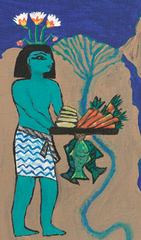
the river god- one of the most important gods to the Egyptians
Osiris*
god who ruled the underworld with his wife Isis
