Molecular Methods in Haematology
 Call Kai
 Learn
 Practice Test
 Spaced Repetition
 Match
 Flashcards
 Knowt Play
1/67

There's no tags or description
Looks like no tags are added yet.
68 Terms
Match these to their type of test: Diagnostic, Prognostic, Monitoring, Predictive
NPM1, FLT3 in AML
MRD testing
Tazemetostat for EZH2 mutation
BCR-ABL in CML
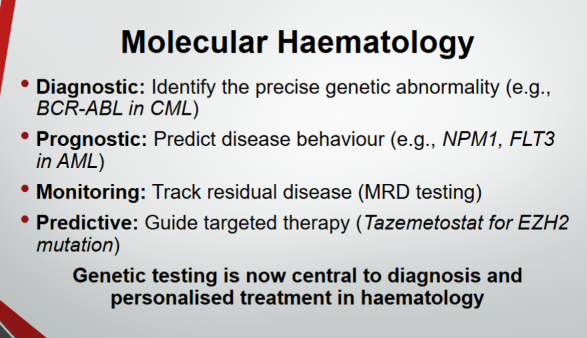
•Diagnostic: Identify the precise genetic abnormality (e.g., BCR-ABL in CML)
•Prognostic: Predict disease behaviour (e.g., NPM1, FLT3 in AML)
•Monitoring: Track residual disease (MRD testing)
•Predictive: Guide targeted therapy (Tazemetostat for EZH2 mutation)


__________ are cancers of the white blood cells, which begin in the bone marrow
Leukaemia
Leukaemias are grouped in two ways by the type of white blood cell affected - what 2 cells
lymphoid or myeloid
Lymphoma is what
Lymphoma is a cancer of the lymphatic system, which includes the lymph nodes, spleen, thymus gland and bone marrow
What is myeloma
Plasma cell disorder
Affecting marrow, bones, kidneys, and other organs
Between Leukaemia, Lymphoma, & Myeloma, which are these terms used for:
Acute v Chronic
High v Low grade
Leukaemia - Acute v Chronic
Lymphoma - High v Low grade
Genomics
Genomics is an all-encompassing term that takes into account all the DNA in a person or organism’s genome – both the genes that code for proteins and the non-coding regions. It looks at how genes are expressed and the interplay between different genes
What was the the Human Genome Project (HGP) and what was its significance
•The Human Genome Project (HGP) was an international research effort aimed at mapping and sequencing the entire human genome. It was initiated in 1990 and completed in 2003, costing millions
•The primary goal of the Human Genome Project was to determine the complete nucleotide sequence of the human genome and to identify and map all the genes present within it to understand their structure and regulation, determine the extent of variation in these genes in different populations, and uncover how genetic variation contributes to disease.
•This has provided a comprehensive understanding of human genetics and has catalyzed significant advancements in technology, particularly in DNA sequencing methods.
•The entire human genome can now be sequenced in 24 hours
Differentiate between genomics & genetics

Proto-oncogenes may be converted to oncogenes by a number of mechanisms - name 3
Point Mutation
Gene Amplification
Translocation
Match the condition to the type of mechanism of Converting Proto-Oncogenes to Oncogenes
Point Mutation
Gene Amplification
Translocation
Sickle Cell Disease
BCR-ABL in Chronic Myeloid Leukaemia
HER2 amplification in breast cancer
Point Mutation -Point mutation in a proto-oncogene gene or gene regulatory element (e.g. Sickle Cell Disease).
Gene Amplification -Copy number variation leading to gene amplification (e.g. HER2 amplification in breast cancer).
Translocation - Translocation causing disruption of regulatory elements, or by production of a constitutively activated fusion protein product (e.g. BCR-ABL in Chronic Myeloid Leukaemia).
Which nucleobases bond to which

Role of Histone proteins
Special proteins that DNA wraps around to stay compact and organised
Role of Non-histone proteins
Additional structural and regulatory proteins that help control gene expression and chromosome structure
Each chromosome contains how many genes
Each one has many hundreds or thousands of genes.
Describe the numbers of pairs of chromosomes in human diploid cells
Human diploid cells contain 23 pairs of chromosomes,including 22 autosomes, named in order of decreasing size from 1 to 22, and one pair of sex chromosomes
what is a gene
Genes are sequences of DNA which encode for specific molecules, usually proteins. Humans have approximately 20,000 genes, the function of ~7000 of which is known
Coding DNA accounts for only what % of all of our genomic information. What does the other % do
Coding DNA accounts for only 2% of all of our genomic information. The other 98% of human nuclear DNA is non-coding, but some of this non coding DNA is functional, by virtue of regulatory activity, control of gene expression, and structural maintenance
Human genomes are about what % identical – approximates to 3 million ‘differences’ between individuals
These ‘differences’ are called _______
Human genomes are about 99.9% identical – approximates to 3 million ‘differences’ between individuals
These ‘differences’ are called genetic variants
What haem test is used for Molecular assessment at a protein level (protein expression)
IHC/Flow
What haem test is used for Molecular assessment at a chromosome level
Cytogenetics, FISH
What haem test is used for Molecular assessment at a nucleotide level
PCR, Sanger, NGS, WES
What does cytomorphology detect
Cytomorphology examines the size, shape and appearance of cells under a microscope
Explain the process of flow cytometry

Name a test used to perform immunophenotyping
Flow cytometry
What is Flow cytometry - method & use
Flow cytometry is a laboratory technique that allows for the analysis of cells based on their physical and chemical properties. E.g. clonality
It involves passing cells in a fluid suspension, one at a time, through a laser beam.
As each cell passes through the laser, it scatters light and emits fluorescence, providing information about its size, granularity, and specific markers or molecules expressed on its surface or within the cell
What is Clonality
A single cell with an advantageous mutation (a "clone") begins to divide and outcompete its neighbors. This leads to the expansion of this clone, forming a tumor that is genetically similar, as all cells originate from the same ancestral cell
What is an Immunophenotype
“Signature” eg. CLL – CD5/CD19/CD23/CD43/CD200 Positive, CD20, CD79b and surface Immunoglobulin (sIg) DIM, CD10 negative,FMC7 negative
Recurrent cytogenetic abnormalities are a hallmark of & can be diagnostic for what
Recurrent cytogenetic abnormalities are a hallmark of many, and can be diagnostic of some haematological malignancies
What stage of cell cycle are cells in for cytogenetic examination
Metaphase

Process of conventional cytogenetics

How common are Chromosomal Translocations
Translocations do not occur or occur rarely in normal cells
Translocations are specific for various types of leukaemia and lymphoma
Name 2 Chromosomal Translocations & their resulting protein & condition
BCR-ABL t(9;22) in CML
PML-RARA (t15;17) in APML

How does FISH (Flourescent in situ Hybridisation) work & what is it used for

Read this FISH report: nuc ish(ABL1,BCR)x3(ABL1 con BCRx2)[138/200]
Rearrangement was observed in 138/200 nuclei
What is the lowest % of cells that must have a translocation for a lab to report it
1%
Acute Promyelocytic Leukemia (APML) is a subtype of acute myeloid leukemia (AML) characterized by what specific chromosomal translocation resulting in what fusion gene
Retinoic acid receptor alpha (RARA) gene on chromosome 17 & the promyelocytic leukemia (PML) gene on chromosome 15 → PML-RARA fusion gene.
How does APML (/APL) present
APL is associated with a high risk of disseminated intravascular coagulation (DIC) → bleeding complications → easy bruising, petechiae, and mucosal bleeding
Prognosis for APML
Up to 30% mortality in first two weeks – but with long term survival of 90%
What molecular test is used to monitor APML response to tx
RT-PCR is used to assess the clearance of PML-RARA transcripts, indicating successful treatment
PCR works at what level
Nucleotides
What does PCR do
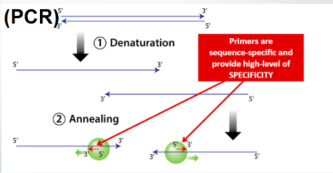
Polymerase Chain Reaction (PCR) amplifies a specific DNA region exponentially
(described as photocopying a single page millions of times so it can be easily read)
Describe the steps of PCR
Denaturation → Annealing → Extension (repeated ~30 cycles).
Name 3 uses of PCR
Detect BCR-ABL in CML, PML-RARA in APL, MRD monitoring
What’s the difference between Conventional PCR & qPCR/RT-PCR
Conventional PCR has end-point detection – is the target DNA present or absent?
qPCR / RT-PCR has quantitative measurement – how much target DNA is present?
Is PCR sensitive/specific
Highly sensitive
Highly specific
PCR products can be used for a variety of downstream molecular assays such as…
- Chain termination sequencing (Sanger or capillary sequencing)
- NGS
- Gel electrophoresis
- Single nucleotide variants
- Not suitable for large genome analysis
Once PCR has amplified the DNA sequence - what reads it
Sanger
How does Sanger sequencing work
Reads DNA base by base using chain-terminating nucleotides
Strengths of sanger sequencing
Accurate, simple, good for confirming known variants.
Limitations of sanger sequencing
Slow, not suitable for large regions or mixed populations
May not detect low VAF (VAF = Variant Allele Frequency – the percentage of DNA copies that contain a specific mutation)
Give some clinical uses of sanger sequencing
Confirm NPM1 mutation in AML or validate NGS findings
What does Next Generation Sequencing do
Sequences millions of DNA fragments in parallel
How does NGS work
Extract DNA fragment & add adapters
Sequence thousands of fragments simultaneously
Analyse & interpret results computationally
Clinical uses of NGS
Myeloid gene panels (e.g. FLT3, NPM1, DNMT3A in AML)
True/False NGS can detect multiple mutations in one test
True
Whole Exome Sequencing does what
Reads only coding regions (~2% genome)
Use of Whole Exome Sequencing
Identify inherited or rare variants
Limitation of Whole Exome Sequencing
Misses non-coding or structural variants
What does Single Cell Sequencing do
Analyses the genetic profile of individual cells.
What does Single Cell Sequencing detect
Detects subclones, resistance mechanisms, tumour evolution


What test is done on Patient with high WCC, basophilia, splenomegaly
PCR for BCR-ABL
What test is done on Patient with new AML
NGS myeloid panel to guide prognosis
What test is done on Patient with Chronic cytopenia, negative marrow
WES for inherited marrow failure