✔️✔️Dentistry L6: Periodontal Disease Management🟢
 Call Kai
 Learn
 Practice Test
 Spaced Repetition
 Match
 Flashcards
 Knowt Play
1/91

There's no tags or description
Looks like no tags are added yet.
92 Terms
Dentistry L6: Periodontal Disease Management
Dentistry L6: Periodontal Disease Management

provide both structural & functional anchorage for the teeth within the mandibles & maxilla
KNOW THIS
What is the function of the periodontium?
-Gingiva
-Periodontal Ligament
-Cementum
-Alveolar Bone
KNOW THIS
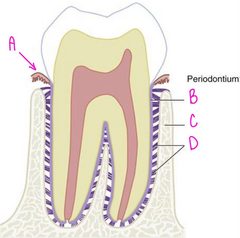
What are the 4 components of the periodontium?
gingiva
What is A?

cementum
What is B?

alveolar bone
What is C?

periodontal ligament
What is D?
Active inflammation of the periodontium
What is periodontitis?
problem of biofilm & inflammation
What are the 2 main problems that make up periodontal disease?
protein film consisting of salivary glycoproteins which forms within seconds of the tooth being cleaned
What is the pellicle?
-bacteria colonize pellicle within 24 hours to form it
-consists of a complex matrix of salivary glycoproteins, extracellular polysaccharides, & bacteria
What is plaque biofilm?
-forms via mineralization of the plaque biofilm by ions in the saliva
-detectable after 48-72 hours
What is calculus?
Pellicle → plaque biofilm → calculus
What is the basic progression after a tooth is cleaned?
-Resists host defenses and limits immune response
-Inhibits antimicrobial penetration
-Prevents desiccation
-Bacteria within the film express altered, favorable genes
Biofilm is a complex, cooperative community of bacteria that.....
Mechanical removal & disruption of the biofilm
What is required to prevent and treat periodontal disease?
growth & pathogenicity
Supragingival bacteria influence the _____ and _____ of subgingival bacterial population
-periapical abscess
-oronasal fistula
-chronic rhinitis
-retrobulbar inflammation
-epiphora
-mandibular fracture (small/toy breeds)
What are the major locoregional consequences of periodontal disease?
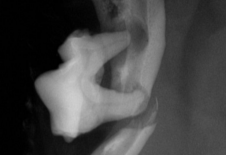
-Bacteremia
-Kidney damage
-Liver damage
-Cardiovascular damage (myocardium)
What are the systemic consequences of untreated periodontal disease?
-Reluctance to chew
-Head shyness
-Pawing at the face
-Dropping food when eating
-Sneezing/nasal discharge
-Exaggerated jaw motion when chewing (cats>dogs)
-Aversion to food or water
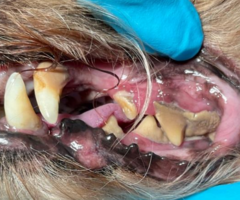
What are the symptoms of periodontal disease?
true
T/F - Most patients will still eat with severe periodontal disease
-Halitosis
-Gingivitis
-Calculus
-Gingival recession/root exposure
-Missing teeth
-Mobile teeth
What intraoral findings are consistent with periodontal disease?
-Submandibular swelling
-Periorbital swelling
-Draining tracts
What extraoral findings are consistent with periodontal disease?
-CBC
-Chemistry profile with electrolytes
-Species specific ELISA testing
What minimum database should be done with suspected periodontal disease?
-Requires anesthesia
-Requires imaging (dental radiographs = standard of care; cone beam computed tomography)
-Requires probe exam
-Dental chart for documentation in addition to written SOAP notes
What is needed for a Comprehensive Oral Health Assessment & Treatment (COHAT)?
false - CANT
T/F - You can diagnose periodontal disease on an awake oral exam alone
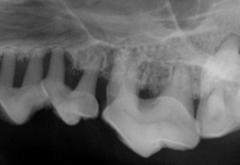
-Evaluating for alveolar bone loss around the roots of the teeth
-Periodontal disease scoring based on percentage of bone loss around each tooth
Why do we do dental radiographs?
stage
The assessment of the extent of pathological lesions in the course of a disease that is likely to be progressive
EX: _____ of periodontal disease
grade
The quantitative assessment of the degree of severity of a disease or abnormal condition at the time of diagnosis, irrespective of whether the disease is progressive
EX: _____ of furcation exposure
index
A quantitative expression of predefined diagnostic criteria whereby the presence and/or severity of pathological conditions are recorded by assessing a numerical value
EX: gingivitis _____
1
Stage _____ furcation:
Periodontal probe extends less than 1/2 way under the crown in any direction of a multirooted tooth with attachment loss
2
Stage _____ furcation:
Periodontal probe extends greater than 1/2 way under the crown of a multirooted tooth with attachment loss, but not through and through
3
Stage _____ furcation:
Periodontal probe extends under the crown of a multirooted tooth, through and through, from 1 side of the furcation out the other
0
Stage _____ mobility index:
Physiologic mobility up to 0.2mm
1
Stage _____ mobility index:
Mobility is increased in any direction other than axial over a distance of 0.2-0.5mm
2
Stage _____ mobility index:
Mobility is increased in any direction other than axial over a distance of 0.5-1.0mm
3
Stage _____ mobility index:
Mobility is increased in any direction other than axial over a distance exceeding 1.0mm or any axial movement
1
Gingival index _____:
Inflammation and swelling of the gingiva with no bleeding during periodontal probing
2
Gingival index _____:
Inflammation and swelling of the gingiva with bleeding during periodontal probing
3
Gingival index _____:
Inflammation and swelling of the gingiva with spontaneous bleeding of the inflamed gingiva prior to periodontal probing
0
Stage _____ periodontal disease:
0% attachment loss & 0% gingivitis
1
Stage _____ periodontal disease:
0% attachment loss & gingivitis present
2
Stage _____ periodontal disease:
3
Stage _____ periodontal disease:
25-50% attachment loss
4
Stage _____ periodontal disease:
>50% attachment loss
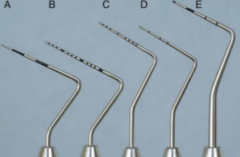
Marquis color-coded probe; A
KNOW THIS
Which periodontal probe is used in DOGS ONLY and has 3-5mm marks?
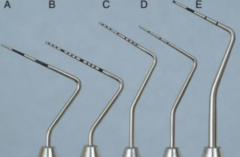
University of North Carolina; B
KNOW THIS
Which periodontal probe is 15-mm long with millimeter markings at each millimeter and color coding at the fifth, tenth, and fifteenth millimeters used in dogs AND cats?

University of Michigan "O" probe; C
KNOW THIS
Which periodontal probe has marking at 1, 2, 3, 5, 7, 8, 9, and 10mm and used in dogs AND cats?
1-3mm
What is a normal pocket depth for a dog?
What is a normal pocket depth for a cat?
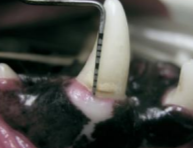
between gingiva & tooth
When probing a tooth, where is the probe placed exactly?
damage the attached gingiva & cause pocketing
When measuring a periodontal pocket with a probe, do NOT use too much force.
What can happen if you do?

-Ultrasonic scaling and polishing
-Closed root planning
-Homecare
-Barrier/sealant application
-Can be performed in general practice
What are the non-surgical options for periodontal disease?
disrupt the biofilm
What is step 1 when treating periodontal disease?
-pediatric toothbrush!
-soft bristle brush that splays across tooth surface & go slightly underneath gumline
What toothbrush is recommended to use?
VOHC
Who validates veterinary dental products?
Any procedure requiring a mucogingival flap; usually requires referral
What is a surgical periodontal procedure?
-8.5% doxycycline (DOXIROBE® GEL) = Powder contained within a slowly dissolving polymer gel
-2% clindamycin (CLINDORAL® GEL) = Hydrated salt in a matrix that gels at body temperature
Perioceutics are antimicrobial products available for dental applications that act as physical barriers to pocket contamination and have anticollagenase activity.
What are 2 examples?
Annual COHATs & home care
How are PD0 and PD1 managed?
Closed root planing ± perioceutic application
How is PD2/F2 managed?
Open root planing ± perioceutic application, guided tissue regeneration (GTR), or extraction
How is PD3 managed?
-PD4
-combined periodontal & endodontic lesions
-periapical pathology
Which cases require extraction?
PD0-PD2
What periodontal stages are considered early-stage disease?
PD3-PD4
What periodontal stages are considered advanced disease?
ultrasonic scaler causes thermal damage to the pulp
Why shouldn't we scale teeth longer than 10 seconds per tooth?
Perio tip
Which ultrasonic scaling tip is being described below?
-A thin, curved tip that is designed to reach deep into periodontal pockets and furcations
-Appropriate to use for subgingival scaling
-Water and vibrations to clean and scale teeth
Universal tip
Which ultrasonic scaling tip is being described below?
-A thicker, straight tip that is used for moderate to heavy supragingival calculus removal.
-NOT appropriate for subgingival scaling
-Water and vibrations to clean and scale teeth
daily tooth brushing
What is the #1 most effective way to prevent periodontal disease?
OraVet
What is an anti-plaque barrier gel applied once by the vet at the time of COHAT and then daily at home?
-Root planing
-Bone grafting
-Guided Tissue Regeneration (GTR)
-Mucogingival flap with osseous contouring/recontouring
What are the treatments for PD2 and PD3?
2
Closed root planing is done for stage _____ disease
3
Open root planing is done for stage _____ disease
gingival sulcus
Root planing involves debriding the _____
maintain alveolar bone height
Why is bone grafting done for PD2 and PD3?
-Tool: Gracey & Universal curettes
-Closed vs open
Describe root planing used for PD2 and PD3 treatment

-Requires a mucogingival flap
-5-0 Monocryl to close
How is open root planing done?
5-0 Monocryl
What suture is used for ALL periodontal surgeries?
root planing
What is being described below?
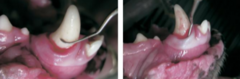
Run the curette along the surface of the tooth into the periodontal pocket, "hook" the granulation tissue and calculus, scrape upward along the tooth to remove debris.
Material acts as a scaffold for new bone growth
CONductive = CONstruction scaffold
KNOW THIS
What does osteoconductive mean?
Material contains growth factors or hormones that signal the host to produce new bone
INductive = INduces new bone
KNOW THIS
What does osteoinductive mean?
Bioceramic
The following are characteristics of _____ bone grafting:
-Osteoconductive ONLY
-Poor integration
-Clinically linked with flap dehiscence
-Ex: Consil
Autologous
The following are characteristics of _____ bone grafting:
-Preferred grafting material
-Osteoinductive AND osteoconductive
-Ex: Synergy, Periomix
Autogenous
The following are characteristics of _____ bone grafting:
-Grafted from patient themselves
-Increases surgery time and morbidity (2 surgical sites)
-Best integration, lowest risk of rejection
-Osteogenic, osteoinductive, AND osteoconductive
regeneration
KNOW THIS
Guided tissue regeneration allows for _____ of the periodontal tissues, rather than repair

6 months
Guided tissue regeneration requires recheck under anesthesia with dental radiographs _____ after, to monitor osseous integration
prevent metastatic bacteremia and to reduce infections associated with surgery
What is the goal of antibiotic prophylaxis?
24hrs
COHATs have been documented to cause transient bacteremia that resolves within _____ of the procedure, in immune-competent patients
Systemically administered antibiotics are needed only for animals that are immune compromised, have underlying systemic disease (such as clinically evident cardiac, hepatic, and renal disease) and/or when severe oral infections are present
What is the AVDC Position Statement?
true!
T/F - Antibiotics are not needed in periodontal surgery
Orally, before & after surgery
If necessary, when should antibiotics be administered in relation to a dental procedure?
Ampicillin or Cefazolin
What antibiotics can be given intraoperatively via IV catheter?
Clavamox
Out of Clavamox and Clindamycin, which has a broad spectrum, (aerobic and anaerobic bacteria)?
Subantimicrobial Dosage Doxycycline (SDD)
What antibiotic has showed significant results in experimentally induced periodontitis?