Greek and Roman ARthistory Midterm study guide
 Call Kai
 Learn
 Practice Test
 Spaced Repetition
 Match
 Flashcards
 Knowt Play
1/24

There's no tags or description
Looks like no tags are added yet.
25 Terms

Artist: Unknown
Title: Cycladic Female Figure
Medium: Marble
Location: Cyclades, Greece
Period: Cycladic

. Palace at Knossos
Artist: Unknown
Title: Palace at Knossos
Medium: Stone and wood architecture
Location: Knossos, Crete
Period: Minoan
Built around 1900 BC;
Etc notes
Different rooms used for different things
One of the largest crretian palalces
Home of legendary king of crete minos
Where legendary theseus hunted the minotaur
Labyrinth
Ariadnes thread
Thesus abandoned ariadne
The abandoned ariadne
Notes of two pieces
The Knossos palace
Many many levels
Spaces to let natural light in
Very complicated
False stairs/stairs that elad to nothing
Pairstyles
Built into the side of the terrian, slopes
All around the villa believed to be mansions of the minoan elites
Palace is a n administrative center
Large (what they believe to be) throne room
Interior very maze like so believed to connect with the minotaur and the myth
Believed that there was a theater like area–believd to be a forerunner for the late greek theater and then amphitheater
Because of the levels they could tell threw ere multiple palaces/levels
Minoans not quite as worried

Artist: Unknown
Title: Bull-Leaping Fresco
Medium: Fresco
Location: Palace at Knossos, Crete
Period: Minoan
Lot of it is restored which can
How would you describe it visually?
Thought maybe they made women lighter then men so thought that the figure in the center is a man
Re painted and recreated in many places so we dont know exactly what it would have looked like
Some kind of minoan ceremony
Young men
One graspning horns of bull
Center figure doing like a back flip onto the back of the bull
Other young man to the right holding arms out
Exacavatrs only recovered small fragments
No exterior setting
Figures depicted with pinched waist – typical of minoan art
Pinche waist and broad shoulders
Minoan art has Lots of curved lines
Believed to be a festival/event
People trained for this event
Very heavily reconstructed which is controversial a bit
Darker areas is original
Bull dominates composition–narrow waist, dramatic shoulders
Artist not interested in naturalistic depiction, instead manipulated to show the bull’s power and strength in the body/upper body of the bull
Intended to show athletic spectacle? Elite performance? Religious ritual? Initiation rite? Showing strength/dominance
What draws our attention
Minoan art has Lots of curved lines

Lion Gate
Artist: Unknown
Title: Lion Gate
Medium: Limestone
Location: Mycenae, Greece
Period: Mycenaean
Use of corbeling
Stable
What does it tell us about society
They were much more defensive
They were much more connected with the mainland because of their location so they had to be much more defensive
Positioning of the lions
Heads missing
Could have been facing outwards which would explain why they are missing
Relief in triangle
Limestone
Geographic context
Trading
Two rows and column
Could be an altar
Or to wards of evil
Could be a unifcation – representative of a unification of groups of people
Combination of post and lintel and corbeling construction
Different from something like the palace of knossos–its useful, not sprawling, shows a different sort of level of organization, reminds of the near east ziggaraut, forced to walk a certain way like walking all around before you get to th temple/main part of the structure

Treasury of Atreus
Artist: Unknown
Title: Treasury of Atreus
Medium: Stone masonry
Location: Mycenae, Greece
Period: Mycenaean
Corbel vaulted inside
Used for burial site for the king or war general
These types of tombs sometimes referred to as tholos tombs
Not a true capstone because of use of corbeling
Later greeks believed it held the riches of Atreus
“Behive tmob”
Interior of the treasury of Atresu
Interior intended to be functional
Built into the side of a hill
Support system
Corbeling
Geometric Krater
Artist: Unknown
Title: Geometric Krater
Medium: Terracotta
Location: Dipylon Cemetery, Athens, Greece
Period: Geometric
grave marker
Depicts funerary processions
Top band: meanderer
Figure is
Very triangular geometric bodies
Arms folded sor of so form into rectangles kind of
Possible this person could be related to some kind of military victory
Human figures very abstract, triangular torsos, small waists
Emphasizes communal mourning and ritual
Different bands called registers
Would have been used for mixing water or wine or grave markers, or storing oil
Kind of like an early headstone
Mourners identifiable with arsm above their heads very common
triangular/geometric bodies
Checkerboard panel above is perhaps buroial ground/canopy
Horses three

Lady of Auxerre
Artist: Unknown
Title: Lady of Auxerre
Medium: Limestone
Location: Crete, probably Eleutherna, Greece
Period: Orientalizing (Daedalic)
Example of diadalic art
Associated rhe style with legendary artist didalist that name basically meant “
Trade area with introduced contact between egypt and other places so influence can be seen
Very symmetrical shape
Similar to old kingdom examples we saw
Stylistically parallels with bronze apollo
Hands very reminiscent of egyptian art
Long rectangular fingers
Small incise lines on dress very geometric
Would have likely been very colorful
Feet right next to each other
Stiff braided hair right in front of shoulders
Looking right ahead
A lot of damage on face
During orientalizing period begin to see interest in other motifs including composite creatures
Found in a museum in france
Loose context and history
Kind of geometric face
Probably would have sued encaustic method for applying pigment to hot wax
Made of limestone
Important because of trade
A bit more porous than marble so usually a tiny bit more pigment left over than marble
Positioning of the feet
Very static very full and frontal
That style comes

New York Kouros
Artist: Unknown
Title: Kouros (New York Kouros)
Medium: Marble
Location: Attica, possibly Anavysos, Greece
Period: Archaic Ancient Greece
Korous statue
Used as a grave marker
Male statue
Defining characteristics
Stiff but feet moving forwards
Very rigid symmetrical pose
Really stylized anatomy
Archaic smile
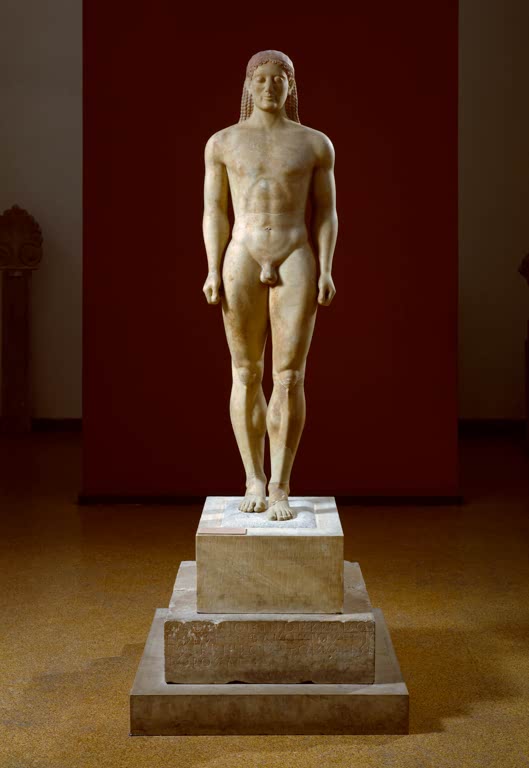
Kroisos
Artist: Unknown
Title: Kroisos (Anavysos Kouros)
Medium: Marble
Location: Anavysos, Greece
Period: Archaic Ancient Greece
Historical knowledge
Commissioned to honor person who died when he was young
Sometime skurorous
Emphasis on idealized proportions
Focus on definition, more defined arm sucles, abdomen, shins, knees, etc
Idealized young man
Work defomstrates transitions towards increasingly anturalistic depictoisn fo the body int he archaic period and fortells whats to come inn t rhe classical period
Greater step towards classical art but still archaic
— (western art hist 1 notes below unsure if the same statue)
Apparently died a heros death in battl e
Some evidenc eof paint
Hair and throughout his body
Inscription invites visitors to stay and mourn at his temple and talks about his contribution and his rank
Most archaic statues have a slight smile, even if its a grave marker or something like that
Smile looks a tiny bti more natural than other examples
A lot more definition by his thighs
Lot more definition in abdomen and chest which makes him feel more human
Hair braided
Legs feel more natural
Taking a bit of a smaller step
Feet dont feel as elongated and rectangular as before
Peplos Kore
Artist: Unknown
Title: Peplos Kore
Medium: Marble
Location: Acropolis, Athens, Greece
Period: Archaic
Could be artemis but not sure because of missing arm
Very rigid, static
Archaic smile
Not much movement – more similar tot he ldy fo auxerre than the [pprevious korous statues
Bow if artemis, if athena would have been spear, helmet, etc
Why would the city of athens bury the statue
They wanted to hide it and protect it
During/after the persian invasion they buried many of the damaged artworks in pits to protect them
Because she was uburied the color especially in the hair has been maintained
Scholars thought she was wearing a peplso originally but then realized shes wearing 4 different garments–one which only goddesses weat
Would have most likely held something in her hands
Could possibly be artemis
Another example of a female figure
Most female figures depicted searing clothes or soem type of garment
Looking straight ahead
Attire falls straight down to the bottom
Top part also falls down to teh bottom
Likely holding a bow and arrow or something
Buried after which might have helped with preserving the pigments like in her braids
Peplos kore meaning woman wearing a peplos

Achilles and Ajax Playing a Dice Game
Artist: Exekias
Title: Achilles and Ajax Playing a Dice Game
Medium: Black-figure ceramic amphora
Location: From Vulci, Italy
Period: Archaic
Black figure drawings
Depicting scene from the trojan war
Spears leaning against their shoulders
Many of these found in italy
Shows that there was a transition of the art being pushed into italy across the mediterranean
(west art hist 1 notes below)
Geometric patterns
Amphora has a medium sized neck
Achilles
Left
Known as one of the mightiest soldiers of the trojan war
Playing a dice game whis friend ajax, intended to be a break from the conflict of the trojan war
Out of his mouth says 4
Ajax
Right
Out of his mouth is the word for 3
Addd decorative element to cape, shield
Intended to show calm moment but they could really be called to war at any moment and have all thier things including lance and things ready at any moment
Lots of little designs similar to geometric period

Death of Sarpedon
Artist: Euphronios
Title: Death of Sarpedon
Medium: Red-figure ceramic calyx krater
Location: From near Cerveteri, Italy
Period: Archaic
Narrative comes from the trojan war also
Troclus Killed sarpedon
What does this tell us or not tell us about naturalism thinking back to the geometric period?
More interest in anatomy and arguably also movement
(West art hist 1 notes below)
Emphasis on background
Deals with death of one of the sons of zeus
Divine intervention
Personification of sleep and death carrying the hero upward
Good example of red figure with very fine incisse lines
Wings on bottom of legs
Hypnos helping carry fallen hero
Focus not on the battle, but more of the aftermath
More pieces, not super common but does happen from time to time of moral/issues things
Use of foreshortening

Kritios Boy
Artist: Unknown
Title: Kritios Boy
Medium: Marble
Location: Acropolis, Athens, Greece
Period: Early Classical (Severe Style)
How does this piece show transitions in sculpture
Contraposto
No archaic smile, more relaxed pose
Found in the acropolis
Well under life size
Oen of the most important statues in the history of art
One of the earliest examples of seeing sculptors moving away from archaic, stiff pose,
Beginning to show interest in how humans can shift their weight and
Transition from archaic to early classical sculpture
Represents departure
Can see it was once painted in the hair
(West art hist 1 notes below)
Time of dramatic transition in architecture and sculpture
Example of an early classical statue
Begin to see abandonment of the rigid style o f more egyptian type figures
Known as the kritots boy because at one point thought to maybe be the work of the scultpro krito sbut known for sure
Kriots csutlprue
Slight contraposto pose and weight shift, hips that are at slight diagonal
Tends to show figures that are less rigid and steeping away from what we saw in previous statues
Not particularly archaic facial features in nature
Sometimes art historian ill call this the severe/? Period?
Muscles adn joints realistically modeled
Good example of an early experimentation with contraposto
Figures feel more fluid

Riace Warrior
Artist: Unknown
Title: Riace Warrior
Date: ca. 460–450 BCE
Medium: Bronze
Found in a seabed in italy
Tells us that there was trade and it was being transported from greece to italy
Whyw as bronze an important medium or greek sculpture
They used the lost waxx casting method which was very long and involved but allowed them to add a lot more details and was more practical than marble
Even thought its a lto fo wrok and many steps, you can add a lot of fine details versus with marble you have to remove a lot of the detail things and potion the arms and things
How does the artist make this work look lifelike
Details
Very strong contraposto, with bronze you dont have to worry about creating balance as much as with marble
There are two ofo them but we will mainly be focusing on one
Found of the coast of _ in 1972
Have been submerged for centuries
Had to be restored but because of the way they were underwater helped preserve them
Warrior A and B
Original weapons and equipment missing
In contraposto pose
Likely part of a larger sculpture group
Believed to have both had a shield based on how arm is raised
likely spear in right hand
Warrior b tought to have had some headgear or maybe a helmet
No really intact shipwreck or cargo intact with them
Preserved because they were in the seabed—almost like underwater pompeii–so much natural sediment that it helped preserve them
Lot of details within the face, hair and beard and muscultature, can really create so much detail

Doryphoros
Artist: Polykleitos
Title: Doryphoros (Spear Bearer)
Medium: Marble Roman copy after a Greek bronze original
Location: Greece
Period: High Classical
Marble roman copy of a greek statue (?)
Shows how Romans liked greek art
Still has to be connected tot he back versus with riace warriors they could balance him
Mature Strong classical contrapasto
Transition from middle classical to high classical
Idealized young male, famously known as the speear bearer
Really famous for his ideal human proportions
Idea that beauty results form the harmonious mathematics in the body
Right hip rising slightly, left dropping and shoulders doing the opposite
(West art hist 1 notes below)
Baked on grr
Wanted to poetry perfect body/man
Achieved this through goals and harmonic proportions and
Tried to figure out what defined perfection?
Aware of mathematics, geometry, etc , music/harmonic cords etc
Was looking for perfection
Wanted to articulate them n the most perfect way
A lot of his works do have contrapasto
Facial expression begins to become a little bit more relaxed
Detailed musculature
Beginning to see softer technique when it comes to facial features
Parthenon
Artist: Iktinos and Kallikrates
Title: Parthenon
Medium: Marble
Location: Acropolis, Athens, Greece
Period: High Classical
They have a lot of marble in this area
Purpose of the parthenon: meant to
Dedicated to athena – battle between athena and poseidon
What is the order here: doric order
Know this because of the capital because it has the square top instead of scrolls, also because of the way the columns are fluted
Structure is doric, ionic frieze ont he interior
How does this reflect the ideals of the high classical period?
Very balanced
Mathematically proportioned with the ratio

Nike Adjusting Her Sandal
Artist: Unknown
Title: Nike Adjusting Her Sandal
Medium: Marble relief
Location: Temple of Athena Nike, Acropolis, Athens, Greece
Period: High Classical
Wet drapery technique revealing shape of body and attention to anatomy
Know that its knile because you can ssee the shape of her wings behind her and holding laurel crown
Originally part of the temple of athen nike

18. Grave Stele of Hegeso
Artist: Unknown
Title: Grave Stele of Hegeso
Medium: Marble relief
Location: Dipylon Cemetery, Athens, Greece
Period: High Classical
Good example of everyday womens life

19. Aphrodite of Knidos
Artist: Praxiteles
Title: Aphrodite of Knidos
Medium: Marble (Roman copy after Greek original)
Location: Knidos, Asia Minor
Period: Late Classical
Revolutionary and very controversial at the time because it depicted a goddess in the nude
Slightly covering herself

20. Apoxyomenos
Artist: Lysippos
Title: Apoxyomenos (Scraper)
Medium: Marble Roman copy after a Greek bronze original
Location: Greece
Period: Late Classical
Scrape oil off after sporting event
contrapposto pose
placed near roman baths as recorded by Pliny the elder

Athena Battling Alkyoneos
Artist: Unknown
Title: Athena Battling Alkyoneos, Great Altar of Zeus
Medium: Marble
Location: Pergamon, Asia Minor
Period: Hellenistic
Mother gayia

22. Dying Gaul
Artist: Epigonos (?)
Title: Dying Gaul
Medium: Marble Roman copy after a Greek bronze original
Location: Pergamon, Asia Minor
Period: Hellenistic
Beginning to see helensitci workst hat are much more emotive

23. Nike of Samothrace
Artist: Unknown
Title: Winged Victory (Nike) of Samothrace
Date: ca. 190 BCE
Medium: Marble
Location: Sanctuary of the Great Gods, Samothrace, Greece
Period: Hellenistic

24. Seated Boxer
Artist: Unknown
Title: Seated Boxer (Boxer at Rest)
Medium: Bronze
Location: Rome, Italy
Period: Hellenistic

25. Laocoön and His Sons
Artist: Athanadoros, Hagesandros, and Polydoros of Rhodes
Title: Laocoön and His Sons
Medium: Marble
Location: Rome, Italy
Period: Hellenistic tradition
Punished by athena after warning that the greeks were coming during the trojan war