Biological explanations for schizophrenia
 Call Kai
 Learn
 Practice Test
 Spaced Repetition
 Match
 Flashcards
 Knowt Play
1/13

There's no tags or description
Looks like no tags are added yet.
Name | Mastery | Learn | Test | Matching | Spaced | Call with Kai | Chat |
|---|
No analytics yet
Send a link to your students to track their progress
14 Terms
Dopamine (DA)
An unusual neurotransmitter.
Can have excitatory or inhibitory effects on the postsynaptic neuron.
Associated with the sensation of pleasure.
Unusually high levels are associated with schizophrenia and usuallu low levels are associated with Parkinson’s disease
Genetics
Genes are the core elements of chromosomes.
Consist of DNA which produces chemical instructions for the physical (eye colour) and psychological (intelligence) features of an organism.
Transmitted from parents to offspring.
Neural correlates
Patterns of structure or activity in the brain that occur in conjunction with an experience and may be implicated in the origins of that experience.
Family studies for schizophrenia
Gottesman
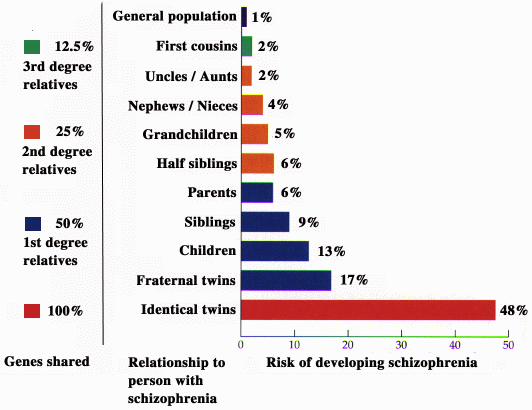
Risk of schizophrenia increases with genetic similarity to a relative.
Someone with an aunt who has schizophrenia has a 2% chance of developing it, increases to 9% for siblings and 48% for identical twins.
Family members tend to share aspects of their environment as well as many of their genes so the correlation represents both genes and environment
Candidate genes
Ripke found that 108 separate genetic variations were associated with an increased risk of schizophrenia. Tested 37,000 people with schizophrenia and compared with 113,000 controls.
Since different studies have identified different candidate genes it appears that schizophrenia is aetiologically heterogeneous - Different combinations of factors can lead to the condition
The role of mutation
Schizophrenia can also come up if no one else inn the family has it.
This can happen through mutation in parental DNA which can be caused by radiation, poison or viral infection.
Evidence for mutation comes from positive correlations between paternal age and risk of schizophrenia increasing from 0.7% with fathers < 25 to over 2% in fathers < 50.
Original dopamine hypothesis
Based on the discovery that drugs used to treat schizophrenia caused symptoms similar to those in people with Parkinson’s disease, a condition associated with low dopamine levels.
Suggests that schizophrenia might be the results of high dopamine levels in subcortical areas of the brain.
An excess of dopamine receptors in pathways from the subcortex to Broca’s area may explain symptoms of schizophrenia such as poverty of speech/hallucinations
Updated versions of the dopamine hypothesis
Davis proposed that cortical hypodopaminergia (low dopamine in the brain’s cortex) may explain symptoms of schizophrenia. Low dopamine in the prefrontal cortex could explain cognitive problems.
Cortical hypodopaminergia could lead to subcortical hyperdopaminergia. Both low and high levels of dopamine in different brain regions are part of the updated hypothesis.
Current versions of the dopamine hypothesis try to explain the origins of atypical dopamine function.
Genetic variations and early experience of psychological and physical stress make some people more sensitive to cortical hypodopaminergia and therefore subcortical hyperdopaminergia
Genetic S Tienari
Evidenced from adoption studies that supports genes rather than environment.
Studied adopted children who had a biological mother with schizophrenia.
Despite not being raised by their biological mothers (no shared environment) they were significantly more likely (6%) to develop the disorder themselves.
Compared with control group of adopted children not born to schizophrenic mothers (2%).
Increases the validity of the idea that schizophrenia may be genetic and is not simply down to environmental factors.
Genetic W Environmental factors
In Gottesman’s study the risk of developing schizophrenia if an identical twin had it was 48%.
In Joseph’s twin study the concordance rate among identical twins was 40%.
We would expect these figures to be higher given that identical twins share 100% of their genes.
Reduces the validity of the idea that schizophrenia may be genetic and suggests that environmental factors may also be important.
DA Hypothesis S
Supported by drug treatments
Amphetamines increase dopamine and worsen symptoms in people with schizophrenia and induce symptoms in people without schizophrenia.
Antipsychotic drugs reduce dopamine activity and the intensity of symptoms.
Leucht found that antipsychotics designed to normalise DA activity were more effective compared to placebo drugs.
Supports the theory that abnormal DA levels can lead to schizophrenia development
DA Hypothesis W Inconclusive evidence
Drugs that induce schizophrenia-type symptoms like cocaine or amphetamines may affect many neurotransmitters other than DA.
Post-mortem studies have not revealed support for abnormalities in DA concentrations
Suggests that the DA hypothesis alone cannot fully explain why someone develops schizophrenia and that there are multiple factors contributing to the development of the disorder.
The validity of the hypothesis is compromised.
Neural S Practical applications to studying them.
Neuroimaging can help to predict individuals who may develop schizophrenia by detecting the loss of brain tissue over time.
This could lead to better treatment of schizophrenia through targeted medication in the early stages of development
Therefore, early detection can help prevent the development of the later stages of the disorder.
Neural W Evidence for a central role of glutamate
Post-mortem and live scanning studies have consistently found raised levels of glutamate in several brain regions of people with schizophrenia.
Candidate genes for schizophrenia are believed to be involved in glutamate production or processing.