3 Psych 1010
 Call Kai
 Learn
 Practice Test
 Spaced Repetition
 Match
 Flashcards
 Knowt Play
1/56

There's no tags or description
Looks like no tags are added yet.
57 Terms
thinking: mental representations
we represent knowledge and information of the world in our minds
▫ E.g., think of a dog
form the basis of thinking
we can form maps in our mind through this as well
Thinking: analogical representations
mental representation that has some of the physical characteristics of what they represent
▫ Analog = analogous (similar) too
▫ E.g., maps correspond to the real world
Thinking: Symbolic representations
representations that do not have the physical characteristics of what they represent
▫ Abstract
▫ E.g., letters, words, numbers, ideas
language is the main thing (symbolic and arbitrary)
if mental representations are usually visual, how do blind people build them?
whats the one thing they cant form representations of?
based on hearing and touch
only thing they cant form are representations for navigation
what is the difference between categorization and concept
catagorization: shared properties
concepts are catagories
categorization
grouping mental representations based on shared properties ▫ E.g., objects that have leaves, are alive, make noise
concept (mental representation)
a category
▫ E.g., animals, plants, instruments
(Worf-Sapir Hypothesis) language and colour perception
ex used was farm animals vs wild animals
For any given concept, some examples will be highly representative of the concept
Other examples will be less representative of the concept
essentially, some things will deviate farther from an idea of a prototype or typical representation.
concept ties into signal detection theory
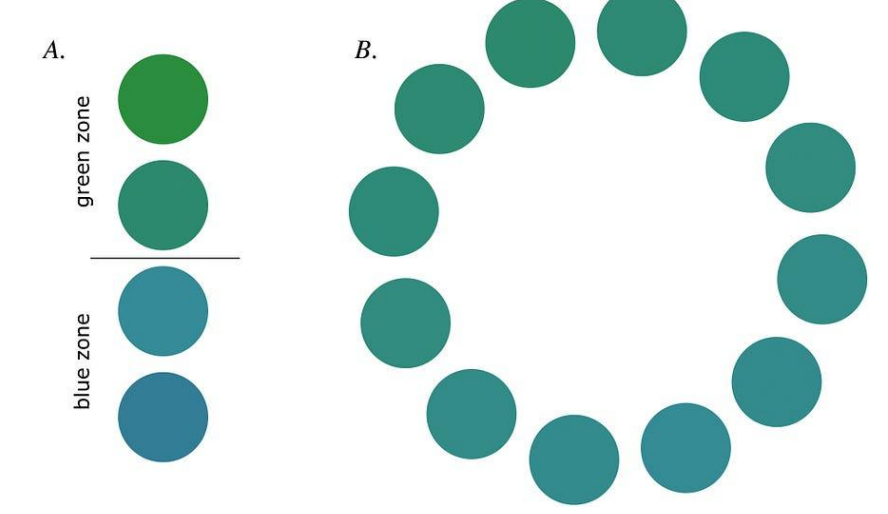
what is the important question about colour and language brought about by the whorf sapir hypothesis
when does blue become green?
cultural differences arrive when people have to draw the line of what fits in each category.
Schemas
cognitive structures that help us perceive, organize, use and understand information about objects or events
▫ E.g., schema of a beach, schema of kitchen
will connect to cognitive biases and decision making
script
a special type of schema that directs behaviour over time within a situation
▫ E.g., how to order food at McDonalds, how to cook dinner
Wenicke’s area
area of temporal lobe involved in speech comprehension
directly connected to primary auditory cortex
Wernicke’s aphasia
deals entirely with comprehension
difficulty producing meaningful words and sentences
can still speak but results in word salad
can process all information properly, just cant make sense of it.
Broca’s area
area of frontal lobe responsible for production of speech
Broca’s aphasia
difficulty producing language
can comprehend language perfectly, but cannot move the mouth to speak
after recovery, person can produce perfectly meaningful messages, but will still struggle to find the right words and move mouth
wernickes and brocas areas
involved in…
whats different for right-handed people
chimps?
Involved in both written & spoken language (brocas only with speech)
• In the left hemisphere in right-handed people
• Chimpanzees have equivalent brain areas!
▫ Involved in gestures and vocal signals
Noam Chomsky
Linguistics professor at MIT
• In 1950s: developed theories of language that still form the basis for our understanding of language
▫ Grammar is a property of language
▫ Language is a uniquely human, innate process
Specifically, grammar
what are the four properties of language
Communicative
Arbitrary
Generative
Structured (grammatical)
Arbitrary
no natural or logical connection between a word and it’s meaning
different languages have different words that mean the same thing, they’re all arbitrarily made up
Generative
we can use a finite set of words and grammatical rules to produce new sentences
Structured (grammatical)
the rules or structure of a language
Its innate & unique to humans (noam chomsky argued)
Nim Chimpsky
what could his language not achieve
1970s
a chimpanzee raised by humans and taught to use American sign language
• Learned 125 signs by third birthday
• Could combine 2 signs and sometimes 3 and 4 signs…but only to ask for things he needed
▫ “More eat” , “Eat me Nim drink”
• Did not learn grammar and language was not generative like humans
Problems in research of language
• Most research has tried teaching animals human language
OR
examined whether their communication has the characteristics of human language
• Animal communication does not have same characteristics as human language
▫ Not generative and no grammar
• Humans also fail tests of human language
who has language: chimpanzees
80+ gestures and humans can understand the 10 most common
campbell’s monkeys
▫ Have calls that refer to specific things.
Meaning?
▫ Can add suffixes to calls to change meaning.
Grammar?

Chickadees:
Calls have a structure and can only occur in a particular order (grammar?)
is language innate or learned?
Behaviourism (b.f. skinner) argues behaviour is learned
Language is learned: behaviourism
• Language learned via operant conditioning → reinforcement and correction from caregivers
• Imitation of adult speech
what are some problems with the behaviourist theory that language is learned
▫ Child not imitating adult → make unique errors
▫ Child not receiving explicit instruction → no operant conditioning
▫ Child’s language is generative → saying sentences they have never heard before
Support and limitations of behaviourism (language)
support: can learn words via operant conditioning
eg. animals, and autistic children learn this way
Limitations:
cannot learn grammar or generative language via operant conditioning
Language is Innate (whats it called, who came up with it)
Nativism (noam chomsky)
Language acquisition device
(LAD):
Innate knowledge of grammar/structural rules of language. Let’s us learn language
Evidence for language being innate/LAD?
Poverty of the stimulus: infants don’t have sufficient input to learn the complexity of language yet they still do
1. Not taught grammar
2. Speech children hear is not complete
3. Children hear finite range of expressions
No negative evidence: parents don’t correct children’s grammar
criticism of nativism
no language aquisition device brain area
what is required to learn language in humans
• Humans have an innate ability to learn language
• But…language requires normal human experience to develop (experience expectant??)
Critical (sensitive) period:
a timeframe during which an organism must receive specific environmental stimuli to develop an ability ▫ If the organism does not receive the stimuli, it will not develop the ability ▫ E.g., language (grammar) before age 5 Binocular depth perception
support for critical periods
case study 1
Genie:
Could understand ~ 12 words
• Vocabulary was 2 twoword phrases (“stop it” , “no more”) • Lacked grammar
How are we impacted if we don’t have language Deaf Nicaraguans
Area of difficulty(?) theory of mind
two abilities (girl idk)
Knowledge that other people have different perspectives than you ▫ Critical period before age 10 • Deception: lying
why theory of mind and lying (two abilities)
Appearance doesn’t match reality (ig)
differences between calls and songs
Generally speaking:
all birds make calls, but only songbirds make songs
calls are innate, songs are learned
calls are shorter, songs are longer
calls are less tonal, songs are more tonal
call are for close distance, songs are for farther communication
Bird sounds: “meaning” and syntax
alarm calls
chicka-dee call - warn other birds about potential threats like predators. more dee’s, bigger the threat
parent to offspring - something about snakes and crows
mobbing - alert approach
What is bird song like
propose or elicit actions
The spectrogram
x axis time
y axis frequency
used to visualize bird calls
why do birds sing
Territory defense and mate attraction are primary functions
what can birds communicate through song
species and population - cultural drift can give the same species different dialect
sex - female birds sing and for different purposes
mating status - produce songs together, duets
location
identity - can sometimes tell specific birds apart
quality
motivation - mating invitation -
aggressive intent
How do birds sing
Birds have two sides of their "larynx" which can both create sounds. Often one creates lower sounds and the other is higher
how does bird song develop
?
language areas matching in human and bird brains
development match
Wernicke’s area - NCM (listening and perception)
Broca’s area - HVC
High parallel in learning and production
humans and birds also have critical periods of vocal learning

Testerone in brain development
how did bird song evolve
three times
most species females can sing
FoxP2 expression
important gene tied to vocal learning and progression, needed for replicating songs from tutor
how are birds studied?
in the field. outside.
capture birds with net, doesnt hurt them.
measure the birds, try to destinguish their sex and note their age.
put colour bands on their legs so if they see them again they can know who the bird is without recapturing them.
then they record their songs, before sunrise?(and set im not sure). 250 songs in like 20 mins
birds as a great system for vocal learning
how do they change their songs depending on thier environment.
Culture: behaviours that are
shared by members of a group
aquired via social learning
can persist across generations or shift as short-term trends (like pop culture trends)
geographic variation in birdsong (dialect)
how do dialects form
note about open and close ended learning
what causes this belief
dialects form from learning by a tutor. birds dont go very far as they age so they stay with their own dialect.
people tend to think birds can be divided into close ended and open ended (can learn after critical period?) learning
this is because of lab research, which doesnt match the diversity in learning patterns of birds in the wild.
Image based approach
Training LLMs can identify individual and song types and classify them.