Graphic Novel Terms
 Call Kai
 Learn
 Practice Test
 Spaced Repetition
 Match
 Flashcards
 Knowt Play
1/30

There's no tags or description
Looks like no tags are added yet.
31 Terms
Panel
A distinct segment of the comic, containing a combination of image and text in endless variety. It offers the reader a perspective or point of view on the subjects also known as the camera angle. Offers a different experience the simply reading text.

Frame
Lines or borders that contain the panels
Splash panel/page
A panel that spans the width of the page.
Bleed
An image that extends to and/ or beyond the end of the page
Emanata
Teardrops, sweat drops, question marks, or motion lines that the artist draws besides the characters face to portray emotion.

Gutter
The space between framed panels. Readers tend to fill in the blanks and imagine what happens between panels.
Voice over
Where narrators have the possibility to speak directly to the reader. Usually this is done with a hard line separating the narrator's speech at the top or bottom from the image within the panel.
Style
The artist's drawing style, some examples are complex to simple, to iconic, objective to subjective, and subjective to universal.

Icon
Symbols and cartoons (at different levels of abstraction) function as a way to communicate to comic readers. Used to represent a place, person, object or idea. It is a visual sign that functions by resemblance. (A lightbulb for an idea)
Narration
Comic books allow the writer to show and tell at the same time. There can be a combination of direct and indirect narration.

Color
The way the author uses them will affect the reader's experience. Can be used symbolically

Graphic Weight
A term that describes the way some images draw the eye more than others, creating a definite focus using colors and shading

Time
The story does not have to be told in a linear way

Foreground
The panel closest to the viewer. The subject that seems closer to the reader, in front of the scene depicted.
Midground
When the subject stands in the middle of the scene depicted. Allows centering if the image by using a natural resting place for vision. The artist deliberately decides to place the image where a viewer would be most likely to look first.
Background
Objects placed here, not usually the subject, help add contextual infomation for the reader.
Camera Angle
Shows where the camera would stand in relation to the subject. Shows how far way the subject would be from the camera. Shows the angle. It will have an effect on the readers understanding of the subject

Transitions
Refer to the process of closure. Refers to what happens between the slides. There are six main types used in comic books: moment to moment, action to action, subject to subject, scene to scene, aspect to aspect, and finally non sequitor.
Speech Bubbles
These are frames around the characters' language, kind of direct speech, in which the characters speak for themselves. Can be written in a variety of ways to demonstrate qualities of a particular voice.. They vary in size, shape, and layout and can depict a conversation.

Thought Bubbles
Appear as clouds and represent a character's thoughts and intearnal dialouge.
Captions
Boxes containing a variety of text elements, including scene-setting, description, etc. Can provide insight into thoughts and feelings the way images alone cannot.
Faces
Can be portrayed in different ways. Some depict an actual person while others are simply representative of an idea or group of people. Can be dramatic when placed against a detailed backdrop. Can be drawn without much expression or detail to try and have the reader guess what the character is feeling.

Hands and Feet
The positioning can be used to express what is happening in the story. Examples: Hands over mouth depict fear, shame, or shyness. Turned in feet may denote embaressment, while feet with motion strokes can create the sense of panic, urgency or speed.
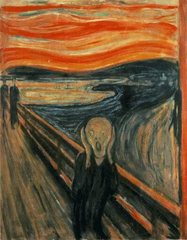
Open Panels
(AKA Borderless Panels) Panels where one or more, or even all, of the sides of the comic panel are open to show dramatic effect.
Negative Space
The areas between and around objects. Areas that - if we notice them at all - we tend to think of as empty.
Exaggeration
In cartoons, artists often stretch the truth, hyperbolize, and create caricatures to emphasize key ideas or attributes with respect to the main claim.
Facial expressions
Can be portrayed in different ways. Some depict an actual person, like a portrait; others are iconic, which means they are representative of an idea or a group of people. Other points to observe about faces include- They can be dramatic when placed against a detailed backdrop; a bright white face stands out. They can be drawn without much expression or detail; this is called an "open blank" and it invites the audience to imagine what the character is feeling without telling them.
Lettering
This is a method of drawing attention to text; it often highlights onomatopoeia and reinforces the impact of words such as bang or wow.
Composition
the arrangement of people or things in a painting, photograph, film scene, cartoon, etc.
Icon
a widely known symbol (elephants and donkeys are icons of republican and democrat political parties)
Sequencing
the order of panels