Chapter 6: Lower Extremities
 Call Kai
 Learn
 Practice Test
 Spaced Repetition
 Match
 Flashcards
 Knowt Play
1/50

There's no tags or description
Looks like no tags are added yet.
51 Terms
What are the three evaluation criteria for an AP and Lateral tibia-fibula?
Entire tib-fib seen
ankle and knee joints seen
Partial superimposition of fibula and tibia at proximal and distal end
What is the CR for an AP knee? Angulation (if so, why)
CR is ½ inch below the apex of patella
Sometimes, dependent on measurement from ASIS to buttock. People who aren’t as thick in that area will have tibial plateaus that slant downward toward feet, people who measure average won’t have an slanting, and those who aren’t thicker will have an angle that slants upward toward head.
For an AP knee, the CR should be parallel to the what?
Tibial plateaus
For an AP knee, how do you determine if the CR is parallel to the articulate facets of the tibia? What are those measurements with corresponding angles?
Measure asis to buttocks using a measurement tool
Under 19cm: 5 degree caudad angle (thin thighs and buttocks)
19-24cm: 0 degree angle (average size thighs and buttocks)
Over 24 cm: 5 degree cephalad ( thick thighs and buttocks)
What are the two evaluation criteria for an AP knee?
Femorotibial joint space is open
Medial head of fibula should be superimposed by tibia

What is this projection?
AP knee

What is this projection?
Lateral oblique of the knee
Evaluation criteria for a medial oblique knee?
Head and neck of fib is well seen
Joint space is open
Half patella superimposed by femur
Eval criteria for lateral oblique knee?
Joint space open
Fibula superimposed by tibia
Half patella covered by femur
For a lateral knee, where is the CR? Any angulation?
CR is an inch distal to medial epicondyle (right in line with the apex of patella)
Angulation is 5 to 7 degrees cephalad to lift the medial condyle so that it superimposes the lateral condyle.
For a lateral knee, when should you angle 5 degree cephalad and when 7 degree cephalad? Why?
5 degree cephalad for shorter, wider hip person. Their hip sits up naturally higher so the angle between condyles is not as great.
7 degree cephalad for taller, more narrow hip people. Their hip sits lower and proximal femur angles upward so there is a greater angle between condyles.
For a lateral knee projection, what body part do you use to ensure no rotation occurs?
The patella. Make sure it’s truly perpendicular to the IR
For a lateral knee projection, what do condyles that are not superimposed and side mean?
Rotation occurred due to poor positioning.
For a lateral knee projection, when the condyles are off vertically what does that mean?
Poor CR angulation.
Where’s the central ray for a medial and lateral oblique knee? Any angulation?
1 inch below apex of patella. No angulation.
What are the three evaluation criteria for lateral knee projection?
Condyles superimposed
Patella in profile (ensures no rotation)
Patellofemoral joint space open

What is this projection?
Medial oblique of the knee
What is the purpose of doing weight bearing bilateral knee projections?
Looking for narrowing of joint spaces (arthritis)
What are the two special projections of the knee?
AP weight bearing
PA axial weight bearing (Rosenberg method)
Why do radiologists request the Rosenberg method be done?
It shifts weight to the posterior side of the femoral condyles which is where arthritis typically starts. Doing an AP weight bearing bilateral could be misleading because narrowing typically starts at back.

Name this projection. Where is our CR and what angle do we project at and why?
PA axial weight bearing knee (Rosenberg method). CR to midpoint of knee joint and 10 degree caudad since tibial plateaus angle 10 degree posteriorly and we want to get open joint space. We do caudad since patient is flexing knees 45 degrees which tips tibial plateaus forward (joint space now at downward angle) unlike if we were standing (joint space would be at upward angle PA)
What are the three projections of the intercondylar fossa?
Camp Coventry
Holmblad
Beclere

Name this projection. What is the CR and any angulation? What degree of flexion for patient?
Camp-Coventry method.
CR to popliteal crease (where you bend knee)
CR angled 40 to 50 degree caudad and flex leg 40 to 50 degree
Evaluation for intercondylar fossa projection (two)
Fossa in profile
Articular facets and intercondylar eminence well visualized

Name this projection. CR and any angulation? Patient leans forward how many degrees?
Holmblad Method.
CR to popliteal crease, no angulation
Patient leans forward 20 to 30 degrees

Alternative positions for which type of projection?
Holmblad Method

Name this projection. CR and any angulation? Degree of flexion? Why do we do these and why are they not common?
Beclere method.
CR is half inch below the apex of the patella, 40 degrees cephalad
Knee flexion is 40 degrees
We do these to reduce OID from the fossa. Not common anymore because you need smaller IR board and hospitals typically don’t carry these.
For a PA projection of the patella, where is your central ray located? Any angulation?
Located at the popliteal crease (mid-patella area). No angulation.
Why would you do a PA patella projection instead of AP?
Reduce OID
What are the 5 tangential projections of the patella?
Bilateral merchant method
Inferior-superior axial
Hughston
Settegast
Hobbs

Name this projection. Where is the CR and any angulation?
How much flexion of knee and why?
Lateral-mediolateral projection of the patella.
The CR is located at the mid femoropatella joint. No angulation.
Only 5 to 10 degree flexion of knee to prevent further injury if there is a fracture of the patella and to keep femoropatellar joint space open

Name this projection. Where is CR and any angulation?
How much knee flexion?
Bilateral merchant method of the patella
CR angled 30 degrees from horizontal
Knee flexed 40 degrees
Why is the bilateral merchant method uncommon and what does the merchant board help with?
Because merchant boards are not common in hospitals. Board used to help relax quads so that patellar space is open.
What are the two evaluation criteria for tangential projections of the patella?
Intercondylar sulcus (aka patellar surface) and patella visualized
Femoropatellar joint spaces are open

Critique this X-ray image
Under-rotation of the knee and slight under angulation

Critique this X-ray image
Over-rotation of knee
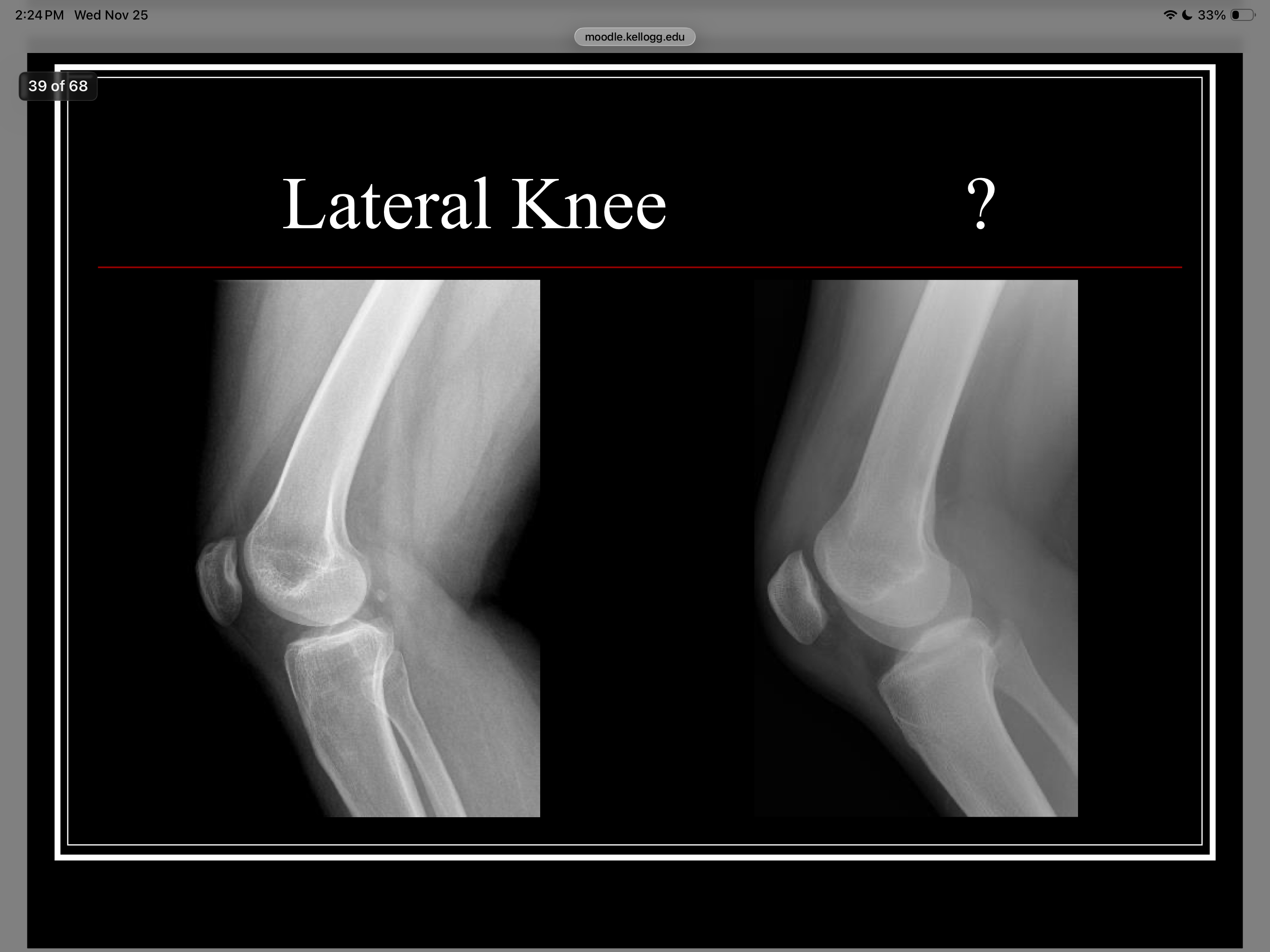
Critique this xray image
Under-angulation. There needs to be more angulation so that The medial condyle sits up higher and superimposes lateral condyle.

Which projection is this? CR to where and any angulation? How much flexion of the knees?
Inferiosuperior axial projection of the patella.
CR is located to the patellofemoral joint and there is a 10 to 15 degree angle from the lower leg
Flex 40 to 45 degrees

Which projection is this called? CR to where and any angulation?
Flexion of the knee?
Settegast Method.
CR tangential to patellofemoral joint and no angle
Flexion is 90 degrees
What is the downside of the Settegast method for a tangential patella X-ray?
90 degree flexion causes over flexion of the knee which draws patella into the intercondylar sulcus. We want to see open joint space

What projection is this called? CR and any angulation? Flexion?
Hobbs method. CR to patellofemoral joint. No angulation. Flexion of knee, does not give a specific range of degree.
*increase SID to 48 to 50 inches since there will be OID

Name this projection. Where is the CR and any angulation? How much flexion of knee?
Hughston method. CR tangential to patellofemoral joint. Angled 45 degree cephalad. Flexion 50 to 60 degrees.
What projections are included in a routine patella exam?
PA, lateral, tangential
A patient comes to the radiology department for a knee study with special interest in the region of the proximal tibiofibular joint and lateral condyle of the tibia. What positioning routines should the technologist obtain?
AP, lateral, and medial oblique knee.
For an AP weight bearing knee projection on an average patient, where should the CR be and any angulation?
CR midpoint between knee joints, level of half inch below apex of patella. No angulation.
What CR angle should be used for a lateral projection of the knee on a recumbent hyposthenic patient?
5 to 7 degree cephalad
What are bone cysts?
Benign neoplastic (abnormal, uncontrolled growth of cells) bone lesions filled with clear fluid that most often appear around knee joint
What is chondromalacia patellae and what’s it also referred to as?
Softening of cartilage underneath the patella bone, which results in erosion of this cartilage, causing pain in this area. Also called runners knee because cyclists and runners are vulnerable to this condition.
What is chondrosarcomas?
Malignant tumors of the cartilage that usually occur in the pelvis and long bones of men over 45.
What is enchondroma?
Slow growing benign cartilaginous tumor that is mostly found in small bones of hands and feet in adolescents and young adults