Unit 3, Chapter 4A-4B: Enzymes that Manipulate DNA and CRISPR-Cas9
 Call Kai
 Learn
 Practice Test
 Spaced Repetition
 Match
 Flashcards
 Knowt Play
1/36

37 Terms
List 3 Types of Enzymes that Manipulate DNA
Endonucleases
Ligases
Polymerases
Define Endonucleases
Endonucleases refer to a broad range of enzymes responsible for cutting nucleic acid strands, by breaking the phosphodiester bond between two nucleotides in a chain.
NOTE: they act like molecular scissors
Define Restriction Endonucleases
Restriction endonucleases are endonucleases that cut nucleic acid strands at specific recognition sites.
Define Recognition Sites
Recognition sites are the specific target sequences of nucleotides upon which restriction endonucleases act.
Describe 3 General Properties of Recognition Sites
They are specific to each enzyme
They are short, typically 4-6 nucleotides in length
Generally, these sequences are palindromic, and the enzyme will cut at the same point on either side for double stranded molecules

Define Blunt End Endonucleases
Blunt end endonucleases cut DNA in the middle of the recognition site, which results in a straight cut and no overhanging nucleotides.

Define Sticky End Endonucleases
Sticky end endonucleases do not cut in the middle of the recognition site, resulting in a staggered cut with overhanging, unpaired nucleotides.

Explain the benefit of Sticky End Endonucleases in DNA Editing
HINT: think about gene insertion
The overhanging unpaired nucleotides of a sticky end cut will be attracted to a complementary set of unpaired nucleotides. Sticky end endonucleases (when used on both the DNA and inserted gene) have the advantage of ensuring an inserted gene is orientated correctly when manipulating DNA.
Define Ligases
Ligases are enzymes that join molecules, including DNA or RNA fragments, by catalysing the formation of phosphodiester bonds between fragments.
NOTE: DNA ligase joins DNA fragments and RNA ligase joins RNA fragments
Explain why Ligases don’t have Specific Recognition Sites
HINT: think about substrates
Ligases lack specificity (they can join any blunt or sticky end fragments) because the substrates for the enzymes are the sugar and phosphate groups of the DNA or RNA rather than specific nitrogenous bases.
Define Polymerases
Polymerases are enzymes that synthesise polymer chains from monomers (such as forming nucleic acid strands from nucleotides).

Outline the Primary Purposes of RNA and DNA Polymerase
While RNA polymerase is primarily used in the transcription of genes for gene expression, DNA polymerase is used in the replication or amplification of DNA in cells.
Define and Outline the Purpose of Primers
A primer is a short, single-stranded chain of nucleotides that acts as a starting point for polymerase enzymes to attach to. Once attached, the polymerase can read and synthesise a complementary strand in a 5’ to 3’ direction.
Briefly Define CRISPR
CRISPR is a naturally occuring short, clustered repeats of DNA found in bacteria that use it for protection from viruses.
Define Cas9 Enzymes
Cas9 are endonucleases that create a blunt end cut at a site specified by guide RNA (gRNA).
NOTE: Cas9 is generally not considered a restriction endonuclease as it requires gRNA to identify target sites, has varying target sequence and cannot cleave any DNA complementary to the gRNA
Briefly Define Bacteriophages and Outline how they attack Bacteria
Bacteriophages are viruses that attach prokaryotic organisms. They do this by:
Inserting viral DNA or RNA into the bacterium, hijackinging the cell
The cell then starts to express the viral genes by producing proteins and nucleic acids
The virus replicates
The cell lyses and dies and the virus spreads
Define Spacers in CRISPR Sequences
Spacers are short sequences of DNA obtained from invading bacteriophages that are added into the CRISPR sequence.
Differentiate Protospacers from Spacers
Protospacers are short sequence of DNA extracted from a bacteriophage by Cas1 and Cas2 enzymes, which is not yet incorporated into the CRISPR sequence.
Define Repeats in CRISPR Sequences
The repeats are short and palindromic DNA sequences that are found interspaced with the spacers.
Define PAM Sequences
PAM sequences are sequences of 2-6 nucleotides that is consistently recognised by Cas1 and Cas2 and found immediately next to the DNA targeted by Cas9.
NOTE: PAM stands for protospacer adjacent motif, as they are found next to the protospacers taken from viral DNA
Explain the 3 Important Roles of PAM Sequences
HINT: what does PAM signal Cas1 and Cas2 to do and why is it important that they aren’t in CRISPR sequences?
When Cas1 or Cas2 recognise PAM in viral DNA, they are signalled to extract a protospacer from the viral DNA.
When Cas9 is scanning viral DNA for a sequence complementary to the gRNA, it speeds up the process to only have to check sequences after a PAM
Since Cas1 and Cas2 do not extract PAM sequences, there are none in a bacteria’s CRISPR repeats. This ensures that Cas9 cannot cut up a bacterium’s own DNA.
Explain the 1st Step of the CRISPR-Cas9 Defence System
(injected DNA to addition of a spacer)
The bacteriophage injects its DNA into a bacterium, which identifies the viral DNA as a foreign substance
Cas1 and Cas2 cut out a short section of the viral DNA (typically ~30 nucleotides long), known as a protospacer.
This protospacer can then be introduced into the bacterium’s CRISPR gene, becoming a spacer

Explain the 2nd Step of the CRISPR-Cas9 Defence System
(creation of CRISPR-Cas9 complex)
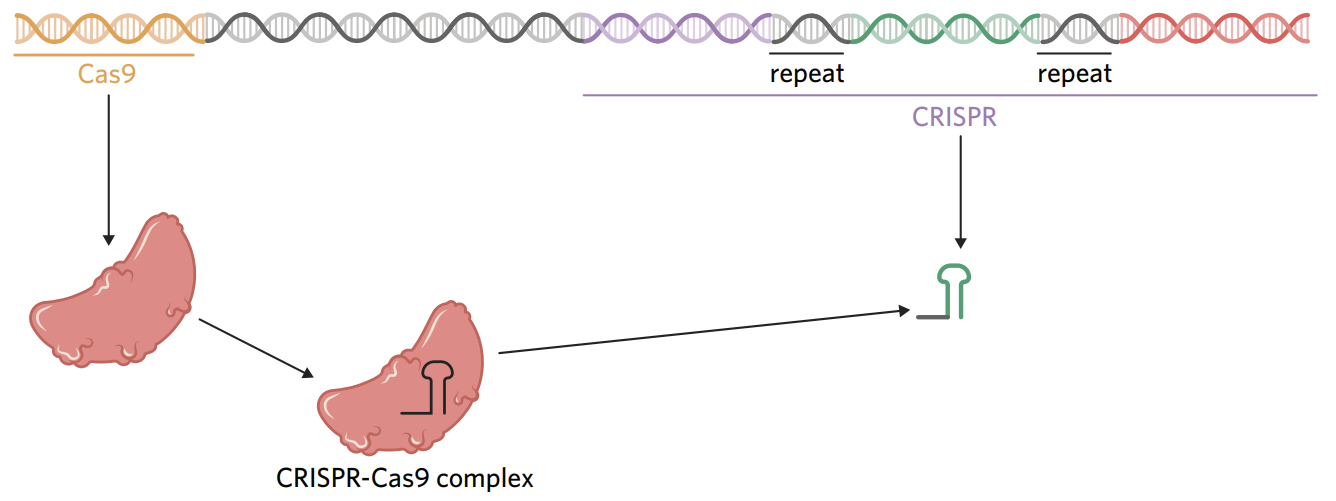
CRISPR spacers are transcribed along with half a repeat from either side of the spacer (the repeats are palindromic)
This becomes gRNA
gRNA binds to Cas9 to create a CRISPR-Cas9 complex
gRNA forms a hairpin loop-like structure from the transcribed palindromic repeats either side of the spacer.
Explain the 3rd Step of the CRISPR-Cas9 Defence System
(attack on viral DNA)
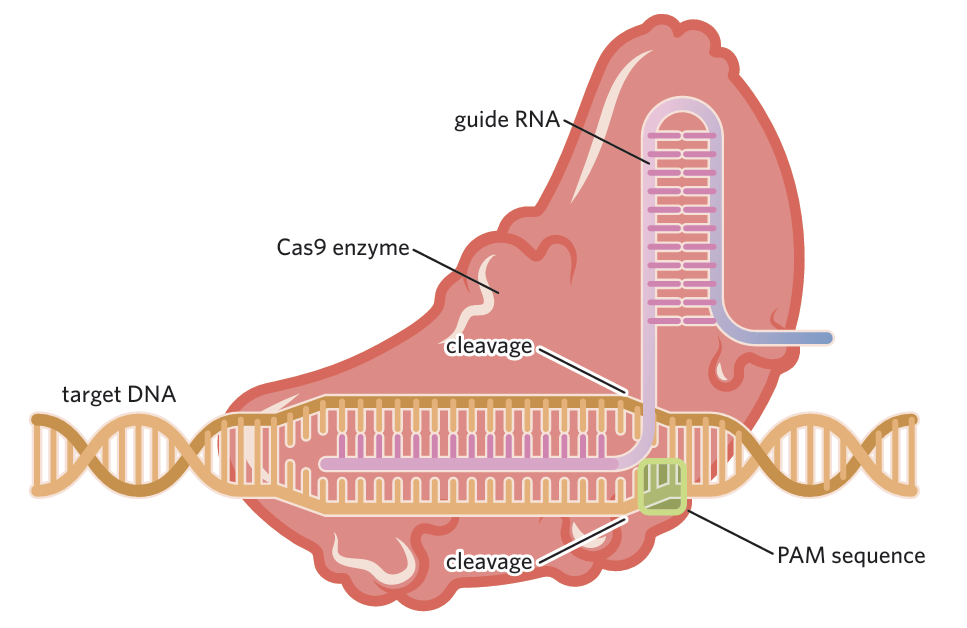
The Cas9 enzyme is directed to viral DNA complementary to the gRNA
It does this by unwinding DNA after PAM sequences
When the complementary sequence is located, Cas9 creates a blunt end cut through the phosphate-sugar backbone to inactivate the virus
Explain What Happens After Viral DNA is Cut
Enzymes in the bacterium will naturally act to repair it
These repair mechanisms are prone to errors that can result in mutations of the viral DNA which render it non-functional
If mutations do not occur, the DNA sequence is still complementary to the gRNA so the process repeats as necessary
Outline how CRISPR is Useful in Gene Editing
CRISPR allows for the controlled cutting of DNA, creating the opportunity for nucleotides to be added, removed, or substituted into a selected sequence. In turn, this can knockout, enhance, or change the function of a gene.
Define Deleterious Mutations
Deleterious mutations are changes in DNA that negatively affect an individual.
Define Gene Therapy
Gene therapy involves repairing genetic mutations by replacing a defective gene with a healthy one.
NOTE: gene therapy has rarely been used on humans outside of research and clinical trials
Identify an Issue with many Gene Therapy Techniques
Techniques often lack precision, which can result in inadvertently inserting an introduced piece of DNA into the wrong part of the genome, interrupting a healthy and functioning gene.
Define Gene Knock-out
Gene knock-out is a technique in gene editing where scientists prevent the expression of a target gene, by making genes non-functional.
This can be to prevent the expression of a mutated gene or to understand the function of a specific gene in an organism.
Define Gene Knock-in
Gene knock-in is a technique in gene editing where scientists substitute or add nucleotides into a gene.
Define sgRNA (single guide RNA)
sgRNA is gRNA used and made synthetically by scientists to instruct Cas9 to cut at a specific site when using CRISPR-Cas9 in gene editing. Unlike gRNA it is made from a single strand of RNA.
List the Materials Necessary for CRISPR-Cas9 Gene Editing
sgRNA complementary to the target DNA site to be cut
Cas9 enzyme with the appropriate PAM sequence
Target cell/s
New nucleotides (ONLY if inserting genetic material)
Explain the Steps for using CRISPR-Cas9 in Gene Editing
sgRNA is created to have a complementary spacer to the target DNA that scientists wish to cut
A Cas9 enzyme with the appropriate PAM sequence is obtained
Cas9 and sgRNA are added together in a mixture and bind to create the CRISPR-Cas9 complex
The sgRNA-Cas9 mixture is then injected into a specific cell
The Cas9 finds the target PAM sequence and checks whether the sgRNA aligns with the DNA.
Cas9 cuts the selected sequence of DNA.
The DNA has a blunt end cut that the cell will attempt to repair.
Scientists may inject particular nucleotide sequences into the cell with the hope that it will ligate into the gap during repair
List 3 Broad Applications for CRISPR-Cas9, with an Example for each
Research
eg. Gene knock-out to determine a gene’s function
Dealing with Genetic Diseases
eg. Replacing deleterious alleles with healthy ones
Agriculture
eg. Modifying crops to give them pest, herbicide, drought, flood, heat, cold or disease resistant genes
Identify a Limitation of CRISPR-Cas9
HINT: think about what happens after the target DNA is cut
To induce substitution mutations or knock-in a new segment of DNA, scientists must introduce the nucleotide sequence they wish to add into the cell and hope it is taken up by the DNA repair machinery. This can be imprecise and is not consistently successful.
Identify and Briefly Describe 3 Ethical Considerations of CRISPR-Cas9 Gene Editing
HINT: to successfully alter an organisms genome, scientists must treat an embryo prior to cell differentiation
Safety: the possibility of off-target cleavages, cell mosaics (some edited, some not), potential unseen side effects
Informed consent: scientists cannot get informed consent from unborn babies to edit their genome
Inequality: a concern that only wealthy people will be able to access CRISPR technologies
Discrimination: CRISPR may be a threat to those judged ‘biologically inferior’ by society when they may not feel they need ‘fixing’
‘Sanctity of Human Life’: some groups are concerned that scientific research on embryos does not respect the sanctity of human life